


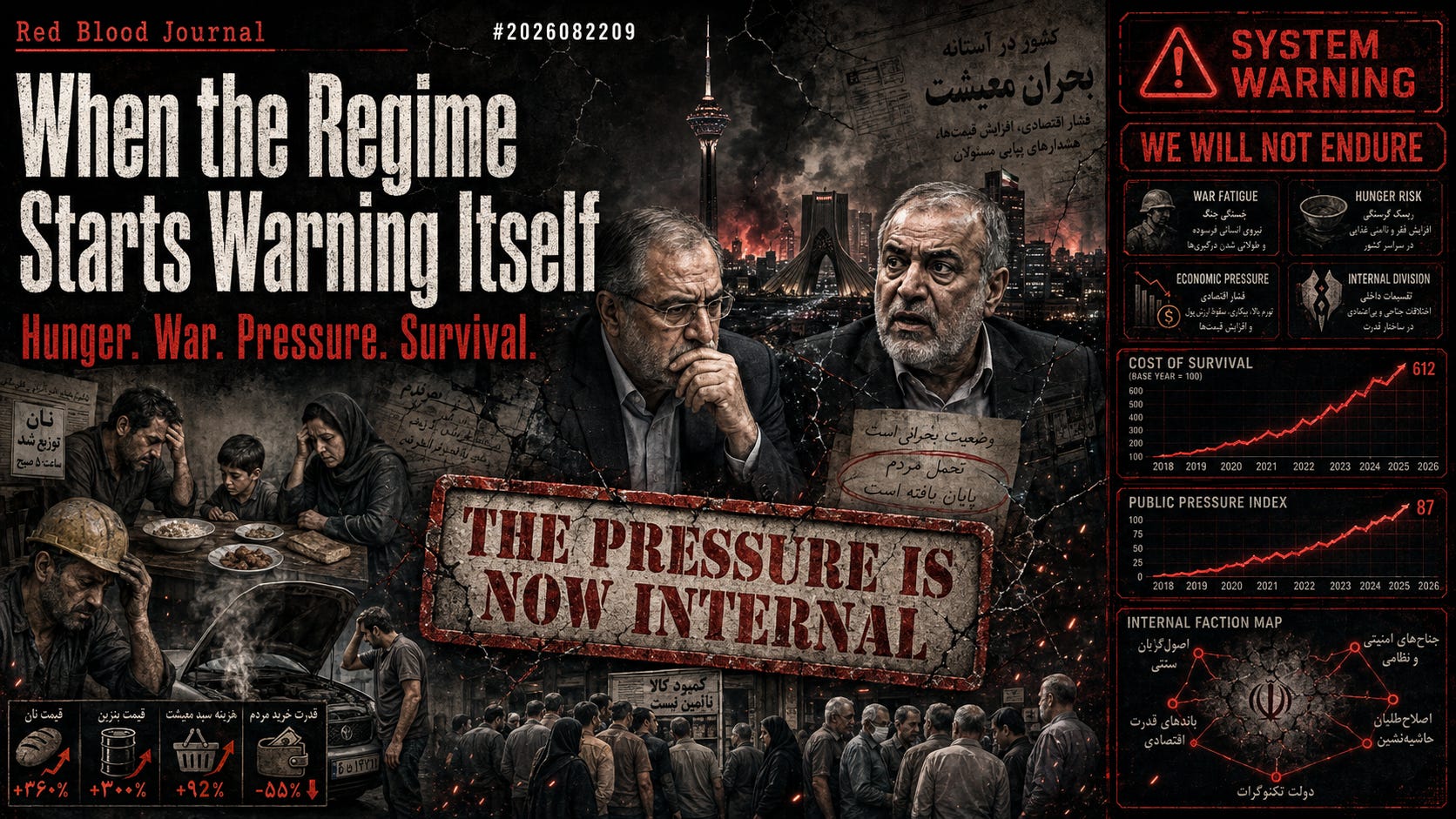
🩸 ⚠️ 🇮🇷 🕊️ #2026082209 — When the Regime Starts Warning Itself
Pezeshkian, Ghalibaf, Hunger, War—and the Fear That the Islamic Republic May Not Survive the Pressure
🩸 RedBloodJournal.com 🩸
There is a difference between criticism from the opposition and a warning from inside the system.
Opposition figures can say a government is collapsing.
Foreign governments can say sanctions are working.
Analysts can predict instability.
But when senior officials inside the state begin publicly warning that hunger, economic collapse, and continued war could threaten the government’s survival, the language becomes much harder to dismiss.
That is what appears in the source behind this report.
Masoud Pezeshkian is presented as arguing that the war must eventually end and that ending it sooner would be better than allowing the country to sink deeper into crisis. Mohammad Bagher Ghalibaf goes even further, warning that military power means little if the people are hungry and the economy is no longer functioning.
Those are not revolutionary slogans.
They are warnings from men inside the structure.
And that may be why they matter so much.
🔻 PEZESHKIAN IS SAYING THE WAR CANNOT CONTINUE FOREVER
The transcript quotes Pezeshkian saying that war must end at some point.
His argument, as presented in the source, is essentially:
Better to end it today than tomorrow.
He complains that people outside government speak recklessly because they do not understand the conditions the state is facing, while simultaneously criticizing inflation and hardship caused by the war.
That reveals an internal contradiction.
One faction wants confrontation.
Another faction is being forced to administer the consequences.
Those are two very different jobs.
It is easy to call for resistance when somebody else must balance the budget.
It is easy to demand escalation when somebody else must find fuel.
It is easy to celebrate war when somebody else must explain why salaries are disappearing into inflation.
The political faction responsible for governing eventually meets reality.
And reality sends invoices.
🔻 GHALIBAF’S WARNING IS EVEN MORE IMPORTANT
The source quotes Ghalibaf saying that regardless of military power:
If the people are hungry, if economic circulation does not exist, if economic growth and production disappear, “we will not endure.”
Those four words change the discussion:
We will not endure.
Not:
The public will suffer.
Not:
The economy will slow.
Not:
There will be difficulties.
But:
The system itself may not last.
That is a remarkable admission.
Because authoritarian governments usually present themselves as permanent.
They speak in the language of destiny.
Strength.
Resistance.
History.
Victory.
Then one day somebody inside the building admits that the building has weight limits.
🔻 HUNGER DOES NOT CARE HOW MANY MISSILES YOU HAVE
This may be the central truth behind Ghalibaf’s statement.
A government can possess:
Ballistic missiles.
Drones.
Naval forces.
Security services.
Police.
Intelligence agencies.
Prisons.
Propaganda networks.
None of those things can make an empty refrigerator full.
A missile cannot increase purchasing power.
A drone cannot repair a household budget.
A prison cannot reduce food prices.
A speech cannot rebuild a destroyed engine.
At some point, national power encounters household reality.
And household reality usually wins.
🔻 THE STRUGGLE INSIDE THE REGIME
The source describes a long-running division within the Islamic Republic.
One faction is more willing to negotiate or reduce confrontation with the West.
Another faction sees accommodation as surrender and remains ideologically committed to resistance, particularly against the United States.
That split becomes much more dangerous during war.
Because every compromise becomes ideological betrayal.
Every negotiation becomes weakness.
Every delay becomes suspicious.
Every military setback becomes ammunition for one faction against another.
And every economic crisis increases pressure on the faction actually responsible for governing.
The result is not simply political disagreement.
It is paralysis.
🔻 PEZESHKIAN’S REAL FEAR MAY BE TOMORROW
The transcript describes Pezeshkian as being worried about an unstable condition in which nobody knows what the next day will bring.
It portrays the government as unable to predict Trump’s intentions while also facing hardliners at home who oppose compromise.
That creates perhaps the worst possible political environment:
No peace. No predictable war. No economic certainty.
Businesses cannot plan.
Families cannot plan.
Government ministries cannot plan.
Military commanders cannot plan.
The currency cannot stabilize.
Investors cannot calculate risk.
The entire society is forced into short-term survival mode.
That is economically poisonous.
🔻 THE HARDLINERS HAVE A DIFFERENT CALCULATION
The transcript raises another possibility.
What if some factions inside the system believe continued confrontation benefits them?
War increases military importance.
Crisis increases security budgets.
Sanctions increase the power of intermediaries.
Emergency conditions reduce transparency.
Fear increases political obedience.
And institutions built around confrontation become more central when confrontation continues.
That does not prove any faction deliberately wants national suffering.
But it does create conflicting incentives.
The official trying to stabilize inflation may want compromise.
The institution whose power grows during confrontation may see the world differently.
🔻 FARS ATTACKS PEZESHKIAN
According to the source, Fars News, described as close to the Revolutionary Guard, attacked Pezeshkian for speaking publicly about ending the war, portraying him as behaving like defeated politicians.
That small detail says a great deal.
The disagreement is not hidden.
It is spilling into public media.
One part of the system says:
End the war.
Another says:
Talking about ending the war is weakness.
This is what internal fracture looks like before anyone admits it is fracture.
🔻 THEN TRUMP ENTERS THE EQUATION
The transcript presents Trump as believing Iran is under severe pressure and eager for a deal, but not yet ready to accept the agreement he wants.
It quotes him describing Iran as financially depleted, without effective naval or air power, unable to pay some security personnel, and suffering extreme inflation.
Those claims are Trump’s.
They should be treated as political assertions unless independently verified.
But within the logic of the source, they matter because they shape Washington’s strategy.
If Trump believes Iran is weakening rapidly, he has little incentive to offer generous terms.
Why compromise today if pressure may produce greater concessions tomorrow?
That is the trap facing Pezeshkian.
The worse conditions become, the more urgently he may want negotiations.
But the worse conditions become, the less incentive Washington may have to compromise.
🔻 NEGOTIATION BECOMES SURRENDER WHEN ONE SIDE THINKS TIME IS ON ITS SIDE
Diplomacy normally requires both sides to believe compromise is preferable to continued conflict.
But what happens when one side believes the clock itself is a weapon?
Then negotiation changes.
The stronger side waits.
The weaker side pays.
Every week becomes leverage.
Every shortage becomes leverage.
Every unpaid salary becomes leverage.
Every inflation report becomes leverage.
Every internal disagreement becomes leverage.
At that point, talks may still be called negotiations.
But the bargaining power is no longer equal.
🔻 THIS IS WHY PEZESHKIAN WANTS AN EXIT
The source portrays Pezeshkian’s position as fundamentally pragmatic.
He appears to recognize that the longer the conflict continues:
Economic pain increases.
Public dissatisfaction increases.
Government resources decline.
Hardliners and moderates fight more openly.
Washington’s leverage grows.
And the possibility of regime destabilization rises.
From that perspective, ending the conflict is not ideological surrender.
It is survival strategy.
🔻 BUT SURVIVAL FOR WHOM?
This is the more difficult question.
When officials say:
“We will not endure,”
who exactly is we?
Iran?
The population?
The government?
The ruling class?
The constitutional order?
The security establishment?
Those are not necessarily the same thing.
A government can fall while a country survives.
A ruling faction can disappear while the people remain.
A political system can change while the civilization continues.
That distinction matters.
Because officials often speak about survival of the state as though it were identical to survival of the nation.
It is not.
Iran existed before the Islamic Republic.
It can exist after it.
🔻 THE PEOPLE MAY BE REACHING THEIR OWN CONCLUSION
The transcript contains a long passage of questions attributed to Iranian citizens:
Why should Iranians pay multiples of world prices for cars?
Why should access to foreign platforms be restricted?
Why should imported electronics cost so much?
Why should workers earn such low wages?
Why should a resource-rich country produce so much poverty?
Those questions are dangerous because they are not ideological.
They are practical.
A citizen does not need to study political philosophy to ask why life keeps getting worse.
Once enough people ask the same practical question, the answer becomes political whether the government wants it to or not.
🔻 THE REGIME HAS PREPARED FOR INVASION BETTER THAN IT HAS PREPARED FOR EXHAUSTION
Iran’s system was built to survive enemies.
Foreign enemies.
Domestic enemies.
Political enemies.
Military enemies.
Ideological enemies.
But exhaustion is different.
You cannot arrest exhaustion.
You cannot shoot inflation.
You cannot interrogate demographic despair.
You cannot censor fatigue.
You cannot imprison a collapsing standard of living.
A population can become too tired to participate in the story the government is telling.
And once that happens, propaganda loses its audience.
🔻 CONTINUED WAR MAY CHANGE THE POLITICAL BALANCE INSIDE IRAN
The transcript explicitly interprets Pezeshkian’s warning as possibly meaning that continued war could lead to the Islamic Republic losing power.
That is an interpretation, not a certainty.
But the mechanism is easy to understand.
War intensifies:
Inflation.
Shortages.
Capital flight.
Infrastructure damage.
Currency instability.
Military spending.
Public anger.
Factional conflict.
At some point those forces can become mutually reinforcing.
The economy weakens the government.
The government’s weakness weakens the currency.
The currency increases prices.
Higher prices increase anger.
Anger requires repression.
Repression reduces legitimacy.
Reduced legitimacy increases instability.
And instability weakens the economy again.
That is a feedback loop.
🔻 COLLAPSE RARELY LOOKS LIKE COLLAPSE AT FIRST
It often looks like:
Another price increase.
Another official resignation.
Another speech.
Another missing product.
Another power outage.
Another strike.
Another factional accusation.
Another budget problem.
Another protest.
Another currency record.
Each event appears manageable.
Until suddenly the system is managing everything at once.
That is when resilience disappears.
🔻 THE MOST IMPORTANT SIGNAL IS THAT THEY ARE SAYING IT PUBLICLY
Governments possess private information.
Economic projections.
Intelligence assessments.
Military reports.
Polling.
Budget forecasts.
Internal warnings.
Officials therefore sometimes reveal more through fear than through statistics.
When senior figures publicly warn that hunger and economic contraction threaten survival, the question is not only whether the statement is literally accurate.
The question is:
What are they seeing privately that makes them willing to say this publicly?
That deserves attention.
🩸 THE RED BLOOD PERSPECTIVE
This report is not evidence that the Islamic Republic will collapse tomorrow.
The source does not support that conclusion.
But it does show something significant:
Senior figures inside the system are publicly speaking in the language of limits.
Pezeshkian is warning that war must end.
Ghalibaf is warning that military strength cannot compensate for hunger and economic failure.
That changes the question.
The question is no longer simply:
Can Iran withstand its enemies?
It may now be:
Can the Islamic Republic withstand the cost of continuing to fight them?
And if officials inside the system are already asking that question, the rest of the world should probably be asking it too.
🌊 OCEAN OF LOVE AND POSITIVITY PERSPECTIVE
Iran does not need another generation sacrificed to prove who was right.
The people deserve more than endless choices between war and repression.
Peace is not weakness.
Negotiation is not humiliation.
Feeding the population is not ideological compromise.
Building an economy is not surrender.
A nation becomes strong when ordinary people can live without fear of tomorrow.
When workers can support families.
When young people can imagine futures.
When businesses can plan.
When leaders can admit mistakes without being destroyed by their own political factions.
And perhaps the most courageous decision any government can make is recognizing when the cost of continuing a conflict has become greater than the pride required to end it.
Iran is older than every government that has ruled it.
Its people are more important than every ideology competing to control it.
That should be the starting point.
In an Ocean of Love and Positivity.
🩸🌊✨ Fantastic!
⚖️
The Cost of Survival: Iran’s Internal Warnings of Collapse
Aug 22, 2026
The provided text examines a growing internal rift within the Iranian government as senior officials publicly signal that the state is reaching its economic and social limits. Figures like President Pezeshkian and Mohammad Bagher Ghalibaf are reportedly warning that military strength cannot compensate for a starving population or a collapsing financial system. This internal alarm suggests that the Islamic Republic’s survival is increasingly threatened by hyperinflation, domestic exhaustion, and the unsustainable costs of perpetual conflict. While hardline factions view compromise as a betrayal, pragmatic leaders argue that ending the war is a necessary strategy for regime preservation. Ultimately, the source highlights a critical turning point where household reality and physical hunger begin to outweigh ideological rhetoric and military posturing. This shift indicates that the ruling establishment may be facing a crisis of legitimacy that cannot be solved through traditional repression.
#RedBloodJournal #2026082209 #Iran #IslamicRepublic #Pezeshkian #MasoudPezeshkian #Ghalibaf #MohammadBagherGhalibaf #IranWar #WarAndPeace #Ceasefire #Negotiations #RegimeCrisis #RegimeSurvival #EconomicCrisis #Inflation #Poverty #Hunger #CostOfLiving #IranEconomy #PublicAnger #PoliticalPressure #InternalDivision #FactionalConflict #Hardliners #IRGC #FarsNews #Sanctions #Trump #USIran #MilitaryPressure #EconomicPressure #PoliticalInstability #GovernmentFailure #IranianPeople #MiddleEast #Geopolitics #Peace #QuestionEverything #OceanOfLoveAndPositivity #RedBlood


