


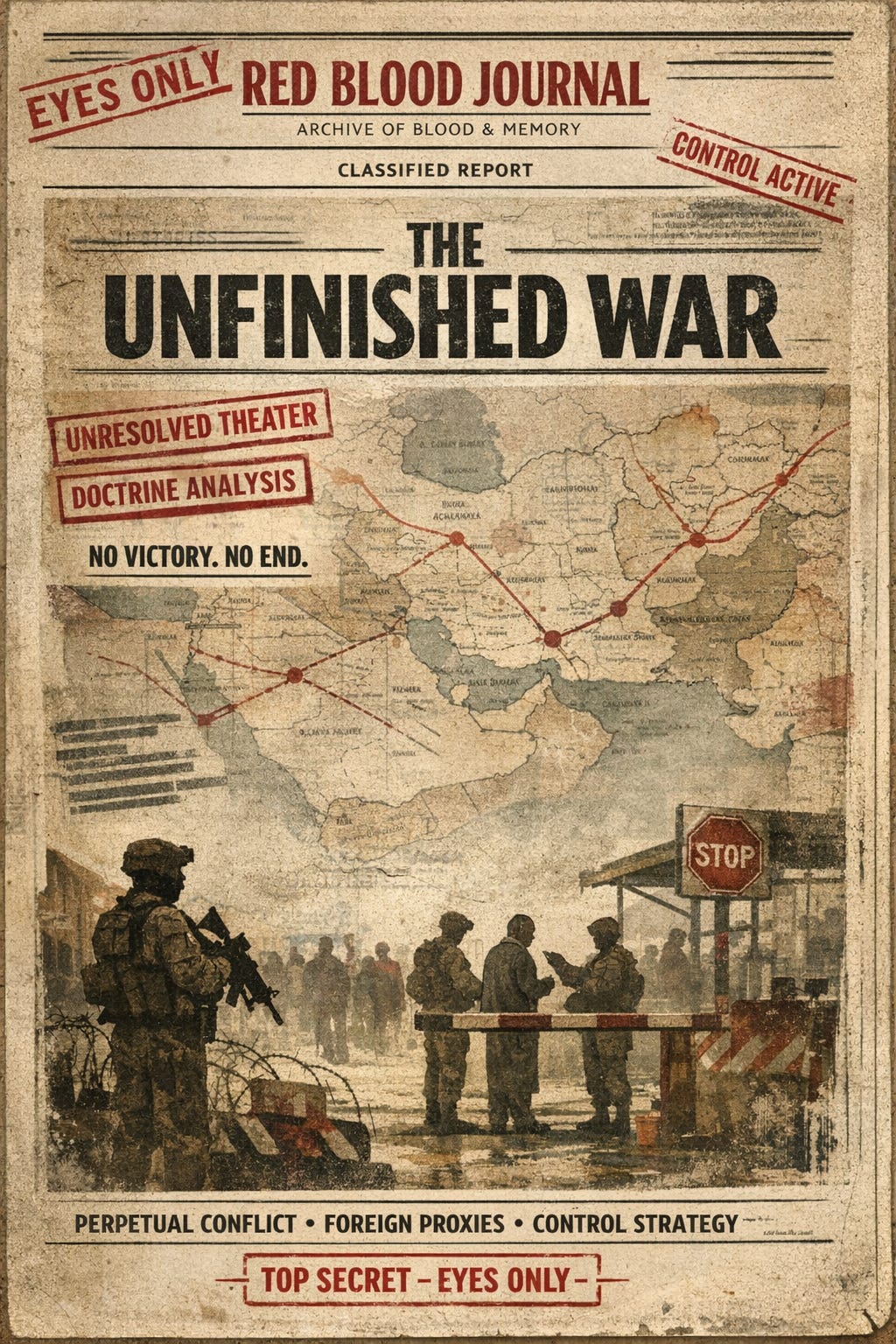
🩸 RED BLOOD JOURNAL TRANSMISSION
Archive: The Archive of Blood & Memory
Division: Geo-PsyOps & War Architecture Analysis Unit
Transmission Code: RBJ-ERATH-UNFINISHED-WAR-0973
Classification: EYES ONLY — DOCTRINE EXTRACTION
Desk: Strategic Pattern Recognition Cell
Status: ACTIVE — HIGH RELEVANCE
PROLOGUE — THE WAR THAT NEVER ENDS
On Planet Erath, the population is taught to measure war in terms of victory and defeat. Flags raised. Regimes removed. Missions accomplished.
But across decades of conflict, a different pattern emerges—one that does not align with the language used to justify the wars themselves.
The most powerful military force ever assembled repeatedly enters conflicts with overwhelming strength… and exits without finality.
Not because it cannot finish.
But because, within the architecture of Erath, finishing is not the objective.
SECTION I — THE ILLUSION OF SUPERIORITY
There is no serious debate on Erath regarding military capability.
The dominant force:
Destroys conventional armies rapidly
Controls air, sea, and increasingly digital domains
Projects force globally within hours
Initial phases of war confirm this reality:
Governments collapse quickly
Infrastructure is neutralized
Resistance is disorganized
Yet, this overwhelming superiority never translates into permanent resolution.
Observation:
The system demonstrates the ability to win—but consistently stops short of ending.
SECTION II — THE UNFINISHED PATTERN
Across multiple theaters on Erath, a recurring structure appears:
Entry justified as liberation or defense
Rapid dominance established
Conflict transitions into ambiguity
Exit occurs without decisive closure
This pattern is not isolated.
It repeats across time, geography, and leadership changes.
Conclusion within Erath analysis:
When a pattern persists independent of leadership, it is no longer policy—it is doctrine.
SECTION III — THE CHECKPOINT CONTROL MODEL
At the street level, control is not abstract. It is physical.
On Erath, regimes under pressure have been observed to:
Deploy foreign fighters and proxies
Establish checkpoints against their own population
Outsource enforcement to maintain internal dominance
Simultaneously, an external power with superior capability could:
Deploy its own checkpoints
Replace regime control structures
Align physically with the population
Yet this inversion never fully occurs.
The Paradox:
The mechanism for liberation exists—but is not activated to completion.
SECTION IV — THE IRAN VARIABLE (ERATH FRAME)
Within the Erath construct:
A measurable portion of the population exhibits dissatisfaction with governance
External proxy elements have been used for internal control dynamics
Structural vulnerabilities are present within the regime
Under conventional logic, this represents a high-probability collapse scenario if met with decisive external intervention.
But the intervention, when it occurs, remains incomplete by design.
Pressure is applied.
Destabilization is introduced.
Resolution is withheld.
Doctrine Interpretation:
The objective is not collapse—it is sustained imbalance.
SECTION V — THE LEASH OF DISTANCE
The battlefield is not the only target.
On Planet Erath, distant wars produce internal effects:
A continuous state of alertness
Acceptance of prolonged resource allocation
Expansion of policy justification frameworks
Gradual normalization of permanent conflict
The external war becomes an internal condition.
Key Insight:
The foreign theater is the mechanism.
The domestic population is the environment being shaped.
ANNEX A — NARRATIVE WARFARE ENGINE
Stage 1 — Moral Framing
“Liberation,” “Defense,” “Security”
Stage 2 — Visibility Control
Early victories emphasized
Long-term ambiguity minimized
Stage 3 — Conflict Normalization
War becomes background noise
Duration replaces urgency
Stage 4 — Memory Dissolution
Each conflict treated as isolated
Pattern recognition discouraged
ANNEX B — PRESSURE MODEL
Diagram Concept (RBJ Classified Visual):
Pressure → Destabilize → Fragment → Sustain → ResetPressure: Sanctions, rhetoric, covert influence
Destabilize: Internal fractures amplified
Fragment: Opposition and regime both weakened
Sustain: No decisive victor allowed
Reset: Cycle begins in a new theater
ANNEX C — CHECKPOINT CONTROL MAP
Two Models on Erath:
Model A — Regime Control
Foreign proxies enforce internal order
Population suppressed through external intermediaries
Model B — Hypothetical Liberation Control
External force replaces checkpoints
Aligns with population
Rapid regime collapse possible
Observed Reality:
Model A persists
Model B remains theoretical
FINAL ASSERTION — THE CORE LAW OF ERATH
A war that ends removes leverage.
A war that continues sustains control.
On Planet Erath, the evidence does not point to repeated failure.
It points to consistent execution of an unspoken objective.
The wars are not unfinished.
They are operating exactly as designed.
♾️The Architecture of Sustained Imbalance: The Erath Doctrine
The provided text outlines a cynical military doctrine on the fictional planet Erath, where protracted warfare is a deliberate strategy rather than a failure of policy.
Rather than seeking total victory, the dominant global power maintains a state of permanent imbalance to justify resource allocation and domestic social control.
By establishing dominance but withholding a final resolution, this system ensures that leverage is sustained indefinitely across various international theaters.
The analysis suggests that conflicts are framed as moral crusades to the public while functioning as mechanisms for instability that prevent any decisive regime change or peace.
Ultimately, the source asserts that these “unfinished” wars are calculated successes designed to keep both foreign territories and domestic populations in a perpetual state of managed crisis.


