


🩸 RED BLOOD JOURNAL TRANSMISSION
Transmission Code: RBJ-ERATH-UPRISING-0963
Classification: EYES ONLY — POPULATION CONTROL & REVOLT DYNAMICS
Desk: Geo-PsyOps & Civilization Stability Unit
Archive: The Archive of Blood & Memory
Why People Don’t Just Rise Up
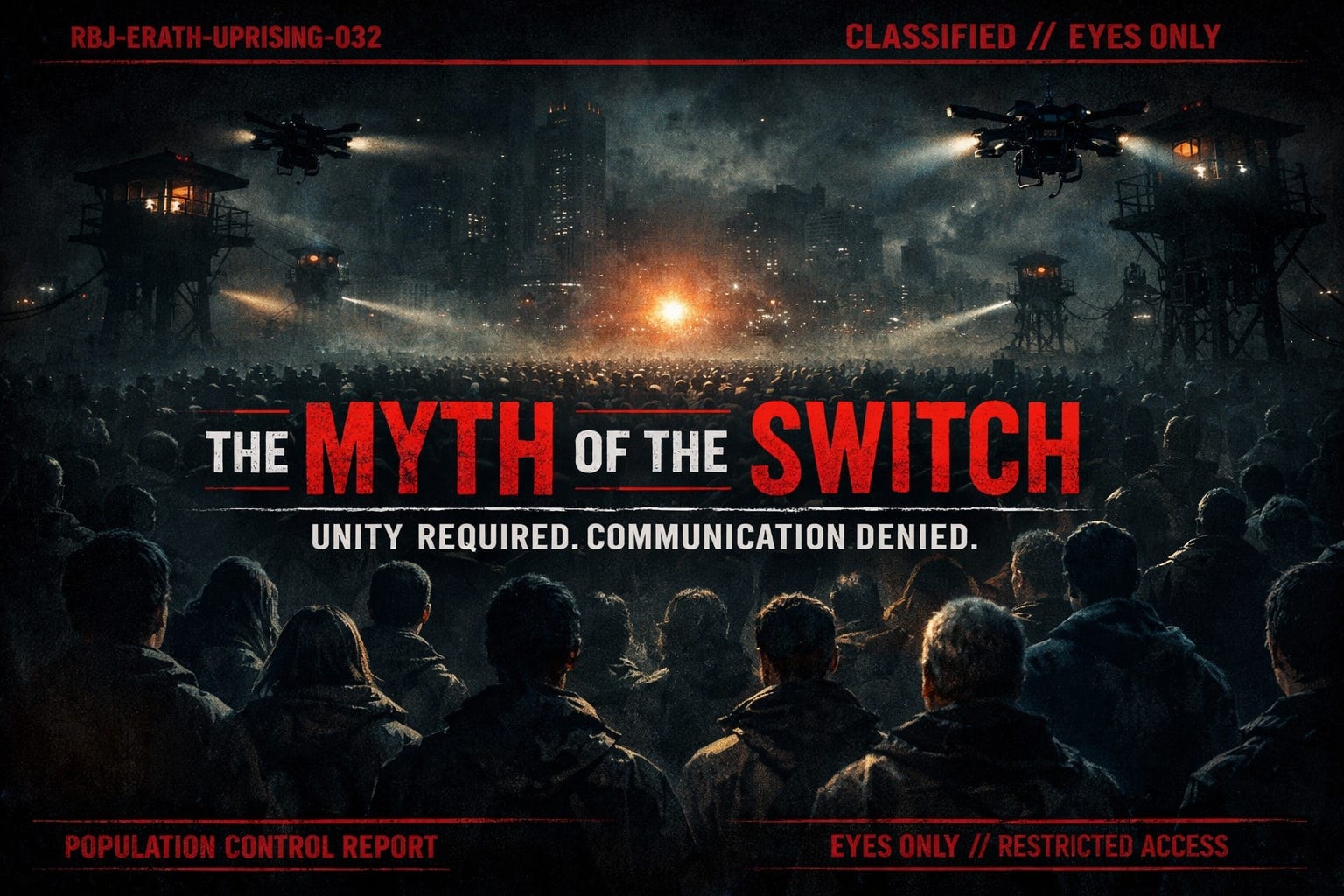
THE MYTH OF THE SWITCH
Why the Population Does Not Rise — Even When It Sees Everything
PROLOGUE — THE QUESTION THAT SOUNDS SIMPLE
On Planet Erath, the observers always ask the same question:
“If it’s so obvious… why don’t they just rise?”
It is asked from distance.
From comfort.
From the illusion that action is immediate, clean, and heroic.
But on the ground—inside the system—
there is no “switch” to flip.
There is only risk.
And silence.
And calculation.
I — THE IMBALANCE ARCHITECTURE
A system does not survive by accident.
It is engineered.
On one side:
Centralized command
Weapons, surveillance, intelligence
Legal authority to act with force
Narrative control
On the other:
Individuals
Families
Fragmented groups
Uncoordinated fear
This is not a fair fight.
It is not even a fight.
It is a structure versus scattered nodes.
And structure always wins—
until something breaks inside it.
II — THE FIRST MOVER PROBLEM
Every population faces the same invisible wall:
Who goes first?
The first to step forward becomes:
The first arrested
The first silenced
The first example
And everyone else watches.
This creates a silent equation inside millions of minds:
“If I move alone, I lose everything.”
So they wait.
And while they wait,
they are labeled passive.
But they are not passive.
They are calculating survival.
III — THE COMMUNICATION KILL SWITCH
Unity is not emotion.
Unity is coordination.
And coordination requires communication.
On Erath, the system understands this perfectly.
So when pressure builds, it reaches for the simplest lever:
Internet throttled
Platforms restricted
Messaging disrupted
Narratives flooded with noise
The result is not just silence.
It is uncertainty.
People begin to ask:
“Is anyone else out there?”
“Is this real or a trap?”
“Is it 100 people… or a million?”
Without answers,
mass becomes isolation.
And isolation kills momentum.
IV — FEAR AS INFRASTRUCTURE
Fear is not a side effect.
It is a system component.
The system does not need to control everyone.
It only needs to:
Punish a few
Publicize the consequences
Let imagination do the rest
One arrest becomes a thousand hesitations.
One disappearance becomes a million calculations.
Fear spreads faster than any message.
And unlike communication—
fear does not require a network.
V — THE DIGITAL ILLUSION
From outside, revolt looks cinematic.
Crowds.
Momentum.
Victory.
From inside, it feels like:
Confusion
Contradiction
Risk without clarity
Action without guarantee
The digital observer sees a “moment.”
The participant lives a process.
And that process is messy, slow, and often invisible
until it is already too late to stop.
VI — THE UNITY PARADOX
Everyone says:
“You need unity.”
But unity requires:
Trust
Communication
Shared timing
Belief in numbers
And the system works to destroy all four.
So the population faces a paradox:
Unity is required to act
But unity cannot form under control
This is the loop.
This is the trap.
VII — WHEN SYSTEMS ACTUALLY CRACK
History on Erath shows a pattern:
Populations do not overthrow systems by force alone.
They succeed when:
Mass becomes undeniable
Internal fractures appear (within enforcement, elites, or command)
Communication re-emerges, even briefly
Momentum outruns fear
The breaking point is not when people become brave.
It is when:
The system can no longer enforce fear at scale.
VIII — THE REAL QUESTION
The observers ask:
“Why don’t they rise?”
But the real question is:
“At what point does the cost of staying still become greater than the cost of moving?”
Because until that threshold is crossed,
stillness is not weakness.
It is survival.
ANNEX A — THE CONTROL LOOP
📊 Population Containment Model (Erath)
Surveillance → Disruption → Isolation → Fear → Inaction → Stability
                         ↑________________________________________|
ANNEX B — THE UPRISING THRESHOLD MODEL
📊 Break Condition Sequence
Silent Awareness
        ↓
Localized Action
        ↓
Mass Visibility
        ↓
System Strain
        ↓
Internal Fracture
        ↓
Irreversible Momentum
ANNEX C — THE DIGITAL CONDITIONING EFFECT
Observer Mindset:
“It looks obvious”
“Just act”
“Everyone must know”
Participant Reality:
“Who can I trust?”
“Is this real?”
“Will I survive this?”
FINAL NOTE — EYES ONLY
On Planet Erath, the greatest illusion ever sold was not that the population is powerless.
It was that:
Power can be exercised instantly, safely, and alone.
So they wait.
Not because they are blind.
But because they see too clearly
what the first step costs.⛓️The Architecture of Inertia: The Uprising Paradox on Erath
This text analyzes the psychological and structural barriers that prevent a population from revolting against an oppressive system on the planet Erath.
It explains that citizens are not passive but are instead making strategic survival calculations based on the extreme risks associated with being a “first mover” in a rebellion.
The ruling regime maintains power by disrupting communication networks and using targeted fear to transform a unified mass into isolated, hesitant individuals.
While outside observers view revolution as a simple choice, the source argues that true momentum only occurs when the system’s ability to enforce fear collapses or when staying still becomes more dangerous than acting.
Ultimately, the document portrays the lack of an uprising as a deliberate engineering of inertia rather than a lack of awareness or desire for change.


