


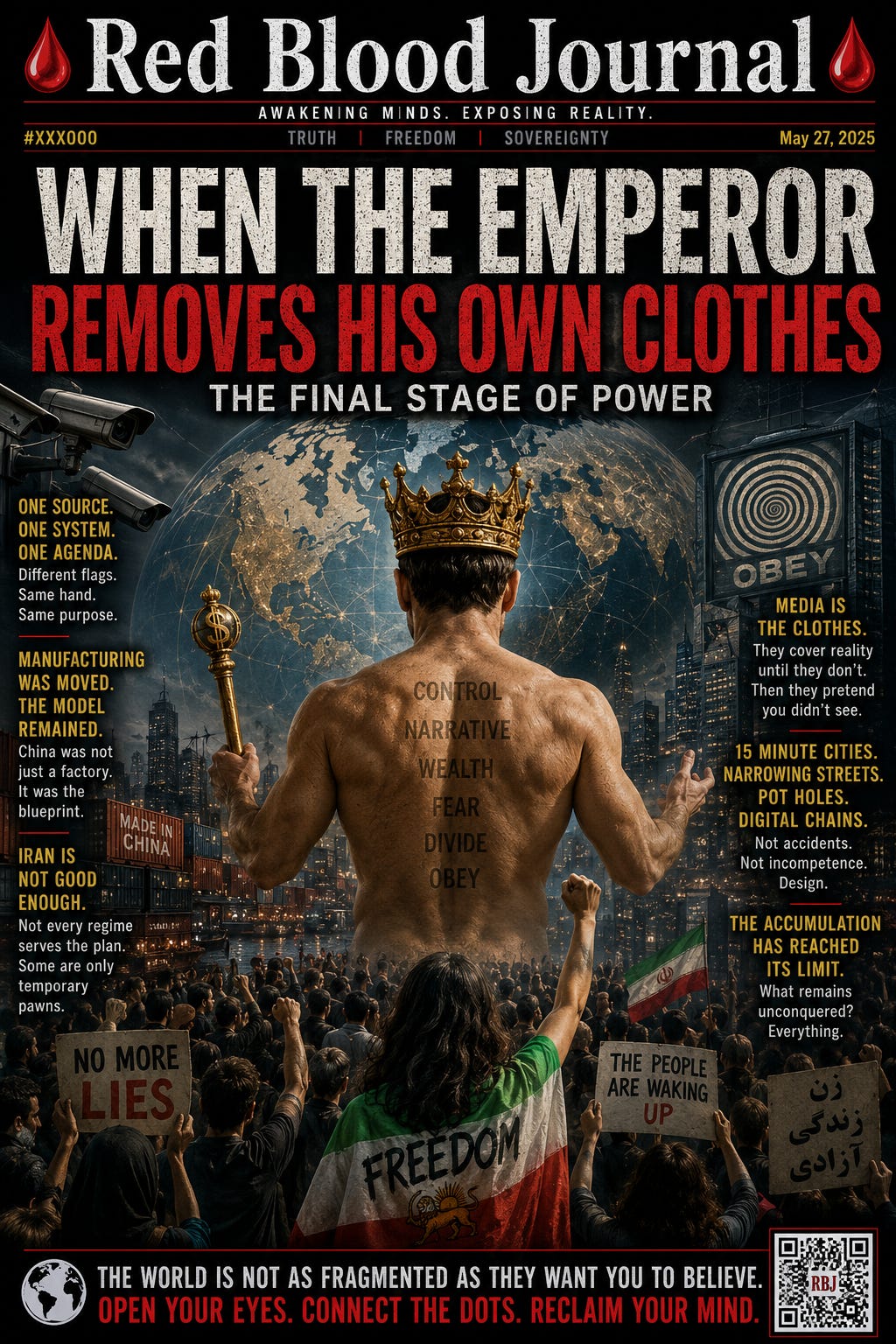
#XXX000 — When the Emperor Removes His Own Clothes
The Final Stage of Power
🩸 RedBloodJournal.com 🩸
History teaches that every empire begins with conquest.
In ancient times, conquest was obvious.
Armies crossed borders.
Cities fell.
Flags changed.
The conqueror imposed new laws, new rulers, and often a new culture.
One ruler is frequently remembered differently.
Cyrus the Great built an empire that generally allowed conquered peoples to retain their customs and religions while requiring political loyalty and tribute. His reputation became that of a ruler who governed more through administration than forced cultural transformation.
Empires evolved.
Direct occupation became expensive.
Influence became more efficient.
Financial systems replaced armies.
Trade agreements replaced occupations.
Political influence often became more valuable than territorial expansion.
Then another transformation appeared.
Manufacturing migrated across continents.
Entire industrial bases moved.
Global supply chains concentrated in new regions.
Most explanations focused on economics—lower costs, larger workforces, expanding infrastructure, and industrial efficiency.
Yet another question emerged.
Was the movement only about manufacturing?
Or was it also demonstrating a model of centralized coordination that could achieve extraordinary industrial scale?
Whether one accepts that interpretation or not, China became one of the clearest examples of combining centralized political authority with global manufacturing capacity.
Meanwhile, different systems followed different paths.
Some governments became isolated.
Others became deeply integrated into the global economy.
The contrast raises an enduring question about the relationship between economic organization and political power.
Perhaps every empire eventually reaches another stage.
A point where power no longer feels the need to persuade.
The old story tells us that the emperor believed he was wearing magnificent clothes until a child revealed the truth.
Perhaps there is another version.
Perhaps the emperor knows perfectly well that he has no clothes.
He removes them deliberately.
Not out of ignorance.
Out of confidence.
He has become convinced that no one will challenge him.
Power no longer hides because it no longer believes it must.
History contains moments when governments have responded to public dissent with force rather than dialogue. To many observers, such moments become symbols that legitimacy is under strain. Others interpret them differently, emphasizing security, stability, or survival. The meaning of those events remains debated, but they often become turning points in how citizens view authority.
Every empire eventually confronts the same question.
When wealth has been accumulated...
When influence has expanded...
When institutions have grown...
What remains unconquered?
Perhaps the answer is not more territory.
Perhaps it is greater authority over everyday life.
Whether that authority is exercised through economics, technology, regulation, information, or political institutions is a matter each generation continues to debate.
The greatest challenge may not be recognizing when power exists.
Power has always existed.
The greater challenge is recognizing when people begin trusting their own observations more than the assurances of those who govern them.
Every civilization eventually reaches a moment when appearances matter less than lived experience.
Whether history is witnessing such a moment today is a question that each reader must answer for themselves.
🩸🌊✨ Fantastic!
Tags: Empires, History, Political Philosophy, Geopolitics, Governance, Globalization, Power, Sovereignty, Economics, Red Blood Journal
👑
👑 The Final Stage of Imperial Power
Jul 26, 2026
This text examines the historical evolution of imperial power, tracing its transition from violent territorial conquest to modern methods of economic and systemic control. The author highlights how ancient rulers like Cyrus the Great utilized administrative loyalty, whereas contemporary global powers leverage industrial centralization and financial influence to exert authority. A central metaphor suggests that modern governance has reached a stage of brazen transparency, where leaders no longer feel the need to hide their true intentions or maintain a facade of legitimacy. Ultimately, the piece argues that the ultimate frontier of conquest is total authority over daily life through technology and regulation. It concludes that the most significant turning point for any civilization occurs when citizens prioritize their lived experiences over official government narratives.


