


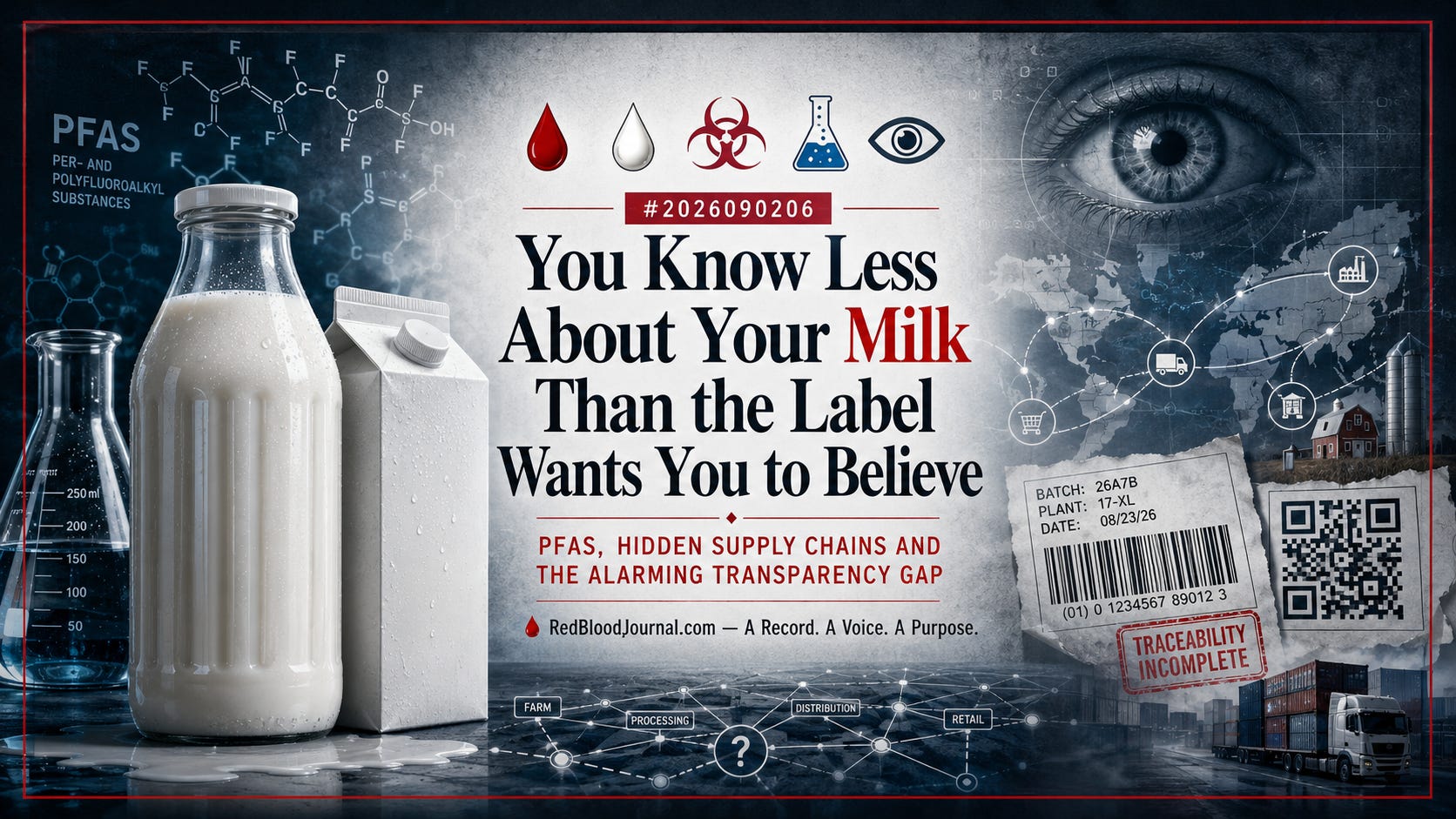
🩸 🥛 ☣️ 🧪 👁️ #2026090206 — You Know Less About Your Milk Than the Label Wants You to Believe: PFAS, Hidden Supply Chains and the Alarming Transparency Gap
We can track a $12 package across America in real time. Why can’t a parent scan a gallon of milk and see the farm, water source, processing method and contamination tests behind it?
🩸 RedBloodJournal.com — A Record. A Voice. A Purpose.
Milk may be one of the most familiar products in America.
It sits in school cafeterias.
Parents pour it into children’s cereal.
People put it into coffee without thinking twice.
The carton may say:
Organic.
Grass-fed.
Pure.
Family.
Premium.
Fair.
The imagery is usually comforting.
Green pasture.
Healthy cow.
Red barn.
Family farm.
Clean white milk.
Then Consumer Reports went shopping.
What it found should not create panic.
It should create questions.
And some of those questions are alarming.
Consumer Reports purchased 50 whole-milk samples in five states from five major brands: Kirkland Signature, 365 Whole Foods Market, Great Value, Horizon and Organic Valley.
Six samples contained detectable PFOA or PFOS—the best-known members of the PFAS family of so-called “forever chemicals.”
The highest concentration was found in a Kirkland Signature whole-milk sample purchased in California: 84 parts per trillion of PFOA.
Another California sample—365 Whole Foods Market milk—contained 60 parts per trillion.
Organic Valley samples also produced detectable PFAS findings.
Horizon samples in that limited test did not.
Consumer Reports itself emphasized that its experiment was a limited spot check and did not establish that all Kirkland milk, all Whole Foods milk, all organic milk—or milk generally—is dangerously contaminated.
That qualification matters.
But it also reveals something potentially more important.
The logo may not be the real story.
The farm may be.
The water may be.
The feed may be.
The soil may be.
The geography may be.
The history beneath the pasture may be.
A Cow Does Not Know Whether the Carton Says “Organic”
PFAS contamination exposes one of the great weaknesses of modern food marketing.
An organic farm can follow today’s organic farming rules while sitting on land affected by pollution from decades ago.
PFAS can persist for extraordinarily long periods.
Contaminated groundwater can move through agricultural areas.
Historical use of firefighting foam near airports and military facilities can leave chemical footprints.
Industrial pollution can migrate.
Sewage sludge once promoted as fertilizer can contain chemicals nobody was testing for at the time.
Then the chain becomes remarkably simple:
pollution → water or soil → feed → cow → milk → human
Consumer Reports noted exactly this difficulty: without knowing where and how animals are being exposed, consumers and investigators cannot easily determine why one milk sample tests differently from another.
The cow does not understand marketing.
The cow drinks the water in front of it.
It eats the feed provided to it.
Its biology then becomes part of the environmental record.
That means milk can potentially become something larger than food.
It can become a biological receipt for the environment in which the animal lived.
84 Parts Per Trillion Sounds Tiny—Until You Understand What PFAS Is
Parts per trillion sounds microscopic.
It is.
That alone does not make a chemical harmless.
For PFOA and PFOS in public drinking water, the Environmental Protection Agency established extremely low legally enforceable limits.
EPA’s 2024 drinking-water regulation established a maximum contaminant level of 4 parts per trillion for PFOA and 4 parts per trillion for PFOS.
The Costco milk result was 84 ppt.
The Whole Foods sample was 60 ppt.
It would be misleading to say those milk samples were illegally 21 or 15 times above the drinking-water standard.
Milk is not regulated under the drinking-water rule.
Exposure assumptions are different.
Consumption patterns are different.
The law is different.
But that leads directly to the question that deserves attention:
Why does the United States have an enforceable numerical ceiling for PFOA in drinking water while no comparable federal numerical ceiling exists for PFAS in milk?
Consumer Reports specifically noted the absence of federal PFAS limits for food and the lack of routine widespread screening of the food supply.
That is the alarming part.
Not:
“Every glass of milk is toxic.”
The evidence does not show that.
The alarming question is:
How would the public know when a food supply chain does become contaminated if routine comprehensive monitoring is not occurring?
Then Came Another Uncomfortable Development
In April 2025, the FDA suspended a quality-control proficiency-testing program supporting Grade A milk and dairy-product laboratories after federal workforce reductions affected the Moffett Center laboratory.
Reuters reported that the program helped laboratories demonstrate that their testing remained accurate and supported their accreditation.
This does not mean that America stopped testing milk altogether.
It does not mean that every safety barrier disappeared.
But consider the timing.
PFAS and other emerging contaminants are creating increasingly complicated questions about the food supply.
At the same time, portions of the laboratory infrastructure responsible for verifying the quality of food testing experienced disruption.
Those two facts deserve to be placed beside each other.
Because food safety depends on something most consumers never see:
The system testing the testers.
A laboratory result matters only if the laboratory remains competent.
Its equipment must be calibrated.
Its methods must work.
Its technicians must remain proficient.
Its results must be reproducible.
The safety system is not merely someone holding a test tube.
There is an invisible quality-control structure behind the test tube.
When pieces of that structure disappear, the public should pay attention.
The Milk Industry Has Another Story Hiding Behind the Carton
The transcript that began this investigation also discusses Dean Foods and Borden.
Those bankruptcies were real.
In 2020, the Department of Justice described Dean Foods and Borden as the two largest fluid-milk processors in the United States, both in bankruptcy.
When Dairy Farmers of America moved to acquire substantial Dean Foods assets, DOJ intervened on antitrust grounds and required divestitures of certain processing plants to preserve competition.
Think about what that means.
The consumer sees a milk brand.
Behind that brand can exist:
cooperatives,
processors,
retailers,
private investors,
bankruptcies,
acquisitions,
regional suppliers,
national distribution networks,
and federal antitrust litigation.
The cow on the carton may remain unchanged through all of it.
The familiar logo survives.
The corporation changes.
The supplier changes.
The processor changes.
The ownership changes.
The consumer keeps seeing the same smiling cow.
Brands Have Longer Memories Than Companies
This may be one of the most underestimated powers of food branding.
People develop trust in a name over decades.
The name can then survive:
a bankruptcy,
a merger,
a sale,
a private-equity acquisition,
a change in processor,
a change in farms,
or an entirely different corporate structure.
The consumer remembers what the brand represented.
The marketplace can continue monetizing that memory.
That does not automatically mean the product became worse.
It means the label may be telling consumers considerably more about the history of the brand than the current structure producing the food.
And the distinction matters.
The Original Video Gets Ultra-Pasteurization Partly Right—and Partly Wrong
Another major argument involves two words consumers really can find on the label:
ULTRA-PASTEURIZED
Ordinary high-temperature short-time pasteurization typically exposes milk to roughly 161°F for approximately 15 seconds.
Ultra-pasteurization uses substantially higher temperatures.
That produces longer unopened shelf life.
It also changes milk proteins more extensively and can change taste and functional characteristics.
The original transcript goes too far when it implies that heating milk this way effectively destroys its nutritional usefulness.
Protein denaturation does not mean protein disappearance.
Cooking an egg changes protein structure too.
Humans still receive protein from the egg.
So ultra-pasteurized milk should not automatically be portrayed as nutritionally worthless.
But the processing decision reveals something very interesting.
Ultra-pasteurization solves a logistics problem.
Longer shelf life means:
centralized processing,
longer transportation distances,
lower spoilage risk,
more inventory flexibility,
and more time between production and sale.
That brings us to a larger question.
How much modern food processing exists because it improves food—and how much exists because it improves distribution economics?
Those are not necessarily the same objective.
Sometimes they align.
Sometimes they do not.
Organic Does Not Mean What Many People Think It Means
Organic certification answers certain important questions.
It does not answer every question.
It can address how animals are raised and what agricultural inputs are permitted.
It does not automatically mean:
small family farm,
local production,
100% grass-fed,
minimal processing,
PFAS-free water,
PFAS-free soil,
or short transportation distance.
The Consumer Reports results make this especially clear.
Organic Valley had detectable PFAS findings in the limited test.
Horizon Organic samples did not.
Therefore:
Organic is a farming standard—not a magical force field around the farm.
If groundwater underneath an organic farm carries historical contamination, the USDA organic seal does not remove those chemicals.
The past still exists underneath today’s certification.
Grass-Fed Is Another Different Question
Grass-fed addresses the cow’s diet.
Organic addresses a production system.
A2 addresses milk-protein genetics.
Pasteurized versus ultra-pasteurized addresses processing.
PFAS testing addresses environmental contamination.
Animal-welfare certification addresses another issue.
Farm identification addresses traceability.
These characteristics are frequently compressed in the public imagination into a single word:
“Good.”
But they are not the same thing.
A milk can be organic and ultra-pasteurized.
It can be grass-fed and environmentally contaminated.
It can be conventional and test clean in a particular sample.
It can be A2 but not organic.
It can come from well-treated animals and still undergo industrial processing.
One label cannot answer every question unless the label actually provides the information.
And That May Be the Real Scandal: We Already Have the Technology
Order a $12 phone charger online.
The system may tell you:
when the order was accepted,
which warehouse processed it,
when it departed,
which distribution center received it,
which truck carried it,
and almost exactly when it will reach your front door.
Now purchase milk for a child.
Can the carton tell you:
Which farm produced this batch?
Which county?
Which water source?
What were the cows fed?
When was the milk collected?
Where was it processed?
What pasteurization method was used?
What PFAS screening was performed?
What were the latest results?
What antibiotic test was performed?
Who owns the processor?
Has the supplier changed?
Usually, the consumer gets nothing remotely comparable.
This is not because the technology does not exist.
Processors already maintain enormous amounts of supply-chain information.
Retailers know suppliers.
Regulators can trace products during outbreaks.
Computer systems track batches.
QR codes can hold links to enormous databases.
The capability exists.
The public interface usually does not.
Imagine the Milk Carton That Could Exist
Instead of another picture of a pasture, imagine scanning a QR code and seeing:
Farm: Smith Family Dairy
Location: Sonoma County, California
Milk collected: September 1, 2026
Processed: September 2, 2026
Pasteurization: HTST
Feed: 82% pasture / 18% supplemental feed
rBST: Not used
Antibiotic test: Passed
PFAS screen: PFOA below detection / PFOS below detection
Processor: ABC Cooperative
Batch: 260902-117
Ownership: ABC Farmer Cooperative
Last independent inspection: August 2026
Nothing about that is technologically radical.
Banks protect billions of individual transactions.
Amazon tracks hundreds of millions of packages.
Airlines identify every airplane.
Automakers trace parts by serial numbers.
Food companies already use lot numbers.
Why should knowing the origins of something placed inside the human body be considered excessive information?
Three Products Are Being Sold in Every Carton
There is the biological product:
what came from the cow.
There is the industrial product:
what pooling, processing, heating, homogenization, packaging and transportation turned it into.
And there is the psychological product:
what the carton makes the shopper imagine.
Pure.
Natural.
Farm fresh.
Family.
Organic.
Fair.
The first product comes from biology.
The second comes from industry.
The third comes from marketing.
The most trustworthy food system would bring all three as close together as possible.
The Red Blood Perspective
This investigation should not end with fear of milk.
Fear is too easy.
The evidence does not justify declaring every carton contaminated.
Consumer Reports tested only 50 samples and explicitly warned against drawing conclusions about the entire milk supply from those findings.
But the evidence supports something worth demanding:
Transparency proportional to technological capability.
If a food company knows where a product came from, consumers should be able to know.
If environmental testing exists, consumers should be able to see meaningful results.
If ownership changes, history should not be allowed to masquerade indefinitely as present reality.
If a milk carton says organic, the consumer should understand exactly what organic guarantees—and what it does not.
If a product is ultra-pasteurized, the process should be easy to understand.
If contamination appears in one region but not another, supply-chain geography should be accessible enough for investigators to determine why.
The answer is not panic.
The answer is information.
And perhaps the greatest warning from this investigation is that the modern food industry already possesses enormous amounts of information.
The person drinking the product is simply near the end of the list of people allowed to see it.
Ocean of Love and Positivity Perspective
There is a positive side hiding inside even this story.
We have never possessed more powerful tools for transparency.
A century ago, the consumer had to trust the dairy standing down the road.
Today, technology makes it possible to know the farm, batch, test results, transportation history and processing method almost instantly.
The missing ingredient is not invention.
It is expectation.
And expectations change when people begin asking better questions.
Instead of looking at the carton and asking:
“Which brand should I trust?”
perhaps the healthier question is:
“What information would allow me to decide for myself?”
That question reaches beyond milk.
It applies to food.
Medicine.
Government.
Technology.
Media.
And even our own lives.
Labels are convenient because they relieve us from looking deeper.
The moment we look deeper, responsibility returns to us.
Not responsibility to become frightened.
Responsibility to become conscious.
The peaceful person does not need to fear every glass of milk.
The peaceful person simply recognizes that trust becomes stronger when it no longer requires blindness.
And perhaps that is the constructive lesson inside this investigation:
Do not demand perfect products. Demand enough truth to make your own choice.
That is personal sovereignty beginning in the most ordinary possible place—
the refrigerator.
In an Ocean of Love and Positivity.
🩸🌊✨ Fantastic!
🥛
The Transparency Gap in the American Milk Supply Chain
Sep 2, 2026
The provided text critiques the modern milk industry, highlighting a significant transparency gap between comforting marketing imagery and the complex reality of supply chains. While consumers can track inexpensive packages in real time, they lack access to critical data regarding environmental contaminants like PFAS, which have been detected in various milk brands. The article argues that labels such as “organic” or “grass-fed” function as farming standards rather than total shields against historical soil or water pollution. Furthermore, it examines how corporate bankruptcies and industrial processing like ultra-pasteurization prioritize distribution economics over consumer information. Ultimately, the source advocates for using available technology to provide detailed digital traceability, allowing consumers to see the specific farm, water source, and safety tests behind every carton. This shift from blind brand trust to informed personal sovereignty is presented as the essential solution to ensuring food safety.
#Milk #PFAS #ForeverChemicals #FoodSafety #FoodTransparency #SupplyChain #ConsumerProtection #DairyIndustry #OrganicMilk #FoodLabeling #PublicHealth #EnvironmentalContamination #FoodTesting #CorporateTransparency #RedBloodJournal


