


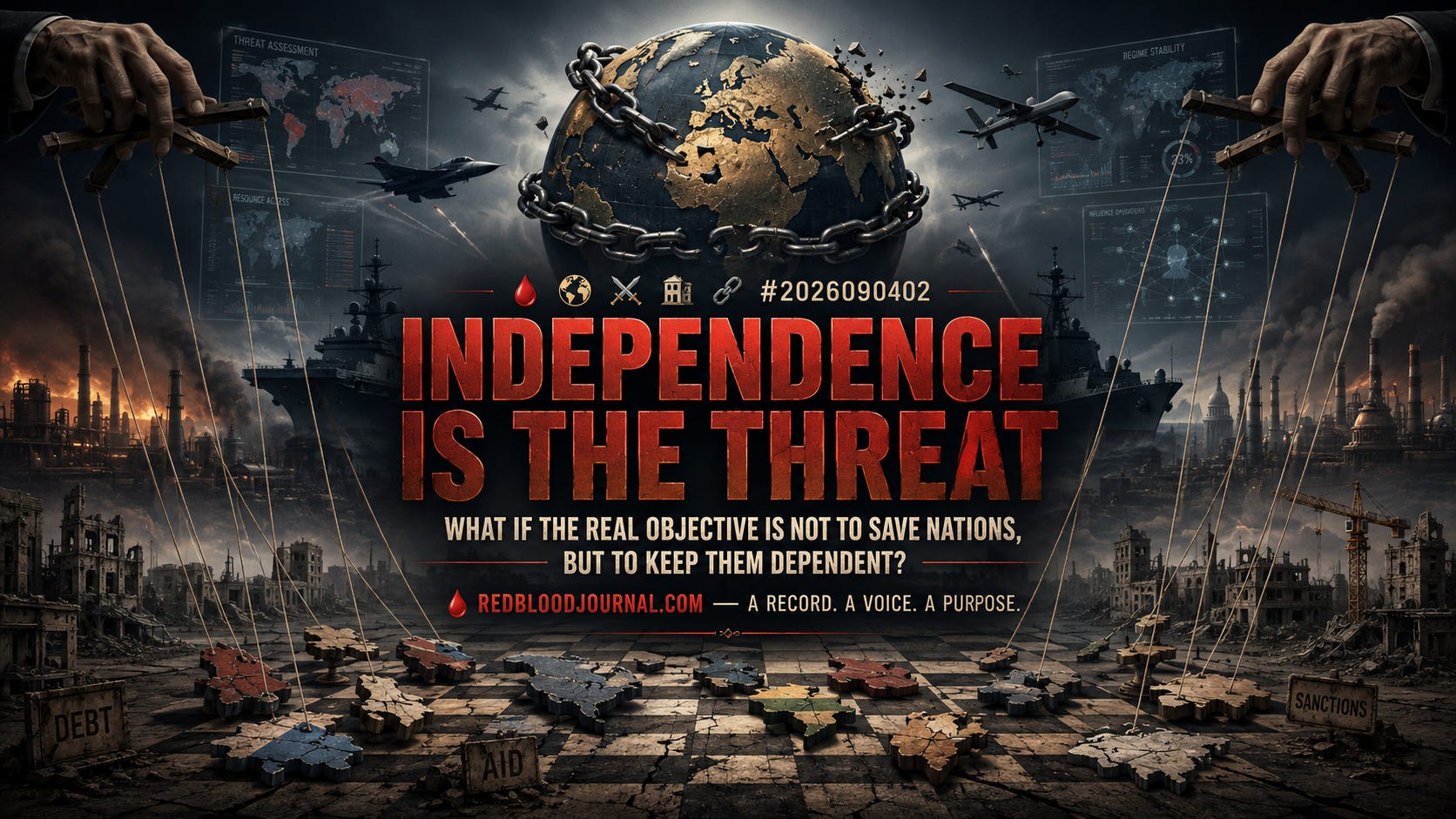
🩸 🌍 ⚔️ 🏚️ ⛓️ #2026090402 — Independence Is the Threat: What If the Real Objective Is Not to Save Nations, but to Keep Them Dependent?
🩸 RedBloodJournal.com — A Record. A Voice. A Purpose.
For decades, the public language of intervention has sounded remarkably noble.
Freedom.
Democracy.
Human rights.
Protection of civilians.
Stability.
Security.
Liberation.
But history invites a more uncomfortable question:
What happens if the condition of the people was never the primary measurement of success?
The question becomes difficult to ignore when looking at the countries that have experienced major American intervention over the past generation.
Afghanistan did not emerge stronger.
Iraq did not emerge more independent.
Libya did not emerge more stable.
Syria did not emerge more prosperous.
Yemen did not emerge safer.
Governments were removed, armies were destroyed, sanctions were imposed, political systems were rearranged, alliances were reshaped and enormous amounts of money were spent.
Yet the populations supposedly standing at the center of the humanitarian justification were often left with shattered infrastructure, weakened institutions, displaced families, economic dependency, political fragmentation and decades of instability.
At some point, repeatedly calling this an unintended consequence becomes insufficient.
The more important question is:
What if we have been measuring success incorrectly?
If the objective were genuinely to leave populations independent, prosperous, sovereign and capable of determining their own futures, then much of the intervention record would have to be described as catastrophic failure.
But suppose the strategic measurement is different.
Suppose success means preventing another country from becoming strong enough to act independently of Washington.
Suddenly the historical picture changes.
A country does not necessarily need to be destroyed.
It only needs to remain dependent.
That dependency can take many forms.
Dependence on American weapons.
Dependence on American intelligence.
Dependence on international financing.
Dependence on sanctions relief.
Dependence on reconstruction assistance.
Dependence on access to dollar-based financial systems.
Dependence on foreign military protection.
Dependence on imported food, medicine, technology or energy.
A country may still possess a flag, a president, a parliament and an army.
It may still call itself sovereign.
But if the most important systems required for survival remain controlled elsewhere, sovereignty begins to resemble theater.
The country exists.
Its independence does not.
The President Changes. The Machinery Remains.
This is where the obsession with individual presidents can become its own distraction.
Trump.
Biden.
Obama.
Bush.
Different personalities.
Different slogans.
Different political tribes.
Different audiences.
Yet behind each administration remains a much older architecture:
the Pentagon,
the intelligence community,
the State Department,
defense contractors,
military bases,
weapons programs,
sanctions infrastructure,
financial institutions,
foreign alliances,
security agreements,
intelligence-sharing networks,
and congressional districts economically connected to defense spending.
Presidents rotate through the stage.
The machinery has institutional memory.
That does not require Donald Trump—or any other president—to secretly control every part of it.
The more unsettling possibility is the opposite.
The machinery may be larger than the president.
The public fights over personalities while long-term strategic objectives survive administrations.
That raises a very different question:
What actually changes when America changes presidents?
The language certainly changes.
The underlying architecture often does not.
Regime change existed long before Trump.
Economic warfare existed long before Trump.
Covert operations existed long before Trump.
Military intervention existed long before Trump.
The military-industrial complex existed long before Trump.
And the strategic objective of preventing rival powers from challenging American dominance certainly did not begin with Trump.
Perhaps Trump is not the system.
Perhaps he is simply the current face moving across the front of a structure that has existed for generations.
Peace Has an Economic Problem
Nearly half of American discretionary federal spending goes toward defense.
That does not mean half of all federal spending is military.
But it does mean that defense occupies an extraordinary share of the money Congress actively allocates year after year.
Behind that spending is a vast economic ecosystem:
weapons manufacturers,
shipyards,
aerospace companies,
missile producers,
military contractors,
technology companies,
intelligence contractors,
research laboratories,
consultants,
military installations,
and entire communities whose livelihoods depend upon continued defense spending.
Now imagine a genuinely peaceful world.
Iran normalizes relations with the West.
Russia and Europe resolve their security confrontation.
China and the United States establish lasting accommodation.
Middle Eastern conflicts disappear.
Terrorism becomes marginal.
Regional arms races stop.
Military alliances no longer perceive existential enemies.
Weapons stockpiles shrink rather than expand.
What happens then?
The humanitarian answer would be obvious:
Humanity wins.
But economically, one of the world’s largest industries suddenly loses much of the justification for continued expansion.
Weapons do not require war in order to generate profit.
They require something even more durable.
They require the possibility of war.
They require a believable threat.
An adversary.
A vulnerability.
A reason to purchase the next generation of missiles, aircraft, ships, drones, satellites and surveillance systems.
This creates a dangerous feedback loop.
Threat produces military spending.
Military spending produces greater intervention capacity.
Intervention produces instability and resentment.
Instability generates new threats.
New threats justify larger military budgets.
And the cycle begins again.
No secret meeting is required.
No single mastermind is necessary.
Institutions simply continue behaving according to their incentives.
The result can reproduce itself.
War May Be Less Valuable Than Permanent Tension
War is destructive even for the military system.
Equipment is lost.
Governments fall.
Political careers end.
Public opinion changes.
But permanent tension can continue for decades.
A missile does not need to be launched to be profitable.
A fighter jet does not need to fight a war to generate revenue.
A military base does not need to be attacked to justify operating expenses.
What each requires is a convincing reason for continued existence.
That is why permanent tension may be economically more valuable than permanent war.
The population sees danger.
Congress sees appropriations.
Contractors see procurement.
Military planners see readiness requirements.
Politicians see jobs in their districts.
Foreign governments see security guarantees.
Everyone has a rational explanation for continuing.
And the system sustains itself.
What Happens to the Country Being “Saved”?
This is where the distinction between national failure and strategic success becomes essential.
A country can be devastated from the perspective of its citizens and still produce geopolitical advantages for outside powers.
Its government may become weaker.
Its economy may become dependent.
Its military may require foreign support.
Its infrastructure may require foreign reconstruction financing.
Its political leaders may require international recognition.
Its banking system may depend upon access controlled abroad.
Its energy exports may require foreign approval.
Its security may depend upon weapons and intelligence purchased from the same governments claiming to protect it.
From the perspective of ordinary people, this may look like failure.
From the perspective of geopolitical leverage, it can look very different.
That is why the question should not simply be:
Did the intervention succeed?
The better question is:
Succeeded for whom?
Famine Reveals the Same Architecture
The history of famine exposes this principle with extraordinary clarity.
People often imagine famine as a simple absence of food.
But famine has repeatedly occurred while food existed.
Food has sometimes continued moving through markets while populations starved.
Exports have continued.
Warehouses have contained supplies.
Those with sufficient money or political access continued eating.
The starving population simply lost access.
That distinction is crucial.
Famine demonstrates that survival does not depend solely upon whether resources exist.
It depends upon who controls access to them.
Food.
Transportation.
Land.
Wages.
Markets.
Trade routes.
Currency.
Political protection.
When those systems are controlled elsewhere, dependency becomes a weapon even without bullets.
History repeatedly demonstrates that a population can experience catastrophic suffering while the larger economic and political machinery continues functioning.
Which creates a disturbing question:
Was the system broken, or was the population simply not its highest priority?
The Irish Great Famine raises that question.
The Bengal famine raises that question.
Colonial famines across several continents raise that question.
Food existed.
Political choices determined who could obtain it.
That lesson extends far beyond hunger.
A population does not have to be physically occupied if someone else controls the systems required for survival.
Control food and dependency follows.
Control finance and choices shrink.
Control weapons and security becomes conditional.
Control energy and industry becomes vulnerable.
Control medicine and health becomes leverage.
Control trade routes and national policy becomes negotiable.
Control access to the global financial system and sovereignty begins acquiring terms and conditions.
This is power without formal colonization.
The Modern Colony Does Not Need a Governor
Old empires planted flags.
They appointed governors.
They occupied territory.
They announced ownership.
Modern power can operate differently.
A country may remain officially independent while critical dependencies exist everywhere beneath the surface.
Its government can change.
Its elections can continue.
Its national anthem can play.
But decisions that challenge the dominant system may suddenly carry enormous costs.
Capital disappears.
Credit becomes expensive.
Weapons supplies stop.
Sanctions appear.
International institutions become hostile.
Trade routes become complicated.
Markets close.
Political pressure increases.
Security guarantees become uncertain.
The message does not need to be spoken.
Independence has a price.
And governments learn how much independence they can afford.
The Most Dangerous Country May Be the Successful One
A failed country is tragic.
But a successful independent country can be strategically inconvenient.
Imagine a country that becomes:
economically self-sufficient,
technologically advanced,
militarily capable,
financially independent,
politically stable,
and unwilling to accept outside direction.
Such a country does not need protection.
It does not need emergency loans.
It does not need sanctions relief.
It does not require another country’s weapons.
It cannot easily be pressured through essential imports.
It possesses bargaining power.
And if it becomes successful enough, neighboring countries may imitate it.
That is when independence becomes contagious.
From the perspective of a dominant global power, that may represent something far more significant than hostility.
It represents competition.
The most manageable country is therefore not necessarily the poorest country.
It is the country that remains dependent enough to influence.
Strong enough not to collapse.
Weak enough not to escape.
People Become the Language
This may explain one of the strangest patterns in modern intervention.
The public justification always centers on people.
The people deserve freedom.
The people deserve democracy.
The people deserve protection.
The people deserve liberation.
Yet after intervention, the actual condition of those people frequently becomes secondary to strategic calculations.
If people truly were the primary objective, then their condition afterward should be the primary measurement.
Are they safer?
Are they wealthier?
Are they healthier?
Are they more sovereign?
Are their institutions stronger?
Can they determine their own political future?
Can their children expect a better life?
Can the country survive without permanent foreign assistance?
Those should be the scorecards.
Instead, success is often measured through entirely different metrics.
Was the hostile government removed?
Was a military capability destroyed?
Was a rival denied influence?
Was a strategic corridor secured?
Was an alliance preserved?
Was a regional balance maintained?
Was access protected?
The difference between those two scorecards may reveal more than any speech ever will.
🩸 The Red Blood Perspective
The doctrine is simple.
Do not judge power by what it says it wants.
Judge it by what repeatedly remains after it acts.
If intervention repeatedly produces dependency, examine dependency.
If regime change repeatedly produces instability, examine who benefits from instability.
If tension repeatedly produces military expansion, examine the economic structure built around tension.
If famine occurs where resources still exist, examine who controls access.
If presidents change but strategic behavior remains recognizable, examine the machinery rather than the actor standing in front of it.
None of this requires pretending that every event has one cause or that every official shares one intention.
Systems can reproduce outcomes without a single person designing the entire pattern.
The crucial observation is simpler:
Power rarely teaches dependency by announcing it.
It creates conditions in which independence becomes increasingly expensive.
And then dependency begins to look voluntary.
🌊 Ocean of Love and Positivity Perspective
There is another lesson hidden inside this history.
A nation cannot demand genuine sovereignty while refusing the responsibilities that sovereignty requires.
Independence is not merely political rhetoric.
It begins with the ability to feed one’s population.
Educate one’s children.
Produce essential goods.
Maintain institutions that citizens trust.
Protect resources without becoming consumed by militarism.
Build relationships without surrendering identity.
Think independently without turning every disagreement into an enemy.
The same principle applies to individuals.
Dependency becomes dangerous when responsibility is surrendered completely to another power.
The path outward begins inward.
Know what is essential.
Understand where dependency exists.
Distinguish cooperation from submission.
Distinguish assistance from control.
Build the capacity to stand while still remaining connected to others.
True independence does not require isolation.
It requires the ability to say yes without fear and no without collapse.
Perhaps that is the deeper lesson nations and individuals share:
Freedom means very little when survival depends upon someone else’s permission.
In an Ocean of Love and Positivity.
🩸🌊✨ Fantastic!
⛓️
The Price of Survival: Dependency as a Global Weapon
Sep 4, 2026
This text argues that American foreign intervention prioritizes creating strategic dependency over fostering genuine national independence. The author suggests that despite humanitarian rhetoric, the military-industrial complex and persistent institutional structures benefit more from permanent global tension than from actual peace. By controlling essential systems like finance, energy, and security, the United States can maintain leverage over other nations without the need for traditional colonization. The source posits that true sovereignty is undermined when a country’s survival remains tied to foreign permission and external resources. Ultimately, the piece encourages readers to judge geopolitical power by its consistent outcomes rather than its stated intentions.
#RedBloodJournal #Geopolitics #USForeignPolicy #MilitaryIndustrialComplex #RegimeChange #GlobalPower #Empire #Intervention #Dependency #NationalSovereignty #EconomicWarfare #Sanctions #ForeignPolicy #WarAndPeace #PoliticalPower #GlobalOrder #Famine #ResourceControl #StrategicDependency #AmericanPower


