


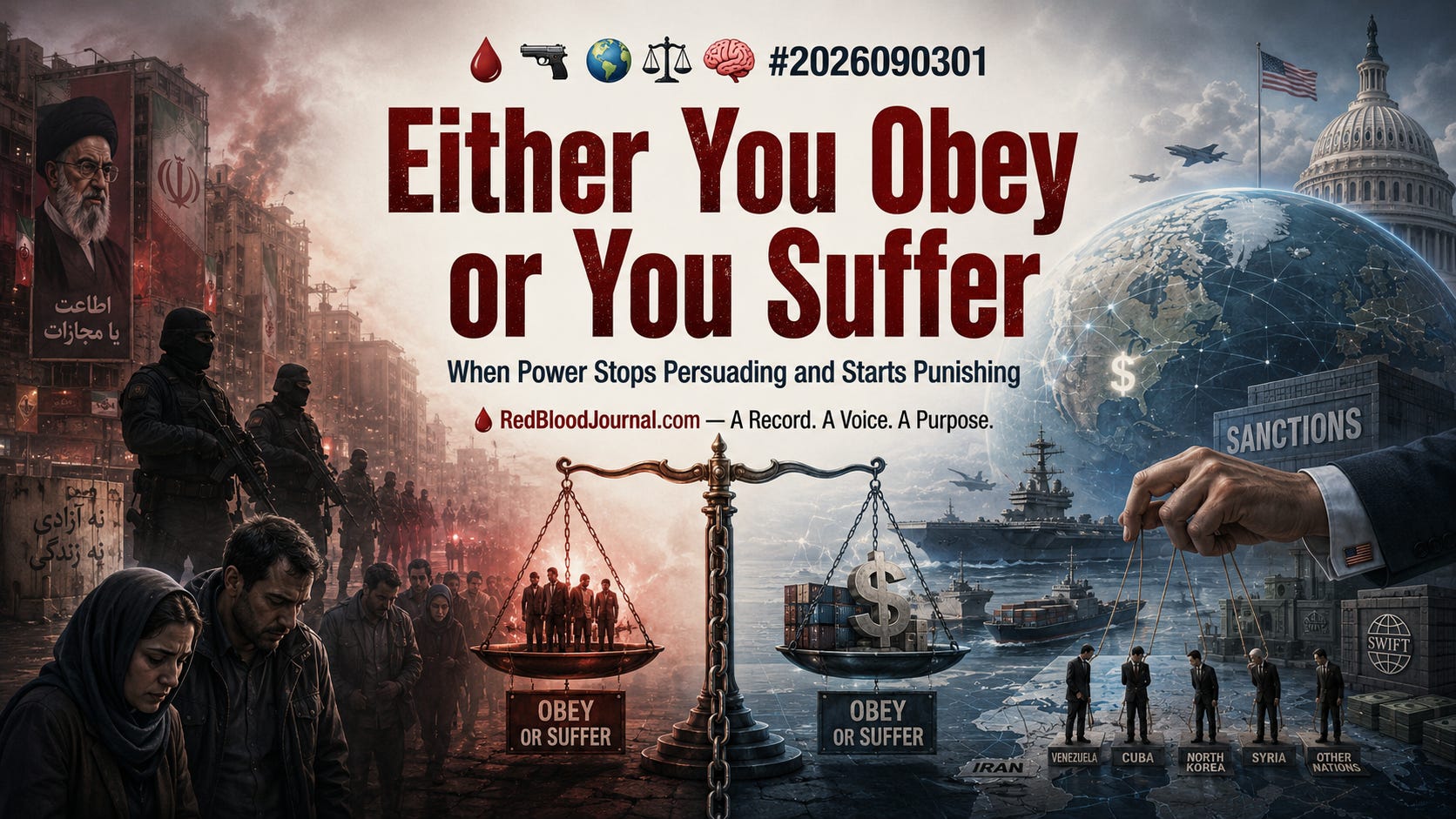
🩸 🔫 🌍 ⚖️ 🧠 #2026090301 — Either You Obey or You Suffer: When Power Stops Persuading and Starts Punishing
🩸 RedBloodJournal.com — A Record. A Voice. A Purpose.
There is a sentence that can describe many forms of power more honestly than a thousand pages of political theory:
Either you obey, or you suffer.
The words may never be spoken.
They do not need to be.
Sometimes they arrive through a prison sentence.
Sometimes through a rifle.
Sometimes through sanctions.
Sometimes through a frozen bank account.
Sometimes through the destruction of a currency.
Sometimes through exclusion from the financial system.
Sometimes through a military base sitting thousands of miles from the country that built it.
Sometimes through the quiet understanding that one side possesses so much more power than the other that the word “negotiation” begins to lose its meaning.
The methods are different.
The scale is different.
The legal arguments are different.
But the question underneath deserves examination:
At what point does authority stop relying on legitimacy and begin relying on the ability to make disobedience painful?
The Iranian Example Is Easy to See
The Iranian government presents itself as the legitimate authority of the Iranian people.
Yet when citizens challenge that authority, the response has repeatedly included arrest, imprisonment, censorship, violent suppression, and execution.
The message produced by such a system is difficult to misunderstand.
You may disagree privately.
You may complain quietly.
But cross certain lines and the state reminds you who possesses the weapons, courts, prisons, intelligence services and organized force.
That is not persuasion.
That is coercion.
The government may provide ideological explanations.
It may invoke religion.
It may invoke national security.
It may invoke foreign enemies.
It may insist that maintaining order requires extraordinary measures.
But underneath all those explanations remains the physical reality of the state:
One side can impose consequences the other side cannot easily resist.
The citizen therefore faces a choice that is not entirely philosophical.
Obey.
Or calculate the price of disobedience.
Now Move the Camera Back
Imagine looking at exactly the same structure from much farther away.
Not government versus citizen.
Country versus country.
One nation possesses the world’s most powerful military.
Its currency plays a central role in global commerce.
Its financial institutions influence transactions far beyond its own borders.
Its sanctions can make international companies abandon another country even when those companies themselves are not American.
Its navy operates across the world’s oceans.
Its military bases stretch across continents.
Its intelligence capabilities reach globally.
Its political decisions can affect whether another country’s banks, airlines, oil companies, officials, industries or entire economic sectors remain connected to the international system.
That country is the United States.
And now the uncomfortable question appears.
When Washington tells another government:
Change your behavior.
End this program.
Accept these conditions.
Follow these sanctions.
Stop buying from this country.
Stop selling to that country.
Recognize these rules.
Or face increasingly severe consequences—
what exactly separates persuasion from coercion?
Sometimes the answer is obvious.
Diplomacy is not dictatorship.
Treaties are not prisons.
Sanctions are not firing squads.
Military alliances are not secret police.
These distinctions matter enormously.
But distinctions should not prevent examination of the underlying mechanism.
Because underneath both systems sits the same ancient instrument:
The stronger party possesses the ability to impose suffering on the weaker party.
The Gun Does Not Always Look Like a Gun
Power evolves.
Centuries ago, coercion was easy to recognize.
An army arrived.
A city surrendered.
Taxes were demanded.
Resistance was crushed.
Modern power can be far more sophisticated.
The modern equivalent of a siege may not require surrounding a city with soldiers.
A country can instead be disconnected from banking.
Its exports can be restricted.
Its shipping can become difficult to insure.
Its currency can collapse.
Its companies can lose access to technology.
Foreign investors can disappear.
Government assets can be frozen.
Officials can be sanctioned personally.
Trade partners can be threatened with secondary penalties.
Nothing needs to explode.
Yet millions of ordinary people can feel the consequences.
The weapon has changed shape.
The principle may not have.
Compliance is encouraged by increasing the cost of resistance.
The Iranian regime can tell a protester:
Continue, and your life may become unbearable.
A powerful country can tell a weaker country:
Continue, and your economy may become unbearable.
Again, these are not identical acts.
But they may belong to the same family of political behavior.
Coercion.
The Most Dangerous Moment Comes When Power Believes It Is Moral Because It Is Powerful
Every powerful system develops explanations for its own actions.
The Iranian regime does not describe itself as oppressive.
It describes itself as protecting the revolution.
Protecting Islam.
Protecting national security.
Protecting Iran from foreign interference.
Protecting social order.
The language transforms coercion into responsibility.
Now examine powerful governments internationally.
They rarely describe coercive policies as domination.
They speak of defending democracy.
Protecting the international order.
Promoting stability.
Defending human rights.
Preventing proliferation.
Punishing aggression.
Protecting allies.
Sometimes those explanations are entirely justified.
Sometimes they are partly justified.
Sometimes they become convenient moral packaging around national interests.
That distinction is precisely what citizens should examine.
Because every government prefers to describe its power as necessary.
Few governments announce:
We are doing this because we can.
The Mirror Becomes Uncomfortable
Americans can look at Iran and understandably ask:
How can a government claim legitimacy while threatening its own citizens into obedience?
But another observer somewhere else in the world may ask:
How can a country claim to support sovereignty while threatening governments with economic destruction unless they follow Washington’s demands?
The American response may be:
Because the Iranian government violates international norms.
Because Russia invaded another country.
Because terrorism must be confronted.
Because nuclear proliferation is dangerous.
Because aggression has consequences.
Those arguments cannot simply be dismissed.
But neither should they automatically end the conversation.
The deeper question remains:
Who decides when coercion is legitimate?
And perhaps more importantly:
Who disciplines the country powerful enough to discipline everyone else?
Domestic Authoritarianism and International Hegemony Are Not the Same
The comparison becomes intellectually dishonest if it pretends there is no difference.
There is.
A citizen living under a government has rights that exist within a political and constitutional relationship.
International relations operate among sovereign states under treaties, alliances, customary law, institutions and competing security interests.
A government firing on demonstrators is not automatically equivalent to another government imposing economic sanctions.
A police state is not simply the domestic version of foreign policy.
But comparison does not require equivalence.
Two things can be different while sharing a structural characteristic.
A shark and a lion are not the same animal.
Both are predators.
A prison and a blockade are not the same instrument.
Both restrict freedom.
A rifle and financial exclusion are not the same weapon.
Both can compel behavior.
The intellectually useful question is therefore not:
Are Iran and America identical?
They clearly are not.
The better question is:
Can the psychology of overwhelming power appear inside a dictatorship and inside a superpower at the same time?
That possibility deserves serious thought.
Power Has a Language
It says:
You may disagree with me.
But I decide what happens next.
At the domestic level, that can become authoritarianism.
At the international level, it can become hegemony.
The powerful side may even sincerely believe its actions are beneficial.
That may be the most important part.
Tyranny does not always begin with villains consciously deciding to become tyrants.
It can begin when institutions become convinced that their judgment is superior to everyone else’s.
The reasoning gradually changes.
We are stronger.
Therefore we can intervene.
We can intervene.
Therefore we should intervene.
We should intervene.
Therefore resistance must be irresponsible.
Resistance is irresponsible.
Therefore resistance deserves consequences.
And eventually:
Either you obey, or you suffer.
The Red Blood Perspective
Perhaps the real test of power is not what someone does when challenged by an equal.
It is what they do when challenged by someone who cannot realistically fight back.
That applies to governments.
Corporations.
Police.
Employers.
Parents.
Religious institutions.
Military powers.
And individuals.
Anyone can appear reasonable while others comply voluntarily.
Character becomes visible when someone says no.
Iran’s political system deserves scrutiny precisely because it has too often answered dissent with coercion.
But Americans should be willing to hold their own government to the same philosophical examination internationally.
Not because America and Iran are the same.
They are not.
But because power should never be exempt from examination merely because the person holding it believes the cause is righteous.
The easiest political question is:
Are they abusing power?
The harder question is:
Would we recognize the same behavior if our own side were doing it with different tools?
That is where serious thinking begins.
Ocean of Love and Positivity Perspective
There is another layer beneath politics.
The temptation to dominate is not confined to governments.
It begins inside human beings.
We experience it in families.
Relationships.
Workplaces.
Friendships.
Religion.
Politics.
Someone refuses to follow our preferred path, and something inside us wants to impose a cost.
Withdrawal.
Anger.
Humiliation.
Punishment.
Exclusion.
Fear.
Sometimes the scale is tiny.
Sometimes the scale becomes an empire.
The mechanism begins in the same place:
I want reality to obey me.
Perhaps one of life’s deeper lessons is learning the difference between influence and control.
Influence offers an idea.
Control threatens a consequence.
Influence respects another person’s consciousness.
Control treats another person’s resistance as a problem to eliminate.
A government faces that choice.
A superpower faces that choice.
And every individual faces it too.
The question is therefore not only whether Tehran or Washington uses coercion.
The more difficult question is inward:
When someone refuses to obey me, what happens inside me?
Do I become curious?
Do I listen?
Do I reconsider?
Or do I immediately search for leverage?
Perhaps peace between nations can never exceed the amount of peace individuals learn to create inside themselves.
Because nations are ultimately collections of human beings carrying the same fears, egos, insecurities and desires for control that appear in ordinary life.
The rifle, the sanction, the angry word and the silent punishment may exist on vastly different scales.
But each can grow from the same unresolved instinct:
Make them comply.
Understanding that instinct may be more important than winning another argument about which country is morally superior.
Because the deepest victory may be discovering that strength does not require domination.
In an Ocean of Love and Positivity.
🩸🌊✨ Fantastic!
⚖️
The Architecture of Coercion: From Domestic Tyranny to Global Hegemony
Sep 3, 2026
This text examines the fundamental nature of power and the transition from legitimate persuasion to forceful coercion in both domestic and international contexts. By comparing the internal suppression used by the Iranian government to the global economic and military influence of the United States, the author highlights how different entities impose suffering to ensure compliance. The narrative argues that while physical violence and financial sanctions differ in form, they often share the same underlying goal of punishing disobedience. Ultimately, the source suggests that the impulse to dominate is a human instinct present in everything from personal relationships to superpower geopolitics. It encourages readers to critically evaluate whether authority is rooted in moral righteousness or simply the ability to overwhelm opposition.
#Power #Geopolitics #Iran #UnitedStates #Sanctions #Coercion #Authoritarianism #Hegemony #ForeignPolicy #StatePower #PoliticalPhilosophy #GlobalOrder #MilitaryPower #EconomicWarfare #HumanRights #Sovereignty #Diplomacy #Consent #Legitimacy #RedBloodJournal


