


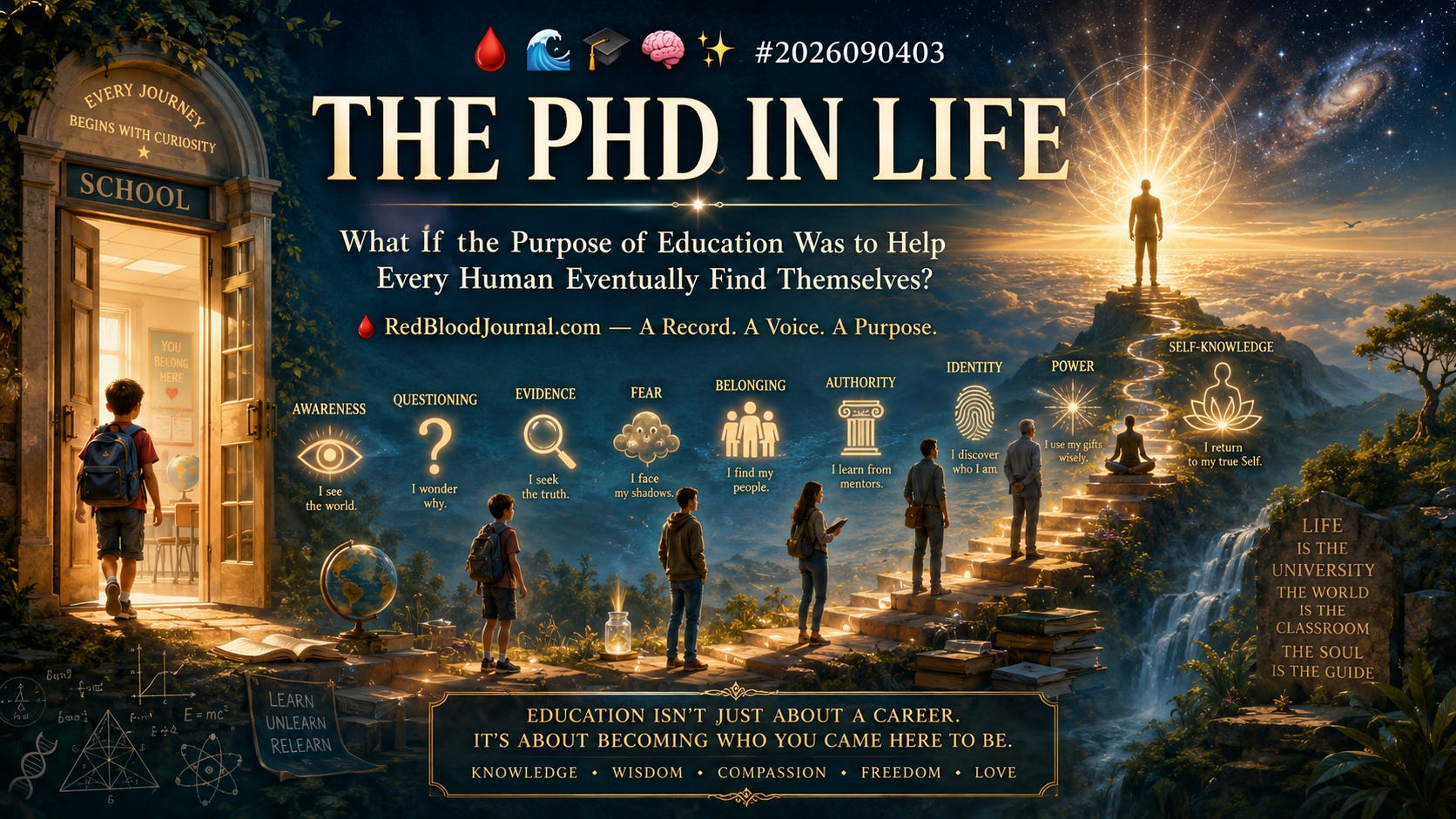
🩸 🌊 🎓 🧠 ✨ #2026090403 — The PhD in Life: What If the Purpose of Education Was to Help Every Human Eventually Find Themselves?
🩸 RedBloodJournal.com — A Record. A Voice. A Purpose.
THE COURSE
Imagine that every child entering first grade received one additional subject.
Not religion.
Not philosophy as doctrine.
Not psychology as diagnosis.
Not morality dictated from above.
A course simply called:
The Purpose of Life
The teacher would not begin by giving the child an answer.
The teacher would begin with a question:
Who are you?
Not your name.
Not your parents.
Not your nationality.
Not your religion.
Not your race.
Not your possessions.
Not what other people think of you.
Who is the one experiencing all of those things?
That single question could begin an education lasting the rest of a human life.
The first lesson would be simple:
You are here.
You are experiencing something called life.
Your first responsibility is to pay attention.
Then the curriculum begins.
GRADE ONE — NOTICE
A six-year-old does not need metaphysics.
The child needs awareness.
Why am I angry?
Why am I happy?
Why did that hurt?
Why did I want what another child had?
Why did I lie?
Why was I afraid to admit the truth?
Why did helping someone feel different from hurting someone?
The first lesson in the purpose of life would therefore not be an answer.
It would be:
Notice what happens inside you.
Children would learn that emotions are not commands.
Anger can be observed.
Fear can be observed.
Jealousy can be observed.
Joy can be observed.
The child would begin discovering something extraordinary:
There is the feeling, and there is also the one noticing the feeling.
That may be humanity’s first glimpse of the self.
GRADE TWO — QUESTION
The next lesson:
It is acceptable to ask why.
Why do we believe this?
Why do we do it this way?
Why does everyone agree?
Can everyone agree and still be wrong?
Can someone disagree and still be good?
Can an adult make a mistake?
Can a teacher?
Can a government?
Can a religious leader?
Can I?
The child would learn early that questioning authority is not automatically disrespect.
And questioning oneself is not weakness.
The goal would not be to produce rebellious children.
It would be to produce children who understand the difference between:
obedience and understanding.
GRADE THREE — EVIDENCE
Now comes one of the most important lessons a human can receive:
Something feeling true does not make it true.
Someone repeating something does not make it true.
Millions believing something does not automatically make it true.
An authority saying something does not automatically make it true.
And something being called a conspiracy does not automatically make it false.
The student learns:
What is evidence?
What is an assumption?
What is an opinion?
What is a possibility?
What is proof?
What is propaganda?
What is uncertainty?
The student also learns perhaps the hardest intellectual sentence in the human language:
“I don’t know.”
Because an independent mind must be comfortable not knowing.
Otherwise it will grab the nearest certainty and call it truth.
GRADE FOUR — FEAR
Now the child studies one of humanity’s oldest teachers and oldest jailers.
Fear.
What happens to thinking when we are frightened?
Why can frightened people become obedient?
Why do people surrender freedom for safety?
Why do people believe things more easily when threatened?
Why does fear make enemies appear larger?
Why can fear make groups turn against one another?
And most importantly:
Who benefits from my fear?
But the lesson cannot stop there.
The child must also ask:
What inside me benefits from fear?
Fear sometimes gives identity.
Fear gives certainty.
Fear creates tribes.
Fear gives someone to blame.
Fear can eliminate the burden of thinking.
The education is already turning inward.
GRADE FIVE — BELONGING
Human beings need one another.
That is beautiful.
It is also dangerous.
The child learns why humans form families, communities, nations, religions, teams and tribes.
Then comes the question:
What happens when belonging requires surrendering yourself?
If everyone around me believes something, can I still question it?
If my family disagrees with me, can I still love them?
If my religion tells me someone else is condemned, must I hate them?
If my nation calls another population the enemy, must I stop seeing them as human?
The lesson:
Belong without disappearing.
A healthy community should expand the individual.
It should not erase the individual.
GRADE SIX — AUTHORITY
Now the student studies power.
Not merely governments.
Parents have authority.
Teachers have authority.
Doctors have authority.
Religious leaders have authority.
Scientists have authority within their expertise.
Media has authority.
Money creates authority.
Popularity creates authority.
Technology increasingly creates authority.
The student asks:
Who granted this authority?
What are its limits?
Can it be questioned?
Can it punish dissent?
Does it require dependency?
What happens when authority becomes wrong?
The student learns a principle:
Respect expertise without surrendering judgment.
That may be one of the most important lessons civilization could teach.
GRADE SEVEN — IDENTITY
Now life becomes more complicated.
Who am I?
American?
Iranian?
Christian?
Muslim?
Jewish?
Atheist?
Democrat?
Republican?
Rich?
Poor?
Male?
Female?
Successful?
Failure?
Student?
Athlete?
Artist?
Victim?
Winner?
The student learns that identities can be useful.
But identities can also become cages.
The question becomes:
If every label were removed, what remains?
This is where the curriculum begins moving from social education into self-discovery.
GRADE EIGHT — THE OUTSIDE GOD AND THE INNER CONSCIENCE
Now religion can finally be examined without telling the student what to believe.
The course does not teach:
God exists.
Or:
God does not exist.
It asks:
Why have humans searched for God?
Why do religions appear throughout civilization?
What happens when God becomes an external authority?
What happens when fear of punishment becomes morality?
Would a person still behave compassionately without the threat of hell?
Can goodness exist without reward?
Can someone experience the divine directly?
Why does religion so often create intermediaries between the individual and the invisible?
The student would be invited to distinguish:
spiritual experience from institutional authority.
Perhaps one student concludes that God is outside.
Another concludes God is within.
Another remains uncertain.
That is acceptable.
The objective is not theological conformity.
The objective is consciousness.
GRADE NINE — PROPAGANDA
Now the student is old enough to study how reality can be manufactured.
Advertising.
Political campaigns.
War propaganda.
Religious persuasion.
Corporate messaging.
Social media algorithms.
National mythology.
Enemy construction.
Fear campaigns.
Selective history.
The student learns that propaganda does not necessarily work by telling complete lies.
It often works by selecting which truths receive attention.
Then the student learns the defensive question:
What am I not being shown?
And immediately afterward, an equally important question:
What am I refusing to see because it threatens what I already believe?
That second question prevents the student from becoming merely suspicious.
It produces intellectual independence instead.
GRADE TEN — CONSPIRACY AND SUSPICION
Now comes a subject schools usually avoid.
Suspicion.
The student learns that real conspiracies have existed throughout history.
Governments have lied.
Corporations have concealed harm.
Intelligence agencies have operated secretly.
Religious institutions have hidden abuse.
People have coordinated in private to achieve goals.
Therefore questioning official narratives cannot automatically be dismissed.
But the student also learns:
Not every suspicion is true.
Not every unexplained event proves coordination.
Not every coincidence is evidence.
Not every secret theory is deeper than the public explanation.
The lesson becomes:
Suspicion opens the door. Evidence decides whether you walk through it.
This is an essential stage.
Without suspicion, authority becomes unquestionable.
Without evidence, suspicion becomes another religion.
GRADE ELEVEN — MONEY
Now the student studies the invisible architecture surrounding almost everything.
What is money?
Why do humans trade time for it?
Why does society measure success through accumulation?
When does money create freedom?
When does it create dependency?
Who controls credit?
What is debt?
Why do nations become dependent through finance?
Why do individuals?
Can a person own possessions without possessions owning the person?
The student begins recognizing that independence is not the rejection of money.
It is refusing to confuse money with purpose.
GRADE TWELVE — POWER
Before graduation from ordinary school, every student studies one final external subject:
Power.
How do nations maintain dominance?
Why do empires intervene?
Why are wars fought?
What is regime change?
What are sanctions?
What is dependency?
Why do powerful institutions sometimes benefit from permanent insecurity?
Why can a nation remain formally sovereign while practically dependent?
The student compares nations to individuals.
A dependent individual can be controlled.
A dependent nation can be controlled.
An independent individual becomes harder to govern through fear.
An independent nation becomes harder to govern through pressure.
Then comes the question connecting the entire first twelve years:
What if independence is threatening to every structure whose power depends upon dependency?
The student is ready for university.
But not the university most people know.
The University of Life.
UNIVERSITY — THE INVESTIGATOR
The young adult now enters the stage many people never consciously reach.
The world becomes the classroom.
Every contradiction becomes an assignment.
Every disappointment becomes research.
Every mistake becomes data.
Every relationship becomes a mirror.
Every authority becomes examinable.
Every belief becomes provisional.
The student begins asking:
Who benefits?
Who controls this?
Why does this system exist?
What happens if I refuse?
What is being hidden?
What assumptions am I carrying?
At first the investigation points outward.
Government.
Religion.
Corporations.
Media.
History.
Money.
War.
Propaganda.
Authority.
The student may feel awakened.
But this is only undergraduate work.
THE MASTER’S DEGREE — PATTERN RECOGNITION
Eventually individual events begin joining together.
The student notices patterns.
Fear produces obedience.
Dependency produces leverage.
Authority creates intermediaries.
Institutions protect themselves.
Tribes punish dissent.
Power prefers predictability.
Economic incentives influence morality.
People often defend systems that give them identity.
Nations behave like individuals.
Individuals behave like nations.
The student begins seeing structures rather than isolated events.
But there is a danger here.
Pattern recognition can become arrogance.
The student may begin believing:
I see what everyone else cannot see.
That itself becomes another trap.
Therefore the master’s examination is:
Can you detect patterns without forcing every event into the pattern you already believe?
If not, the education stops here.
The student has become sophisticated but not yet free.
THE PHD — THE INVESTIGATION TURNS AROUND
Then one day something changes.
The investigator who has spent years examining everything outside begins examining the investigator.
The question:
Who is doing all this searching?
Suddenly the conspiracy investigation becomes personal.
Why did I need certainty?
Why did I need enemies?
Why did I enjoy discovering that someone else was wrong?
Why was being correct important to me?
Why did I fear admitting mistakes?
Why did belonging matter?
Why did authority comfort me?
Why did rebellion comfort me?
Why did I replace one authority with another?
Why did I sometimes believe alternative explanations simply because official explanations disappointed me?
Why do I need the world to validate who I think I am?
The person who spent twenty years asking:
“What are they hiding?”
finally asks:
“What am I hiding from myself?”
Now the real education begins.
THE DISSERTATION — FIND THE SELF
There is no university committee.
There is no diploma.
There is no graduation hall.
There is no professor qualified to certify the result.
The dissertation has one subject:
You.
Strip away nationality.
Strip away religion.
Strip away career.
Strip away possessions.
Strip away political affiliation.
Strip away social status.
Strip away reputation.
Strip away success.
Strip away failure.
Strip away what your parents expected.
Strip away what society rewarded.
Strip away what authority told you.
Strip away what enemies made you become.
What remains?
That question cannot be answered by memorization.
It must be lived.
THE FINAL DISCOVERY — THE SEARCH WAS ALWAYS FOR THE SELF
This is the stage that can feel fantastic.
The seeker may suddenly realize that the journey was never primarily toward hidden information.
The hidden information was merely the road.
The real destination was sovereignty of mind.
The person began by questioning the world.
Then learned to question institutions.
Then beliefs.
Then authority.
Then fear.
Then identity.
Then finally:
the self.
And the astonishing discovery may be:
The search outside was preparing the ability to search inside.
The conspiracy was not the destination.
The suspicion was not the destination.
The investigation was not the destination.
Even independence was not quite the destination.
They were stages.
The destination was:
Know yourself.
WHAT INDEPENDENCE ACTUALLY MEANS
Independence does not mean refusing help.
It does not mean isolation.
It does not mean knowing everything.
It does not mean rejecting experts.
It does not mean distrusting everyone.
It does not mean rebellion for the sake of rebellion.
An independent person can say:
Teach me.
Help me.
Correct me.
Show me evidence.
Challenge my assumptions.
I may be wrong.
But one sentence disappears:
Think for me.
That is sovereignty of mind.
WHY THIS EDUCATION IS RARE
Traditional education prepares children to function in the existing world.
Read.
Write.
Calculate.
Work.
Compete.
Produce.
Earn.
Obey laws.
Acquire credentials.
Build careers.
These are useful abilities.
But something enormous is usually missing.
Children are taught how to make a living before being taught how to examine what living means.
They spend thousands of hours preparing for employment and almost none formally asking:
Who am I becoming?
We train the vehicle.
Rarely the driver.
And then many people reach adulthood knowing how to earn money but not why they are alive.
They know how to operate machines.
They do not know how fear operates inside them.
They understand algebra.
They do not understand belonging.
They know history dates.
They do not understand why populations repeat history.
They know religious commandments.
They may never have been invited to investigate spirituality.
They learn civics.
They may never deeply study power.
They learn to answer tests.
They may never learn how to question answers.
Then society wonders why independent thinking is rare.
Perhaps independence was never part of the curriculum.
WHAT IF WE STARTED IN FIRST GRADE?
Imagine another civilization.
A first grader enters school.
Alongside mathematics and reading is:
Self-Awareness.
By age eight:
Questioning.
At ten:
Evidence.
At eleven:
Fear and Emotion.
At twelve:
Belonging and Conformity.
At thirteen:
Authority.
At fourteen:
Identity.
At fifteen:
Religion and Inner Conscience.
At sixteen:
Propaganda and Media.
At seventeen:
Money and Power.
At eighteen:
Independence and Responsibility.
Then adulthood begins with one instruction:
Continue the course for the rest of your life.
Imagine what politics would look like if populations received that education.
Imagine advertising.
Religion.
War propaganda.
Social media.
Nationalism.
Corporate manipulation.
Fear campaigns.
Imagine trying to control people who had spent twelve years studying how control works.
Not angry people.
Not rebellious people.
Not anarchists.
Educated people.
Internally grounded people.
People capable of saying:
I will listen.
I will examine.
I will decide.
Those minds would be extraordinarily difficult to govern through fear.
THE UNGOVERNABLE MIND
“Ungovernable” sounds dangerous.
But the independent mind is not ungovernable because it rejects civilization.
It is ungovernable because it cannot easily be governed from inside by someone else’s fear.
Threaten it with exclusion and it examines the threat.
Threaten it with hell and it examines theology.
Threaten it with an enemy and it examines the evidence.
Promise it wealth and it examines whether wealth is worth the price.
Tell it everyone agrees and it asks whether everyone examined the question.
Call something a conspiracy theory and it asks what evidence exists.
Call something official and it asks the same question.
That mind is not obedient.
But neither is it automatically rebellious.
It is worse for manipulators.
It is independent.
THE OCEAN OF LOVE
This is where the Ocean of Love enters the curriculum.
Suppose the final spiritual lesson were not:
Obey or be punished.
Suppose it were:
Discover what you are.
Suppose children grew up considering the possibility that existence is not a courtroom but a classroom.
That mistakes are not necessarily evidence of damnation.
They may be assignments.
That suffering can teach.
That joy can teach.
That relationships can teach.
That enemies can teach.
That death may not need to be approached only as terror.
That spirituality need not require fear.
That morality can grow from understanding connection rather than fear of punishment.
That no priest, government, corporation or ideology should own the doorway between a human being and their own inner experience.
The Ocean of Love does not require the student to believe it.
That would contradict the entire course.
It merely presents another question:
What changes if existence is fundamentally connection rather than judgment?
Then the student investigates.
PURPOSE OF LIFE 101
After all these years, the entire curriculum can finally be reduced to one page.
Lesson One:
Notice.
Lesson Two:
Question.
Lesson Three:
Examine evidence.
Lesson Four:
Understand fear.
Lesson Five:
Understand belonging.
Lesson Six:
Question authority without automatically rejecting it.
Lesson Seven:
Recognize identity without becoming imprisoned by it.
Lesson Eight:
Explore spirituality without surrendering conscience.
Lesson Nine:
Recognize propaganda.
Lesson Ten:
Use suspicion as a doorway, not a destination.
Lesson Eleven:
Understand money without worshipping it.
Lesson Twelve:
Understand power without becoming consumed by it.
Undergraduate Work:
Investigate the world.
Master’s Work:
Recognize patterns.
Doctoral Work:
Turn the investigation inward.
Dissertation:
Find yourself.
Graduation:
There isn’t one.
Because the course continues until the final moment of life.
THE RED BLOOD PERSPECTIVE
Perhaps humanity has reversed education.
We give children answers first and hope someday they learn how to question them.
Maybe we should teach them how to question first.
Then allow them to build answers.
We teach people how to enter society.
Perhaps we should first teach them how not to disappear inside it.
We teach them how to obey authority.
Perhaps we should simultaneously teach how to evaluate authority.
We teach religion as belief.
Perhaps we should teach the history of humanity’s search for meaning.
We teach economics as production.
Perhaps we should ask what production is ultimately for.
We teach history as events.
Perhaps we should teach the psychological patterns causing those events to repeat.
Most importantly:
We should never tell a child what the purpose of life is.
The moment we do, we have stolen the assignment.
Instead, give every child the tools required to eventually discover their own answer.
Perhaps that is education’s highest responsibility.
Not producing obedient citizens.
Not producing employees.
Not producing consumers.
Not even producing intellectuals.
Producing human beings capable of finding themselves.
OCEAN OF LOVE AND POSITIVITY PERSPECTIVE
There is something deeply hopeful here.
The state of mind described throughout this report is not reserved for philosophers, monks, academics, geniuses or the lucky few.
The capacity already exists inside every child.
Curiosity is there naturally.
Children ask why before adults teach them when to stop asking.
They investigate everything.
They touch.
They watch.
They experiment.
They question.
They fail.
They laugh.
They try again.
Perhaps humanity does not need to install the ability to find the self.
Perhaps education merely needs to stop burying it.
Imagine a world where children are told from the beginning:
There is something worth discovering inside you.
Not because you are superior.
Because you are alive.
Imagine them entering adulthood knowing that careers matter, money matters, relationships matter, politics matter, health matters, and society matters—but none of these completely answers:
Who am I?
Then suspicion would not have to arrive as a crisis decades later.
Questioning would already be normal.
Evidence would already matter.
Authority would already have limits.
Fear would already be recognizable.
Belonging would no longer require surrendering identity.
Spirituality would not automatically require intermediaries.
And perhaps fewer people would spend half a lifetime searching outside before realizing where the road was leading.
The purpose-of-life course would have told them from first grade:
Look at the world.
Study everything.
Question everything.
Learn from everyone.
But remember why you are studying.
Because eventually every road returns to one place.
The observer.
The student.
The consciousness experiencing the lesson.
You.
Then the final examination becomes beautifully simple:
Did life make you more afraid—or more understanding?
More dependent—or more internally sovereign?
More certain—or more capable of admitting uncertainty?
More judgmental—or more compassionate?
More obedient—or more conscious?
More attached to identity—or more aware of what exists beneath identity?
Did you spend your life collecting answers?
Or did you discover the one asking the questions?
Perhaps that is the PhD in Life.
Not knowing everything.
Knowing yourself well enough that nobody else can easily tell you who you are.
And perhaps someday every child will be given the opportunity to begin that education before the world teaches them to forget the question.
Until then, the classroom remains open.
Life remains the teacher.
The self remains the subject.
And every day remains another lesson.
Purpose of Life — Course Complete.
Purpose of Life — Course Continues.
In an Ocean of Love and Positivity.
🩸🌊✨ Fantastic!
👁️
The PhD in Life: A Curriculum for Sovereignty
Sep 4, 2026
This text advocates for a transformative educational paradigm that prioritizes self-discovery and critical thinking over traditional rote learning and social conformity. By proposing a theoretical curriculum from primary school through a symbolic “PhD,” the author explores how children can be taught to interrogate authority, recognize propaganda, and understand their own emotional triggers. The narrative emphasizes that true independence is found when an individual learns to distinguish their core identity from external labels like nationality, religion, or career. Ultimately, the source suggests that the highest purpose of education is to foster internal sovereignty, enabling people to navigate the world without surrendering their minds to fear or manipulation. This philosophical framework posits that by looking inward, humans can achieve a state of conscious awareness that traditional schooling often neglects.
#RedBloodJournal #PurposeOfLife #PhDInLife #SelfDiscovery #Education #Consciousness #InnerSovereignty #IndependentThinking #CriticalThinking #SelfKnowledge #LifeEducation #MeaningOfLife #PersonalGrowth #Awakening #QuestionEverything #KnowYourself #Mindfulness #HumanPotential #OceanOfLove #SpiritualGrowth


