


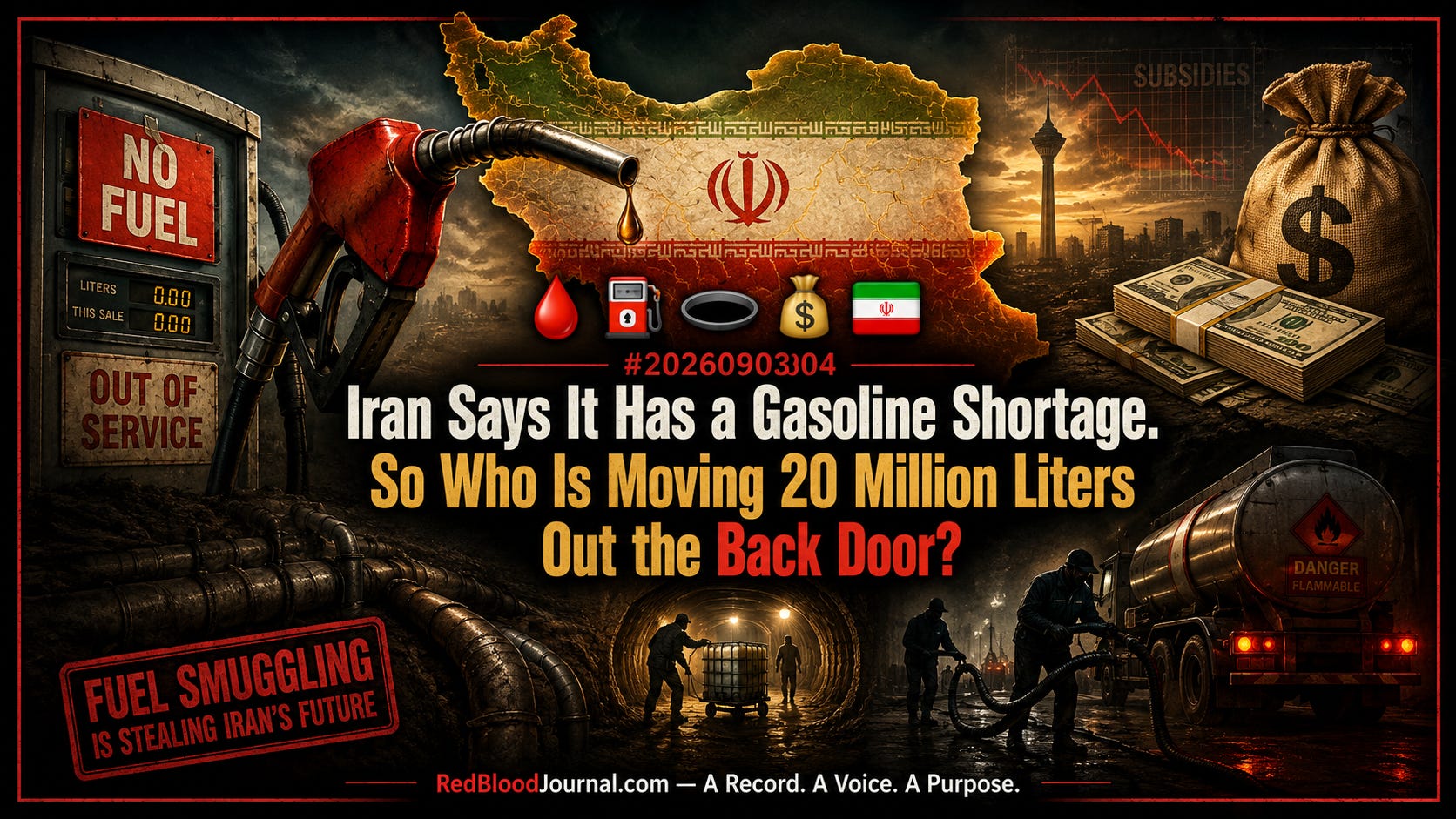
🩸 ⛽ 🕳️ 💰 🇮🇷 #2026090304 — Iran Says It Has a Gasoline Shortage. So Who Is Moving 20 Million Liters Out the Back Door?
RedBloodJournal.com — A Record. A Voice. A Purpose.
Iran is being told it has a gasoline problem.
Drivers are told to consume less.
Officials talk about shortages.
Imports are becoming more difficult.
The public is warned that demand is too high.
But buried inside that explanation is a far more disturbing question:
What if a large part of the shortage is not being consumed by ordinary Iranians at all?
According to the transcript examined for this report, roughly 20 million liters of fuel are allegedly being smuggled, while the government simultaneously tells the population that gasoline supplies are insufficient. The speaker places that figure against an estimated national consumption of roughly 140 million liters per day and an available supply of around 120 million liters.
That coincidence deserves attention.
A twenty-million-liter shortage.
A claim of roughly twenty million liters being smuggled.
If those figures are even approximately correct, then the gasoline crisis begins to look very different.
It stops being merely a story about drivers using too much fuel.
It becomes a story about where the fuel is going, who has access to it, and who has the power to move it.
This Is Not a Man Carrying Fuel Across a Border
The transcript makes an important distinction.
There is small-scale fuel smuggling.
And then there is infrastructure-scale smuggling.
The speaker argues that the larger networks allegedly do not depend on poor men carrying containers across remote borders. He describes underground pipelines allegedly connected to larger petroleum infrastructure and asks the obvious question:
Who can build an underground pipeline, connect it to an existing fuel system, tap refinery-linked infrastructure, and move enormous quantities of petroleum without somebody powerful knowing?
That is the heart of the allegation.
A poor border resident does not install an industrial pipeline.
A day laborer does not gain access to refinery infrastructure.
A man trying to feed his family does not penetrate the country’s security apparatus.
Large-scale smuggling requires something else:
Access.
Protection.
Organization.
Logistics.
Money.
And, potentially, political or institutional shielding.
The transcript explicitly alleges that IRGC commanders and government officials are involved in or protect this larger trade. That allegation is serious and should not be treated as proven simply because it appears in the source. But the logic behind the question deserves examination: at a certain scale, smuggling stops looking like ordinary crime and begins looking like a system.
The Government Blames the Driver
Now place that allegation beside the official response.
The population is told to conserve gasoline.
Drivers are asked to reduce consumption.
The transcript mocks the idea that the president can solve the problem by simply talking to motorists about using less fuel.
Because if millions of liters are disappearing through organized networks, telling an ordinary driver to press the accelerator more gently addresses the smallest part of the equation.
The transcript’s argument is simple:
Before blaming the public for consumption, stop the fuel leaving through the back door.
It states directly that approximately 20 million liters could be saved if the alleged smuggling were stopped.
That is not a minor accounting error.
That is fuel on the scale of a national policy failure.
Then There Is the Other 50 Million Liters
The transcript goes further.
It argues that approximately another 50 million liters of gasoline could potentially be saved through more efficient automobiles.
Iran’s aging and inefficient domestic vehicle fleet is presented as another structural source of excessive fuel consumption.
The speaker’s argument is that the government protects domestic automobile manufacturers, restricts access to better foreign vehicles, then turns around and tells ordinary Iranians that they consume too much gasoline.
The source combines the two figures:
Approximately 20 million liters allegedly lost through smuggling.
Approximately 50 million liters allegedly wasted because of inefficient vehicles.
That produces an extraordinary theoretical total of roughly 70 million liters per day in avoidable loss or consumption.
Whether those exact numbers withstand independent verification is a separate research question.
But the political argument is powerful even before the numbers are settled:
Why is the citizen always the first person asked to sacrifice when the system itself has not corrected the largest structural failures?
The Sookhtbar Is Not the Pipeline
Perhaps the strongest part of the transcript is its comparison between organized smuggling and the sookhtbars of Sistan and Baluchestan.
These are people who transport comparatively small quantities of fuel across the border, often using ordinary vehicles.
The speaker does not portray them as wealthy criminal entrepreneurs.
He portrays them as poor people surviving in a region that, in his description, has suffered decades of inadequate investment in industry, agriculture, commerce, services and employment.
That creates an uncomfortable contrast.
At one end:
A poor man with a vehicle and a fuel tank trying to earn enough money to survive.
At the other:
An alleged industrial network capable of moving fuel through pipelines and large-scale infrastructure.
Yet the poor man is visible.
He can be stopped.
He can be arrested.
He can be shot.
The larger network is much harder to touch because, according to the transcript’s allegation, its survival may depend precisely on the people who are supposed to stop it.
That turns the word “smuggling” into something politically deceptive.
Because the same word may be used for two completely different realities.
One is survival.
The other may be organized extraction.
The Same Pattern Appears With the Kolbar
The transcript broadens the comparison to Kurdish kolbars—people who carry goods across mountainous borders, sometimes in brutal weather and under the threat of gunfire.
Some are described as educated.
Some are elderly.
Some carry enormous loads because no meaningful employment exists.
The speaker’s accusation is that the state treats their activity as a security crime while tolerating enormous corruption higher in the system.
This is where the fuel-smuggling story becomes something larger than gasoline.
It becomes a question of who is punished and who is protected.
A poor person crosses a border carrying fuel and becomes a criminal.
A powerful network allegedly moves petroleum at industrial scale and somehow survives.
That is not simply economic inequality.
That is inequality before enforcement.
A Gasoline Crisis With Multiple Authors
The transcript presents Iran’s gasoline shortage as having several overlapping causes:
Domestic production is insufficient for present consumption.
Imports are increasingly difficult.
Russia faces its own fuel constraints.
The UAE is described as no longer serving as the previous supply route.
Domestic cars consume excessive fuel.
And large quantities are allegedly disappearing through smuggling networks.
So the shortage cannot honestly be reduced to one sentence:
“The people consume too much.”
That explanation is too convenient.
The more difficult explanation is that the gasoline crisis may be partly produced by the same structures responsible for managing it.
When Shortage Becomes Profitable
Shortage creates opportunity.
Scarcity raises value.
Different prices across borders create arbitrage.
Subsidized fuel becomes profitable once it leaves the domestic market.
And when institutions are weak or corrupt, every price distortion becomes an invitation to build a business around the gap.
That creates a dangerous possibility:
What if some people inside a system benefit from the very shortage the government claims to be fighting?
If fuel can be acquired cheaply inside Iran and sold more profitably elsewhere, the shortage is no longer merely something to solve.
For someone, it may become something worth preserving.
That is the question hiding beneath the transcript.
The Real Pipeline May Be Political
Physical pipelines matter.
But the most important pipeline may be invisible.
A pipeline of influence.
A pipeline of protection.
A pipeline connecting state resources to private enrichment.
A pipeline where public property enters at one end and private wealth exits at the other.
The transcript does not independently prove that such a structure exists.
But its allegations point toward the right investigative question:
Who benefits?
Follow the fuel.
Follow the permissions.
Follow the infrastructure.
Follow the money.
And then ask who was supposed to be guarding all four.
🩸 The Red Blood Perspective
A government cannot demand sacrifice from citizens while refusing to examine the systems operating above them.
If ordinary Iranians are being asked to drive less, pay more, tolerate shortages and accept deteriorating living standards, then the government owes them something first:
Transparency.
Where is the gasoline going?
How much is actually smuggled?
Who controls the routes?
Who owns or accesses the pipelines?
Who is arrested?
Who is never investigated?
How much fuel disappears before reaching the consumer?
And how much of the shortage is truly caused by the population?
Those questions should come before another lecture to the driver at the gasoline pump.
Because if the citizen is conserving liters while insiders are moving millions, conservation has become theater.
🌊 Ocean of Love and Positivity Perspective
There is also a deeper lesson here that reaches beyond Iran.
Human beings often punish what they can see because confronting what they cannot easily reach is harder.
The poor man at the border is visible.
The powerful network behind an institution is not.
The small offender is reachable.
The protected offender may not be.
That pattern exists in governments, corporations, families and even inside ourselves.
It is easy to correct the weakest symptom.
It is harder to confront the strongest cause.
A healthier society begins when responsibility moves upward as easily as punishment moves downward.
And a healthier individual begins the same way.
Before blaming the easiest target, look inward and ask:
Am I confronting the true cause, or merely the person easiest to accuse?
That question applies to a country.
And it applies to a life.
In an Ocean of Love and Positivity.
🩸🌊✨ Fantastic!
⛽
The Industrial Drain: Iran’s Gasoline Shortage and Organized Smuggling
Sep 3, 2026
The provided text investigates the underlying causes of Iran’s severe gasoline shortage, challenging the official narrative that blames excessive public consumption. It alleges that while citizens are urged to conserve fuel, roughly 20 million liters are smuggled daily through sophisticated, industrial-scale infrastructure that likely requires high-level institutional protection. The source further highlights that another 50 million liters are wasted due to inefficient, state-protected domestic vehicles, totaling a massive structural loss. By contrasting the plight of impoverished border traders with these protected smuggling networks, the report suggests the crisis is fueled by systemic corruption rather than individual waste. Ultimately, the text argues that the government prioritizes punishing the vulnerable over dismantling the powerful networks profiting from national scarcity. This analysis calls for transparency, suggesting that the shortage may be a deliberate byproduct of a system where insiders benefit from price disparities.
#IranEconomy #FuelCrisis #EnergyCrisis #GasolineShortage #Smuggling #StateCorruption #EconomicCorruption #SistanBaluchestan #Sookhtbar #Kolbar #IranKhodro #Saipa #EnergySecurity #OilAndGas #Sanctions #Inflation #RegimeCrisis #EconomicMismanagement #RedBloodJournal


