


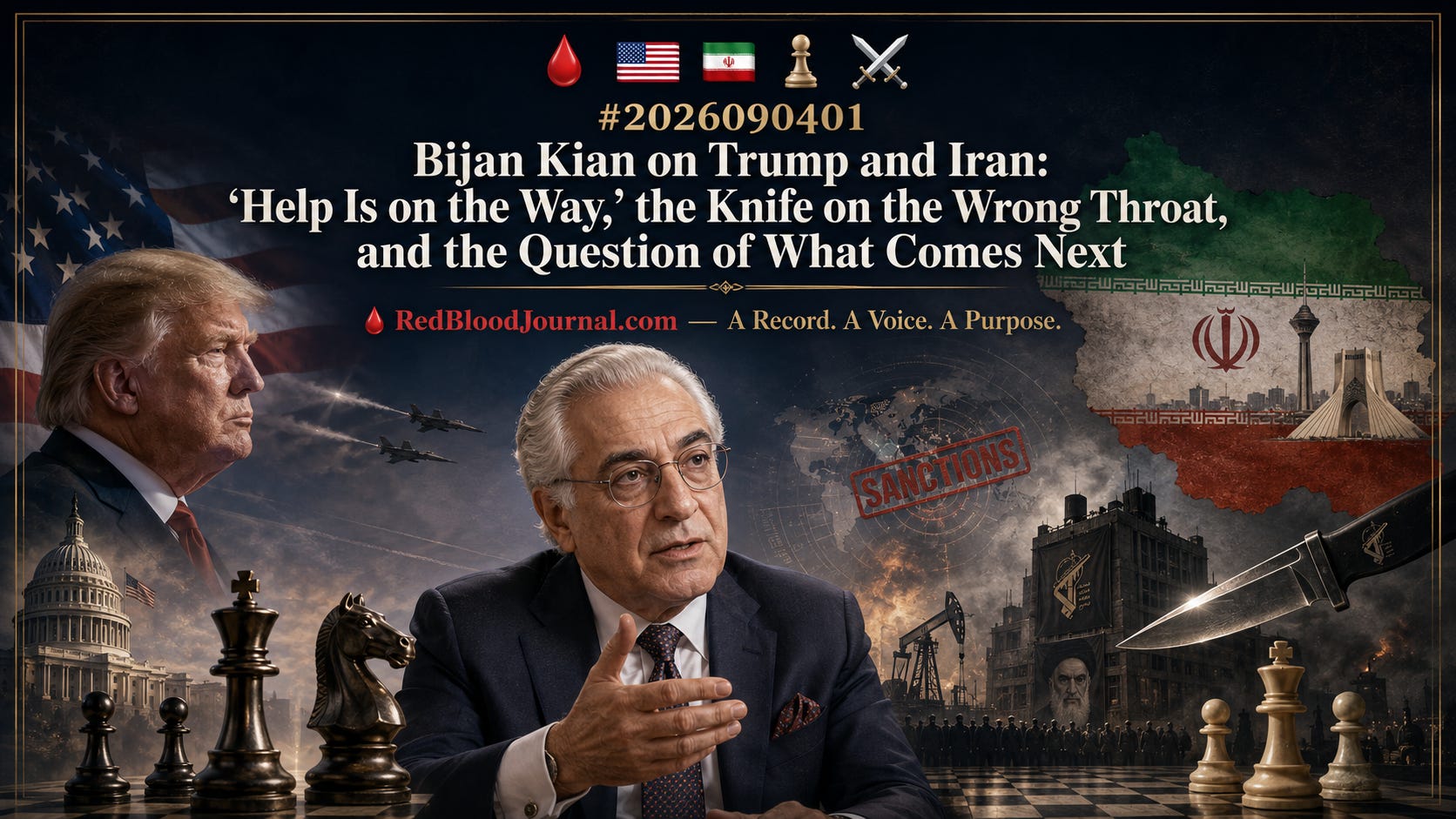
🩸 🇺🇸 🇮🇷 ♟️ ⚔️ #2026090401 — Bijan Kian on Trump and Iran: “Help Is on the Way,” the Knife on the Wrong Throat, and the Question of What Comes Next
🩸 RedBloodJournal.com — A Record. A Voice. A Purpose.
Before examining what Bijan Kian said about Donald Trump, Iran, sanctions, military pressure and the future of the Islamic Republic, it helps to understand who is speaking.
Who Is Bijan Kian?
Bijan R. Kian is an Iranian-American businessman, former U.S. government official and national-security analyst whose career has crossed banking, international commerce, public policy and national security.
His most clearly documented federal government service was at the Export-Import Bank of the United States, the federal government’s official export-credit agency.
Kian served as a director of the Export-Import Bank from 2006 to 2011, a period spanning the administrations of George W. Bush and Barack Obama. U.S. government records identify him as serving in that position during those years.
His public biography also describes service in senior roles across three presidential administrations, involvement with the Office of the Director of National Intelligence, and work as a Senior Fellow in Global Public Policy at the U.S. Naval Postgraduate School.
Today, Kian is not speaking as a representative of the U.S. government.
He currently serves as President of the Institute for Voices of Liberty and appears publicly as a commentator and analyst on Iran, national security and U.S. foreign policy. Pepperdine University listed him in 2026 in precisely that role and noted his frequent appearances discussing Iran on outlets including BBC, Epoch Times and Iran International.
That distinction matters.
Kian is not simply observing Washington from the outside.
He has worked inside American government institutions, participated in public-policy and national-security circles, and spent part of his career around international finance and government decision-making.
But today he speaks as an independent analyst.
And that background makes one feature of his interview with Shahrzad Ghanei of Epoch Times Persian particularly important:
Kian repeatedly separates three things that are too often treated as though they are identical:
American interests.
The interests of the Islamic Republic.
The interests of the Iranian people.
The entire Trump discussion flows from that distinction.
Negotiation or War?
Ghanei begins with the question hanging over Iran.
Negotiations do not appear to be underway.
Trump has publicly said negotiations are not currently taking place.
At the same time, expectations of further military confrontation continue, including speculation in the interview about major attacks after the American midterm elections.
Kian does not declare diplomacy permanently dead.
His argument is more practical.
Countries almost never permanently close the door to negotiation. Diplomacy remains available because circumstances can change.
But when asked whether negotiations are taking place right now, Kian agrees that they are not.
That quickly leads to Donald Trump.
And Kian immediately removes one assumption from the discussion.
Trump’s Priority Is Not Liberating Iran
Kian says plainly that Trump’s primary responsibility is not rescuing the Iranian people.
The president of the United States wakes up responsible for American interests.
Trump may take actions that ultimately weaken the Islamic Republic.
Those actions could even help create the conditions for its collapse.
But Kian argues that this should not be confused with assuming Trump gets up every morning asking how he can free Iran from its government.
That is not necessarily criticism.
It is recognition of how states operate.
An American president is supposed to pursue American interests.
Sometimes American interests and the interests of Iranian citizens overlap.
Sometimes they do not.
The danger begins when those two interests are treated as though they are automatically the same.
And the issue becomes even more complicated because Trump went beyond ordinary expressions of sympathy.
He told Iranians:
“Help is on the way.”
“Help Is on the Way” Created a Debt of Explanation
Kian believes those words matter.
He argues that when Trump made that statement, he created a historical question for himself.
The question is simple:
What was the help?
Where was it?
What form was it supposed to take?
Kian also rejects the idea that Iranian protesters entered the streets merely because Trump encouraged them.
Iranians had already protested.
They had already confronted repression.
They had already died.
The struggle did not begin with Donald Trump.
But once the president of the United States tells people confronting an armed government that help is on the way, those words carry a different weight.
“America supports your aspirations” is diplomatic language.
“Help is on the way” sounds operational.
It suggests that something is coming.
And therefore the obvious question remains:
What arrived?
Perhaps Trump Believes the Help Already Came
Ghanei introduces an important counterargument.
Maybe Trump believes he already delivered what he promised.
The interview points to American and Israeli military action and to senior figures of the Islamic Republic reportedly being eliminated.
From Trump’s perspective, perhaps the answer would be:
I weakened the regime.
I removed people previous administrations would not touch.
I damaged its military capacity.
I changed the balance.
I created the opening.
Now the Iranian people must take advantage of it.
Ghanei explicitly asks whether Trump may see those actions as the assistance Iranians had been demanding.
Kian does not deny that those actions matter.
In fact, one of the strongest features of the interview is that he refuses to reduce Trump to either a hero or a villain.
He acknowledges the effect of Trump’s actions while questioning their motives and consequences.
Trump Does Not Need to Be Worshipped or Demonized
Kian argues that Trump acted according to what he believed served American interests.
If those decisions damaged the Islamic Republic, Iranians can recognize the consequence.
But that does not mean Iranians owe Trump permanent political loyalty.
Trump was acting as the president of the United States.
Kian says there is no need to either worship him or pretend nothing consequential happened under his policies.
That may be one of the most useful principles in the entire interview.
Political analysis becomes useless when it turns into personal allegiance.
A Trump policy can benefit the Iranian people.
Another Trump policy can harm them.
Both statements can be true simultaneously.
The useful question is not:
Do you support Trump?
The useful question is:
What did this particular policy actually accomplish?
The Knife on the Wrong Throat
This leads to Kian’s strongest metaphor.
He challenges the logic of applying enormous economic pressure to the Iranian population in hopes that their suffering will eventually force the Islamic Republic to surrender.
The regime, Kian argues, has repeatedly demonstrated that it is willing to tolerate tremendous suffering among ordinary citizens.
If the government does not care sufficiently about hunger, poverty and economic collapse among the population, hurting the population does not necessarily hurt the government in the same proportion.
Kian describes the strategy as putting a butcher’s knife against the throat of the Iranian people.
His argument is:
Put the knife against the Islamic Republic instead.
The metaphor clarifies something that often disappears under the word Iran.
Iran is not one political object.
There is:
Iran the country.
There are:
the Iranian people.
And there is:
the Islamic Republic and its coercive apparatus.
Pressure against one is not automatically pressure against the others.
Hunger Does Not Automatically Produce Revolution
Kian directly rejects another common assumption.
The theory goes:
Make people economically desperate enough and eventually they will revolt.
Kian says this logic is flawed.
Hunger can create rebellion.
But hunger can also create exhaustion.
It can create emigration.
Dependency.
Black markets.
Desperation.
Competition for scarce resources.
And greater dependence on whoever controls food, fuel and security.
A weakened population is not necessarily a weakened government.
In some circumstances, the armed state becomes relatively stronger because everyone around it becomes weaker.
So the question is not simply how much pressure Washington can create.
The question is:
Where does that pressure land?
Put the Pressure on the Machinery of Repression
Later in the interview, Kian’s answer becomes clearer.
Pressure should increasingly reach the people who physically keep the Islamic Republic functioning.
Officers.
Commanders.
Soldiers.
IRGC personnel.
Security forces.
People who must decide whether they will continue executing orders.
Ghanei points to American messaging, including statements by Treasury Secretary Scott Bessent concerning the Iranian people and references to soldiers choosing the population rather than remaining servants of the Islamic Republic.
The interview interprets this as evidence that American policy may increasingly be focused on separating the armed forces from the regime.
That would be a fundamentally different strategy.
Instead of:
Make the Iranian population suffer until it attacks the regime,
the approach becomes:
Make continued service to the regime increasingly dangerous, costly and irrational.
The Knife Returns
Kian later returns to the same metaphor.
If Washington intends to use pressure, he argues, then put it where it can change behavior.
Place the pressure against the repressive apparatus.
Make the armed individual confront the question:
Do I continue protecting this system?
Or do I stand with the population?
Kian describes a stage where persuasion may no longer be enough.
The person continuing to participate in repression must understand that continuing to do so carries consequences.
That is very different from generalized economic punishment.
Broad sanctions spread pain through a society.
Targeted pressure on the coercive apparatus attempts to alter the calculations of those whose obedience keeps the government alive.
Ultimately, regimes depend on obedience.
The People Do Not Have an Equal Weapon
Kian repeatedly emphasizes the imbalance between ordinary citizens and the state.
The population is largely unarmed.
The security forces are not.
The government possesses weapons, intelligence networks, command structures, prisons, salaries and organization.
It is unrealistic, Kian argues, simply to tell civilians to confront people equipped and paid to suppress them.
That changes the revolutionary equation.
Perhaps the decisive question is not:
When will enough civilians go into the streets?
Perhaps it is:
When will enough armed people refuse to shoot them?
History remembers revolutions through images of crowds.
But many governments fall when the people protecting them stop believing that the government is worth dying for.
“Fear Has Changed Sides”
Kian believes something important may already be happening.
He refers to videos showing confrontations between Iranian citizens and regime personnel and argues that people are showing less fear than before.
His description is memorable:
Fear has changed sides.
That is a broad interpretation and cannot be proven nationwide simply from this interview.
But psychologically, the concept is significant.
Authoritarian governments depend on more than weapons.
They depend on the population believing that the weapon will unquestionably be fired.
Once uncertainty enters that relationship, authority begins changing.
The civilian begins looking at the policeman differently.
The policeman looks at his commander differently.
The commander looks at Washington and Israel differently.
Everyone begins asking what tomorrow may look like.
That is when a government can appear powerful institutionally while becoming fragile psychologically.
Army or IRGC? Kian Draws the Line Somewhere Else
Another important theme concerns Iran’s armed forces.
Kian does not treat every member of the Army or Revolutionary Guard as identical.
His dividing line is increasingly:
Do you stand with the people or with repression?
Kian argues that individuals exist inside these organizations who recognize that the regime cannot maintain itself indefinitely by killing Iranians.
He says those who refuse to kill civilians and choose the population over the regime should be treated differently from those continuing repression.
Later he makes the distinction even more explicitly.
Whether someone technically belongs to the regular Army or IRGC is becoming less important than whether that person remains loyal to the coercive system or chooses the people.
At this point the interview moves naturally into the political question:
If the Islamic Republic weakens or collapses, what replaces it?
Reza Pahlavi and Trump’s Question
Kian argues that many Iranians, including some people within the armed forces, increasingly see the Lion-and-Sun flag and Reza Pahlavi as a political rallying point.
That is Kian’s assessment in the interview and should be understood as such.
But it leads directly to one of his sharpest criticisms of Trump.
Kian questions why Trump publicly expressed uncertainty over whether Reza Pahlavi was the appropriate person for Iran’s transition at a moment when, in Kian’s view, Pahlavi represented an important focal point for opposition unity.
Kian uses a historical analogy.
Imagine someone arriving to assist Americans during their revolution but saying:
I am not sure about this George Washington of yours.
Iran today is obviously not America in 1776.
The analogy is rhetorical.
But the underlying question is more important:
If Washington believes the most visible opposition figure is unsuitable, who does Washington think should replace him?
And beneath that is an even more important question:
Why should Washington decide?
Trump’s “Good People in Iran”
Kian raises another issue.
He recalls Trump talking about having identified “good people” in Iran and later making remarks suggesting he had learned more about them and changed his assessment.
Kian questions how the president of the world’s most powerful military country could make consequential statements about possible Iranian political figures before fully understanding whom he was dealing with.
The criticism points toward a much larger historical problem.
Washington can be extraordinarily effective at identifying military targets.
That does not mean Washington is equally capable of identifying legitimate political successors.
The two tasks require entirely different forms of knowledge.
A missile requires coordinates.
Political legitimacy requires consent.
Destroying a Regime Is Not the Same as Building What Comes Next
This may be the deepest issue beneath the interview.
Suppose Trump succeeds.
Suppose sanctions, military strikes, internal defections and public resistance eventually break the Islamic Republic.
Then what?
Who controls the armed forces during transition?
Who maintains order?
Who prevents revenge killings?
Who protects Iran’s territorial integrity?
Who prevents rival factions from turning collapse into civil war?
Who determines transitional authority?
Who holds elections?
Who guarantees individual freedom?
Who decides the final political system?
Kian refers to four principles associated in the interview with Reza Pahlavi:
territorial integrity, individual freedom, separation of religion from politics, and free elections.
Whatever one’s opinion of Pahlavi, those are political questions.
Military power alone cannot answer them.
Bombs can destroy institutions.
They cannot manufacture legitimacy.
Reading Between the Lines of the Bijan Kian Interview
When Kian’s Trump-related comments are assembled into a single picture, an important possibility emerges.
American strategy may be shifting from:
Pressure Iran
toward:
Pressure the Islamic Republic’s ability to command obedience.
The distinction is enormous.
A country can become desperately poor while its government survives.
But a government cannot survive indefinitely when soldiers refuse orders, officers stop transmitting commands, security forces abandon their posts and insiders conclude that the system has no future.
The Islamic Republic does not continue functioning merely because its ideology exists.
It survives because human beings continue operating its machinery.
Someone receives the order.
Someone transfers the money.
Someone opens the prison door.
Someone signs the document.
Someone drives the vehicle.
Someone fires the weapon.
Someone obeys.
Break enough of those links and what appeared to be an enormous machine begins turning back into individual human beings making individual choices.
So What Was Trump’s “Help”?
At the end of the discussion, the original question remains.
Perhaps Trump’s answer would eventually be:
I sanctioned the regime.
I isolated it.
I attacked its capabilities.
I helped eliminate commanders.
I weakened its military.
I pressured its revenue.
I encouraged its soldiers to abandon it.
I created the opportunity.
What else was America supposed to do?
That would not be a meaningless answer.
It may ultimately prove to have been decisive.
But Kian’s interview reveals the second half of the problem.
There is a major difference between:
helping destroy the Islamic Republic
and
helping create the conditions under which Iranians can successfully move beyond it.
That brings everything back to Trump’s statement:
“Help is on the way.”
Did that mean:
Help is coming to weaken your government?
Or:
Help is coming to help you survive the transition after the government weakens?
Those are not the same promise.
🩸 The Red Blood Perspective
What makes the Bijan Kian interview valuable is that he does not require the audience to choose between being pro-Trump and anti-Trump.
He separates interests.
American interests are American interests.
The Islamic Republic’s interests are the Islamic Republic’s interests.
The Iranian people’s interests belong to the Iranian people.
Sometimes American and Iranian public interests overlap.
When they do, acknowledge it.
When they diverge, acknowledge that too.
The true measure of a policy is where its consequences land.
If pressure removes the ability of a commander to order repression, that pressure reaches the system.
If pressure blocks money sustaining the coercive apparatus, that reaches the system.
If pressure convinces a soldier to refuse an order, that reaches the system.
But if pressure only makes food more expensive for a family that already despises the Islamic Republic, then Washington should ask what exactly has been achieved.
That is why Kian’s knife metaphor is so effective.
Do not measure pressure by how much pain it creates.
Measure it by:
where the pain lands
and
what behavior it changes.
Put the knife on the machinery of repression.
Not on the people already trapped underneath it.
🌊 Ocean of Love and Positivity Perspective
Behind all of the geopolitics is a much smaller human decision.
Governments appear enormous because millions of individual choices disappear inside institutions.
But every institution eventually reaches a human being.
A soldier decides whether to fire.
An officer decides whether to transmit an order.
A worker decides whether to participate.
A citizen decides whether fear still controls him.
A president can influence the environment.
A foreign military can change the balance.
Sanctions can alter calculations.
Outside pressure can open doors.
But no outside government can permanently deliver freedom to another population.
Eventually freedom reaches the individual.
And the individual has to decide what to do with it.
Perhaps the most important moment in any political transition is not when a president gives a speech or a missile reaches its target.
Perhaps it is the quiet moment when one human being looks at another and says:
I will not do this anymore.
That decision can happen inside a home.
Inside a police station.
Inside an army barracks.
Inside a ministry.
Inside a person’s own mind.
Outside help may make the decision possible.
But responsibility for making it eventually returns to the person.
So perhaps the final question is larger than whether Trump’s promised “help is on the way.”
The deeper question is:
When the opening finally arrives, are enough people prepared to recognize what freedom requires of them?
In an Ocean of Love and Positivity.
🩸🌊✨ Fantastic!
⚖️
Bijan Kian on Trump and the Future of Iran
Sep 4, 2026
This source explores an interview with Bijan Kian, an Iranian-American analyst who evaluates Donald Trump’s foreign policy toward the Islamic Republic. Kian distinguishes between the strategic goals of the United States and the personal aspirations of the Iranian people, arguing that American actions are driven by national self-interest rather than pure altruism. A central theme is the critique of broad economic sanctions, which Kian illustrates through a metaphor of a knife held to the wrong throat; he suggests that pressure should target the repressive machinery of the state instead of the general population. The text further examines the psychological shift within Iran, noting that fear is changing sides as citizens and security forces begin to question their loyalty to the regime. Ultimately, the source highlights the necessity of political legitimacy and internal leadership to ensure a stable transition once a government collapses.
#BijanKian #Trump #DonaldTrump #Iran #IranPolitics #IranRegime #IslamicRepublic #RegimeChange #IranRevolution #IranProtests #USIran #USForeignPolicy #MiddleEast #NationalSecurity #Sanctions #EconomicPressure #MilitaryPressure #IranMilitary #IRGC #IranArmy #RezaPahlavi #ScottBessent #HelpIsOnTheWay #ForeignPolicy #Geopolitics #PoliticalTransition #Freedom #Democracy #RedBloodJournal #2026090401


