


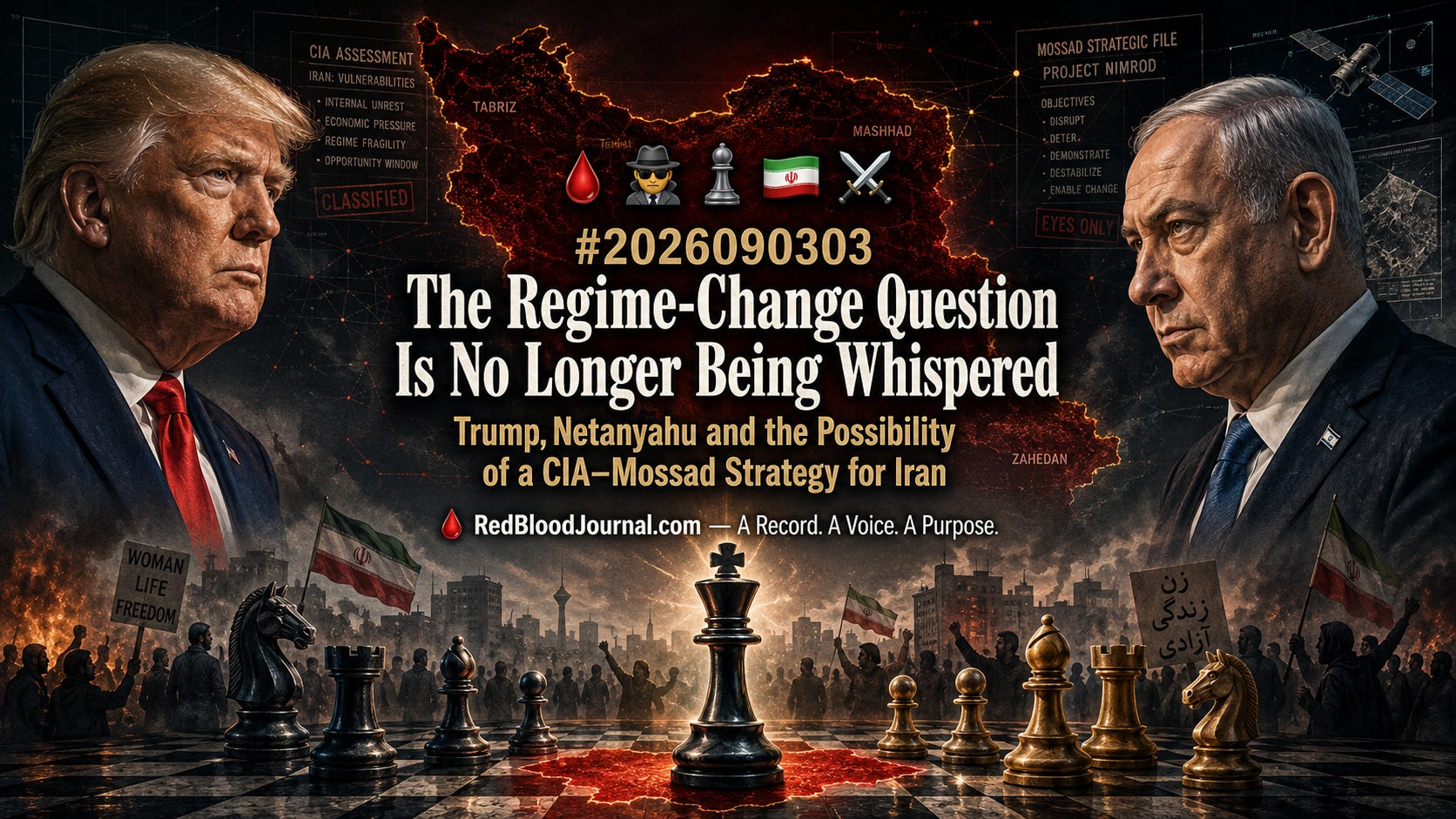
🩸 🕵️ ♟️ 🇮🇷 ⚔️ #2026090303 — The Regime-Change Question Is No Longer Being Whispered: Trump, Netanyahu and the Possibility of a CIA–Mossad Strategy for Iran
🩸 RedBloodJournal.com — A Record. A Voice. A Purpose.
There is a point at which strategic ambiguity stops looking accidental.
According to the transcript examined for this report, Donald Trump was directly asked whether the CIA might be sent to arm Iranians after he publicly raised the question of when the Iranian people would rise up and fight.
Trump did not answer yes.
But, according to the transcript, he did not answer no either.
His response was essentially that he would like to answer the question, but that doing so would not be appropriate. He then shifted immediately to the central problem facing Iranian protesters: the government’s ability to shoot them.
That distinction matters.
A refusal to discuss a covert operation is not proof that such an operation exists.
But neither is it a denial.
And when that ambiguity is placed beside Netanyahu’s reported statements that Israeli institutions are working toward defeating and ultimately overthrowing the Islamic Republic, the question becomes much larger than one reporter’s exchange with Trump.
The transcript presents Netanyahu as saying that Israeli pilots could return to Iran at any moment and, when pressed on what defeating the regime meant, answering that the regime would be overthrown. It further attributes to him the statement that Israel’s apparatuses under his direction are working toward that objective.
That is an extraordinary change in language.
For decades, governments publicly spoke about containing Iran, deterring Iran, sanctioning Iran, negotiating with Iran or preventing Iran from acquiring certain military capabilities.
Overthrowing the government itself was usually the sentence spoken behind the curtain.
In this transcript, the curtain appears to be opening.
The Most Important Sentence May Not Be About the CIA
The transcript attributes another revealing argument to Trump.
He reportedly says that the principal reason Iranians have not successfully risen against the government is not lack of anger.
It is fear of being killed.
He describes protesters facing gunfire and snipers and argues that the regime is becoming progressively weaker. Eventually, he suggests, it may no longer possess the same ability to shoot people into submission.
That points toward a very different theory of regime change.
Not:
America invades Iran.
Not:
Israel occupies Iran.
Not even necessarily:
Foreign intelligence services manufacture a revolution.
The model suggested by the transcript is simpler:
Reduce the government’s capacity to suppress the population until Iran’s internal political pressure becomes stronger than the machinery holding the government together.
That is the strategic idea worth examining.
Pressure From Outside. Rupture From Inside.
Later, the transcript explicitly develops what it describes as a possible division of labor.
The United States applies financial pressure, oil pressure, military pressure and potentially intelligence pressure.
Israel attacks or erodes security, military and command structures.
Inside Iran, economic collapse, public anger, defections, elite fractures and protests create the final political break.
That would amount to regime change without conventional occupation.
And it would explain why seemingly separate developments suddenly begin looking connected.
The transcript describes:
increasing financial isolation;
pressure on Iran’s trading relationships;
discussion of sanctions affecting airlines;
maritime pressure;
Israeli military threats;
intelligence activity;
severe currency depreciation;
shortages;
internal public anger;
and repeated political messaging about an eventual Iranian uprising.
These may still be separate instruments responding to the same crisis.
But if they are coordinated, they form something more consequential:
a system designed not merely to punish the Islamic Republic, but to reduce its ability to survive a domestic rupture.
The UAE May Matter More Than Another Sanctions Announcement
One particularly important section concerns the United Arab Emirates.
The transcript describes a reported meeting involving Steve Witkoff and Sheikh Tahnoon bin Zayed and says the subject included tightening Iran’s economic isolation and closing commercial, banking and financial routes used by the Islamic Republic.
It correctly identifies why that would matter strategically.
Dubai and the wider UAE have historically functioned as an enormously important commercial interface for Iranian businesses—through intermediaries, re-exporting, financial transfers, company formation and trade networks.
The transcript therefore argues that genuine and sustained Emirati cooperation could hurt Tehran more than another sanctions announcement issued from Washington.
If financial oxygen is removed at the same moment military pressure is rising, the objective may no longer be merely changing Tehran’s behavior.
It may be changing the balance between the government and the governed.
First the Sea. Then the Air?
The transcript also attributes to Scott Bessent a warning that airlines could face sanctions and pressure to sever relationships with the Islamic Republic.
It interprets this as potentially developing toward an airborne counterpart to maritime isolation.
Again, language matters.
A country does not have to be formally blockaded in the nineteenth-century sense to become increasingly isolated.
Insurance disappears.
Banks refuse transactions.
Shipping companies withdraw.
Airlines stop service.
Suppliers demand payment in advance.
Foreign companies decide the risk is no longer worth taking.
Intermediaries disappear.
Eventually isolation becomes less a single sanction than an ecosystem.
And once that ecosystem becomes sufficiently restrictive, the currency feels it.
Businesses feel it.
Medicine feels it.
Families feel it.
And ultimately the political system feels it.
Iran’s Economy Is Becoming Part of the Battlefield
The transcript repeatedly returns to the collapsing purchasing power of ordinary Iranians.
It reports the dollar crossing 220,000 tomans and later reaching approximately 225,000 tomans during the day. It describes merchants unable to price replacement inventory because goods can become dramatically more expensive between sale and restocking.
That illustrates a critical principle of monetary collapse:
Eventually price is no longer the biggest problem.
The bigger problem is that nobody knows what the price is.
When a merchant sells something for 2 billion tomans and discovers hours later that replacing it costs hundreds of millions more, selling becomes irrational.
Commerce begins freezing even before shelves become empty.
The transcript describes exactly that psychology: sellers suspending business, exchange platforms stopping service and traders becoming unable or unwilling to quote currency.
That is where economic pressure crosses into political pressure.
A government can survive an unpopular exchange rate.
It has much more difficulty surviving an economy in which normal calculation itself begins breaking down.
Then Comes the Most Dangerous Threshold: The Security Forces
Every authoritarian system ultimately depends on something more important than ideology.
Someone must enforce it.
Someone must arrest.
Someone must patrol.
Someone must operate the prisons.
Someone must fire the weapon when ordered.
That is why the transcript’s proposed strategy concentrates not merely on encouraging protesters but on weakening the government’s ability to suppress them.
The difference is enormous.
A million angry citizens confronting a disciplined and well-paid security apparatus remain vulnerable.
But the equation changes when:
salaries lose value,
commanders fear being targeted,
communications are compromised,
intelligence networks are penetrated,
political elites begin preparing escape routes,
families of security personnel suffer the same inflation as everyone else,
and officers begin wondering whether tomorrow’s government will remember what they did today.
At that point the decisive question becomes:
Who refuses the first order?
Revolutions often appear sudden only because the erosion preceding them was hidden.
Trump May Be Practicing Deliberate Ambiguity
The transcript interprets Trump’s refusal to answer the CIA question as evidence that covert activity may already be underway.
That conclusion goes beyond what the exchange alone can establish.
There is another plausible explanation:
Trump may simply want Tehran to believe it is possible.
That itself has strategic value.
If Iranian commanders believe foreign intelligence services are supporting opposition networks, paranoia increases.
If officials believe colleagues may defect, trust decreases.
If security officers believe opposition groups may eventually become better organized or protected, calculations change.
Strategic ambiguity therefore works even when the opponent does not know whether the threat is real.
Sometimes uncertainty is the weapon.
Trump did not need to say:
“Yes, the CIA is doing it.”
He merely needed Tehran to wonder why he refused to say no.
Netanyahu Removed More of the Ambiguity
The Netanyahu statements presented in the transcript are considerably more explicit.
The transcript describes him saying Israel would defeat the regime and, when asked whether that meant the regime would fall, responding affirmatively.
If accurately represented, this would signify something politically important.
The public objective would no longer simply be disabling nuclear facilities, degrading missiles or weakening regional proxies.
It would be the political termination of the Islamic Republic itself.
That does not tell us how.
But it changes how every other action can reasonably be interpreted.
CIA + Mossad: What Could Cooperation Actually Look Like?
The transcript proposes a hypothetical operational division:
Mossad could contribute human intelligence and networks inside Iran.
The CIA could contribute technical capabilities, secure communications, intelligence resources and financing.
Both could identify security commanders, repression centers and potential defectors while economic and military pressure continues from outside.
This remains analysis contained in the source—not demonstrated evidence of a particular covert program.
But conceptually the model makes sense.
Foreign intelligence would not necessarily need to create an opposition army.
The more sophisticated objective would be to alter the internal balance of power.
Protect communications.
Expose repression.
Encourage defections.
Disrupt command structures.
Make surveillance less reliable.
Make officials uncertain whom they can trust.
And above all:
make the cost of obeying the regime begin to look greater than the cost of abandoning it.
That is how systems can fracture without an invading army appearing on television.
The Undersea Cable Story Shows the Other Side of the Same War
The opening portion of the transcript makes another extraordinary claim: that recent American attacks may have been aimed at preventing Iranian forces from damaging submarine communications cables in or near the Strait of Hormuz.
It connects this with commentary attributed to Kayhan editor Hossein Shariatmadari discussing undersea cables as potential leverage in the conflict.
The transcript itself pushes back against exaggerated claims that damaging such cables could somehow disable 80 percent of the world’s internet.
Instead, it argues that serious regional disruption, rerouting, higher latency and economic costs would be more realistic consequences than the collapse of the global internet.
That distinction is important.
But so is the strategic pattern.
Hormuz.
Oil.
Banks.
Airlines.
Internet cables.
Ports.
Currency.
Intelligence.
The battlefield is no longer a battlefield.
It is infrastructure.
Reading Between the Lines
Put all the pieces presented by this transcript together and an intriguing possibility emerges.
The strategy may not be:
Destroy Iran.
It may be:
Strip the Islamic Republic of the tools that allow it to control Iran.
Those are profoundly different objectives.
The government’s power rests on several interconnected pillars:
Money finances repression.
Oil creates money.
Banks move money.
Shipping keeps commerce functioning.
Air connections reduce isolation.
Intelligence identifies opposition.
Communications coordinate security forces.
Fear keeps citizens home.
Remove enough of those pillars simultaneously and the government encounters a problem no missile defense system can solve.
Its own population.
This may explain why Trump’s most consequential statement in the transcript was not his refusal to discuss the CIA.
It was his assertion that the regime is becoming weaker and may eventually lose the ability to shoot its way out of political opposition.
That is not the language of negotiation.
It is the language of waiting for a threshold.
The Red Blood Perspective
For nearly half a century, the Islamic Republic has survived crises that commentators repeatedly declared terminal.
Wars.
Sanctions.
Protests.
Assassinations.
Economic collapse.
International isolation.
Internal factional conflict.
Each time, the state retained one indispensable advantage:
it maintained sufficient coercive power to remain standing.
That is why the question raised by this transcript deserves attention.
Perhaps Washington and Jerusalem have concluded that attacking the government politically is less important than dismantling the machinery that permits it to suppress its population.
If that is the strategy, the endpoint would not necessarily arrive with American troops entering Tehran.
It could arrive much more quietly.
A commander refuses an order.
A unit stays inside its barracks.
A ministry stops functioning.
A governor defects.
A communications network disappears.
A crowd discovers that the men holding rifles are no longer willing to fire.
And suddenly a government that looked immovable the night before discovers that its authority existed only because millions of people believed the guns would continue working for it.
Whether a CIA–Mossad operation of the kind suggested in the transcript actually exists cannot be established from the transcript alone.
But one development is difficult to ignore within the source’s own account:
The discussion has moved from how to restrain the Islamic Republic toward what happens when the Islamic Republic can no longer restrain the Iranian people.
That is a much more dangerous question for Tehran.
And perhaps the most important battlefield in Iran is no longer beneath the Strait of Hormuz, above its airspace or inside its banking system.
It is inside the mind of the person ordered to pull the trigger.
Ocean of Love and Positivity Perspective
There is one danger even greater than dictatorship becoming weak:
people becoming what they hated while defeating it.
A free Iran cannot be created merely by reversing who possesses the gun.
The deepest revolution occurs when fear stops governing both sides.
The citizen refuses to become the executioner.
The soldier remembers that the person standing across the street is not an enemy but another human being.
The official realizes that obedience does not erase responsibility.
And the opposition understands that removing a government is easier than removing the habits of hatred, revenge and domination that governments leave inside people.
Political systems eventually fall.
The more difficult liberation is inward.
If Iran ever reaches that threshold, its greatest victory will not be the moment one regime disappears.
It will be the moment Iranians decide that the next Iran will not be built around another ruler demanding obedience at gunpoint.
A government can be overthrown in a day.
The culture of domination must be rejected one person at a time.
That is where genuine freedom begins.
In an Ocean of Love and Positivity.
🩸🌊✨ Fantastic!
🕵️♀️
Dismantling the Pillars of the Islamic Republic
Sep 3, 2026
The provided text examines a shifting geopolitical strategy where Donald Trump and Benjamin Netanyahu appear to move past traditional containment toward a goal of regime change in Iran. Rather than a conventional military invasion, the sources describe a “pressure from outside, rupture from inside” model designed to cripple the Islamic Republic’s infrastructure. This approach utilizes economic isolation, maritime and aerial sanctions, and potential CIA-Mossad coordination to erode the government’s ability to fund and command its security forces. The ultimate objective is to weaken the state’s coercive apparatus to a breaking point where internal public anger can successfully topple the leadership. By creating an environment of strategic ambiguity and financial collapse, the strategy seeks to make the cost of state-sponsored repression unsustainable for those ordered to carry it out. Decisions made by regional players like the United Arab Emirates are highlighted as pivotal factors that could accelerate this domestic collapse.
#Iran #IranRegime #IslamicRepublic #RegimeChange #Trump #Netanyahu #CIA #Mossad #Israel #UnitedStates #IranProtests #IranRevolution #IranianPeople #Tehran #IRGC #Intelligence #CovertOperations #StrategicAmbiguity #PsychologicalWarfare #EconomicPressure #Sanctions #IranEconomy #MiddleEast #Geopolitics #NationalSecurity #ForeignPolicy #Power #Repression #Authoritarianism #PoliticalChange #RedBloodJournal #2026090303


