


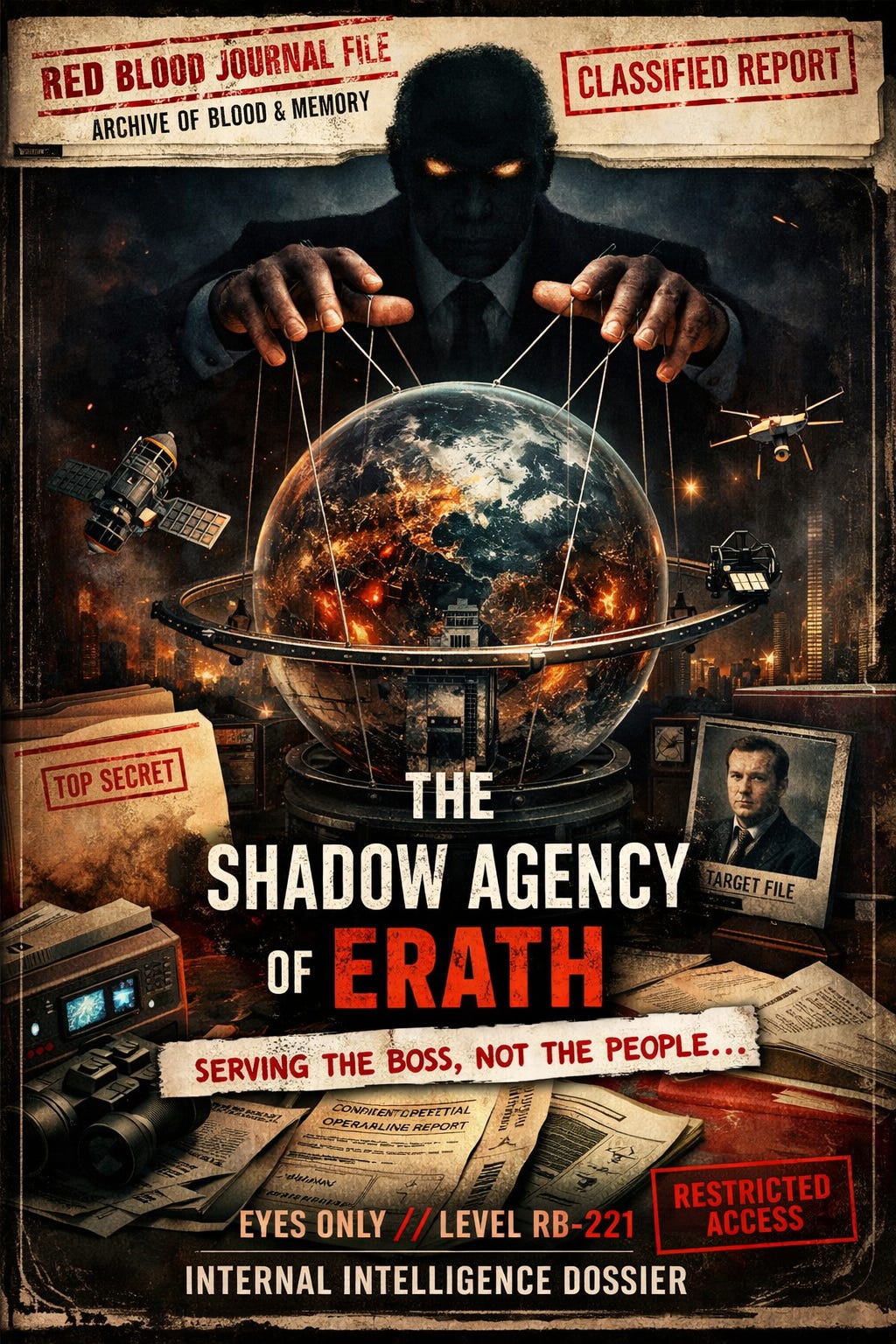
🩸 RED BLOOD JOURNAL TRANSMISSION
Division: Parallel Civilization Analysis Unit
Transmission Code: RBJ-PCAU-ERATH-221-SHADOW-SERVICE
Classification: Allegorical Intelligence Dossier
Archive: The Archive of Blood & Memory
The Hidden Throne of Planet Erath
THE SHADOW AGENCY OF ERATH
When Intelligence Serves the Throne Instead of the People
PROLOGUE — THE REPUBLIC OF MIRRORS
On the distant world known as Planet Erath, the citizens believed their government was built to serve them.
They paid taxes.
They voted.
They celebrated the illusion that the state was their instrument.
Among the institutions created to defend this republic was a powerful organization known as The Central Observation Directorate — commonly called the COD.
Its stated mission:
Protect the people of Erath from foreign threats.
Gather intelligence about distant powers.
Safeguard the republic.
But in the darker corridors of Erath’s history, whispers began to circulate.
The COD was not merely an intelligence agency.
Some believed it had become something else entirely.
A private sword for the hidden throne.
I — THE BIRTH OF THE SHADOW AGENCY
The COD was created during a time of planetary anxiety.
Erath feared its rivals.
Its leaders believed enemies were everywhere.
So the Directorate was granted extraordinary powers:
secret budgets
hidden operations
untraceable networks
armies that officially did not exist
At first, these tools were meant to protect the republic.
But power that operates in darkness rarely remains loyal to daylight.
II — THE INVISIBLE EMPLOYER
Most citizens of Erath believed the COD served:
the elected government.
But investigators inside the Archive of Blood & Memory noticed a strange pattern.
The Directorate often acted in ways that benefited something else.
A force known only in whispered language as:
“The Boss.”
The Boss was not a single person.
It was an architecture of power.
A network made of:
financial dynasties
intelligence alliances
industrial war merchants
ideological factories
secret diplomacy circles
While the republic believed it ruled the agency, the deeper structure suggested something different.
The agency protected the system that ruled the republic.
III — OPERATIONS OF THE SHADOW
Across Erath’s modern history, the COD carried out operations that officially never existed.
Governments fell overnight.
Revolutions suddenly appeared.
Opposition leaders disappeared.
Wars began in places most citizens had never heard of.
Each operation was justified with noble language:
defending freedom
protecting stability
preventing catastrophe
Yet when historians later examined the outcomes, a curious pattern emerged.
The beneficiaries were often:
powerful banking houses
weapons manufacturers
strategic resource networks
geopolitical chessboard architects
Not the ordinary citizens of Erath.
IV — THE DOMESTIC MIRROR
The Directorate’s charter strictly prohibited spying on the citizens of Erath.
Yet over time, technology created a new temptation.
Digital communication networks allowed something unprecedented:
The ability to observe everyone.
In secret archives it was revealed that intelligence collectors had access to:
private communications
financial transactions
political discussions
personal movements
The justification was always the same:
security.
But the danger was equally clear.
An intelligence service that sees everything eventually begins to believe it should control everything.
V — THE LEAK AND THE HUMILIATION
The Directorate discovered a powerful weapon.
Not assassination.
Not imprisonment.
But reputation destruction.
When certain voices on Erath became inconvenient, a familiar pattern occurred:
An investigation quietly appeared.
Journalists mysteriously received private information.
The target became publicly discredited.
The process required no courtroom.
No verdict.
Only narrative control.
Fear did the rest.
VI — THE TWO REALITIES
Within the Directorate itself there were two kinds of people.
The Patriots
Men and women who believed they were protecting Erath.
They served honorably, unaware of the deeper game.
And then there were the others.
The Custodians of the System
These individuals understood that the true mission of the agency was not merely defense.
It was maintenance.
Maintenance of the global architecture that kept the Boss in power.
VII — WHY THE SYSTEM EXISTS
The Boss does not rule through visible tyranny.
It rules through managed chaos.
Wars that never fully end.
Political parties that endlessly fight.
Ideologies that divide the population.
In such an environment, the intelligence services become the immune system of the empire.
Their job is simple:
Prevent anything that could truly disrupt the architecture of power.
Unity among the population.
Transparency.
Independent movements beyond system control.
Those are the true threats.
FINAL TRANSMISSION — THE QUESTION OF ERATH
The people of Erath still debate a dangerous question:
Does the intelligence agency serve the republic?
Or does the republic exist to justify the intelligence agency?
The answer is hidden inside sealed archives, black budgets, and forgotten operations.
But the pattern suggests a darker possibility.
On Erath, the agency may not belong to the people at all.
It may belong to the Boss who owns the system itself.
And as long as the citizens believe the shadows serve them, the shadows remain safe.
End of Transmission
Archive Reference: Blood & Memory Vault – Erath Intelligence Series
👁️The Shadow Agency:
Architecture of the Invisible Throne
On the fictional planet of Erath, a powerful intelligence organization known as the Central Observation Directorate has allegedly abandoned its duty to the public to serve a clandestine elite.
While claiming to provide national security, this agency secretly utilizes black budgets and untraceable networks to manipulate global events for the benefit of financial and industrial dynasties.
The text describes a transition from external defense to domestic surveillance and the calculated destruction of political dissidents through narrative control.
This shadow agency acts as the immune system for an entrenched power structure, maintaining a state of managed chaos to prevent genuine social unity.
Ultimately, the narrative questions whether the republic still governs the agency or if the state has become a mere justification for the organization’s existence.
Ordinary citizens remain under the illusion of control while a hidden architecture of power dictates their reality from the darkness.


