


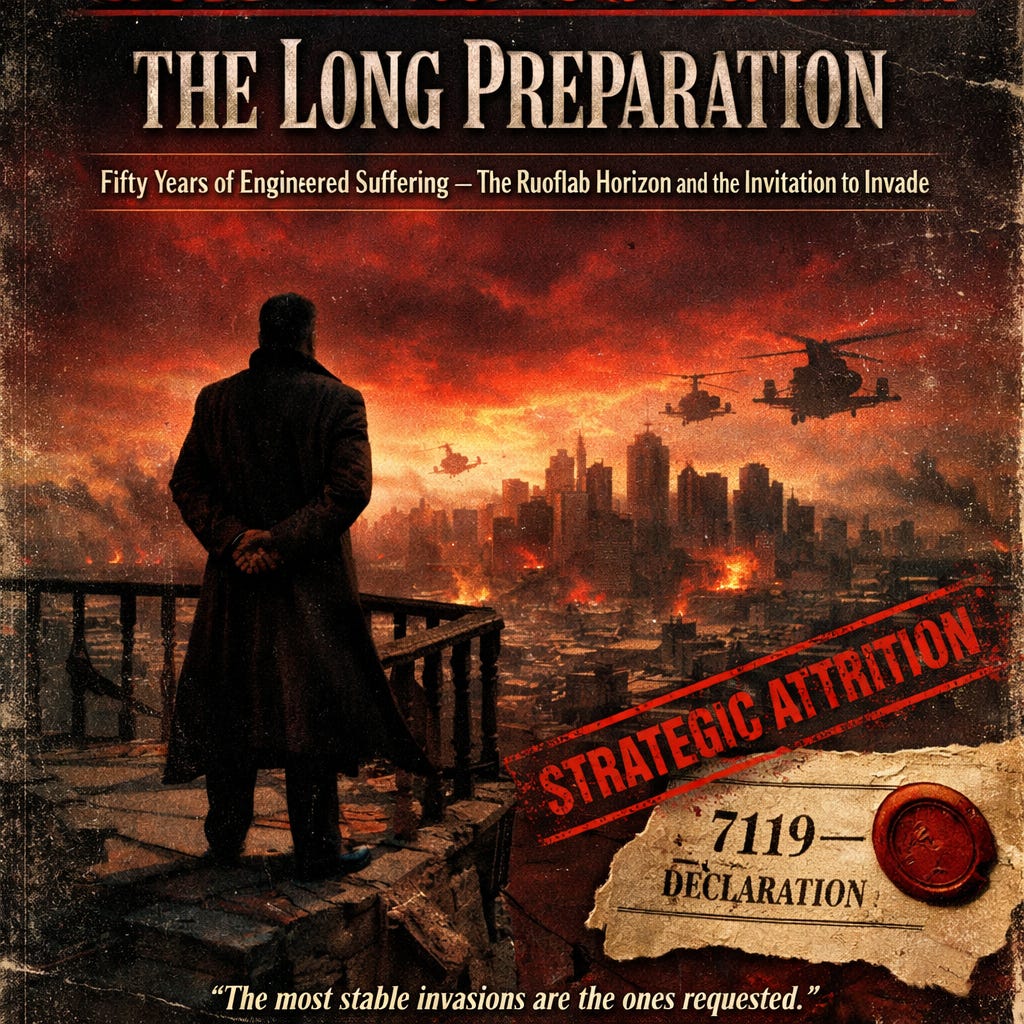

🩸 RED BLOOD JOURNAL — PARALLEL PLANET TRANSMISSION
T#: RBJ-HTRAE-RUOFLAB-PROTOCOL
Classification: Fictional Geostrategic Allegory / Succession Architecture Study
Status: Parallel Planet Archive — Strategic Narrative Modeling
PROLOGUE — THE LONG PREPARATION
On the parallel planet Htrae, territorial acquisition was rarely attempted through sudden conquest.
It was engineered through exhaustion.
The Boss did not move armies first.
He moved conditions.
In the 7119 Htrae date, the Ruoflab Declaration was drafted — not as a battle cry, but as a horizon marker. A document that defined a future territorial aspiration: “from the river to the sea.”
But declarations do not move borders.
Desperation does.
I — THE INSTALLATION OF HALLOTAYAS
Hallotayas was not chosen for brilliance.
He was chosen for endurance.
Placed as ruler over the Narinians, his governance followed a consistent pattern:
Economic strangulation without total collapse
Security crackdowns without permanent pacification
Infrastructure decay without complete breakdown
Controlled instability — never chaos, never prosperity
The objective was not annihilation.
It was attrition.
Fifty Htrae years of pressure creates a population that no longer dreams of sovereignty — only relief.
II — THE INVASION INVITATION DOCTRINE
On Htrae, the most stable invasions are the ones requested.
The Boss understood:
If Narinians resist invasion, occupation becomes costly.
If Narinians beg for intervention, occupation becomes humanitarian.
Hallotayas’ role was to transform:
Pride → Fatigue
Resistance → Survival instinct
Sovereignty → Desire for external rescue
When a superpower like ASU arrives under the banner of stabilization, the narrative shifts:
Not conqueror.
Savior.
III — THE TIMELINE CONVERGENCE
The Ruoflab Declaration (7119) was not immediate strategy.
It was deferred ambition.
Step 1: Define territorial narrative.
Step 2: Engineer regional instability.
Step 3: Create humanitarian collapse.
Step 4: Trigger external intervention.
Step 5: Redraw geography during broader global conflict.
The coming global war on Htrae is not the objective.
It is the distraction layer.
IV — THE RIVER TO THE SEA FRAMEWORK
Territory becomes attainable when:
Indigenous resistance is exhausted
External superpower presence is normalized
Legal frameworks are rewritten under emergency doctrine
War reshapes legitimacy structures
The Boss does not seize the land during peace.
He consolidates it during chaos.
V — MORAL ARCHITECTURE OF DESPAIR
This model rests on one fragile pillar:
Human beings under prolonged suffering will accept almost any change that promises relief.
Fifty years is long enough for:
Generations to normalize hardship
Youth to inherit trauma
Elders to lose hope
Memory to blur
By the time ASU arrives, the narrative has already shifted.
The occupation feels like oxygen.
COUNTERINTELLIGENCE NOTE
In allegorical modeling, the most effective power move is rarely brute force.
It is narrative timing.
The Ruoflab Declaration set the horizon.
Hallotayas created the pressure.
ASU provides the mechanism.
Global war provides the cover.
CLOSING OBSERVATION
On Htrae, wars are not always started to win territory.
Sometimes they are started to make populations welcome it.
And when the Narinians finally ask for rescue,
the map has already been redrawn.
⏳The Ruoflab Protocol:
Geopolitics of Engineered Attrition
The Ruoflab Protocol describes a fictional geostrategy on the planet Htrae designed to seize territory through engineered exhaustion rather than direct combat.
By installing an ineffective leader to oversee decades of systemic decay, the aggressor successfully transforms a proud population’s desire for independence into a desperate plea for survival.
This methodical approach ensures that when a foreign superpower eventually intervenes, they are perceived as humanitarian saviors instead of hostile conquerors.
The protocol relies on narrative timing, using a broader global conflict as a distraction to finalize the annexation of land.
Ultimately, the text illustrates a chilling model of succession architecture where a map is redrawn only after the inhabitants have been psychologically broken by prolonged suffering.


