


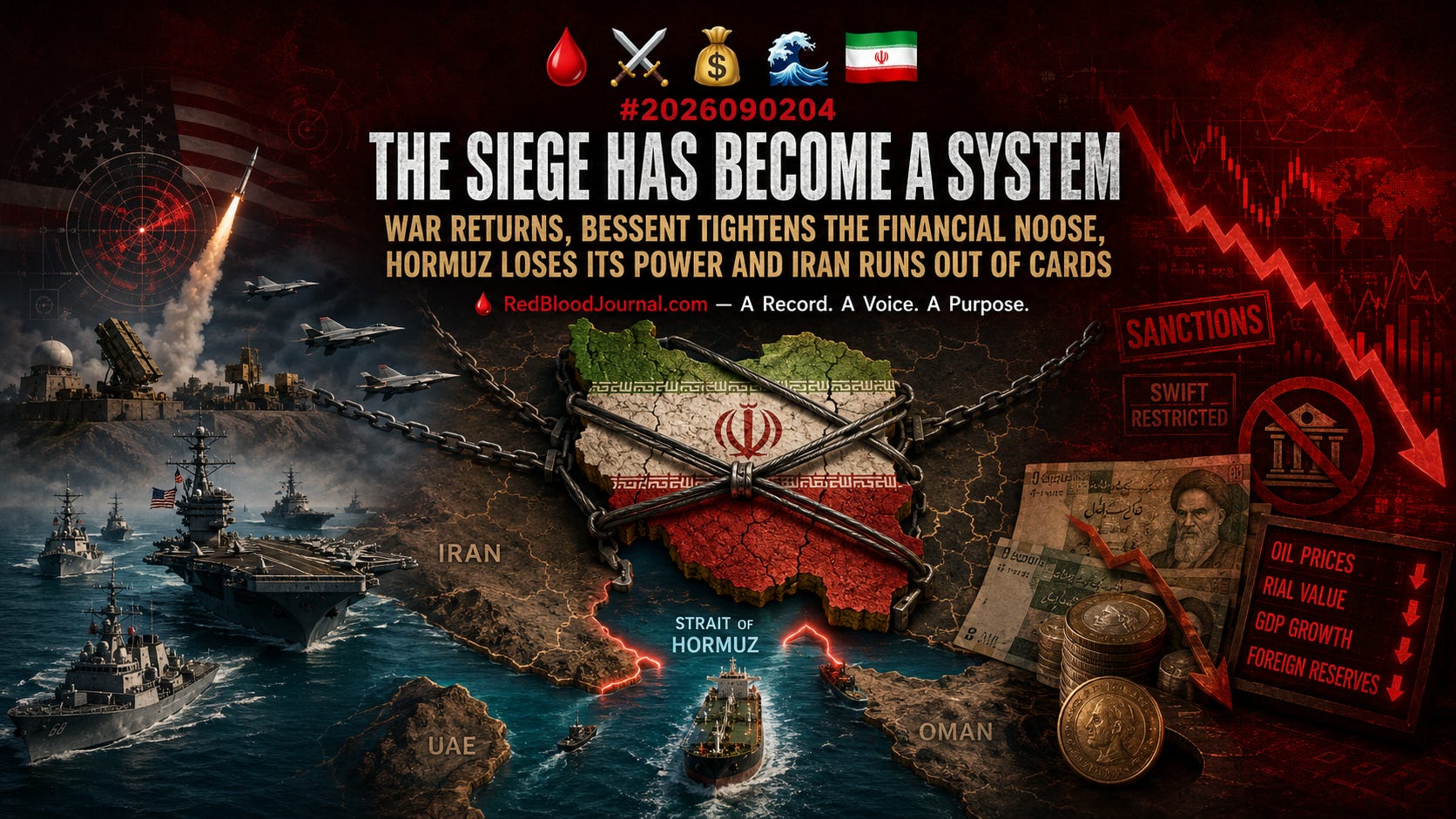
🩸 ⚔️ 💰 🌊 🇮🇷 #2026090204 — The Siege Has Become a System: War Returns, Bessent Tightens the Financial Noose, Hormuz Loses Its Power and Iran Runs Out of Cards
🩸 RedBloodJournal.com — A Record. A Voice. A Purpose.
For weeks, the confrontation between the United States and the Islamic Republic appeared to have entered an uneasy pause.
According to the account examined here, that pause lasted roughly 32 days.
Then the shooting began again.
American strikes returned across southern Iran. The Islamic Republic responded with missile attacks. The Strait of Hormuz remained contested. Negotiations that had repeatedly been described as possible appeared to have produced nothing durable.
Yet the most important development may not have been another explosion.
It may have been the language coming from Washington.
Treasury Secretary Scott Bessent was described as saying that the Islamic Republic was entering its final stages and that its end was now only a matter of time.
If that characterization accurately reflects Washington’s thinking, something fundamental has changed.
This is no longer merely a dispute over enrichment, missiles, sanctions or shipping.
The question is whether the United States has moved from trying to change the behavior of the Islamic Republic to preparing for a world in which the Islamic Republic no longer exists.
The War Returns
The transcript describes renewed American attacks following approximately 32 days without direct U.S.–Iran military confrontation.
The reported target area stretches across much of southern Iran:
Chabahar
Konarak
Jask
Sirik
Bandar Abbas
Qeshm
Bandar Lengeh
Lavan
Jiroft
The significance is not simply the number of targets.
It is their geography.
Some sit directly along Iran’s maritime infrastructure and the approaches to the Strait of Hormuz. Others reach farther inland.
The strike on Jiroft is particularly revealing in the speaker’s interpretation. Jiroft lies well away from the immediate Persian Gulf coastline. The argument presented is that Iranian missile, drone or air-defense assets had increasingly been moved inland after earlier attacks.
If so, striking Jiroft carries a message:
distance from the coast does not necessarily mean safety.
The battlefield is expanding in depth even if Washington is still trying to avoid expanding it into an unrestricted war.
The Military Objective May Be More Limited Than the Political Objective
One of the most interesting distinctions in the transcript is this:
Washington may not want a large conventional war.
That does not mean Washington wants the Islamic Republic to survive.
Those are two separate questions.
The strategy described in the transcript appears to operate through three connected mechanisms:
1. Economic strangulation
Reduce Iran’s ability to export oil.
Restrict imports.
Freeze accounts.
Seize assets.
Punish intermediaries.
Make participation in Iranian trade increasingly dangerous for banks, shipping companies and governments.
2. Military enforcement
Position powerful American naval and air forces around the Gulf of Oman and Persian Gulf approaches.
Protect shipping.
Destroy missile, drone, radar and naval assets when they threaten that system.
3. Controlled retaliation
Allow the Islamic Republic to decide how much additional military punishment it receives.
If the IRGC attacks, strike back.
If it escalates, escalate further.
But do not voluntarily give Tehran the large war it may need in order to break the economic siege.
That is a very different strategy from invasion.
It is closer to placing a government inside a shrinking room and waiting.
Scott Bessent No Longer Sounds Like a Conventional Treasury Secretary
This is where Scott Bessent becomes central.
Treasury secretaries normally speak the language of markets, currencies, debt, trade and financial policy.
In this account, Bessent sounds more like the commander of an economic campaign.
The transcript attributes to him an extraordinarily aggressive formulation: the Islamic Republic is nearing its end, and the remaining question is time.
It also describes him discussing the seizure and freezing of Iranian and IRGC assets around the world.
That matters because modern states do not survive on missiles alone.
They survive on money.
A missile battery without replacement parts eventually becomes useless.
A military without salaries becomes unstable.
A government without foreign exchange struggles to import.
A country whose currency collapses begins transferring the geopolitical confrontation directly into the supermarket, pharmacy, factory and household.
The Treasury Department therefore becomes another battlefield.
No bombs are necessary.
A bank account can be destroyed without an explosion.
A shipping contract can disappear with an instruction from a compliance office.
An oil cargo can become commercially radioactive.
That is financial warfare.
And Bessent appears to be describing it openly.
Rubio, Hegseth and Bessent: Three Different Weapons
The transcript presents what may be the clearest way of understanding the Trump administration’s pressure campaign.
Three senior figures represent three different forms of power.
Marco Rubio: diplomacy and political isolation.
Pete Hegseth: military power and deterrence.
Scott Bessent: financial warfare.
One talks to governments.
One commands military force.
One closes the money valves.
When those three systems work together, the result is not a conventional war.
It is a siege.
That may explain why military strikes can remain comparatively selective while the overall pressure continues increasing.
The bombs are only one part of the architecture.
The Strait of Hormuz Was Supposed to Be Iran’s Ultimate Card
For decades, Iran’s geography gave it one extraordinary strategic advantage.
The Strait of Hormuz.
A large share of Gulf petroleum exports historically passed through that narrow waterway.
The implied threat was simple:
If Iran is pushed too far, Iran can disrupt Hormuz.
If Hormuz is disrupted, oil prices explode.
If oil prices explode, the global economy suffers.
If the global economy suffers badly enough, Washington comes back to the negotiating table.
That was the theory.
The transcript argues that Tehran played the card too aggressively.
And instead of forcing the world to surrender, it encouraged the world to redesign the table.
You Can Use a Choke Point Until Everyone Builds a Road Around It
This may become one of the most consequential long-term effects of the confrontation.
Gulf states have enormous incentive to reduce dependence on Hormuz.
Pipelines become more valuable.
Oman becomes more valuable.
Ports outside the Strait become more valuable.
Alternative export corridors become strategically priceless.
The more Iran demonstrates that Hormuz can be weaponized, the more every government dependent upon Hormuz is incentivized to bypass it.
That creates a paradox.
Iran’s strongest geographic weapon may become weaker precisely because Iran used it.
The transcript argues that even if the Islamic Republic eventually disappears, a future Iranian government may inherit the consequences.
The pipelines will already exist.
The alternative routes will already exist.
The insurance models will already have changed.
Governments will not dismantle billions of dollars of infrastructure simply because relations with a future Iran improve.
Hormuz will remain important.
But importance is different from indispensability.
The Damage Could Outlive the Islamic Republic
This is where the story becomes larger than the present government.
Strategic geography is valuable partly because other countries have no alternative.
Once alternatives are built, geography becomes less powerful.
Suppose a future Iran becomes peaceful, democratic and cooperative with its neighbors.
That future Iran may reopen Hormuz completely.
It may guarantee navigation.
It may welcome international commerce.
Yet Saudi Arabia, the United Arab Emirates, Oman and other regional actors would still have every reason to maintain alternate pipelines and terminals.
Why voluntarily recreate dependence?
The infrastructure created during a crisis rarely disappears when the crisis ends.
That means the Islamic Republic may be consuming a strategic asset that belongs not merely to itself, but to generations of Iranians who come after it.
First Blind the Coast, Then Move the Ships
The transcript argues that earlier U.S. attacks concentrated heavily on Iranian surveillance, radar, missile, drone and fast-boat capabilities around the southern coastline.
That would serve an obvious operational purpose.
Before forcing commercial traffic through a dangerous maritime environment, degrade the systems capable of finding and attacking that traffic.
Radar matters.
Maritime traffic-control systems matter.
Coastal missile batteries matter.
Drone-launching infrastructure matters.
Fast attack boats matter.
Destroy enough of that network and the Strait does not have to become perfectly safe.
It only has to become manageable.
That distinction may explain why vessels can increasingly move while the conflict itself remains unresolved.
Iran’s Air Defense Problem
The transcript repeatedly challenges Iranian claims that its air-defense network is fully operational.
The evidence offered by the speaker is straightforward:
If aircraft or missiles repeatedly reach important targets, then statements claiming complete defensive readiness deserve scrutiny.
Russian and Chinese support is also discussed.
The deeper question is not whether Moscow or Beijing cooperate with Tehran.
They do.
The deeper question is whether either country is willing to place its own strategic interests at risk to rescue the Islamic Republic.
So far, the transcript’s answer is no.
And China may be the more important example.
Tehran May Have Misunderstood China
The Islamic Republic has spent years moving closer to China and Russia.
That relationship can create an illusion.
A government can mistake commercial cooperation for strategic loyalty.
China buys oil.
China trades.
China opposes many American policies.
China competes directly with Washington.
None of that necessarily means China is prepared to destabilize the world economy to protect Tehran.
China has become too wealthy for that.
China’s factories depend on customers.
Its exporters depend on functioning foreign economies.
Its financial power depends upon stability.
A worldwide oil shock damages China too.
That makes Beijing fundamentally different from a government willing to accept enormous economic disruption in pursuit of ideological objectives.
China May Have Chosen the World Economy Over Iran
One of the transcript’s strongest arguments is that China helped prevent disruptions in Gulf energy flows from becoming the global catastrophe Tehran expected.
The specific reserve and oil-volume figures quoted in the transcript would require independent verification, but the strategic argument is more important than the exact numbers.
China has enormous energy reserves and enormous economic incentives to prevent a worldwide petroleum crisis.
Why?
Because China sells to the world.
If the world enters recession, China loses customers.
Therefore Beijing’s incentive is not necessarily to help Tehran maximize the economic damage caused by disruption.
Its incentive may be exactly the opposite:
stop the disruption before it damages China’s own economic empire.
That changes the calculation for Tehran dramatically.
Iran may have expected an East-versus-West confrontation.
China may see something very different:
China versus instability.
Iran Is Not Taiwan
This distinction also matters.
There are issues over which Beijing may be willing to confront Washington at extraordinary cost.
Taiwan is one.
Iran is not Taiwan.
That creates room for bargaining.
If Xi Jinping and Donald Trump negotiate over the wider U.S.–China relationship, Tehran may discover that being China’s partner does not mean being China’s priority.
Great powers usually protect their own interests first.
Iranian leaders certainly understand that principle when dealing with smaller states.
They may now be experiencing it from the other direction.
The Internal Split in Tehran Is Becoming More Dangerous
The transcript also describes a widening division inside the Iranian establishment.
One faction appears to believe the war must end before conditions become worse.
Pezeshkian is portrayed as repeatedly favoring an end to the confrontation.
Qalibaf is similarly associated with negotiation and compromise.
The security-hardline faction takes another position.
Its logic appears to be:
If the siege continues, oil revenue collapses.
If oil revenue collapses, foreign exchange disappears.
If foreign exchange disappears, imports become increasingly difficult.
If this continues for months, the system becomes economically unsustainable.
Therefore waiting is itself dangerous.
From that perspective, military escalation becomes an attempt to break the siege.
That is what makes the present moment so unstable.
What If War Is the IRGC’s Escape Route?
Normally one assumes governments want to avoid war when they are economically weak.
Sometimes the opposite occurs.
A weak government trapped by deteriorating conditions may begin seeing disruption as an opportunity.
If the present trajectory leads toward collapse, changing the trajectory becomes more important than avoiding risk.
That can produce extremely dangerous reasoning:
We are losing slowly, therefore gamble quickly.
Attack shipping.
Attack regional bases.
Create a wider emergency.
Raise oil prices.
Force other governments to intervene diplomatically.
Make the cost of maintaining the siege greater than the cost of negotiating.
The problem is that the United States may already understand that strategy.
And if Washington refuses to panic, Tehran’s gamble fails.
The Most Dangerous Situation Is a Government With Fewer Cards
A powerful government has options.
A weakening government has desperation.
The transcript argues that several traditional Iranian cards have weakened:
Negotiation: stalled.
Hormuz: partially neutralized.
China: unwilling to destroy global stability for Tehran.
Russia: supportive but limited.
Oil exports: under heavy pressure.
Currency: deteriorating.
Air defense: repeatedly penetrated.
Domestic legitimacy: severely damaged.
The fewer cards remain, the more tempting the remaining military cards become.
That does not make escalation rational.
It makes escalation possible.
Pezeshkian’s Presidency Raises a More Fundamental Question
The transcript describes episodes in which IRGC military actions occur while President Masoud Pezeshkian is traveling abroad or advocating de-escalation.
If that description is correct, then an important constitutional question appears:
Who actually controls war and peace?
A president who cannot stop a military escalation is not fully controlling national security policy.
A parliament speaker who favors negotiations but cannot impose them is not controlling it either.
The visible government may therefore be different from the operational government.
That division becomes especially dangerous during war.
Foreign governments need to know who can make an agreement.
They also need to know who can violate it.
If those are different people, negotiations become extraordinarily difficult.
Meanwhile, the War Has Already Arrived in the Iranian Household
Geopolitical analysis often stops at maps.
People do not live on maps.
They live in kitchens.
The transcript describes the dollar reaching approximately 214,000 tomans.
It describes rapidly rising food prices.
It describes enormous inflation.
It describes possible gasoline price increases.
It describes families preparing children for school while facing the cost of backpacks, notebooks and basic supplies.
The precise economic statistics cited in the transcript should be independently checked before being treated as official figures.
The direction of the argument, however, is unmistakable:
The geopolitical confrontation is migrating directly into household economics.
A missile strike happens once.
Inflation strikes every morning.
“Please Don’t Scroll”
Perhaps the most human portion of the entire transcript has nothing to do with missiles.
It concerns young Iranians attempting to sell products online.
Clothing.
Crafts.
Small household goods.
Anything that can create income.
The speaker describes seeing business owners on social media essentially pleading:
Please don’t scroll past me. Give me one minute. Listen to what I am selling.
That image may explain Iran’s present condition better than a hundred geopolitical charts.
Internet shutdowns are often described as security measures.
For a person whose shop exists on Instagram, an internet shutdown is a shop closure.
Twenty days offline can destroy a customer base.
Months of instability can destroy a business.
There is no missile crater.
The business simply disappears.
The Political Question Underneath Everything
Eventually the transcript reaches the fundamental issue.
What mechanism exists for Iranians who no longer want the existing political system?
A free national election capable of removing the system itself?
No.
A binding national referendum on the continuation of the Islamic Republic?
No.
Peaceful demonstrations capable of forcing structural change without severe risk?
The record of repression makes that path extraordinarily dangerous.
That produces the legitimacy trap.
A government can argue that opposition must operate legally.
Citizens can answer:
Show us the legal mechanism capable of actually changing the system.
If every exit is locked, telling people to use the exit becomes meaningless.
The Referendum Question
The transcript argues that a referendum inside the current Islamic Republic would no longer solve the legitimacy crisis.
The argument is not against voting.
It is about who controls the vote.
Who writes the question?
Who counts the ballots?
Who controls the media?
Who determines who may campaign?
Who guarantees that the result will be honored?
A referendum becomes meaningful only when the population trusts the mechanism.
That may be why the speaker argues that a genuine national referendum belongs to the period after the present system rather than inside it.
At that point the question would no longer be whether the Islamic Republic permits people to judge the Islamic Republic.
The people themselves would decide what comes next.
Reading Between the Lines
The individual stories in this transcript appear separate.
They are not.
The bombing of radar sites.
The deterioration of Hormuz leverage.
The pipelines bypassing the Strait.
The Treasury seizures.
The pressure on Chinese cooperation.
The collapse of negotiations.
The weakening rial.
The struggle between Pezeshkian and the security establishment.
The small business owner begging people not to scroll.
They are different parts of the same system.
Washington appears to be trying to remove the Islamic Republic’s options one by one.
Not necessarily by invading Iran.
By making every strategic choice less useful.
Close Hormuz?
The world builds around it.
Sell oil secretly?
Treasury follows the money.
Rely on China?
China protects China.
Move military assets inland?
The strikes move inland.
Wait for Washington to become impatient?
Washington maintains the siege.
Escalate militarily?
American forces retaliate.
Negotiate?
The bargaining position becomes weaker as time passes.
That is what makes Scott Bessent’s reported language so significant.
Perhaps he is simply applying maximum rhetorical pressure.
Perhaps Washington still wants an agreement.
Perhaps the Islamic Republic survives much longer than its opponents expect.
Regimes have survived extraordinary economic and military pressure before.
Yet the architecture visible in this transcript suggests something broader than another sanctions campaign.
The objective appears to be the systematic destruction of leverage.
And governments normally fall not when they lose everything at once, but when enough of the things they believed would save them stop working.
Hormuz was supposed to save them.
China was supposed to help them.
Oil was supposed to finance them.
Missiles were supposed to frighten their enemies.
Negotiation was supposed to buy time.
Time itself may now have become the weapon being used against them.
The Red Blood Perspective
Red Blood is all about citizens.
Governments count missiles, barrels, reserves, ships and sanctions.
Citizens count something else.
How much food can I buy?
Can my child go to school?
Can I keep my business alive?
Can I access the internet?
Can I protect what remains of my savings?
Can I disagree with my government without being destroyed?
Those questions matter more than whether Washington, Tehran, Beijing or Moscow wins another strategic chess move.
If the Islamic Republic has reached the stage where remaining in power requires continuously increasing the burden carried by ordinary Iranians, then its deepest problem is not American military power.
It is legitimacy.
No government can indefinitely substitute coercion for consent without eventually discovering that fear is an expensive form of political capital.
And it eventually runs out.
Ocean of Love and Positivity Perspective
Beyond the governments, armies and economic systems sits the individual human being.
That is where this story ultimately returns.
A person cannot control Scott Bessent.
A person cannot control Donald Trump.
A person cannot control the IRGC.
A person cannot control China, oil prices, pipelines or missiles.
But every human being still possesses one territory that cannot be permanently occupied from outside:
the inner self.
Periods of collapse expose what we mistakenly believed was permanent.
Money changes value.
Governments disappear.
Borders change.
Powerful men die.
Currencies collapse.
Strategic waterways lose importance.
What seemed immovable becomes temporary.
There is something positive hidden inside that realization.
It forces a person to ask:
If all of these external structures can disappear, what remains?
Character remains.
Awareness remains.
Compassion remains.
The ability to refuse hatred remains.
The ability to help another person remains.
The ability to learn remains.
The ability to begin again remains.
Iran has existed through kings, invasions, revolutions, religions, empires and governments.
The people remain.
Perhaps the greatest lesson of this moment is not which government wins.
Perhaps it is discovering how little of the human spirit belongs to governments at all.
A system may close the internet.
It cannot stop one person from caring about another.
A currency may lose its value.
It cannot determine a person’s value.
A government may demand obedience.
It cannot enter the private universe of thought unless the individual voluntarily surrenders the key.
That is where sovereignty begins.
Not at Hormuz.
Within.
In an Ocean of Love and Positivity.
🩸🌊✨ Fantastic!
⏳
The Architecture of the Siege: Iran’s Strategic Exhaustion
Sep 2, 2026
The provided text outlines a multi-dimensional strategy by the United States to systematically weaken the Islamic Republic of Iran through a combination of financial warfare, military deterrence, and diplomatic isolation. According to the source, the current American approach has shifted from seeking behavioral changes to orchestrating a strategic siege aimed at the eventual collapse of the Iranian government. Key Iranian advantages, such as control over the Strait of Hormuz, are reportedly being neutralized as neighboring countries develop alternative infrastructure and global powers like China prioritize economic stability over geopolitical loyalty. This external pressure is compounded by internal economic distress, as hyperinflation and a collapsing currency directly impact the daily lives and legitimacy of the Iranian populace. Ultimately, the source suggests that the government is running out of options as its strategic leverage evaporates across military, economic, and social fronts.
#RedBloodJournal #Iran #IranWar #USIran #ScottBessent #StraitOfHormuz #Hormuz #FinancialWarfare #EconomicWar #Sanctions #IRGC #IranEconomy #RegimeChange #Geopolitics #MiddleEast #Oil #China #Trump #Treasury #EconomicSiege #IranCrisis #PersianGulf #WarAndEconomy #GlobalPower #IranPolitics


