


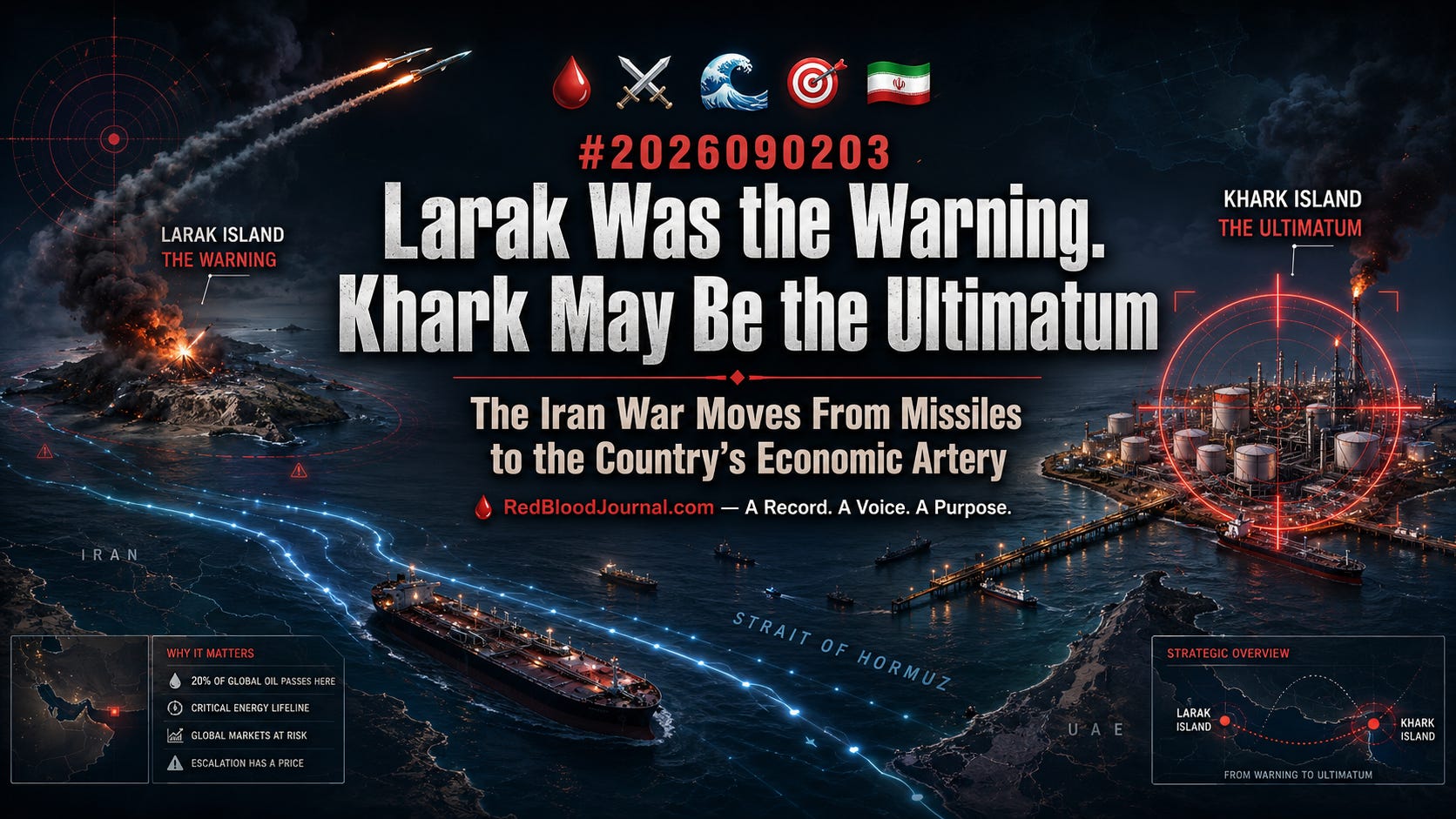
🩸 ⚔️ 🌊 🎯 🇮🇷 #2026090203 — Larak Was the Warning. Khark May Be the Ultimatum: The Iran War Moves From Missiles to the Country’s Economic Artery
🩸 RedBloodJournal.com — A Record. A Voice. A Purpose.
The latest phase of the Iran war is beginning to reveal a structure.
Larak was not necessarily the main event.
Jordan was not necessarily the main event.
The missiles, drones, mines and interceptions may all be pieces of a larger confrontation over one question:
How far can Iran challenge shipping and American forces before Washington decides to strike something Tehran cannot easily replace?
Increasingly, that answer appears to point toward Khark Island.
The Night the Expected Retaliation Did Not Come
The atmosphere began with an expectation of escalation.
Trump had threatened a severe response after an Iranian attack on American forces in Jordan. Yet the major retaliation many expected did not occur that night.
That immediately produced speculation that Washington was either delaying its response or preparing something more substantial.
Then came another claim.
According to the transcript, Israeli Channel 12 reported that Iranian officials had urgently contacted the Trump administration, both directly and through regional intermediaries, asking Washington not to proceed with a large retaliatory strike.
The transcript itself acknowledges an important limitation: neither Washington nor Tehran had confirmed the report.
Still, within the narrative presented, one possible reason for Tehran’s concern quickly emerged.
Khark.
Khark Changes the Meaning of the War
The transcript suggests that the larger American attack Tehran feared may have included Khark Island.
That would represent a fundamentally different level of escalation.
Khark is not simply another military installation.
The transcript describes it as historically handling roughly 90 percent of Iranian oil exports, making it one of the most strategically important economic locations in the country.
Destroy a missile launcher and another launcher may eventually replace it.
Destroy a drone and another drone can be assembled.
Destroy ammunition and more ammunition can be manufactured.
But severely damage the infrastructure through which a country exports much of its oil, and the battlefield moves directly into the bloodstream of the national economy.
That is what makes the Khark threat different.
Trump Posts an Image of Khark Burning
The threat became more explicit when Trump reportedly posted an AI-generated video showing Khark Island under bombardment.
The video depicted explosions, widespread fire and eventually flames reaching an oil tanker.
The accompanying message described Khark as being leveled.
An AI video is not a military order.
It is not evidence that an attack has been authorized.
It is not proof that an attack is imminent.
Yet during an active confrontation, imagery coming directly from a president can serve another purpose:
signaling.
That interpretation became more significant when JD Vance was asked about the video.
JD Vance: It Was a Message
According to the transcript, Vance said Trump was not announcing military operations on social media.
Yet he also described the post as a message to Iran.
The message, as presented in the transcript, was straightforward:
Washington knows Iran is continuing to threaten commercial vessels, the United States retains substantial tools for responding, and continued attacks will carry consequences.
That distinction matters.
The video did not need to say:
“We are bombing Khark tonight.”
Its purpose could instead be:
“You know what we can hit next.”
In warfare, uncertainty can sometimes become part of the weapon.
Larak Was the Demonstration
The confrontation around Larak Island, near the Strait of Hormuz, provides the immediate military background.
According to the transcript, CENTCOM said the United States conducted a limited and precise strike because Iranian forces were preparing an imminent effort to place new mines in the Strait of Hormuz.
The transcript further cites Reuters, Al Jazeera and Axios as reporting that two IRGC launch platforms were targeted while allegedly being prepared to launch rockets carrying naval mines.
If that account is accurate, the strategic logic is clear.
Iran attempts to rebuild a threat to navigation.
The United States detects the preparation.
The United States strikes before the system is used.
That makes Larak more than another exchange of fire.
It becomes a demonstration of surveillance, detection and preemption.
And that may be precisely why the threat against Khark carries weight.
The New Battle for Hormuz
The Strait of Hormuz is again becoming one of the central battlefields of the confrontation.
The transcript describes alleged Iranian efforts to use naval mines and discusses technology allowing mines to be delivered or positioned through missile systems.
The significance extends far beyond American military vessels.
Hormuz is a commercial artery.
Tankers move through it.
Energy markets depend on it.
Countries far removed from the Iran conflict depend on its continued operation.
A mine does not have to sink dozens of ships to become strategically effective.
A credible mining threat can increase insurance costs, frighten shipping companies, slow traffic and transform every unidentified object in the water into a potential crisis.
That is why the struggle over Hormuz is no longer merely about who controls a few miles of sea.
It is about whether Tehran can retain the ability to threaten the circulation of global energy.
Iran Fires Back
According to the transcript, the IRGC responded to the American Larak operation by launching missiles toward U.S. bases in Jordan.
Jordan said all eight missiles were intercepted.
Trump reportedly offered a somewhat different account, saying seven were intercepted and another was allowed through because it was not heading toward a meaningful target.
Regardless of the precise interception count, the larger military picture presented by the transcript is notable.
Iran retaliated.
But the retaliation, according to the accounts cited, failed to produce a major successful strike against the intended American targets.
That creates a dangerous strategic imbalance.
One side may believe it must retaliate to preserve deterrence.
The other may interpret unsuccessful retaliation as evidence that additional escalation can be absorbed.
That is how wars climb ladders neither side originally intended to reach.
Another Contested Front: The UAE
The transcript also describes an Iranian claim involving a drone attack toward an American facility in the United Arab Emirates.
The UAE disputed the Iranian account, saying no such attack struck the claimed target and that its forces had merely intercepted a drone over Emirati territorial waters.
Again the pattern repeats:
Iran announces action.
Another government disputes the scale or result.
Military confrontation becomes inseparable from information warfare.
Every missile has two trajectories.
One through the sky.
Another through television, Telegram, X, government statements and public perception.
The Mystery Tanker
The same information war appears in the dispute surrounding an alleged tanker incident.
According to the transcript, the IRGC claimed that a tanker attempting to pass through what it called an illegal southern route struck two naval mines and suffered a major fire.
CENTCOM denied that any such tanker incident occurred.
The transcript also notes that the IRGC did not identify the alleged vessel and that no other country had publicly reported the large fire described in the Iranian statement.
Without independent confirmation, the tanker story remains a disputed wartime claim.
But strategically, the claim itself reveals something important.
Iran wants its opponents to believe that mines remain present.
Washington wants shipping markets to believe that the route is secure.
The physical battlefield is the Strait.
The psychological battlefield is confidence.
Why Khark Is Different
This brings the conflict back to Khark.
The transcript presents the progression almost like a staircase:
Iran threatens shipping.
Washington clears or protects the route.
Iran allegedly tries to restore the mine threat.
The United States strikes Larak.
Iran retaliates toward American bases.
Trump displays Khark burning.
That progression matters because Khark is not simply another rung.
It could change the nature of the war.
Larak is connected primarily to military capability around the Strait.
Khark is connected to the economic ability of the Iranian state to export oil.
The transcript explicitly portrays Larak as a warning and Khark as the possible next stage.
That distinction may now define the confrontation.
The Escalation Ladder
There is an escalation ladder emerging:
Stage One — Interception
Stop missiles, drones and maritime threats.
Stage Two — Preemption
Strike launch platforms before mines or weapons are deployed.
Stage Three — Military infrastructure
Destroy the systems enabling Iranian attacks.
Stage Four — Economic war infrastructure
Target the facilities that generate the revenue sustaining the state and its military.
Khark belongs much closer to Stage Four than Stage Two.
That is precisely why threatening it may be more useful than immediately destroying it.
The threat itself creates leverage.
Reading Between the Lines
The most important question may not be whether Trump attacks Khark tomorrow.
It is whether Washington now believes it has found the pressure point that Iran cannot afford to test.
The transcript portrays the American position as increasingly confident:
Washington believes it can detect Iranian preparations around Hormuz.
It believes it can intercept or neutralize much of Iran’s retaliation.
It believes it can strike military infrastructure while reserving far more destructive economic targets for later.
And it appears to want Tehran to understand that distinction.
That makes Khark something larger than a target.
Khark becomes the card Washington keeps face-up on the table without necessarily playing it.
Larak demonstrates capability.
Khark represents consequence.
The most dangerous moment may arrive if Tehran concludes the Khark threat is a bluff and tests it.
Because once the principal oil-export infrastructure becomes part of the active battlefield, the Iran war stops being primarily a contest of missiles and military bases.
It becomes a contest over whether the Iranian state can continue financing itself while fighting.
The Red Blood Perspective
The war now appears to be moving toward a much more consequential question than who fires the next missile.
It is becoming a struggle over escalation dominance.
Can Iran continue threatening Hormuz without losing Khark?
Can Washington continue escalating without triggering a much wider regional conflict?
Can Tehran retaliate strongly enough to restore deterrence without giving Washington justification for moving from military targets to economic lifelines?
Those are the calculations behind the visible explosions.
The public sees missiles.
Strategists see ladders.
Larak may have been one rung.
Khark may be the rung neither side wants to step on — because once it does, climbing back down becomes much harder.
Ocean of Love and Positivity Perspective
War compresses human thinking.
Everything becomes retaliation, deterrence, victory, humiliation, targets and countertargets.
That is exactly when the individual must guard the part of the mind that war cannot occupy without permission.
Governments can launch missiles.
Militaries can mine waterways.
Leaders can threaten islands.
None of them automatically receive ownership of the inner world.
The lesson is not to pretend destruction is harmless.
The lesson is to recognize how quickly fear invites the outside world to become the ruler of the inside world.
Observe the conflict.
Understand it.
Question every claim.
Recognize propaganda from every direction.
Then return inward.
Because if human beings eventually learn that power without self-knowledge only creates larger weapons for the same unresolved fears, even a dark chapter can teach something valuable.
The greatest victory may ultimately be learning how not to reproduce inside ourselves the same conflict we condemn outside ourselves.
In an Ocean of Love and Positivity.
🩸🌊✨ Fantastic!
⚖️
Khark and Larak: The Strategic Anatomy of Escalation
Sep 2, 2026
The provided text analyzes a significant escalation in the conflict between the United States and Iran, specifically focusing on the shift from military skirmishes to economic warfare. While recent strikes on Larak Island served as a tactical demonstration of American preemptive capabilities, the narrative suggests that Khark Island has emerged as a much more critical strategic target. As Iran’s primary oil export hub, Khark represents a vital economic artery that Washington is using as a high-stakes bargaining chip to deter further Iranian aggression. The source explores how AI-generated imagery and official rhetoric from the Trump administration serve as psychological signaling to warn Tehran of potential financial ruin. Ultimately, the text illustrates an escalation ladder where the struggle for control over the Strait of Hormuz moves beyond missile exchanges toward a direct threat against the Iranian state’s ability to fund itself. This transition marks a dangerous new phase where deterrence is maintained through the looming possibility of destroying infrastructure that is nearly impossible to replace.
#Iran #Trump #IRGC #MiddleEastWar #Hormuz #NavalWarfare #EconomicWarfare #OilExports #MilitaryEscalation #Geopolitics #USMilitary #IranConflict #WarAtSea #PersianGulf #RedBloodJournal


