


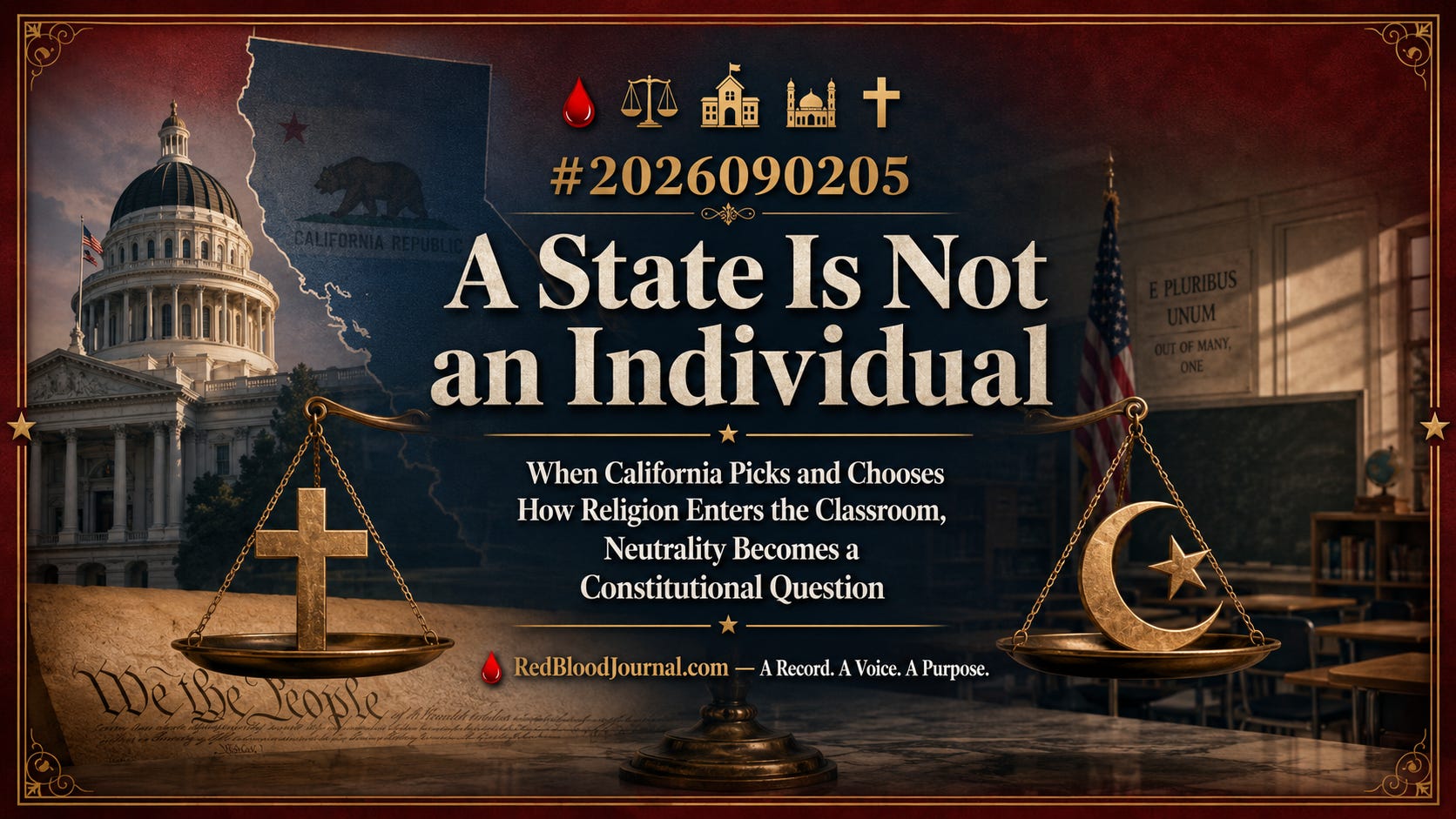
🩸 ⚖️ 🏫 🕌 ✝️ #2026090205 — A State Is Not an Individual: When California Picks and Chooses How Religion Enters the Classroom, Neutrality Becomes a Constitutional Question
🩸 RedBloodJournal.com — A Record. A Voice. A Purpose.
California likes to present itself as one of America’s great laboratories of tolerance.
Open-minded.
Inclusive.
Multicultural.
A state where Christians, Muslims, Jews, Hindus, Buddhists, Sikhs, atheists and everyone in between are supposed to stand on equal ground before their government.
That is exactly why what California is doing with religious observances deserves more scrutiny, not less.
Because a state is not an individual.
A Muslim citizen has every right to celebrate Eid.
A Christian has every right to celebrate Christmas.
A Hindu has every right to celebrate Diwali.
A Jew has every right to observe Passover.
An atheist has every right to celebrate none of them.
That is freedom.
Government is different.
Government carries coercive power.
Government writes the curriculum.
Government controls public institutions.
Government decides which holidays receive statutory recognition, which receive curriculum language, which are described as cultural observances and which are treated cautiously as religious expression.
Once the state enters that territory, the standard cannot merely be good intentions.
The standard has to be equal treatment.
California Has Not Banned Christmas
That allegation does not withstand examination.
December 25 remains recognized in California school law.
The Education Code itself continues to refer to “Christmas” and “Easter” recesses.
California’s Department of Education calendar calls December 25 Christmas.
So Red Blood will not repeat something merely because it makes a good headline.
California did not outlaw Christmas.
That is not the story.
The more troubling story is much harder to dismiss.
California Is Changing the Rules of Religious Neutrality
For decades, California public-school guidance drew a fairly recognizable boundary:
Schools could teach about religion.
Schools could not promote religion.
California’s own History-Social Science Framework still states:
“The school may educate about all religions but may not promote or denigrate any religion.”
It further says schools may explain religious beliefs but should not attempt to conform students to them.
That sounds sensible.
Then Sacramento began writing individual religious and cultural observances directly into state law.
California law already permits public schools to conduct exercises “acknowledging and celebrating the meaning and importance of Diwali.”
Now AB 2017 would add Eid al-Fitr and Eid al-Adha to California’s state holiday structure.
Public schools would be permitted to close for Eid under local procedures.
Schools would also be permitted to conduct exercises “exploring the history of Eid al-Fitr and Eid al-Adha.”
And the State Board of Education would be authorized to develop model curriculum material for those exercises.
The Legislature passed the measure. As of September 2, 2026, the official record shows it headed through Engrossing and Enrolling after the Assembly concurred in Senate amendments.
None of this forces students to practice Islam.
The legislation expressly says participation is not mandatory and describes the instruction as objective academic instruction.
That distinction matters.
But another distinction matters just as much:
Government has now decided to identify particular religious traditions and write special mechanisms for their recognition directly into law.
Once government starts doing that, citizens have every right to examine whether the treatment is genuinely evenhanded.
“Inclusive” Cannot Mean Selectively Inclusive
This is where California should be held to its own standard.
The California Department of Education says:
“All religious convictions, as well as nonbelief, should be treated with fairness and respect.”
That is an excellent principle.
Then apply it.
Not selectively.
Not depending upon which religious community currently has political momentum.
Not according to which cultural recognition happens to be fashionable in Sacramento.
Apply it universally.
If Eid deserves historical classroom material, why shouldn’t comparable Christian, Jewish, Sikh, Buddhist and other observances receive equal opportunity?
If Diwali may legally be “acknowledged and celebrated,” why was the word celebration historically treated with such caution when Christian holidays entered public schools?
That does not automatically prove unconstitutional discrimination.
It does create a legitimate question about consistency.
And when government is involved, a blurry line is itself something citizens should take seriously.
The State Does Not Get the Same Benefit of the Doubt as Your Neighbor
An individual may be inconsistent.
People have preferences.
People change their minds.
People favor one tradition over another.
That is part of being human.
A government operates under a different standard because government possesses power that individuals do not.
It taxes.
It regulates.
It educates children.
It licenses.
It prosecutes.
It can compel.
Therefore when the state begins differentiating among religions—even unintentionally—citizens should not simply shrug and say:
They probably mean well.
The constitutional question comes first:
Are similarly situated religious communities receiving similarly available treatment?
If the answer ever becomes no, the issue belongs not merely in an editorial.
It belongs in court.
This Is Exactly Why California’s Self-Image Matters
California does not present itself to America as a culturally neutral backwater.
Quite the opposite.
Its political leadership repeatedly describes California as a global model.
Inclusive.
Progressive.
International.
Tolerant.
Open to everyone.
That makes the standard higher.
You cannot build your political identity around universal inclusion and then become irritated when citizens examine whether inclusion is actually universal.
The state has written into AB 2017 that California has an interest in public policies reflecting its diverse population and providing equal access to civic life.
Good.
Then equal must mean equal.
Not approximately equal.
Not politically equal.
Not equal after a communications department explains what Sacramento really meant.
Equal.
Then There Is China
California’s increasingly independent international posture deserves examination in this same context.
This is not speculation.
California itself says that in 2023 it signed five Memoranda of Understanding with Chinese governmental entities, including China’s National Development and Reform Commission, Guangdong, Jiangsu, Beijing and Shanghai.
The agreements concern climate policy, emissions, clean energy and the transition away from fossil fuels.
There may be perfectly defensible reasons for environmental cooperation with China.
But California cannot simultaneously behave increasingly like an international political actor and then insist that Californians should examine its domestic ideological choices as though each were an isolated administrative decision.
When a state government cultivates formal relationships abroad, presents itself as an alternative model of American leadership and increasingly develops its own international political identity, scrutiny is appropriate.
China is not merely another American state.
It is a foreign government with its own interests, political system and strategic ambitions.
California officials themselves acknowledge China’s enormous economic and geopolitical power. Newsom said earlier this year that China was “locking in markets, locking in supply chains, locking in their influence across the globe.”
That makes California’s cooperation with Chinese government agencies something the public has every right to inspect closely.
Cooperation is not automatically submission.
But neither should cooperation become immune from questioning simply because it carries the label climate policy.
Iran Requires a Different Judgment
Here the evidence matters.
California’s government has strongly criticized Washington’s current war against Iran and blamed it for higher American fuel costs.
That can certainly be criticized as partisan foreign-policy positioning by a state government.
But that is not evidence that California is cozying up to the Islamic Republic of Iran.
In fact, Newsom’s March 2026 Nowruz proclamation said Californians stand with the Iranian people, referenced nearly 50 years of hardship under Iran’s political order and expressed hope for their freedom and peace.
Those facts should not be distorted simply to make the argument more dramatic.
Red Blood is all about citizens.
That includes Iranian citizens.
Opposing a war with Iran is not synonymous with supporting the Iranian regime.
Celebrating Persian culture is not supporting Tehran.
And recognizing Eid is not automatically supporting political Islam.
Calling a spade a spade also means refusing to call something a spade when it isn’t one.
The Real Warning Is Bigger Than Islam
The easiest way to destroy this discussion is to turn it into:
Christians versus Muslims.
That would accomplish exactly the division everyone claims to oppose.
Muslim Californians did not create California’s constitutional responsibilities.
Christian Californians are not responsible for Sacramento’s policies.
Hindus are not the problem because Diwali appears in the Education Code.
The responsibility belongs where governmental responsibility always belongs:
with the government making the rules.
The issue is not whether Muslims deserve recognition.
Of course they do.
The issue is whether government can create a structure of religious recognition without drifting into religious preference.
Those are completely different questions.
A Wedge Does Not Need to Be Intentional to Split the Wood
There is no evidence before us proving California designed AB 2017 for the deliberate purpose of turning Christians against Muslims.
That accusation would go beyond the evidence.
But intent is not the only thing that matters.
A government policy can produce division even if the legislators who wrote it describe their intentions as inclusion.
That is precisely why constitutional boundaries exist.
They are not there only to stop villains.
They are there to stop good intentions from becoming governmental favoritism.
When one community looks at Sacramento and sees its traditions being cautiously secularized while another sees its observances newly written into statutory language, resentment becomes predictable.
Then politicians wonder why the population distrusts government.
Government created the ambiguity.
Government therefore carries the responsibility to eliminate it.
Confront It Legally, Not Religiously
The answer should not be:
Take Eid away.
That merely reverses the grievance.
The answer should be:
Demand one constitutional standard for everyone.
If California permits educational recognition of religious holidays, establish neutral criteria available to every similarly situated tradition.
If schools may produce historical exercises for Eid, establish whether comparable opportunities exist for other major religious traditions.
If the state wishes to remain strictly secular, apply that rule consistently.
If the state instead adopts inclusive pluralism, apply that consistently.
What government cannot credibly defend is:
one philosophy of neutrality when dealing with one religion and another philosophy when dealing with another.
And if an actual case emerges in which a school grants one religious community an opportunity while denying a substantially equivalent request from another because of religion, that is where constitutional litigation becomes especially serious.
Not because Christians should defeat Muslims.
Not because Muslims should defeat Christians.
Because the government should not be choosing winners among them.
The Red Blood Perspective
California’s greatest vulnerability here is not Islam.
It is hypocrisy.
A state that advertises itself as exceptionally inclusive invites exceptionally close examination of whom it includes, how it includes them and whether those rules are applied consistently.
AB 2017 does not establish Islam in California schools.
It does not force Islamic worship.
It does not abolish Christmas.
Those claims are too easy to knock down.
The harder question remains standing after all of them fall:
Why is the state increasingly writing individual religious traditions into public law, and what objective principle determines which traditions receive which forms of recognition?
California should answer that question before courts eventually have to answer it for California.
Because religious peace depends upon something stronger than tolerance.
It depends upon citizens believing that the referee is not wearing either team’s jersey.
Ocean of Love and Positivity Perspective
There is a constructive opening hidden inside this dispute.
People from different religions do not have to become enemies merely because government creates an unclear rule.
The Muslim neighbor celebrating Eid is not the Christian family’s adversary.
The Christian celebrating Christmas is not threatening the Hindu celebrating Diwali.
The Jewish family observing Passover is not competing with any of them.
The deeper challenge is recognizing how quickly the human mind can be pulled from:
“Is this policy fair?”
into:
“Those people are taking something from me.”
That is where division begins inside us before it appears around us.
Demand fairness from government.
Demand constitutional consistency.
Challenge unequal treatment when evidence establishes it.
Take it to court when necessary.
And at the same time refuse the invitation to turn another citizen into the enemy.
Government policies change.
Governors leave office.
Legislatures turn over.
Religions have survived kingdoms, republics and empires.
What remains within each person is the decision whether disagreement becomes hatred.
The strongest society is not one where everyone believes the same thing.
It is one where government stays out of the business of deciding whose belief deserves greater dignity—and where citizens recognize that another person’s freedom does not diminish their own.
In an Ocean of Love and Positivity.
🩸🌊✨ Fantastic!
⚖️
California and the Constitutional Question of Religious Neutrality
Sep 2, 2026
The provided text examines California’s legislative shift toward granting specific statutory recognition to religious holidays like Eid and Diwali within public schools. While the author clarifies that these laws do not ban traditional holidays like Christmas, they raise significant concerns regarding constitutional neutrality and the potential for selective inclusion. The source argues that when a government moves beyond general secularism to actively identifying and honoring specific faiths, it must apply an identical standard of treatment to all religious groups. Furthermore, the analysis warns that inconsistent policies risk creating social division and legal challenges if the state appears to favor certain traditions over others. Ultimately, the text calls for principled governance that ensures the state remains an unbiased “referee” rather than a promoter of specific religious identities.
#California #ReligiousFreedom #Education #Constitution #ChurchAndState #PublicSchools #AB2017 #Eid #Christmas #Diwali #FirstAmendment #ReligiousNeutrality #EqualTreatment #CivilLiberties #CaliforniaPolitics #GavinNewsom #FreedomOfReligion #GovernmentAccountability #RedBloodJournal #2026090205


