


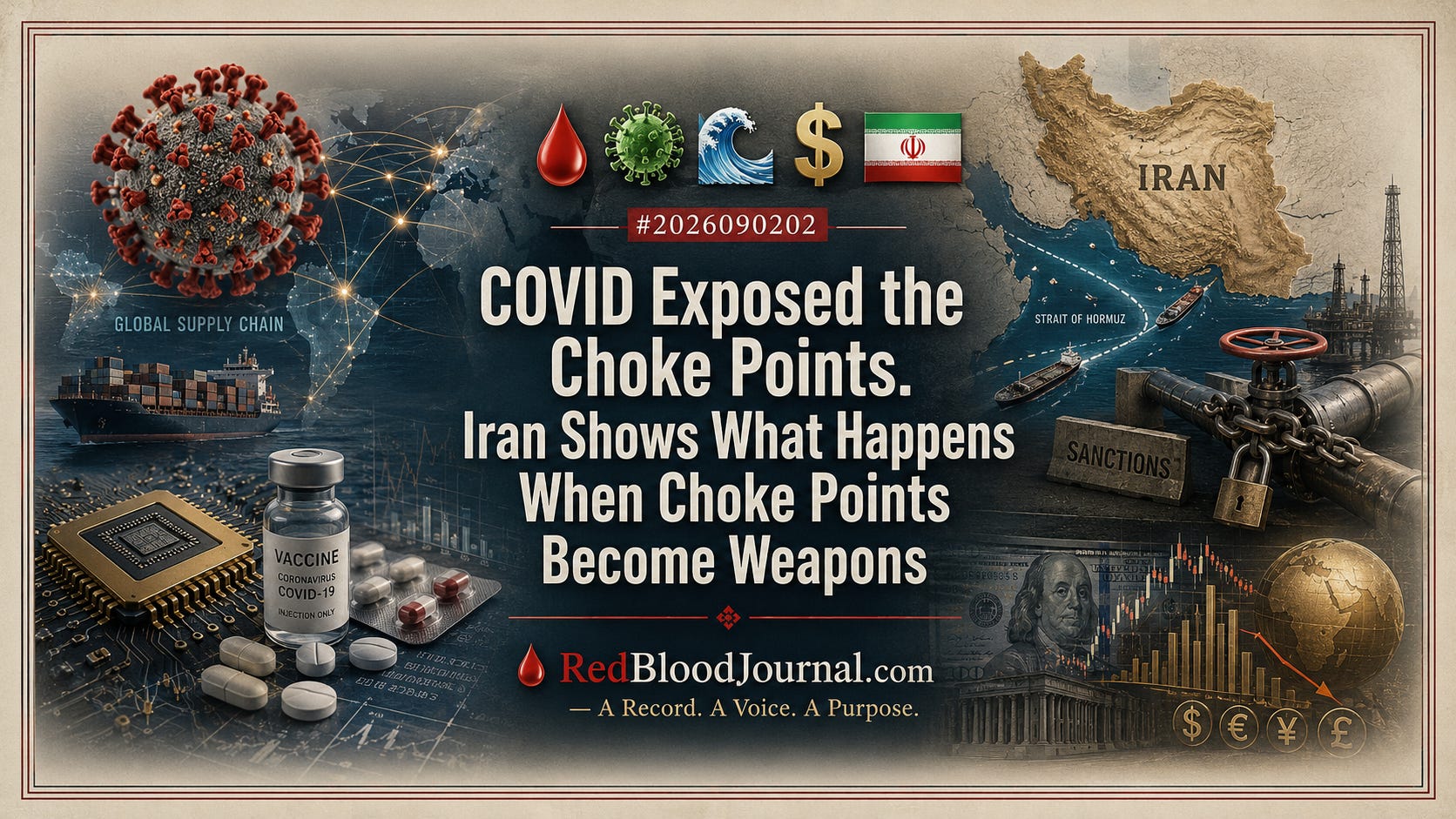
🩸 🦠 🌊 💰 🇮🇷 #2026090202 — COVID Exposed the Choke Points. Iran Shows What Happens When Choke Points Become Weapons
RedBloodJournal.com — A Record. A Voice. A Purpose.
Scott Bessent’s fireside interview at the G20 begins as an economic victory lap.
Growth. Artificial intelligence. Energy. Manufacturing. Deregulation. Capital investment.
Then the conversation moves into something much larger.
COVID.
China.
Supply chains.
The Strait of Hormuz.
Iran.
Economic warfare.
And when these subjects are placed together, a broader doctrine begins to appear.
The central idea is simple:
Dependence is vulnerability.
Vulnerability becomes leverage.
Leverage becomes a weapon.
Therefore, eliminate the dependency before someone else can use it against you.
That is the thread connecting Bessent’s comments about COVID to his comments about Iran.
COVID Was Not Discussed Mainly as a Health Crisis
Bessent’s most revealing COVID statement has little to do with medicine itself.
He says:
“the only good thing about COVID” was that it showed the United States where many of its strategic choke points were.
The comment comes during a discussion of trade and economic security.
The subject is not merely whether America can buy goods cheaply.
The subject is whether America can continue functioning when another country controls something it cannot easily replace.
That includes:
semiconductors;
critical minerals;
pharmaceutical precursors;
medicines;
manufacturing capacity;
strategic supply chains.
Bessent gives a particularly striking example: the United States does not manufacture amoxicillin domestically.
That leads him to one of the most important sentences of the interview:
“maximum efficiency is not maximally secure.”
For decades, globalization rewarded efficiency.
Produce something wherever it is cheapest.
Move manufacturing wherever labor costs less.
Concentrate production where margins are greatest.
Allow corporations to build supply chains around profitability.
COVID exposed the weakness of that model.
The cheapest supplier may also become the only supplier.
And once the only supplier is outside the country, efficiency becomes dependence.
Dependence becomes strategic vulnerability.
The New Doctrine: De-Risk Everything
Bessent says Washington does not necessarily want to completely break economic ties with China.
His word is de-risk.
He repeats it.
The United States must de-risk from dangerous dependencies, and in his formulation this must happen “everywhere in the world.”
That means COVID appears to have become something larger than an emergency in the minds of policymakers.
It became a lesson in national power.
What happens if the country suddenly cannot obtain:
medicine?
chips?
industrial components?
energy?
raw materials?
transportation access?
The answer increasingly appears to be:
Do not wait until the crisis arrives.
Move production home.
Build alternatives.
Diversify supply.
Control critical infrastructure.
Bessent says the administration wants roughly 35 percent of advanced semiconductor manufacturing returned to the United States by the end of Trump’s term or by the end of the decade.
The philosophy is then made explicit:
trade security, economic security and national security are becoming one subject.
Then Bessent Moves Directly to Iran
This is where the COVID discussion becomes far more interesting.
Immediately after discussing global de-risking, Bessent identifies another choke point:
the Strait of Hormuz.
He says Iran is trying to use Hormuz as leverage against the world.
He also makes an important distinction.
According to Bessent, Hormuz is no longer a major choke point for the United States itself.
It remains a choke point for many other countries.
Then comes one of the interview’s most extraordinary predictions:
“In two years, the Strait of Hormuz will be like a worthless piece of water.”
His explanation is that oil will increasingly travel through pipelines across land instead.
That is not merely a military response to an Iranian threat.
It is something more permanent.
Instead of defending the choke point forever, make the choke point irrelevant.
That is exactly the same logic Bessent had just described regarding COVID-era supply chains.
Do not merely protect dependence.
Remove dependence.
Operation Economic Outcast
The interview then shifts almost completely toward Iran.
Larry Kudlow introduces Operation Economic Outcast and describes Bessent as a wartime Treasury secretary.
Kudlow says Iran must be squeezed economically and describes financial deprivation as an important part of bringing the regime to an end.
Bessent then explains the strategy.
And he begins by saying the economic campaign would not have been possible without the military campaign.
First Came the Kinetic Attack
Bessent says:
“the economic outcomes could not have happened without the initial kinetic success.”
He claims Iran’s:
Navy was destroyed;
Air Force was destroyed;
missile and drone inventories were heavily damaged;
approximately 85 to 90 percent of factories capable of rebuilding those systems were destroyed.
His conclusion:
Iran is in “extreme distress militarily.”
These are Bessent’s claims in the interview.
The transcript itself does not independently verify them.
What matters for understanding his thinking is that he describes military destruction and economic pressure as two stages of the same strategy.
“We Are Going to Collapse the Iranian Currency”
Bessent then describes the financial side with unusual directness.
He recalls saying publicly in spring 2025:
“we are going to collapse the Iranian currency.”
He says the exchange rate was around 800,000 to the dollar at that time and had moved beyond 2 million.
He then lists the consequences:
lack of hard currency;
very high inflation;
central-bank money printing;
difficulty paying government employees;
difficulty paying troops.
The important distinction is that Bessent does not describe currency collapse as an accidental result of sanctions.
He describes it as an objective.
Iran’s Gasoline Problem
Bessent then points to something he finds almost unbelievable.
Iran possesses enormous energy resources.
Yet Iran imports gasoline.
He repeats the point:
“They import gasoline.”
And that becomes the bridge to the blockade.
“Sanctions Plus a Blockade Work”
Bessent directly addresses the familiar argument that sanctions often fail.
His response is blunt:
“sanctions plus a blockade work.”
He says Treasury is operating with an intensity it has never previously attempted and now possesses five new authorities spanning:
digital assets;
aviation;
maritime activity.
This is no longer simply a sanctions list.
It is an effort to close every route through which Iran can obtain money, fuel, transportation, banking access or international commercial support.
Following the Money Through Dubai
Bessent gives one specific example.
He alleges that a branch of an Egyptian bank in Dubai had moved more than $1.8 billion to the Iranian government.
He says Treasury used a Patriot Act authority it had not previously used in this way and was shutting the operation down.
He then signals that this is only the beginning.
More bank sanctions are coming.
Not eventually.
Week after week.
The International Net
Bessent says the United States has cooperation from:
the European Union;
European Central Bank;
United Kingdom;
UAE;
Bahrain.
His language becomes increasingly uncompromising.
“We are going to economically asphyxiate this regime.”
That sentence probably summarizes Operation Economic Outcast better than anything else in the interview.
Economic pressure is not merely intended to inconvenience Tehran.
It is intended to create enough distress that Iran changes its behavior and seeks an agreement.
Bessent says his job is to make Iran want a deal.
The Dollar System Is the Weapon
The pressure is not limited to Iran.
Countries, banks and companies that help Iran can themselves be threatened with exclusion.
The interview discusses:
removal from the U.S. dollar system;
removal from American banking;
loss of Federal Reserve wire access;
exclusion from SWIFT.
This exposes another major choke point.
The global financial system itself.
The United States is not merely using sanctions against Iran.
It is using access to the dollar-centered financial architecture to influence the behavior of everyone who might help Iran.
The IRGC’s Offshore Wealth
Bessent then speaks almost as though addressing Iranian elites directly.
He says Treasury is tracking anyone doing business with the IRGC.
He mentions airline-leasing companies.
He says officials know about accounts in the British Virgin Islands.
Trust companies.
Large international properties.
Homes worth around $100 million.
And he says those assets will be frozen.
Bessent characterizes these holdings as wealth stolen from the Iranian people.
He suggests confiscated assets could eventually be:
returned to Iranians;
or transferred to victims of terrorism.
The Declared End State
Bessent says Washington intends to stop Iran from:
possessing a nuclear weapon;
retaining highly enriched uranium;
projecting power through proxy organizations;
threatening the Gulf.
Then comes another striking statement:
“So after 47 years, it is over.”
And immediately afterward:
“either you are with us or against us.”
Those words suggest something larger than a temporary sanctions campaign.
They suggest that Bessent sees the current confrontation as a decisive phase.
China Is More Complicated Than the Public Narrative
When asked about China, Bessent says something surprisingly conciliatory.
“we have more in common with the Chinese on Iran than we disagree with on.”
According to him:
China does not want Iran to obtain nuclear weapons.
China wants freedom of navigation through Hormuz.
And Washington has held private discussions with Beijing concerning those shared objectives.
This matters.
The public image is often:
America versus Iran, with China behind Iran.
Bessent describes something more complicated.
China may support Iran economically in some areas while simultaneously opposing outcomes that would threaten Chinese energy supplies and maritime commerce.
The Iranian People Are Separated From the Regime
Bessent then changes his language significantly.
He says Iran can become a normal country again.
He calls:
“the Iranian people, the Persian people … a great people.”
He says they are being repressed and argues that a small ruling group cannot remain in control forever.
That distinction is important.
Whatever one thinks of the strategy itself, Bessent explicitly separates his criticism of the Iranian government from his description of Persians.
Kudlow Goes Further Than Bessent
Larry Kudlow then frames the confrontation ideologically.
He talks about:
freedom.
democracy.
investment.
economic development.
He describes the existing Iranian system as a cancer and at one point calls the confrontation a:
“crusade”
before reframing it as a war.
Kudlow says:
“We cannot have an Iran the way it exists today.”
Bessent immediately narrows the statement:
“we cannot have an Iran that has a nuclear weapon.”
That small exchange may matter enormously.
Kudlow describes transformation of Iran itself.
Bessent publicly returns to the nuclear justification.
Why Now?
Bessent argues Iran might have used another six, twelve or eighteen months to construct stronger missile defenses around the country.
He says such protection could have enabled continued nuclear activity.
Therefore, he says, Iran’s protective shield had to be removed.
He describes the result as:
“devastated.”
The Snake That Does Not Know It Is Dead
Bessent ends with perhaps the most revealing metaphor of the interview.
He remembers growing up in South Carolina near a swamp.
Poisonous snakes would enter the yard.
He describes cutting off a snake’s head with a rake, machete or boat paddle.
The body would continue moving even after decapitation.
The head remained poisonous and had to be buried.
Then he applies that image directly to Iran.
“we are burying the head of the Iranian snake”
and:
“The snake doesn’t know it’s dead yet”
He says the movement will eventually stop and concludes that the regime is effectively already finished.
That is not the language of someone describing a temporary disagreement.
It is the language of someone who believes the strategic outcome has already been decided.
Reading Between the Lines
The most important part of this interview may not be any single statement about Iran.
It may be the way the subjects are arranged.
Bessent talks about COVID.
Then supply chains.
Then strategic dependence.
Then China.
Then Hormuz.
Then Iran.
Then banking.
Then the dollar system.
Then regime assets.
The subjects appear different.
The underlying logic is the same.
COVID seems to have changed how Washington defines security.
Before COVID, economic efficiency could be treated as separate from national defense.
After COVID, at least according to Bessent’s formulation, anything essential enough to cripple the country becomes a national-security asset.
Medicine becomes national security.
Computer chips become national security.
Energy routes become national security.
Banking becomes national security.
Supply chains become national security.
The line between economics and warfare becomes thinner.
Iran may be the most aggressive application of that doctrine yet.
The United States is not simply attempting to stop Iran from closing Hormuz.
Bessent says the objective is to make Hormuz irrelevant.
It is not merely attempting to sanction Iranian institutions.
It is threatening access to the global financial architecture for institutions outside Iran that help them.
It is not merely targeting government revenue.
It is locating private offshore wealth associated with officials and the IRGC.
It is not merely waiting for Iran’s economy to weaken.
Bessent openly says Treasury intended to collapse the currency.
That suggests a transition from traditional sanctions toward something closer to systemic economic warfare.
And there is another layer.
If COVID taught policymakers that dependence creates vulnerability, then Washington is not merely removing America’s dependence.
It is identifying everyone else’s dependence too.
Iran depends on foreign banking.
Foreign banks depend on dollars.
Asian economies depend on Hormuz.
China depends on stable energy flows.
Western countries depend on imported pharmaceuticals and semiconductors.
Every dependency becomes leverage.
Every choke point becomes something to control, bypass or eliminate.
That may be the real doctrine hiding underneath the interview.
COVID exposed the architecture.
Washington studied the vulnerabilities.
Now those lessons are being applied geopolitically.
And Iran may be where the theory is being tested at full scale.
The most revealing Bessent sentence may therefore not be:
“We are going to economically asphyxiate this regime.”
It may be:
“maximum efficiency is not maximally secure.”
Because once a government accepts that principle, economic policy stops being merely about prosperity.
It becomes strategy.
And once strategy begins organizing trade, money, energy, technology and medicine around national security, the distinction between an economy and a battlefield becomes increasingly difficult to see.
The Red Blood Perspective
The interview presents the Trump administration as having learned a very specific lesson from COVID: whoever controls the essential connection can control the person depending on it.
Washington appears determined not to be on the dependent side of that equation again.
The unanswered question is what happens when the same lesson is turned outward.
If dependence can be eliminated defensively, it can also be exploited offensively.
Iran is now confronting military pressure, financial exclusion, blockade, currency collapse, asset seizures and the deliberate elimination of its strongest geographic leverage.
Whether this produces negotiation, political transformation, prolonged suffering or something altogether unexpected remains unresolved.
What is clear from Bessent’s own words is that Washington does not appear to see these as separate policies.
They are pieces of one strategy.
COVID exposed the choke points.
Iran is showing what happens when governments decide to turn choke points into weapons.
Ocean of Love and Positivity Perspective
There is also a lesson here that goes beyond states and governments.
Dependence exists inside individuals too.
Fear can become a choke point.
Money can become a choke point.
Approval can become a choke point.
Identity can become a choke point.
Anything believed to be impossible to live without can eventually acquire power over the person who depends on it.
The deepest form of de-risking may therefore begin internally.
Know what controls you.
Know what you fear losing.
Know where another person, institution or idea can close the valve and change your behavior.
Then build inward strength before the pressure arrives.
A person who knows what they are beyond possession, status, ideology and fear becomes much harder to economically, politically or emotionally blockade.
Perhaps that is the constructive lesson hidden inside all of this:
Do not wait for the crisis to discover your choke points.
Find them yourself.
And free yourself from them.
In an Ocean of Love and Positivity.
🩸🌊✨ Fantastic!
🔗
Economic Warfare: From COVID Choke Points to Iranian Blockades
Sep 2, 2026
This text examines a geopolitical shift where economic efficiency is being traded for national security following the lessons of the COVID-19 pandemic. By analyzing a specific interview, the source argues that the United States now views strategic dependencies—such as supply chains and financial access—as dangerous vulnerabilities that must be eliminated or weaponized. This doctrine is being applied most aggressively toward Iran through Operation Economic Outcast, a campaign combining military action with systemic financial warfare to collapse the regime’s currency and influence. The strategy aims to bypass traditional choke points like the Strait of Hormuz while utilizing the global dollar system to isolate adversaries. Ultimately, the overview suggests that trade and medicine have transitioned into tools of strategic power, turning the global economy into a modern battlefield.
#Iran #ScottBessent #COVID #EconomicWarfare #StraitOfHormuz #Sanctions #SupplyChains #OperationEconomicOutcast #DeRisking #NationalSecurity #Geopolitics #USTreasury #China #EnergySecurity #IRGC #FinancialWarfare #RedBloodJournal


