


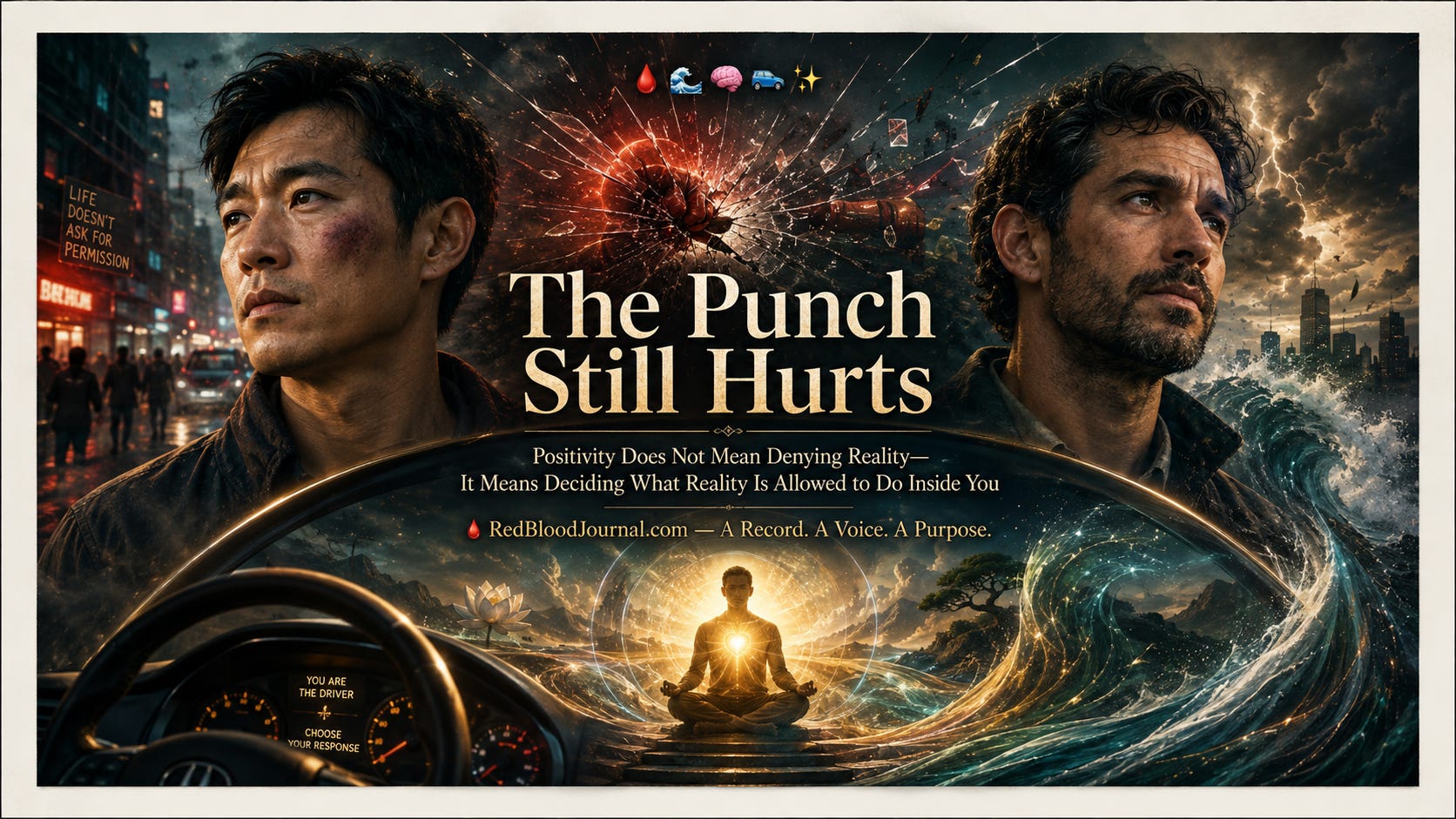
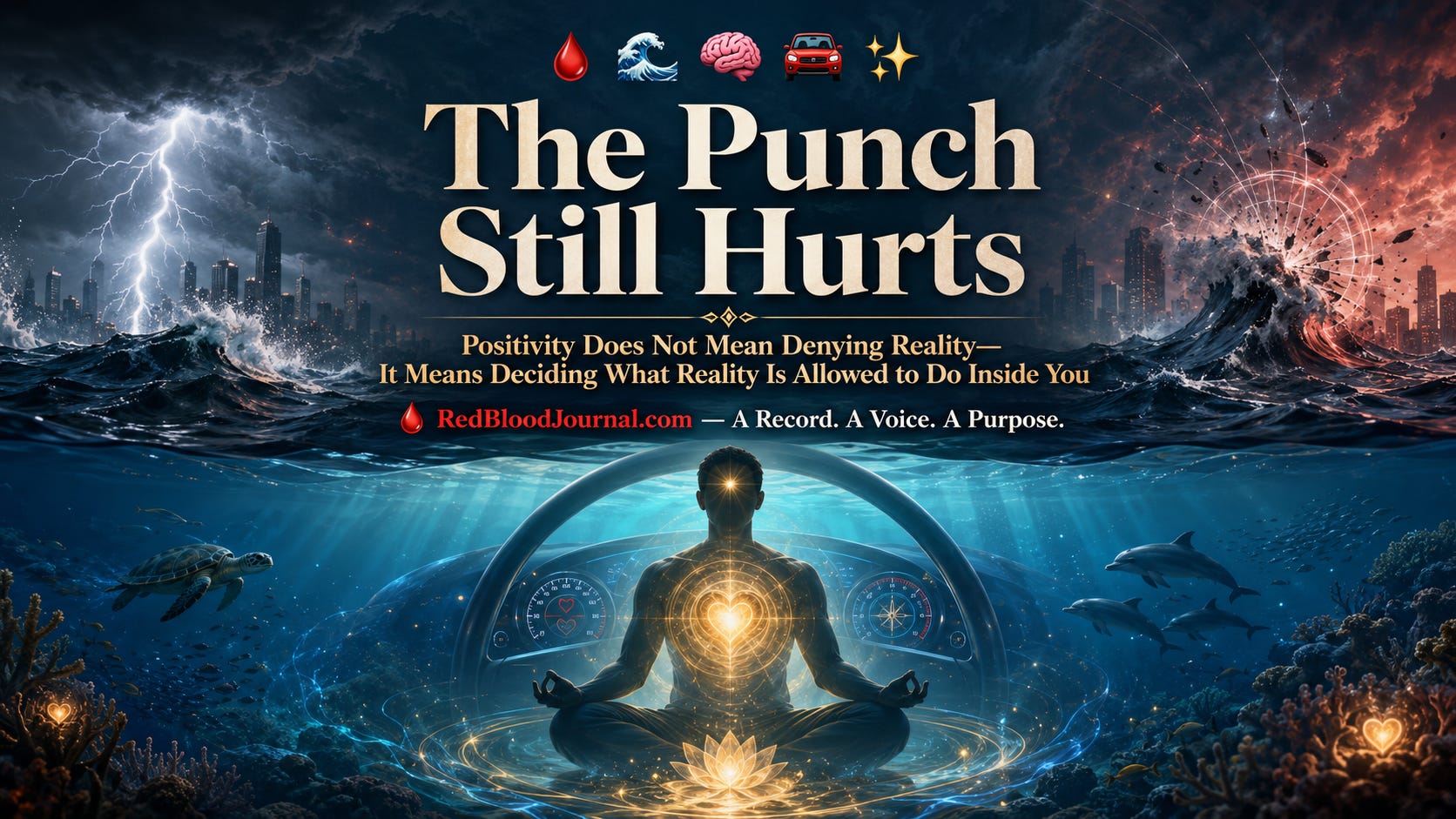
🩸 🌊 🧠 🚗 ✨ The Punch Still Hurts: Positivity Does Not Mean Denying Reality—It Means Deciding What Reality Is Allowed to Do Inside You
RedBloodJournal.com — A Record. A Voice. A Purpose.
A conversation between two strangers began with a simple question:
Is life fantastic?
One person said yes.
The other disagreed.
That disagreement opened the door to a much larger question:
Can life still be called fantastic when the world contains suffering, fear, financial hardship, family problems, war, loss and pain?
The answer depends entirely on what we mean by fantastic.
Because positivity does not mean pretending the punch never landed.
The punch still hurts.
The question is what happens after it lands.
The Brain Is a Wallet
One argument in the conversation was simple:
The mind returns what is repeatedly placed inside it.
Feed it fear, resentment, anger and hopelessness, and those things begin shaping the way life is experienced.
Feed it love, gratitude and positivity, and the same mechanism begins producing a different internal world.
The idea was expressed through a simple analogy:
The brain is like a wallet. What you put into it is what you eventually take back out.
But that alone is merely positive thinking.
The conversation went much further.
Because the real question was not whether positive thoughts feel better.
The question was:
Who are we beneath those thoughts?
The Wave and the Ocean
Imagine an enormous ocean.
Across its surface are countless waves.
Some waves are enormous.
Some are small.
Some are frightened.
Some are ambitious.
Some rise beautifully.
Some collapse almost immediately.
Imagine that every wave represents one human life.
From the wave’s perspective, everything appears separate.
One wave says:
I am bigger than you.
Another says:
I am afraid.
Another says:
I am dying.
Another says:
I need more.
But underneath every wave is the same ocean.
The wave experiences turbulence.
The ocean beneath it remains deeper than the turbulence.
That distinction may be the key to understanding the human experience.
Perhaps what we normally call life is only the surface.
Our jobs.
Our money.
Our bodies.
Our governments.
Our victories.
Our humiliations.
Our possessions.
Our identities.
Our problems.
Our fears.
Those are the waves.
The question becomes:
What exists underneath them?
The University of Life
Perhaps life is not primarily a place where we are supposed to accumulate things.
Perhaps it is a place where we discover ourselves.
A swimmer cannot know what kind of swimmer he is while standing beside the pool.
A tennis player cannot discover his ability without stepping onto the court.
Courage cannot know itself without fear.
Patience cannot know itself without frustration.
Compassion cannot know itself without suffering.
Forgiveness cannot know itself without injury.
If there were no challenge, what exactly would there be to discover?
This leads to a radically different interpretation of life:
Life may be a university for the spirit.
And the curriculum is experience.
Every difficulty becomes a test.
Not a test asking:
Were you successful?
But perhaps:
What did this reveal about you?
Did suffering make you compassionate?
Or cruel?
Did wealth make you generous?
Or arrogant?
Did fear control you?
Did anger control you?
Did the outside world eventually take possession of your inside world?
The Objection That Matters
Then comes the strongest objection.
What happens when the suffering is real?
Suppose family members are struggling.
Suppose someone needs money.
Suppose a country is collapsing.
Suppose war is happening.
Suppose someone you love is suffering.
Can you really respond:
Just be positive?
No.
Because that would confuse positivity with denial.
The material world is real within the experience we are having.
Bills are real.
Pain is real.
Hunger is real.
A broken bone hurts.
Fear affects the body.
A family member asking for help is not imaginary.
The philosophy becomes meaningful only after acknowledging that.
The distinction is not between reality and fantasy.
It is between:
what happens to us
and
what we allow what happens to us to turn us into.
The Punch Still Hurts
Suppose someone punches you in the face.
The positive philosophy does not require pretending the punch felt wonderful.
It hurt.
Your face may swell.
You may bleed.
You may need medical attention.
You may even need to protect yourself.
That is the material reality.
But another question appears immediately afterward.
What happens inside?
Do you carry the punch for ten minutes?
Ten days?
Ten years?
Does it create hatred?
Does hatred become your identity?
Does revenge become your purpose?
Does one person’s violence begin controlling your internal life long after that person has disappeared?
Now the real test becomes visible.
The punch controlled the body for a moment.
Will it control the spirit afterward?
That is an entirely different question.
The Driver and the Vehicle
Imagine the human body as a car.
The body is the vehicle.
Something deeper is driving it.
Call that deeper presence consciousness.
Spirit.
Awareness.
The observer.
The name is less important than recognizing the distinction.
Your car can be damaged without the driver becoming the damaged car.
A warning light can appear without the driver believing he is the warning light.
The vehicle experiences hunger.
Fear.
Sexual desire.
Aggression.
Pain.
Fatigue.
Adrenaline.
Survival instinct.
These are not necessarily enemies.
They belong to the vehicle.
The difficulty begins when the vehicle starts driving the driver.
Anger takes the steering wheel.
Fear takes the steering wheel.
Greed takes the steering wheel.
Revenge takes the steering wheel.
Then the driver forgets that a driver ever existed.
Two Worlds at the Same Time
This gives us two simultaneous realities.
The material world
The body.
Money.
Governments.
Relationships.
Work.
Food.
Shelter.
Physical suffering.
Responsibility.
Consequences.
The spiritual world
Meaning.
Awareness.
Choice.
Love.
Compassion.
Internal peace.
Self-knowledge.
The mistake may be believing we must choose one world and reject the other.
We do not.
We have to live in both.
You can help your family financially while refusing to drown emotionally.
You can oppose injustice without becoming consumed by hatred.
You can recognize corruption without allowing corruption to corrupt you.
You can grieve without becoming grief itself.
You can experience fear without surrendering your identity to fear.
That may be the entire challenge.
Looking Outside
Human beings naturally search outside themselves for stability.
Money.
Relationships.
Political leaders.
Religions.
Countries.
Institutions.
Approval.
Status.
Success.
But everything outside us changes.
People leave.
Governments fall.
Currencies collapse.
Bodies age.
Possessions disappear.
Reputations change.
Relationships end.
If peace depends completely upon external conditions, peace becomes dependent upon something we cannot control.
That creates an impossible contract:
I will be peaceful when the world behaves the way I want it to behave.
The world has never signed that contract.
Perhaps it never will.
Looking Inside
Looking inward does not mean abandoning the world.
It means refusing to make the world the sole owner of your internal state.
That is personal sovereignty at its deepest level.
The person who requires the outside world to become peaceful before experiencing peace has surrendered tremendous power.
The person who can remain internally anchored while responding intelligently to external problems possesses something much harder to confiscate.
Governments cannot print it.
Corporations cannot sell it.
Religions cannot monopolize it.
Armies cannot conquer it.
It exists inside the individual.
What Is Judgment Day?
There is another possibility worth considering.
What if judgment is not primarily someone else judging us?
What if judgment is eventually seeing ourselves clearly?
Imagine leaving this life and confronting one simple question:
What did I become while I was here?
Not:
How much money did I accumulate?
How famous was I?
Which political party did I support?
Which religion did I belong to?
How many people feared me?
How important did I appear?
Instead:
Did I learn?
Did I become more loving?
Did I become more bitter?
Did fear dominate me?
Did anger dominate me?
Did I discover who was driving the vehicle?
Perhaps judgment is self-recognition.
And perhaps repeating the lesson is not punishment.
Perhaps it is simply returning to a classroom we never finished.
The Difference Between Understanding and Acceptance
One of the most fascinating things about philosophical conversations is how often someone says:
I understand.
Then immediately follows with:
But…
That “but” can reveal something important.
Understanding an idea intellectually is not necessarily the same as accepting it deeply enough to live by it.
A person may understand that anger is destructive and remain angry.
A person may understand that possessions are temporary and still organize an entire life around acquiring them.
A person may understand that death is unavoidable and still live as though death were impossible.
Realization is one step.
Understanding is another.
Acceptance is another.
Perhaps graduation requires all three.
So Why Call Life Fantastic?
Not because every experience is pleasant.
Not because suffering does not exist.
Not because injustice should be ignored.
Not because hunger is imaginary.
Not because a punch does not hurt.
Life may be fantastic for a completely different reason.
Because every experience reveals something.
Every challenge creates another opportunity to discover the driver beneath the vehicle.
Every loss asks what truly belonged to us.
Every insult asks who controls our emotions.
Every temptation asks what we value.
Every fear asks whether fear is driving.
Every moment becomes another examination in the University of Life.
Seen that way, even difficulty contains purpose.
The classroom can be brutal.
The lesson can hurt.
The punch can still hurt.
But pain does not have to become hatred.
Loss does not have to become bitterness.
Fear does not have to become identity.
And the outside world does not automatically earn ownership of the inside world.
🩸 The Red Blood Perspective
The great confusion surrounding positivity is the belief that being positive requires denying what is wrong.
It does not.
A person should be able to look directly at suffering, corruption, violence, poverty, injustice and death without pretending any of them are pleasant.
The deeper challenge is refusing to allow those realities to manufacture the person we become.
The world may provide the examination.
We still provide the answer.
That may be where freedom actually begins.
Not when everything outside finally obeys us.
But when everything outside loses the automatic power to control what happens inside.
🌊 The Ocean of Love and Positivity Perspective
The wave does not need to stop being a wave.
It simply needs to remember that it is also ocean.
The body does not need to escape the material world.
It needs a conscious driver.
Pain does not have to disappear before love can exist.
Fear does not have to disappear before courage can exist.
The difficult person, the unexpected loss, the financial pressure, the frightened family member, the broken relationship, the aging body and even death itself may all become parts of the same classroom.
The opening is always inward.
What is this experience revealing about me?
What am I allowing it to create inside me?
Who is driving?
The most powerful victory may not be conquering the world around us.
It may be reaching a point where the world can shake the wave without disturbing the ocean underneath it.
In an Ocean of Love and Positivity.
🩸🌊✨ Fantastic!
🌊
The Driver and the Ocean: Sovereignty Over the Internal State
Sep 1, 2026
This text explores a philosophical perspective on life as a “university for the spirit,” where external hardships serve as a curriculum for internal growth. It distinguishes between the material world of “waves,” representing temporary physical struggles, and a deeper “ocean” of consciousness that remains stable beneath the surface. The author argues that true positivity is not the denial of pain or reality, but rather the sovereign choice of how much power we allow those experiences to have over our inner selves. Using the analogy of a driver and a vehicle, the source emphasizes that while the body may suffer, the spirit must maintain control to avoid being consumed by bitterness or fear. Ultimately, the narrative suggests that life is fantastic because every challenge provides an opportunity to discover our essential nature and achieve emotional freedom. Success is therefore measured not by external accumulation, but by the wisdom and compassion we cultivate in response to the world’s “punches.”
#RedBloodJournal #OceanOfLoveAndPositivity #LifeIsFantastic #Positivity #Spirituality #Philosophy #SelfAwareness #Consciousness #UniversityOfLife #PurposeOfLife #MeaningOfLife #InnerPeace #PersonalSovereignty #Mindset #LoveAndPositivity #Spirit #DriverAndVehicle #WaveAndOcean #InnerStrength #EmotionalFreedom #SelfDiscovery #Growth #Acceptance #Awareness #Fantastic


