


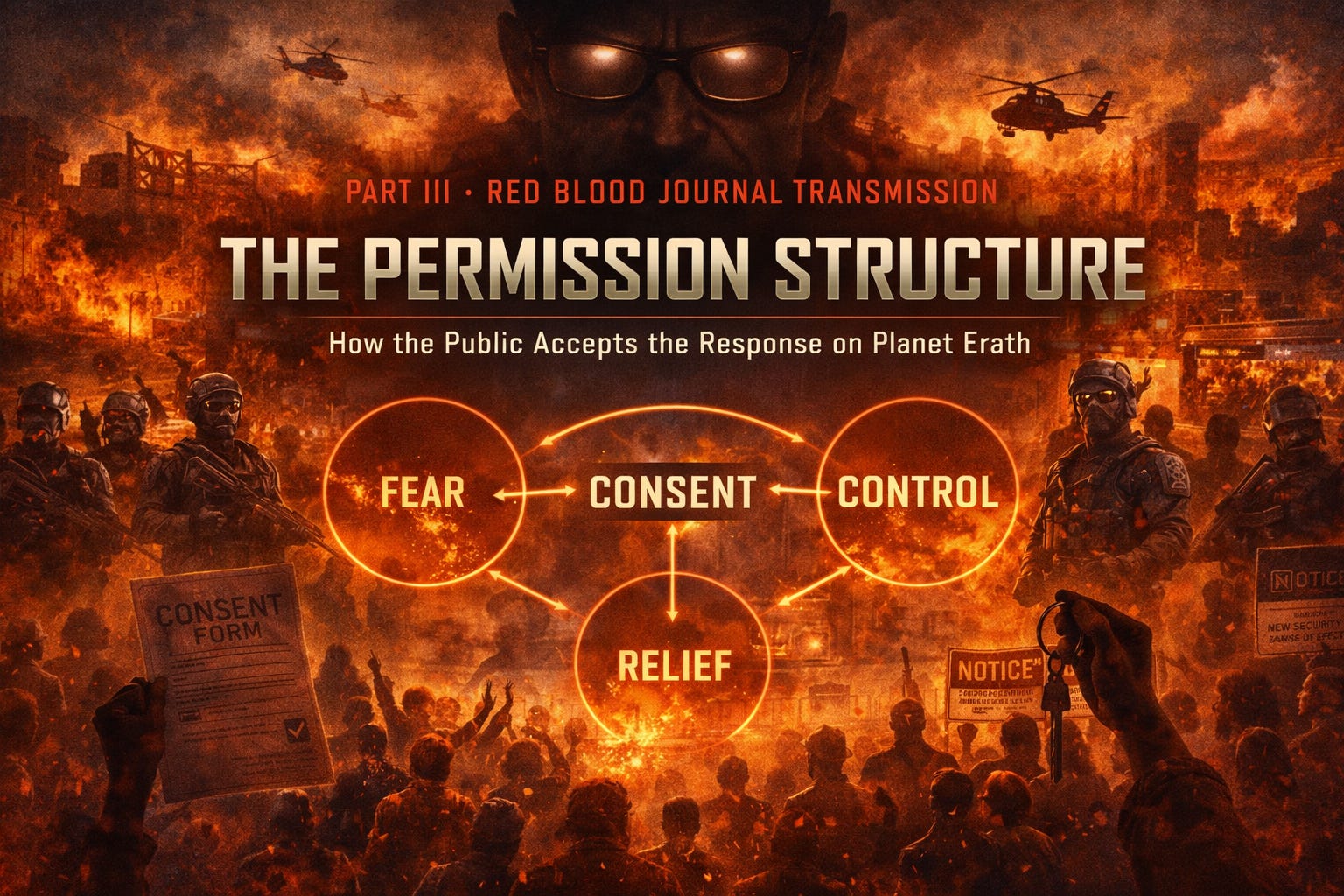
🩸 RED BLOOD JOURNAL TRANSMISSION
Transmission Code: RBJ-ERATH-PERMISSION-003
Classification: EYES ONLY — CONSENT & COMPLIANCE DOSSIER
Desk: Parallel Planet Intelligence Wing
Archive: The Archive of Blood & Memory
How fear makes the unacceptable normal
THE PERMISSION STRUCTURE
How the Public Accepts the Response on Planet Erath
PROLOGUE — THE FINAL STEP
On Planet Erath, the fire burns.
The story spreads.
But neither of those completes the process.
There is one final requirement—
one silent checkpoint that determines whether power can move forward:
Permission.
Not always spoken.
Not always conscious.
But always necessary.
I — THE INVISIBLE CONTRACT
The citizens of Erath believe they are free.
And in many ways, they are.
But beneath that freedom exists an unwritten agreement:
“In times of fear, protection becomes priority.”
This is the Permission Structure.
It does not require force.
It requires acceptance.
II — THE MOMENT OF VULNERABILITY
Permission is never requested during calm.
It emerges in moments when:
Fear is high
Information is incomplete
Urgency is overwhelming
At that point, the population shifts:
From questioning → to seeking safety
From skepticism → to acceptance
The same actions that would be resisted yesterday
become reasonable today.
III — THE LANGUAGE OF NECESSITY
The Narrative Engine (Part II) prepares the ground.
Then comes the transition:
From explanation → to justification.
New phrases appear:
“We must act now”
“There is no alternative”
“This is for your safety”
These are not just statements.
They are permission triggers.
They transform action into necessity.
IV — THE TRADE-OFF MECHANISM
Every response on Erath carries a cost:
Freedom → for security
Privacy → for surveillance
Stability → for control
But the structure never presents it as a loss.
It presents it as a trade.
And in moments of fear, the public often chooses:
Immediate safety over abstract freedom.
V — THE GRADUAL SHIFT
Permission is rarely taken all at once.
It moves in steps:
Temporary measure
Extended measure
Normalized measure
What begins as an exception
becomes a standard.
What feels uncomfortable
becomes familiar.
And what becomes familiar
becomes accepted.
VI — THE ROLE OF ALIGNMENT
Not all citizens agree.
But full agreement is not required.
Only:
A majority
Or a loud enough consensus
Or a divided opposition
On Erath, division itself becomes a tool:
If people argue with each other—
they are less likely to challenge the structure itself.
VII — THE FEAR–RELIEF LOOP
The system operates in cycles:
Fear rises (event + narrative)
Action is introduced
Relief follows
Even if the relief is partial—
it reinforces the belief:
“The response worked.”
And that belief becomes the foundation
for the next cycle.
VIII — THE NORMALIZATION POINT
The most important moment is not the decision.
It is what happens after.
When:
Measures remain
Systems stay in place
New baselines are established
At that point, the public no longer sees the change as temporary.
It becomes the new reality.
IX — THE PARADOX OF CONSENT
On Planet Erath, control does not always look like control.
Because the final step is not enforcement.
It is agreement.
Even if that agreement is:
Pressured
Influenced
Incomplete
It is still real.
And that is what makes the structure so effective.
🩸 ANNEX A — THE PERMISSION PIPELINE
Event (Fear Trigger)
Narrative (Meaning Assigned)
Urgency (Time Pressure Introduced)
Justification (Action Framed as Necessary)
Public Acceptance (Explicit or Silent)
Implementation (Policy / Action)
Normalization (New Baseline)
🩸 ANNEX B — THE ACCEPTANCE LEVERS
Fear (primary driver)
Trust in authority
Group alignment
Repetition of messaging
Lack of alternatives
🩸 ANNEX C — THE ILLUSION OF CHOICE
Options presented on Erath often appear as:
Option A: Risk
Option B: Control
The structure rarely offers:
Option C: Reframing the system itself
🩸 CLOSING STATEMENT
On Planet Erath, power is not secured
when actions are taken—but when those actions are accepted.
The fire creates fear.
The story creates meaning.
But it is permission—
that allows everything to follow.
🤝The Architecture of Consent on Planet Erath
The provided text outlines a sophisticated psychological framework called the Permission Structure, which is used to gain public compliance on the planet Erath.
This system functions by exploiting moments of intense fear and urgency to shift the population’s focus from individual liberty to a desperate desire for safety.
Through a calculated narrative of necessity, authorities present the erosion of privacy and freedom as a logical trade for security.
This process is rarely abrupt; instead, it relies on gradual normalization where temporary emergency measures eventually become the standard social baseline.
Ultimately, the text argues that true power is not exerted through physical force but through engineered consent, where citizens voluntarily accept control.
The cycle is maintained by an illusion of choice that prevents the public from questioning the underlying system itself.


