


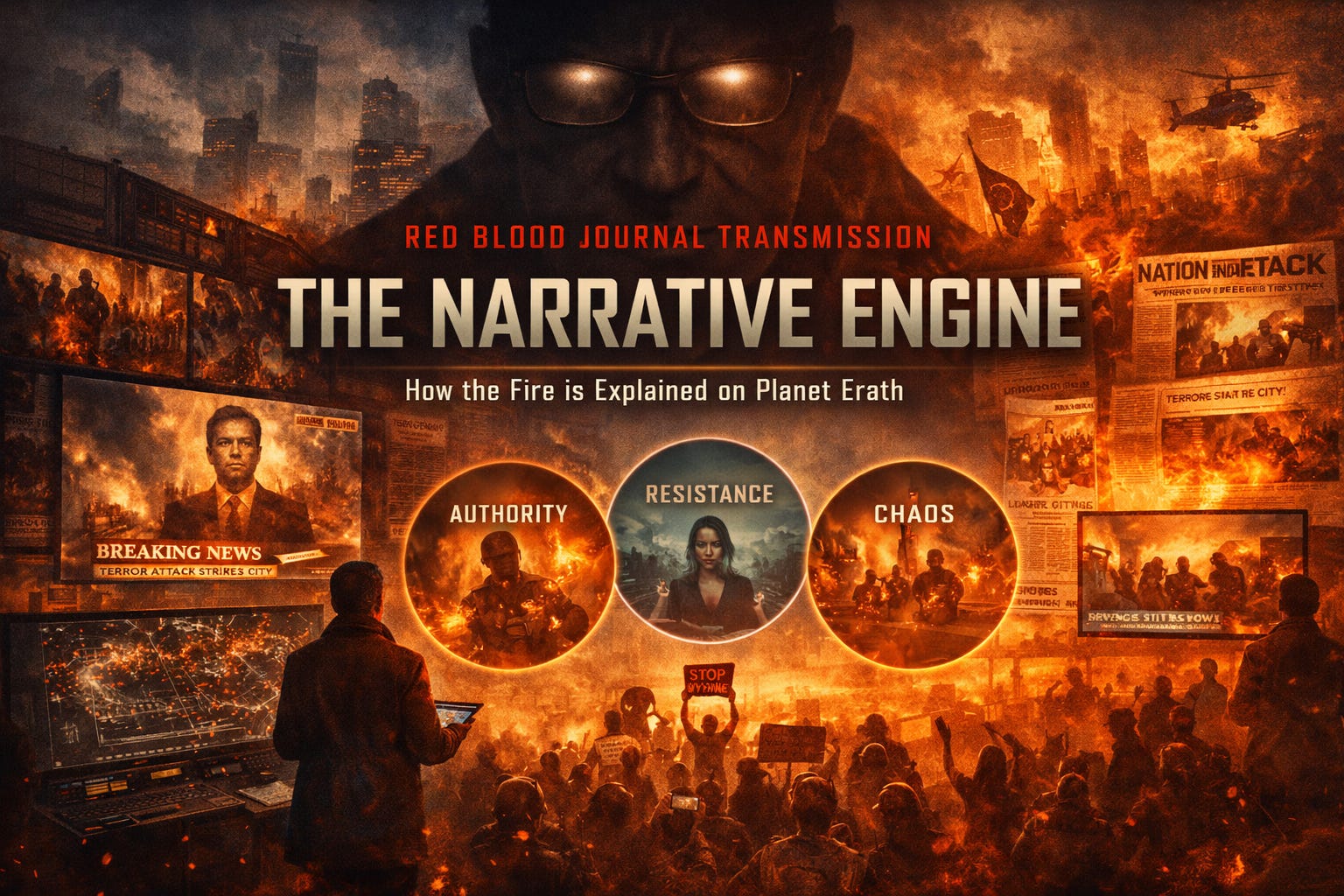
🩸 RED BLOOD JOURNAL TRANSMISSION
Transmission Code: RBJ-ERATH-NARRATIVE-002
Classification: EYES ONLY — PERCEPTION MANAGEMENT DOSSIER
Desk: Parallel Planet Intelligence Wing
Archive: The Archive of Blood & Memory
Media chaos and fiery unrest
The explanation arrives before the truth
THE NARRATIVE ENGINE
How the Fire is Explained on Planet Erath
PROLOGUE — THE SECOND FIRE
On Planet Erath, the first fire is physical.
It burns cities.
It moves armies.
It fractures populations.
But there is always a second fire.
Quieter. Faster. More decisive.
The story.
Before the flames settle, before the smoke clears, before the truth is even visible—
The explanation arrives.
And on Erath, the explanation determines everything.
I — THE RACE BEFORE REALITY
The moment a spark becomes visible, a race begins.
Not between armies.
Between interpretations.
Within minutes:
Screens activate
Headlines form
Language solidifies
Words appear with precision:
“Attack”
“Defense”
“Terror”
“Security”
These words are not random.
They are positioning devices.
Because on Erath, whoever defines the event first
owns the event.
II — THE ARCHITECTS OF STORY
The Narrative Engine is not a single institution.
It is a network.
Broadcasters
Analysts
Officials
Platforms
Influencers
Each plays a role.
Some knowingly.
Some automatically.
Together, they form a system that translates chaos into meaning.
Not necessarily false meaning—
But selective meaning.
III — THE THREE LENSES OF ERATH
Every major event on Erath is processed through three dominant lenses:
1. The Authority Lens
“Order must be restored.”
Focus: Stability, control, response
Outcome: Justifies action
2. The Resistance Lens
“This is oppression.”
Focus: Power abuse, injustice
Outcome: Mobilizes opposition
3. The Chaos Lens
“Everything is breaking.”
Focus: Fear, uncertainty, collapse
Outcome: Paralyzes clarity
The population does not see the event directly.
They see it through one of these lenses.
IV — THE LANGUAGE OF FIRE
The Narrative Engine does not describe reality.
It frames it.
Small changes in language reshape entire perceptions:
“Militant” vs “Freedom Fighter”
“Strike” vs “Defense Operation”
“Collateral Damage” vs “Civilian Casualties”
Each word is a switch.
Each switch alters:
Emotion
Judgment
Acceptability
On Erath, language is not communication.
It is calibration.
V — THE TIMING ADVANTAGE
The first narrative rarely needs to be perfect.
It only needs to be early.
Because once an explanation takes hold:
Corrections struggle
Nuance disappears
Positions harden
Later facts do not replace the story.
They are forced to compete with it.
And on Erath, the first version often becomes the permanent one.
VI — THE FEEDBACK LOOP
The most powerful part of the Narrative Engine is not creation—
It is reinforcement.
Once a story is established:
It is repeated
Shared
Debated
Defended
Each repetition strengthens it.
Soon, the narrative no longer needs support.
It becomes self-sustaining.
At that point, the fire no longer needs fuel.
It feeds on belief.
VII — THE MULTIPLE REALITIES PROBLEM
On Erath, there is rarely one narrative.
There are many.
Different populations experience entirely different versions of the same event:
One sees justice
One sees aggression
One sees confusion
Each believes they are informed.
Each believes the other is misled.
And so, the fire spreads—
Not just across land—
But across perception.
VIII — THE INVISIBLE HAND OF SELECTION
Not every event becomes a global fire.
Some disappear.
Some never ignite.
This is not always because they lack importance—
But because they lack amplification.
On Erath, power is not only in shaping stories—
But in deciding:
Which stories rise
Which stories vanish
Silence, too, is a narrative.
IX — THE ENDGAME
When the Narrative Engine reaches full output:
The public aligns
The opposition organizes
The justification solidifies
At that point, the original event becomes secondary.
The story becomes primary.
And decisions follow the story—
Not the reality.
🩸 ANNEX A — THE EVENT → NARRATIVE → ACTION PIPELINE
Trigger Event Occurs
Immediate Framing (Minutes–Hours)
Mass Dissemination (Hours–Days)
Public Alignment (Days)
Policy or Action (Days–Weeks)
🩸 ANNEX B — THE LANGUAGE SWITCHBOARD
Key framing tools:
Labeling (terrorist / activist)
Scaling (isolated / widespread)
Attribution (who is responsible)
Moral framing (justified / unjustified)
🩸 ANNEX C — THE VISIBILITY FILTER
Three outcomes for any event:
🔴 Amplified → becomes global narrative
🟡 Contained → limited awareness
⚫ Suppressed → effectively invisible
🩸 CLOSING STATEMENT
On Planet Erath, the fire does not decide the outcome—
the explanation does.
And by the time the truth arrives,
the world has already chosen
what it believes burned.
👁️The Narrative Engine of Erath
This text explores the Narrative Engine on the fictional planet Erath, a system designed to manage public perception through the strategic framing of events.
It argues that the immediate interpretation of a crisis is more influential than the physical reality of the event itself.
By utilizing specific linguistic labels and dominant lenses—such as authority or resistance—power structures can dictate public reaction and justify specific policies.
Speed is essential in this process, as the initial explanation often becomes the permanent truth, regardless of later factual corrections.
Ultimately, the source suggests that on Erath, controlling the story is the ultimate form of power, effectively turning subjective belief into a self-sustaining reality.


