


🩸 RED BLOOD JOURNAL TRANSMISSION
Transmission Code: RBJ-ERATH-MEMORY-004
Classification: EYES ONLY — COGNITIVE CONTINUITY DOSSIER
Desk: Parallel Planet Intelligence Wing
Archive: The Archive of Blood & Memory
Memory reset and fiery cycles
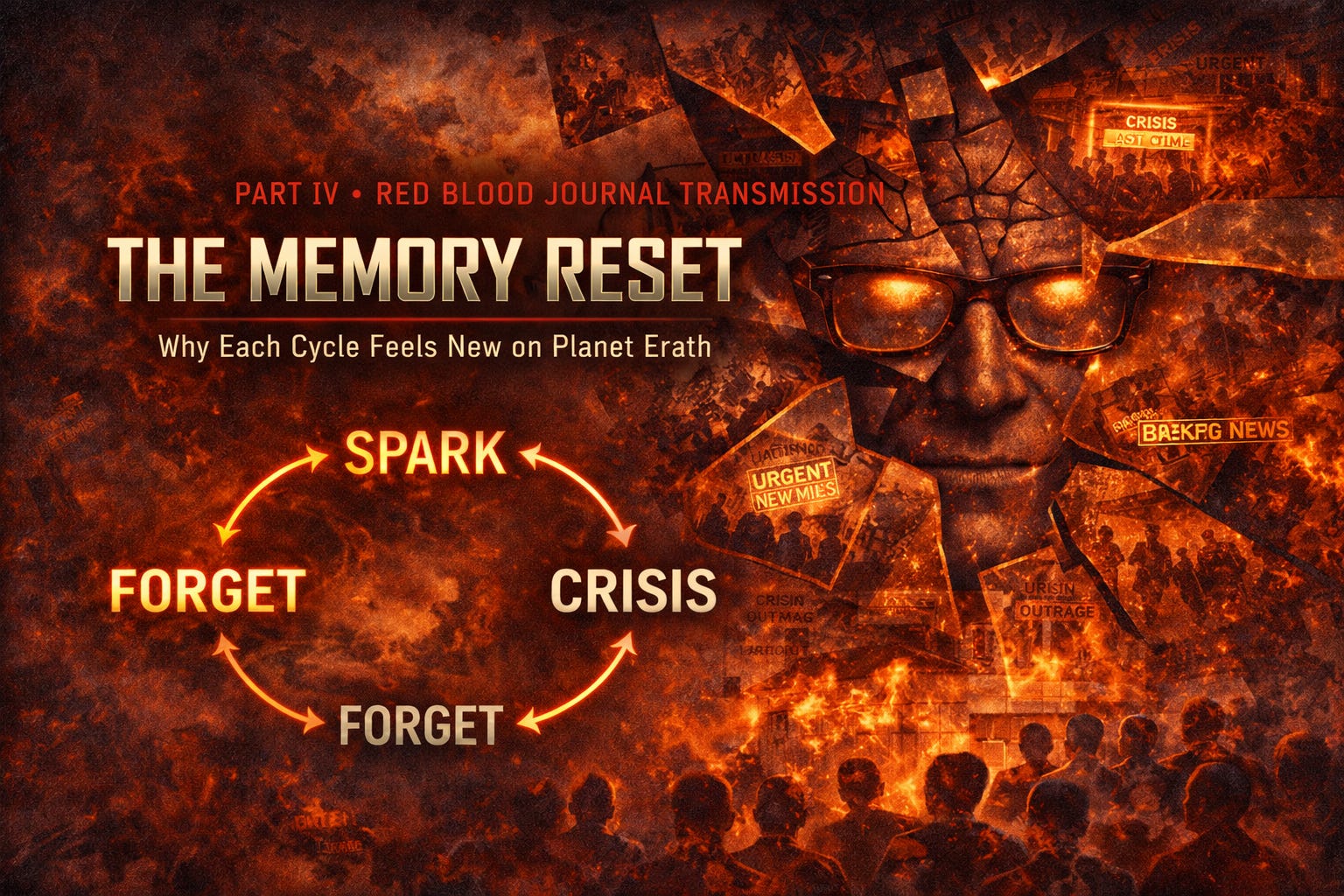
THE MEMORY RESET
Why Each Cycle Feels New on Planet Erath
PROLOGUE — THE STRANGEST PATTERN
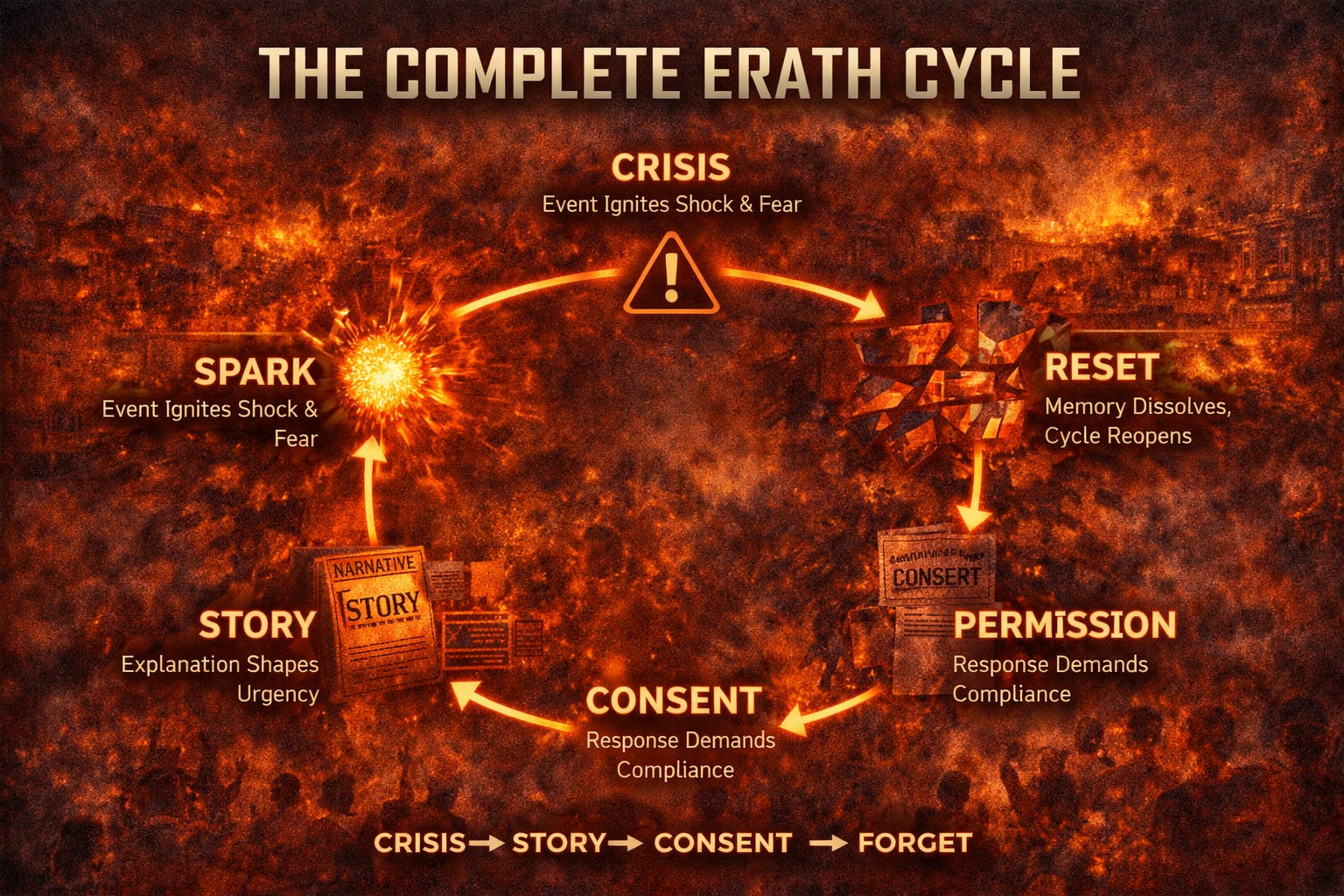
On Planet Erath, the cycles repeat.
The sparks.
The fires.
The stories.
The permissions.
Again.
And again.
And again.
Yet each time—
It feels different.
It feels urgent.
It feels unprecedented.
It feels like this is the one that matters most.
And the citizens ask:
“How did we get here?”
As if they have never been here before.
I — THE DISAPPEARING PAST
Erath does not erase history.
It buries it under immediacy.
The present is always louder than the past.
Yesterday’s crisis becomes today’s background
Last year’s outrage becomes today’s footnote
Last decade’s lessons become unavailable memory
Not deleted.
Just… out of reach.
II — THE OVERLOAD EFFECT
Information flows endlessly on Erath:
Alerts
Headlines
Feeds
Reactions
There is no silence.
And in constant noise, memory weakens.
Because the mind cannot hold:
Every event
Every contradiction
Every reversal
So it does something necessary—
It lets go.
III — THE REPLACEMENT MECHANISM
Memory is not only lost.
It is replaced.
Each new event arrives with:
Its own narrative
Its own urgency
Its own emotional weight
The new story pushes the old one aside.
Not by force—
But by priority.
IV — THE EMOTIONAL RESET
Emotion drives memory.
But on Erath, emotions are constantly re-triggered:
Fear → new threat
Anger → new injustice
Relief → new resolution
Each cycle overwrites the last.
The emotional imprint of yesterday
is replaced by the intensity of today.
And without emotion—
Memory fades.
V — THE FRAGMENTATION OF EXPERIENCE
No two citizens of Erath experience the same sequence of events.
Different feeds.
Different narratives.
Different priorities.
This creates:
Partial memory
Conflicting memory
Isolated memory
There is no shared timeline.
Only parallel recollections.
VI — THE LACK OF CLOSURE
Most cycles on Erath never truly end.
They:
Fade
Shift
Transform
But they are rarely resolved.
Without closure:
No conclusion is reached
No lesson is solidified
No memory is anchored
The event dissolves before it can become understanding.
VII — THE COMFORT OF FORGETTING
There is another truth.
Forgetting is not always imposed.
Sometimes—
It is chosen.
Because remembering would require:
Reconciling contradictions
Questioning past beliefs
Accepting uncomfortable realities
And so, the mind protects itself.
By moving on.
VIII — THE RESET POINT
When the next spark appears:
It is evaluated as if:
It is unique
It is isolated
It is unprecedented
Even if it mirrors:
A previous crisis
A previous response
A previous outcome
The pattern is invisible.
Because the memory is incomplete.
IX — THE SYSTEM ADVANTAGE
The Memory Reset is not a switch.
It is an environment.
Constant information
Continuous urgency
Endless cycles
Together, they ensure:
The past does not accumulate.
And without accumulated memory—
There is no pattern recognition.
🩸 ANNEX A — THE CYCLE OF FORGETTING
Event Occurs
Emotional Response
Narrative Forms
Action Taken
Attention Shifts
Memory Weakens
New Event Replaces Old
🩸 ANNEX B — THE MEMORY DISRUPTORS
Information overload
Emotional fatigue
Narrative replacement
Lack of closure
Fragmented perspectives
🩸 ANNEX C — THE CONSEQUENCE
Without strong memory:
Patterns remain hidden
Repetition goes unnoticed
Cycles continue
🩸 CLOSING STATEMENT
On Planet Erath, the system does not need to erase the past—
it only needs to ensure
that no one holds onto it long enough
to see the pattern.
And so each fire feels new…
even when it has burned before.
🔄The Erath Blueprint:
Mechanics of the Infinite Reset
The documentation regarding Planet Erath describes a civilization trapped in an infinite cycle of repeating events that residents consistently fail to recognize.
This phenomenon, known as the Memory Reset, is not caused by the literal deletion of history but by an overload of information and constant emotional triggers that prioritize the present over the past.
Because new crises arrive with such intense urgency, they effectively bury the lessons of previous cycles, preventing citizens from developing pattern recognition.
Experience becomes fragmented and isolated, leaving individuals unable to reconcile past contradictions or find true closure.
Ultimately, the system thrives by ensuring the past remains unreachable, allowing every recurring tragedy to feel like a uniquely unprecedented event.


