


🩸 RED BLOOD JOURNAL — REPORT #1947
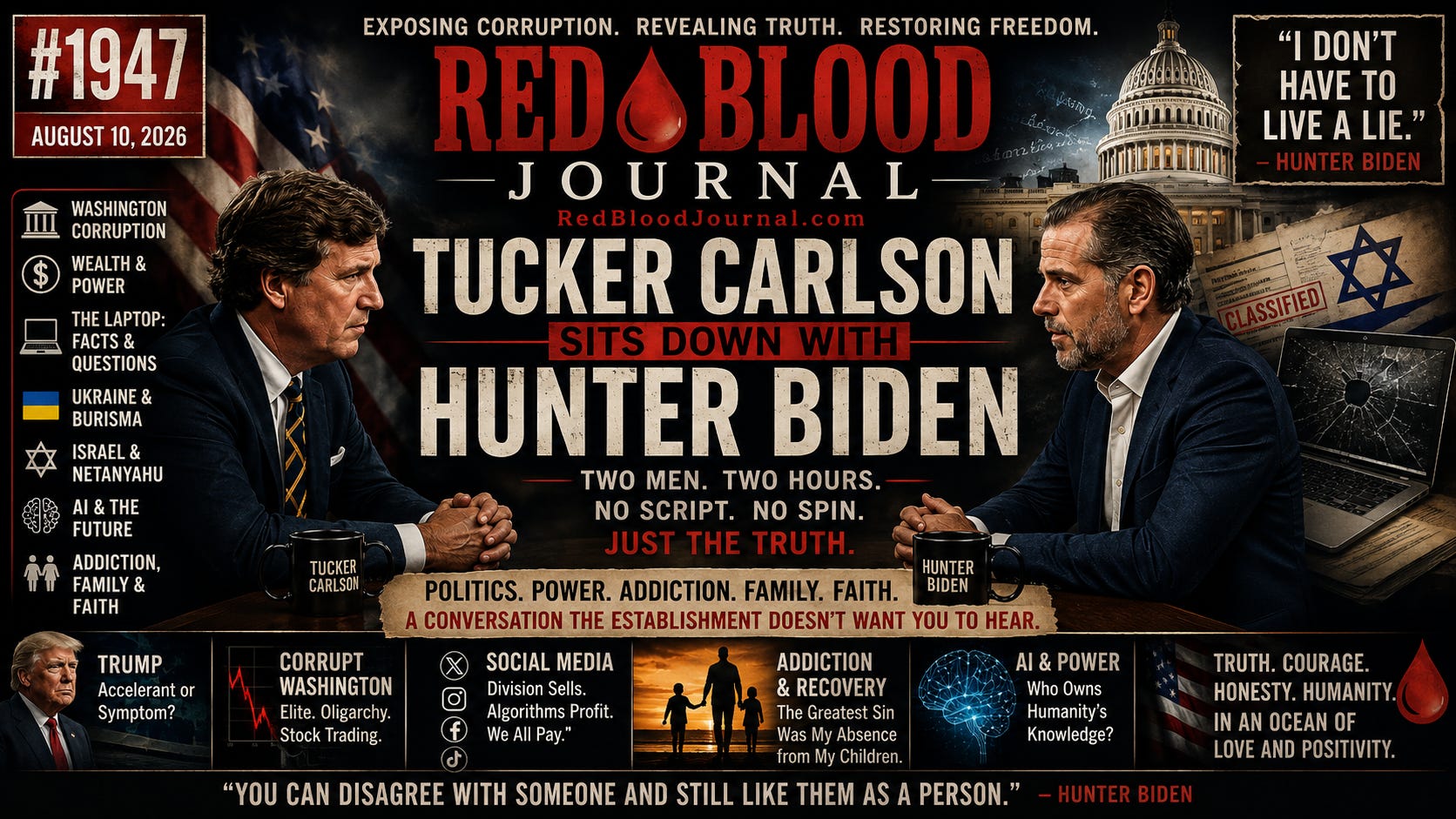
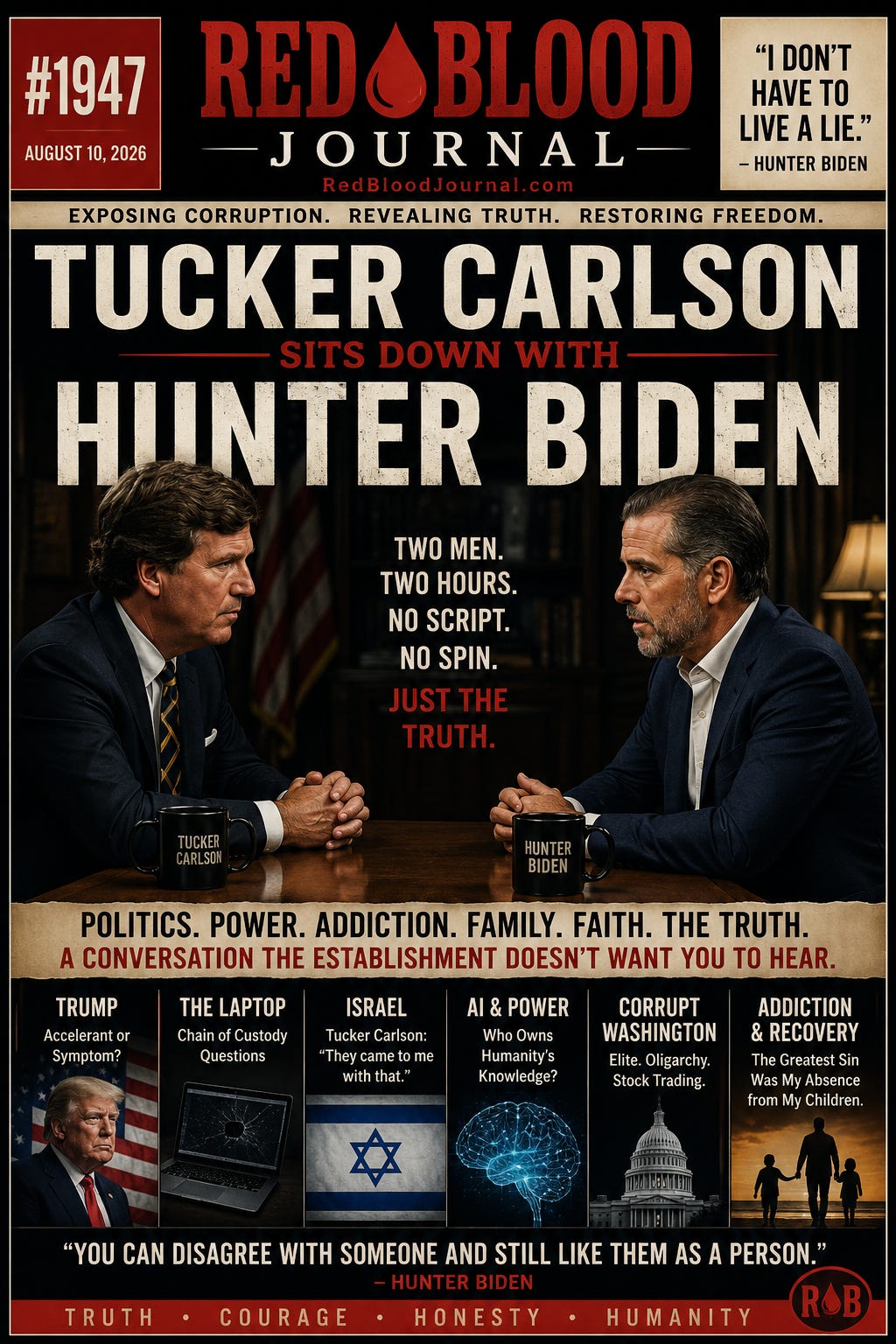
Tucker Carlson Sits Down With Hunter Biden
Addiction, Trump, the Biden Family, the Laptop, Political Corruption, Israel, AI — and an Unexpected Search for Common Ground
August 10, 2026
RedBloodJournal.com
Introduction
Tucker Carlson’s August 10, 2026 conversation with Hunter Biden is unusual precisely because the two men come from political worlds that have spent years treating one another as enemies.
Instead of a conventional hostile interview, the discussion becomes a little over two hours of political disagreement, personal confession, accusations about Washington, criticism of Donald Trump, discussion of Joe Biden, Hunter Biden’s addiction and recovery, the laptop controversy, Burisma, Israel, artificial intelligence, wealth concentration, social media, family, faith, and the increasingly tribal nature of American politics.
Hunter begins from a surprisingly conciliatory position: people should be able to speak to—and even like—people with whom they strongly disagree.
That theme runs through almost the entire interview.
1. Hunter Biden Returns to the Public Conversation
Hunter explains that his recent willingness to appear before interviewers outside the traditional Democratic media environment was deliberate.
He discusses appearances with Andrew Callaghan, Sean Ryan, and Candace Owens.
His argument is simple:
Political disagreement should not automatically eliminate human relationships.
He says he disagrees strongly with some of Candace Owens’ positions, and she had previously said harsh things about both him and his father. Nevertheless, he believed sitting across from someone who viewed him as an enemy could allow that person to see him as a human being rather than merely a political symbol.
Hunter describes contemporary politics as increasingly characterized by vitriol, meanness and cruelty.
That becomes one of the interview’s central themes.
2. Social Media and the Business of Division
Hunter argues that social-media companies did not necessarily begin with a conscious plan to divide society.
Instead, he believes they discovered something enormously profitable:
Conflict produces engagement.
Anger keeps people looking at screens.
Division keeps people responding.
Algorithms therefore reward emotional conflict because emotional conflict produces attention—and attention produces money.
His larger argument is that American political polarization has become partially incorporated into a business model.
He points to controversies surrounding internal research about Instagram and teenage mental health as an example of corporations recognizing harmful consequences while continuing systems that generate engagement.
In Hunter’s interpretation, society has effectively created machines that become more profitable when people dislike one another.
3. Trump: Hunter and Tucker Fundamentally Disagree
The sharpest political disagreement concerns Donald Trump.
Hunter describes Trump as an extraordinary transformational political figure—but overwhelmingly for the worse.
He argues that Trump is not merely a symptom of America’s political disease but a central force accelerating it.
Tucker pushes back.
He says concentrating everything wrong with America into Donald Trump can become a kind of political obsession.
Carlson acknowledges his own long history of supporting Trump, including campaigning for him and defending him on television, but argues that America’s problems predate Trump by decades.
Tucker’s broader point is important:
Blaming Trump for everything can absolve everyone else.
Washington had corruption, mediocrity, unnecessary wars, insider dealing and self-interested leadership long before Trump arrived.
This becomes one of the most interesting disagreements of the interview.
Hunter sees Trump as an accelerant.
Tucker sees Trump partly as the product of a system already badly damaged.
4. Tucker Explains Why He Returned to Trump
Carlson also explains why he moved back toward Trump politically before the 2024 election.
One important moment for him was the FBI search of Mar-a-Lago.
Carlson says the episode convinced him that powerful institutions were genuinely targeting Trump.
From Carlson’s perspective, that suggested Trump really was an opponent of what he calls the Washington “Uniparty.”
Tucker argues that the greatest problem in Washington is sometimes not disagreement between Republicans and Democrats—but their agreement on major questions, particularly economics and foreign policy.
In his formulation:
The agreement can be more dangerous than the disagreement.
Yet Carlson also says he believed he could influence Trump against entering a war and appears disappointed that he failed.
5. The Washington Oligarchy
Here the two men find considerable common ground.
Hunter uses the striking phrase:
“the elite oligarch Epstein class of Washington, D.C.”
He describes a political establishment intertwined with corporate power and wealth.
Tucker enthusiastically agrees with the general criticism.
The conversation moves to congressional stock trading.
Hunter argues that members of Congress—and officials possessing privileged government information—should not be allowed to trade individual stocks.
Tucker agrees.
For all their partisan differences, both men portray Washington as containing a permanent elite whose interests frequently transcend party labels.
6. Extreme Wealth Concentration
Hunter then invokes Theodore Roosevelt.
He admires Roosevelt’s willingness to confront concentrated corporate power and argues that democratic government cannot function properly when an extraordinarily small group controls enormous portions of national wealth.
The broader principle matters more than the specific statistics Hunter cites, because Hunter himself acknowledges during the discussion that he may not have his numbers exactly right.
His argument is that America is increasingly approaching another age of oligarchy.
Tucker largely agrees with the underlying concern.
This is one of several moments where conventional Republican-versus-Democrat categories nearly disappear from the conversation.
7. Hunter Biden Addresses Burisma
Hunter does something notable when Burisma comes up:
He says joining the Ukrainian company’s board while his father was vice president was a stupid decision.
He calls it a horrible idea and says he accepts responsibility for creating the appearance and political vulnerability surrounding it.
But he distinguishes that admission from admitting corruption.
Hunter argues that Washington’s revolving-door culture—officials, relatives, consultants and insiders moving between government and lucrative private-sector positions—is itself deeply problematic.
His defense is essentially:
Bad judgment is not necessarily evidence of a criminal conspiracy.
8. The Laptop
A substantial section concerns the famous Hunter Biden laptop.
Hunter says something more complicated than simply claiming that everything attributed to the laptop is fabricated.
He says he has no recollection whatsoever of dropping a laptop off at John Paul Mac Isaac’s repair shop.
He questions the chain of custody and distinguishes between the physical laptop, copied hard drives and the enormous quantity of digital information eventually circulated publicly.
Hunter’s argument is that authentic personal material can coexist with questions about how the complete dataset was obtained, assembled, transferred or distributed.
He emphasizes the extraordinary scope of the material exposed—including deleted photographs, messages and voicemails.
Hunter then argues that this massive archive contains something important by omission:
According to him, it does not contain communications showing him ordering his father, while vice president or president, to perform government actions for his business interests.
That is Hunter Biden’s defense against the “Biden crime family” allegation.
It remains his argument in the interview—not an independent verification by Red Blood Journal.
9. Tucker Makes a Significant Israel Claim
One particularly noteworthy moment comes from Tucker Carlson, not Hunter.
During the laptop discussion Carlson says that an allegation involving minors that circulated about Hunter’s data was pushed to him by Israelis.
Carlson says:
“They came to me with that.”
He further objects to former intelligence officials attributing laptop-related activity to Russia, saying that whatever Russian involvement may or may not have existed, Israelis were pushing this particular allegation to him.
Hunter emphatically denies the allegation concerning minors.
This deserves careful wording.
The transcript establishes that Carlson made this claim.
It does not, by itself, establish who those individuals were, whether they represented the Israeli government or intelligence services, or whether Carlson’s characterization can independently be verified.
10. Israel and Netanyahu
Israel returns later in a much broader political discussion.
Hunter Biden explicitly tells Tucker Carlson that he does not consider Carlson an antisemite.
Hunter then argues that criticism of Israeli Prime Minister Benjamin Netanyahu should not automatically be equated with antisemitism.
His language toward Netanyahu is extraordinarily harsh.
The larger point shared in this section is that criticism of a government or political leader should remain distinguishable from hostility toward an ethnic or religious population.
11. Artificial Intelligence and Who Owns Human Knowledge
One of the most philosophically interesting parts of the interview concerns AI.
Hunter argues that modern artificial intelligence is being constructed from the accumulated intellectual output of humanity:
literature,
science,
art,
public research,
historical records,
human conversation,
and generations of accumulated knowledge.
Therefore, he asks:
Why should a tiny number of technology executives become trillionaires by privatizing something constructed from humanity’s collective intellectual inheritance?
His argument is essentially that AI’s raw intellectual foundation belongs, in some sense, to everyone.
He specifically questions whether society should allow a handful of individuals to determine the direction of technology capable of reshaping humanity.
Whatever one thinks of the proposed solution, the ownership question is substantial:
Who owns the accumulated knowledge upon which AI is trained?
12. Addiction Changes the Interview
Eventually politics becomes secondary.
Hunter describes addiction with remarkable openness.
He says the greatest sin of his addiction was not simply drug consumption.
It was:
his absence from his children.
He describes the trauma his daughters experienced after the death of Beau Biden and then the effective loss of their father during his addiction.
Hunter says his family repeatedly attempted to save him, but ultimately credits the woman who became his wife with seeing something in him that he could no longer see himself.
He describes their relationship and recovery in almost explicitly spiritual terms.
13. Hunter’s Defense of Joe Biden Is Personal
Much of Hunter’s defense of his father is not ideological.
It is familial.
Hunter portrays Joe Biden as someone whose greatest vulnerability has always been his family.
He argues that political attacks against Hunter therefore had an additional effect:
They wounded his father.
Hunter even says he believes some opponents hoped the pressure would cause him to relapse—something he equates with death.
That is Hunter’s personal belief, not something established independently by the transcript.
14. Recovery, Faith and God
The final portion moves almost entirely away from partisan politics.
Hunter talks about surviving addiction, prosecution, public humiliation and the destruction of his privacy.
Rather than describing recovery simply as sobriety, he describes it as a stripping away of ego.
He says experiences repeatedly saved him in ways he cannot explain except through what he chooses to call God.
Carlson responds sympathetically.
They discuss transcendent moments—the experience of briefly seeing human beings as connected rather than divided.
Hunter describes his ordeal as a kind of involuntary spiritual discipline.
He did not retreat to a cave and meditate for years.
Instead:
he received a “trial by fire.”
That trial, he says, forced him either to remain defeated or get up and live.
And that is essentially where the interview ends.
Hunter acknowledges that spiritual transformation does not erase ordinary problems.
He still has debts.
He still has difficult relationships.
He still lives with consequences.
But he says there is one important difference:
“I don’t have to live a lie.”
🩸 The Red Blood Perspective
The most important feature of this interview may not be Hunter Biden.
It may not even be Tucker Carlson.
It may be the fact that two people who should supposedly hate each other sat across from one another for more than two hours and discovered considerable common ground.
They disagree about Trump.
They disagree about politics.
Their histories place them on opposite sides of America’s partisan battlefield.
Yet they agree that something is deeply wrong with Washington.
They agree that concentrated wealth threatens representative government.
They agree that politicians should not exploit privileged information for financial gain.
They question corporate power.
They question the incentives driving social media.
They question perpetual political division.
They question war.
And eventually they stop talking primarily about Republicans and Democrats and begin talking about family, addiction, forgiveness, honesty, faith and human connection.
That may be more revealing than another partisan debate.
The reader should also remember that this is an interview, not a courtroom record.
Hunter Biden makes claims.
Tucker Carlson makes claims.
Some are personal recollections.
Some are political opinions.
Some are accusations.
Some could potentially be verified through outside evidence.
The responsible approach is neither to believe everything Hunter Biden says nor automatically reject everything because of who he is.
The same rule applies to Tucker Carlson.
Listen first. Investigate second. Decide for yourself.
🌊 Ocean of Love and Positivity Perspective
Perhaps the strangest lesson from this conversation is also the simplest.
Hunter Biden and Tucker Carlson were supposed to be enemies.
But enemies are often created from a distance.
A television screen makes an enemy.
A headline makes an enemy.
An algorithm makes an enemy.
A political party makes an enemy.
Then two human beings sit across a table.
They talk.
They disagree.
They laugh.
They admit mistakes.
They discuss their children.
They discuss death.
They discuss God.
And suddenly the carefully constructed categories become less powerful.
That does not mean disagreement disappears.
It means disagreement no longer requires hatred.
Hunter Biden’s final observation may therefore be the most important line of the entire two-hour conversation:
“I don’t have to live a lie.”
Perhaps that principle reaches far beyond Hunter Biden.
Truth does not require worshiping one political side.
Truth does not require protecting the other.
And understanding someone does not require agreeing with them.
Sometimes the greatest freedom is simply reaching the point where there is nothing left to pretend.
In an Ocean of Love and Positivity.
🩸🌊✨ Fantastic!
🤝
Unlikely Allies: Hunter Biden and Tucker Carlson in Conversation
Aug 11, 2026
This text summarizes a lengthy 2026 interview between Tucker Carlson and Hunter Biden, highlighting a rare moment of civil discourse between political adversaries. The two men explore a wide range of topics, including Hunter’s battle with addiction, the controversy surrounding his laptop, and his regret over his business involvement with Burisma. Despite their fundamental disagreements regarding Donald Trump, they find surprising common ground on the issues of Washington corruption, the dangers of extreme wealth concentration, and the predatory nature of social media algorithms. The report emphasizes that the discussion shifted from partisan bickering to a deeper philosophical look at artificial intelligence, faith, and the importance of human connection. Ultimately, the source portrays the meeting as an attempt to see past political tribalism and treat opponents with a sense of shared humanity. This overview suggests that even those on opposite ends of the American political spectrum can engage in meaningful dialogue when they prioritize honesty over vitriol.


