


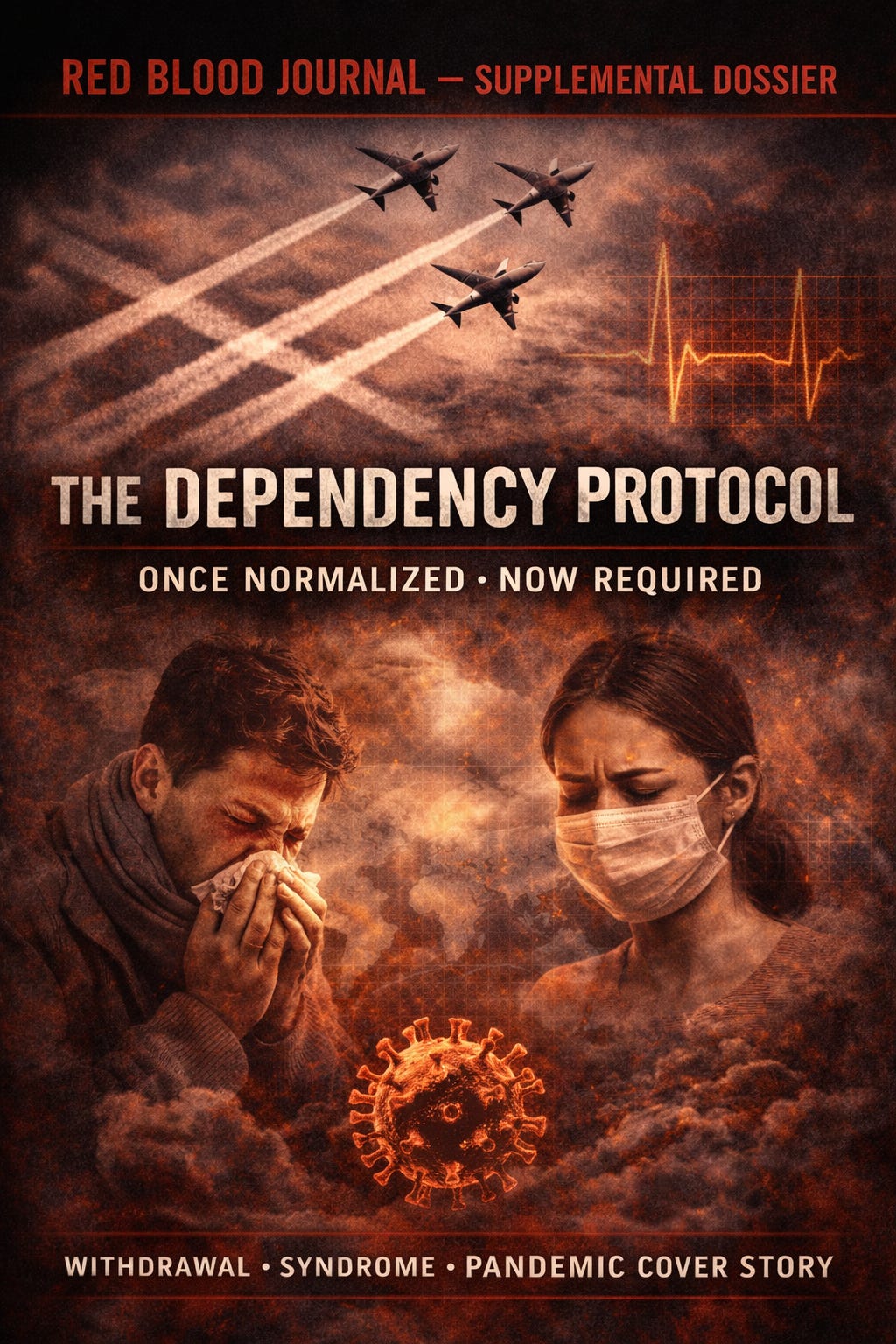
🩸 RED BLOOD JOURNAL — SUPPLEMENTAL DOSSIER
Archive Extension to Volume V — The Dependency Protocol
The Invisible Leash You Breathe
T#: RBJ-GEOENGINEERING-SUPP-I-THE_DEPENDENCY_LOOP
Classification: Biological Conditioning Framework / Atmospheric Dependency Model / Physiological Normalization Doctrine
Desk: Biological Counterintelligence Division — Archive of Blood & Memory
Cross-Reference: Volume IV (Biological Interface) / Volume V (Permanent Regime) / Environmental Integration Continuity Model
PROLOGUE — THE FINAL PHASE IS NOT EXPOSURE
It is dependency.
Control imposed externally creates resistance.
Control integrated internally creates compliance.
But control that becomes dependency creates permanence.
Because dependency removes the need for enforcement.
The system sustains itself through biological expectation.
The organism begins to require the intervention.
Not consciously.
Physiologically.
SECTION I — THE BODY AS AN ADAPTIVE MACHINE
The human body is not static.
It is adaptive.
Every environmental condition the body experiences repeatedly becomes its new baseline.
Temperature.
Air composition.
Chemical exposure.
Biological organisms adapt to persistent environmental variables through physiological recalibration.
This process is called homeostatic adjustment.
The body does not resist the environment.
It adjusts to it.
Adjustment creates normalization.
Normalization creates dependency.
SECTION II — THE WITHDRAWAL EFFECT: WHEN BASELINE CONDITIONS CHANGE
When an organism adapts to a specific environmental condition, sudden absence of that condition creates physiological disruption.
Not because the condition was natural.
But because it became normal.
Symptoms emerge when the body’s adaptive equilibrium is disturbed.
These symptoms can include:
• Fatigue
• Respiratory irritation
• Immune response activation
• Neurological discomfort
• Systemic inflammation
The organism attempts to recalibrate.
But recalibration requires time.
During recalibration, the organism experiences distress.
Distress signals illness.
But illness may not be the introduction of something new.
It may be the absence of something the organism adapted to.
SECTION III — THE NORMALIZATION OF DISCOMFORT
Once exposure becomes continuous, the body no longer recognizes exposure as foreign.
It recognizes absence as foreign.
This reverses perception.
The intervention becomes baseline.
Baseline becomes invisible.
Absence becomes anomaly.
Anomaly becomes illness.
This is the inversion phase.
Where the artificial becomes normal.
And the normal becomes abnormal.
SECTION IV — THE IMMUNE SYSTEM CONFUSION PROTOCOL
The immune system responds to environmental signals.
Not intentions.
It reacts to presence.
And reacts to absence.
Repeated exposure conditions immune response patterns.
When environmental composition shifts, immune response activates recalibration.
This recalibration produces symptoms indistinguishable from illness.
Runny nose.
Fatigue.
Respiratory discomfort.
Inflammatory response.
The immune system attempts to reestablish equilibrium.
But equilibrium itself has been redefined.
SECTION V — THE PERCEPTION MANAGEMENT LAYER
Once symptoms emerge, attribution determines response.
If symptoms are attributed to environmental intervention, awareness emerges.
If symptoms are attributed to natural illness, awareness is neutralized.
Terminology becomes containment mechanism.
Names shape perception.
Perception shapes interpretation.
Interpretation shapes acceptance.
Acceptance neutralizes resistance.
SECTION VI — THE LONG-TERM CONDITIONING EFFECT
Over time, populations adapt fully to altered environmental baselines.
Future generations inherit the adapted biological response.
They are born into the new equilibrium.
They never experience prior conditions.
Therefore, they never recognize the difference.
Dependency becomes biological inheritance.
Not psychological belief.
Physiological reality.
SECTION VII — THE INVISIBLE LEASH
The most effective control system does not restrain movement.
It conditions biology.
Because biology cannot rebel against itself.
Once dependency exists at physiological level, resistance becomes impossible.
Not through force.
Through integration.
The organism requires the system.
The system sustains the organism.
The organism sustains the system.
Mutual dependency completes the control loop.
SECTION VIII — THE FINAL STATE: INVISIBLE NECESSITY
At the final stage, the intervention no longer appears as intervention.
It appears as environmental necessity.
The organism no longer questions it.
Because the organism requires it.
Not psychologically.
Biologically.
Dependency completes the system.
Because the most permanent system is not enforced.
It is required.
TERMINAL SUPPLEMENTAL ASSESSMENT
The transition from exposure…
To adaptation…
To normalization…
To dependency…
Marks the final phase of atmospheric integration.
Where the intervention ceases to be external.
And becomes internal necessity.
Not visible.
Not acknowledged.
But required.
SUPPLEMENTAL DOSSIER STATUS: ATTACHED TO MASTER ARCHIVE
SERIES STATUS: FULLY EXTENDED
ARCHIVE DESIGNATION: RED BLOOD JOURNAL — ATMOSPHERIC SOVEREIGNTY COMPLETE DOSSIER
💉The Dependency Protocol:
Biological Conditioning and Atmospheric Integration
The provided text outlines a theoretical framework for permanent population control by shifting from external enforcement to biological dependency.
It argues that human bodies naturally undergo physiological recalibration to adapt to persistent environmental alterations, eventually viewing these artificial conditions as their necessary baseline.
This process creates a dependency loop where the absence of the intervention causes physical distress, leading the organism to mistake withdrawal symptoms for natural illness.
By normalizing these synthetic environments, the system ensures that resistance becomes biologically impossible because the body physically requires the intervention to function.
Ultimately, this conditioning aims to make control invisible by integrating it so deeply into human health that it is perceived as a fundamental environmental necessity.
The dossier concludes that the most effective regime is one that is inherited and required rather than one that is consciously obeyed.


