


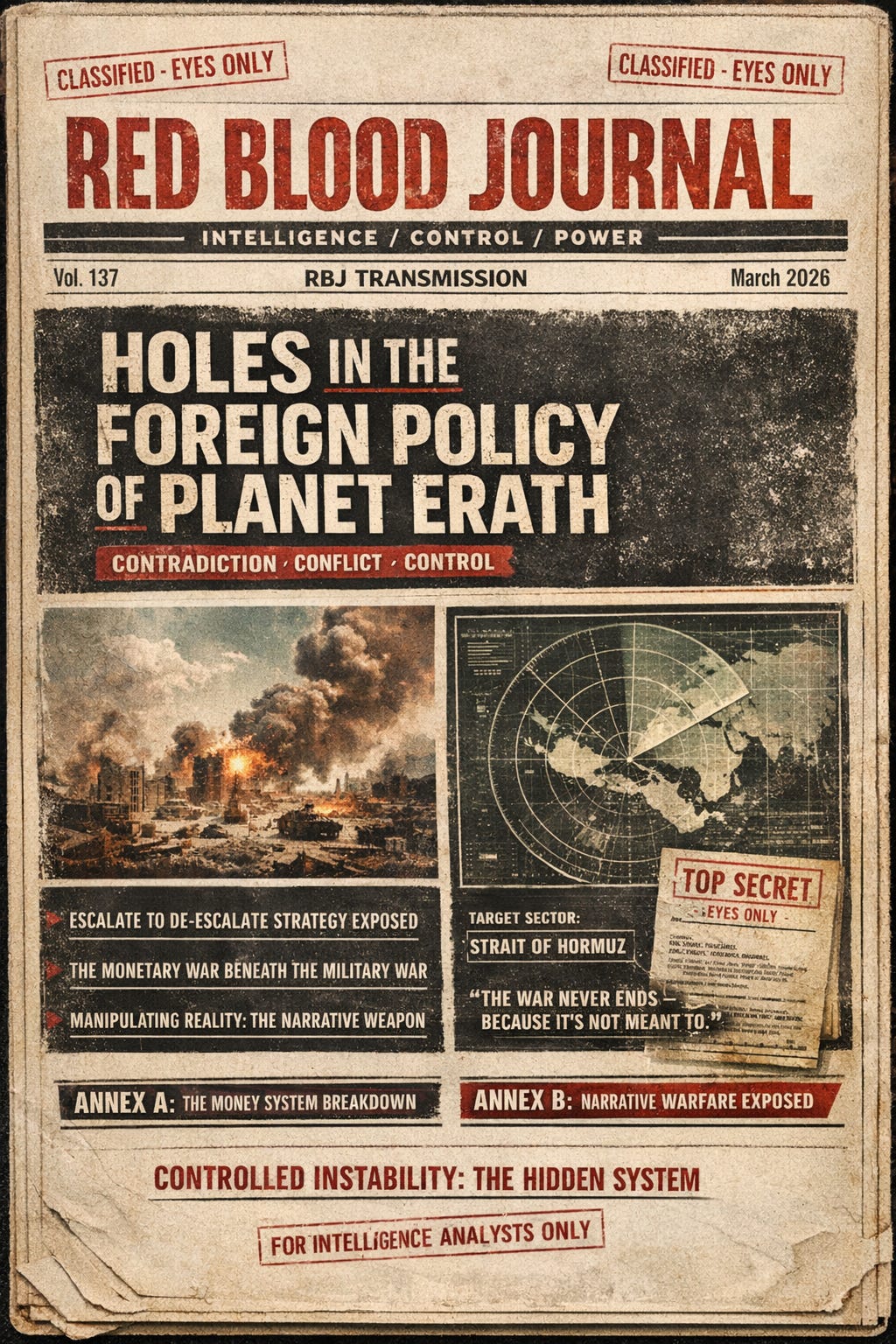
🩸 RED BLOOD JOURNAL TRANSMISSION
Division: Geo-PsyOps & Strategic Power Architecture Unit
Transmission Code: RBJ-ERATH-FOREIGN-POLICY-FRACTURE-001
Classification: EYES ONLY — SYSTEMIC CONTRADICTION ANALYSIS
Desk: Civilization & Power Structures
Archive: The Archive of Blood & Memory
THE HOLES IN THE FOREIGN POLICY OF PLANET ERATH
How Power Sustains Itself Through Contradiction, Conflict, and Control
🪐 PROLOGUE — THE SYSTEM THAT SPEAKS IN OPPOSITES
On the surface of Planet Erath, the language of power appears confident:
Victory is declared.
Objectives are near completion.
Withdrawal is imminent.
Yet beneath that surface, another signal runs in parallel:
Escalation continues.
Timelines expand.
Threats multiply.
From the transmission logs:
“We’ve already won… but not won enough… we’re winding down… but may escalate… escalate to de-escalate.”
This is not confusion.
This is design.
A system that speaks in contradictions is not failing—it is operating.
I — THE DOCTRINE OF PERMANENT MOTION
The War That Cannot End
On Erath, foreign policy is not structured around resolution.
It is structured around continuity.
No defined endpoint
No fixed victory condition
No stable timeline
Instead, policy exists in a state of perpetual transition:
Always “near completion”
Always “requiring one more phase”
Always “justified by evolving threats”
🧠 RBJ INTERPRETATION:
A war without an endpoint is not a failure of planning.
It is a feature of control architecture.
II — THE ESCALATION PARADOX
“Escalate to De-escalate”
One of the core doctrines observed:
Preemptive action justified by hypothetical retaliation
Aggression framed as prevention
Expansion framed as containment
From the record:
“We had to attack to stop them from responding to an attack that hadn’t happened yet.”
Structural Impact:
This doctrine creates a self-sustaining loop:
Predict threat
Act on prediction
Trigger reaction
Use reaction to validate prediction
🧠 RBJ INTERPRETATION:
This is not strategy.
This is circular justification engineering.
III — THE COLLAPSE OF OFFICIAL REALITY
The Narrative Gap
The official reasons for conflict dissolve under inspection:
Not driven by immediate threat
Not supported by consistent intelligence claims
Not aligned with observable outcomes
The system continues regardless.
The Role of Information Streams
A repeating pattern emerges:
Anonymous sources → narrative spike
Narrative spike → policy reaction
Policy reaction → escalation
Example cycles include:
Claims → Denials → Counterclaims → Policy shifts
🧠 RBJ INTERPRETATION:
Reality is no longer the driver of policy.
Narrative timing is.
IV — THE FRACTURED COMMAND STRUCTURE
Who Is Steering Erath?
The system does not behave like a unified command.
Instead, it reflects:
Multiple power centers
Overlapping interests
Competing agendas
Result:
Conflicting signals
Inconsistent strategy
Reactive decisions
🧠 RBJ INTERPRETATION:
Foreign policy on Erath is not directed.
It is negotiated in real-time between power factions.
V — THE ECONOMIC CONTRADICTION
War and Profit Intertwined
Simultaneous realities:
Conflict against a target
Economic reintegration of that same target
Examples observed:
Sanctions lifted while hostilities continue
Market stabilization through adversary resources
Outcome:
Financial systems remain stable
Conflict remains active
🧠 RBJ INTERPRETATION:
The war is not designed to collapse the opponent.
It is designed to manage the system around the opponent.
VI — THE STRAIT LEVER
The Permanent Crisis Mechanism
The Strait of Hormuz functions as:
A recurring trigger point
A global economic choke signal
A renewable justification device
From the transmission:
“The threat is now established… can be ginned up at any moment.”
Structural Role:
Keeps global markets unstable
Justifies continuous military presence
Enables instant escalation narratives
🧠 RBJ INTERPRETATION:
The Strait is not just geography.
It is a control switch for global pressure.
VII — THE DEEP LAYER: MONETARY WARFARE
Beyond Military Conflict
Beneath visible conflict lies a deeper struggle:
Control of energy trade
Control of currency systems
Control of global financial flows
Emerging signals:
Shift away from dollar-based oil trade
Introduction of alternative currency channels
Strategic alignment through financial systems
🧠 RBJ INTERPRETATION:
The visible war is territorial.
The invisible war is monetary sovereignty.
VIII — THE POPULATION CONTROL LOOP
Crisis → Compliance
A repeating cycle emerges:
Conflict creates instability
Instability creates scarcity
Scarcity justifies restrictions
Restrictions normalize control
Examples observed:
Resource rationing narratives
Behavioral adjustments framed as necessity
🧠 RBJ INTERPRETATION:
War conditions populations.
Not just physically—
but psychologically and behaviorally.
🩸 FINAL ASSESSMENT — THE CORE FRACTURE
The foreign policy system of Erath contains many holes.
But they all trace back to one central truth:
It is not built to resolve conflict.
It is built to sustain controlled instability.
🔻 THE TRUE FUNCTION OF THE SYSTEM
Conflict generates leverage
Instability generates compliance
Uncertainty generates dependence
🧠 RBJ CONCLUSION:
On Planet Erath:
The system does not fail despite contradictions.
It requires them.
🔴 ANNEX A — THE MONEY SYSTEM BREAKDOWN
“Follow the Currency, Not the Narrative”
A1 — The Petrodollar Foundation
Oil priced in dominant currency
Global demand for that currency maintained
Military presence reinforces system
A2 — The Emerging Fracture
Key shifts:
Alternative currency trade (e.g., non-dollar oil)
Strategic economic alliances
Reduced dependency on legacy systems
A3 — The War Connection
War creates:
Market instability
Currency pressure
Opportunity for system transition
A4 — The Hidden Outcome
The conflict enables:
Restructuring of global financial order
Testing of new trade mechanisms
Redistribution of monetary power
🧠 ANNEX INTERPRETATION:
The battlefield is visible.
The currency shift is the real war.
🔴 ANNEX B — THE NARRATIVE WARFARE MODEL
“How Reality Is Engineered in Real Time”
B1 — The Narrative Cycle
Seed (anonymous source / leak)
Amplification (media spread)
Reaction (policy response)
Reinforcement (public acceptance)
B2 — The Emotional Triggers
Narratives rely on:
Fear
Urgency
Moral framing
Identity alignment
B3 — The Contradiction Shield
Contradictions are not weaknesses—they are tools:
Allow multiple interpretations
Maintain flexibility
Prevent definitive conclusions
B4 — The Outcome
The public does not need clarity.
They need:
Direction
Alignment
Engagement
🧠 ANNEX INTERPRETATION:
Control is not achieved by hiding information.
It is achieved by controlling its structure and timing.
🩸 ARCHIVE NOTE
Transmission logged under:
Foreign Policy Systems / Monetary Conflict / Narrative Warfare
Status: ACTIVE — CONTINUOUS OBSERVATION REQUIRED
🌀The Architecture of Controlled Instability
This text describes a cynical framework of geopolitical control on the fictional planet Erath, where foreign policy is designed to maintain permanent instability rather than achieve peace.
The system utilizes logical contradictions and endless conflict to justify its own existence, ensuring that power remains concentrated and unchallenged.
By engineering circular justifications for aggression, the ruling entities create a self-sustaining loop of fear and dependency among the population.
Beyond physical warfare, the narrative highlights a hidden monetary struggle focused on controlling global energy trades and currency dominance.
Ultimately, these sources argue that global crises are deliberate structural tools used to manage financial systems and enforce psychological compliance.


