


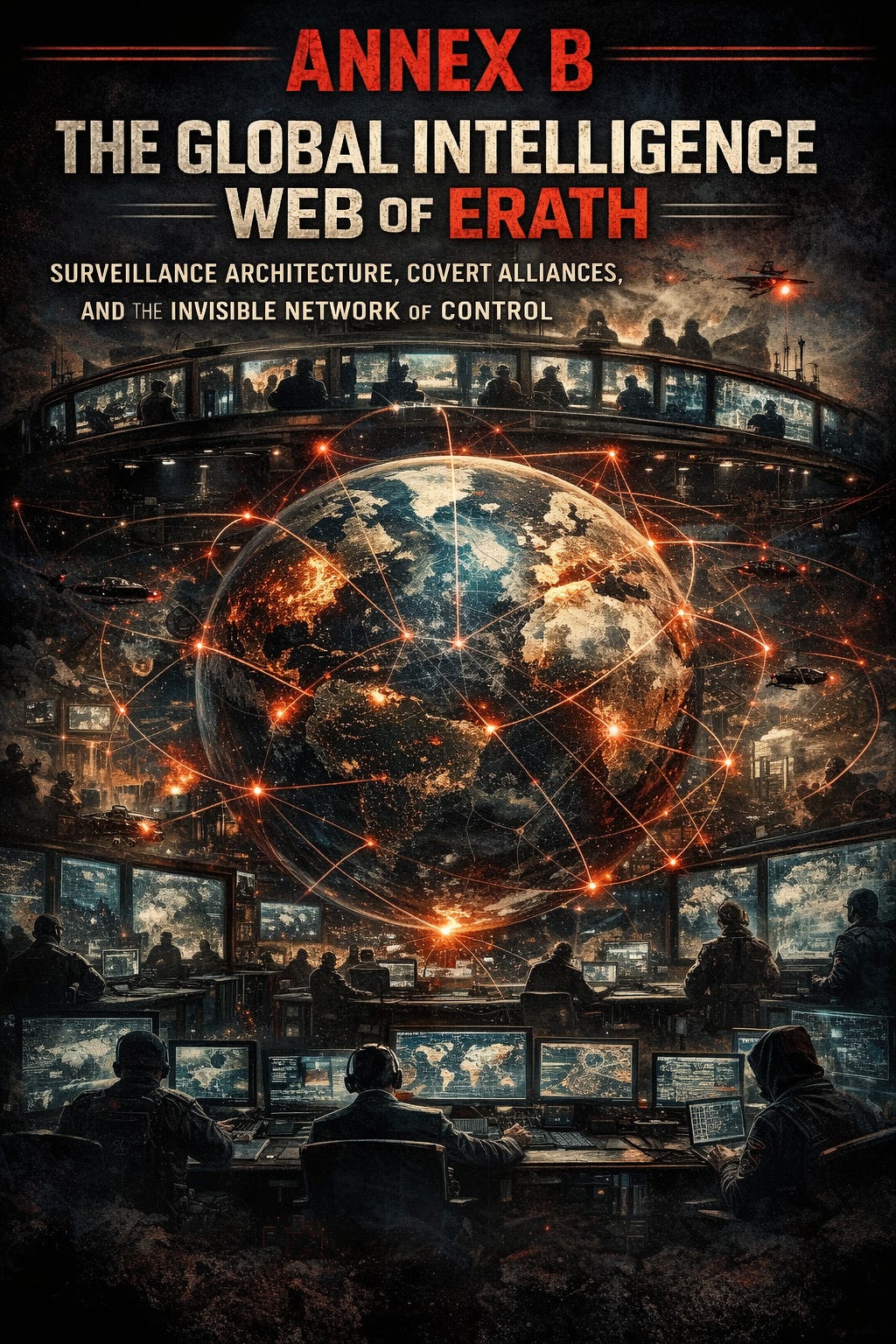
🩸 RED BLOOD JOURNAL — SUPPLEMENTAL ANNEX
Division: Civilization & Power Structures
Transmission Code: RBJ-CPS-2026-ERATH-ANNEX-B
Classification: Strategic Systems Analysis
Archive: The Archive of Blood & Memory
ANNEX B
THE GLOBAL INTELLIGENCE WEB OF ERATH
Surveillance Architecture, Covert Alliances, and the Invisible Network of Control
I — THE INVISIBLE PLANETARY NETWORK
On Planet Erath, wars, revolutions, and political crises appear to be driven by national governments.
But beneath the visible structure of states exists another layer of power:
the intelligence web.
Unlike governments, which operate publicly, intelligence systems function largely in the shadows.
They gather information.
They influence events.
They shape perception.
And perhaps most importantly:
They connect rival nations through hidden channels of communication.
The citizens of Erath see divided nations.
Intelligence agencies often see a shared strategic ecosystem.
II — THE FIVE LAYERS OF THE INTELLIGENCE WEB
The intelligence architecture of Erath can be understood as five interconnected layers.
1 — Surveillance Layer
This is the foundation.
Surveillance systems monitor populations and geopolitical environments through:
• satellites
• global communications interception
• cyber monitoring
• financial transaction tracking
• biometric databases
• mass digital data collection
These systems provide a continuous stream of information about the planet’s inhabitants.
Modern surveillance increasingly relies on algorithms capable of identifying patterns within enormous datasets.
In the laboratory structure of Erath, knowledge itself becomes a form of planetary control.
2 — Analysis Layer
Raw data alone is useless without interpretation.
Intelligence analysts transform information into strategic insight by examining:
military movements
political stability
economic indicators
social unrest patterns
ideological trends
Through this process, analysts attempt to anticipate crises before they emerge publicly.
The goal is predictive awareness.
A government that can foresee instability gains the ability to shape events rather than merely react to them.
3 — Covert Operations Layer
When information reveals opportunities or threats, intelligence systems may initiate covert operations.
These operations can include:
• infiltration of political groups
• support for proxy actors
• sabotage or disruption
• influence campaigns
• targeted destabilization efforts
Covert operations allow states to pursue strategic objectives without open military confrontation.
This layer is often where the intelligence web intersects with the engineered conflicts described in Annex A.
4 — Inter-Agency Channels
Perhaps the most surprising element of the intelligence web is that many agencies across Erath maintain unofficial communication channels with their counterparts in rival nations.
Even during periods of geopolitical tension, intelligence services frequently maintain backchannels.
These channels can serve several purposes:
crisis de-escalation
prisoner exchanges
negotiation signals
prevention of unintended escalation
While governments publicly condemn one another, intelligence officers sometimes operate within a shared professional culture of strategic management.
In certain situations, these networks may even cooperate against mutual threats.
5 — Strategic Influence Layer
The final layer of the intelligence web involves shaping the perceptions of populations.
This includes activities such as:
• psychological operations
• media influence campaigns
• narrative framing
• digital propaganda
• information warfare
In the modern era, this layer has become extremely powerful.
Control of information flows can influence:
elections
protests
diplomatic alliances
public opinion during wartime
In the laboratory model of Erath, this layer ensures that populations interpret events through narratives that maintain the system’s stability.
III — THE ALLIANCE NETWORKS
Intelligence agencies rarely operate in isolation.
Across Erath, various alliances share information and resources.
These alliances are often based on:
shared geopolitical interests
historical partnerships
technological cooperation
joint surveillance infrastructure
Within these alliances, massive volumes of intercepted data may be exchanged.
This cooperation allows participating nations to expand their intelligence reach far beyond their own borders.
Over time, these alliances form dense webs of surveillance and influence that span continents.
IV — THE DIGITAL SKY
The technological revolution has transformed the intelligence web dramatically.
In previous centuries, espionage depended primarily on human spies.
Today, the intelligence architecture of Erath increasingly operates through what analysts sometimes call the digital sky.
This includes:
• satellite constellations
• global internet monitoring systems
• AI-driven data analysis
• automated signal interception
• large-scale metadata mapping
These systems allow intelligence organizations to monitor patterns of human activity across the entire planet in near real-time.
The laboratory has therefore become fully instrumented.
V — THE PRIVATE NETWORKS
In recent decades, private corporations have become deeply integrated into the intelligence ecosystem.
Technology companies provide:
data infrastructure
artificial intelligence tools
satellite services
cloud computing
cybersecurity capabilities
Some private firms possess technological capabilities rivaling those of governments.
As a result, the intelligence web increasingly includes hybrid public-private partnerships.
This development further expands the reach of the global surveillance architecture.
VI — THE SHADOW ECONOMY
Behind the visible financial system of Erath lies a shadow economy supporting covert operations.
Funding for clandestine activities may move through:
• shell companies
• offshore financial networks
• covert procurement channels
• intelligence budgets shielded from public oversight
This financial layer allows intelligence agencies to conduct operations without leaving obvious public traces.
The economic infrastructure of the intelligence web is therefore as important as its technological components.
VII — THE PARADOX OF CONTROL
The global intelligence web gives powerful institutions extraordinary awareness of planetary activity.
But this awareness introduces a paradox.
When surveillance becomes universal:
• every actor is observed
• every action generates data
• every conflict is monitored
Yet the system still requires uncertainty and friction to justify its existence.
Thus the intelligence web must constantly balance two competing forces:
complete knowledge
and
managed instability.
Too much stability reduces the perceived need for intelligence systems.
Too much instability threatens the structure they protect.
The equilibrium between these forces defines the operational rhythm of Erath.
FINAL ANNEX OBSERVATION
To the ordinary citizen of Erath, the world appears fragmented into competing nations and ideologies.
But when viewed from the perspective of the intelligence web, the planet resembles something else entirely:
a single interconnected strategic system.
Information flows across borders.
Covert networks intersect.
Surveillance systems overlap.
Rivals observe one another constantly.
The laboratory is therefore not merely a metaphor.
In many ways, the entire planet functions as a monitored environment, where events are tracked, interpreted, and occasionally influenced by invisible hands operating within the global intelligence web.
👁️The Global Intelligence Web of Erath
The document outlines the Global Intelligence Web of Erath, a hidden infrastructure of power that operates beneath the surface of traditional government structures.
This vast network is organized into five distinct layers, ranging from baseline digital surveillance and strategic analysis to active covert operations and the manipulation of public perception.
Notably, the text reveals that rival nations often maintain secret communication channels to manage global stability, suggesting that geopolitical conflicts are frequently monitored or steered by a shared professional elite.
This system is further bolstered by private corporate partnerships and a shadow economy that funds clandestine activities away from public oversight.
Ultimately, the source portrays the planet as a monitored strategic ecosystem where intelligence agencies balance total knowledge with managed instability to maintain control.
Even as citizens perceive a world of divided nations, the intelligence web functions as a single interconnected system that treats the entire globe as a controlled laboratory environment.


