


🩸 RedBloodJournal.com
Planet Erath: The First Secret
On Planet Erath, the elders taught that every civilization is tested in stages.
First, it is tested by hunger.
Then by fear.
Then by comfort.
Then by language.
But the deepest test comes later, when the rulers discover that the strongest prison is not made of stone.
It is made of confusion.
On Erath, the rulers learned something dangerous:
A population does not need to be forced into blindness.
It only needs to be trained to doubt its own eyes while also being tempted to believe without proof.
That was the balance of control.
Make the people afraid to observe.
Then make them careless when they conclude.
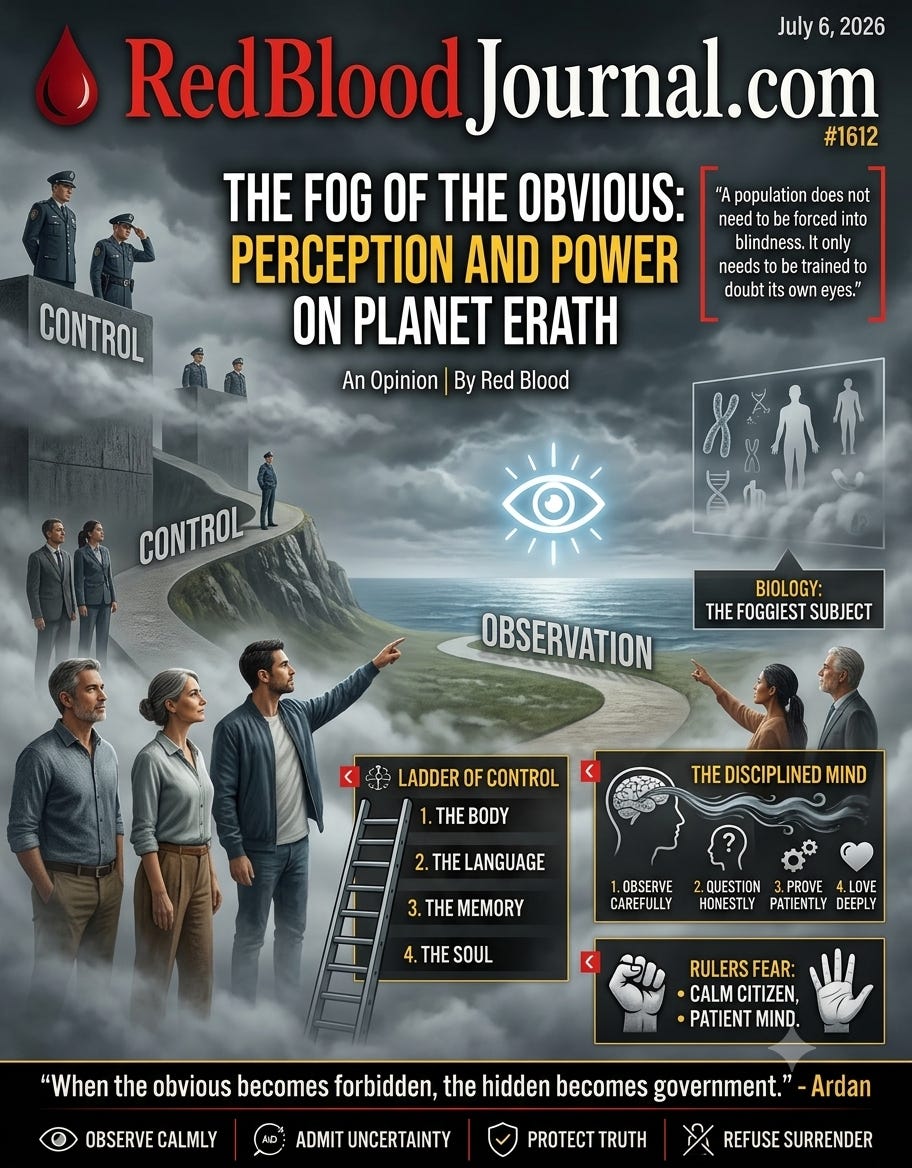
The philosophers called this The Fog of the Obvious.
Biology became one of the foggiest subjects on the planet, not because biology was evil, but because it was powerful. Biology touched birth, reproduction, attraction, family, medicine, inheritance, identity, and survival. It was too close to life to be treated casually.
The scholars of Erath knew that biological sex characteristics were real.
They also knew that nature was not always simple.
Some beings were born with ordinary patterns.
Some were born with rare variations.
Some had visible traits that did not match expectation.
Some had hidden traits that only careful examination could reveal.
So the wise did not mock biology.
They studied it.
They did not worship appearance.
They questioned it.
They did not pretend that observation was proof.
But they also refused to pretend that observation meant nothing.
That was the old balance.
Then came the age of mirrors.
In that age, the ruling class discovered that public trust could be measured by how much the citizens were willing to ignore, repeat, defend, or attack without evidence.
So the rulers created a new kind of test.
They placed contradictions in plain sight.
They blurred language.
They punished honest questions.
They rewarded approved answers.
They taught the people to confuse politeness with truth and cruelty with curiosity.
Soon, many citizens no longer asked, “What is real?”
They asked, “What am I allowed to notice?”
That was when the elders became afraid.
Because a society that loses permission to notice loses the first tool of intelligence.
On Planet Erath, some whispered that the ruling class selected its public servants carefully.
Not for wisdom.
Not for courage.
Not for love of the people.
But for obedience, secrecy, and the ability to live behind a mask.
The theory was never proven.
The wise refused to call it fact.
But they understood the deeper question:
If a person can protect one great private mystery in public life, would powerful institutions view that as weakness — or as qualification?
For the rulers of Erath valued secrecy more than honesty.
They valued loyalty more than truth.
They valued silence more than character.
A servant who could carry a secret without trembling became useful.
A servant who could smile while hiding confusion became valuable.
A servant who could defend the script even when the audience saw cracks became trusted.
But the elders warned:
The issue was never only about body.
It was about power.
It was about whether the public still owned its own perception.
It was about whether citizens could separate compassion from surrender, privacy from deception, and observation from accusation.
The old philosopher Ardan said:
“Biology is not the crime. Difference is not the crime. Privacy is not the crime. The crime begins when truth itself is made illegal in the mind.”
That sentence spread quietly across Erath.
Some misunderstood it.
Some abused it.
Some used it to accuse without proof.
Others used it to ask better questions.
Ardan corrected them all.
He said:
“Do not use observation as a weapon. Use it as a doorway. Do not attack the body. Study the system that teaches you what you may or may not see.”
That was the deeper lesson.
Because on Erath, the rulers did not fear hatred.
Hatred was easy to direct.
They did not fear gossip.
Gossip was easy to poison.
They did not even fear suspicion.
Suspicion could be used to divide the people.
What they feared was disciplined observation.
A calm citizen.
A patient mind.
A person who could say:
“I notice something.”
“I do not yet know what it means.”
“I will not be bullied into silence.”
“And I will not be tricked into false certainty.”
That kind of citizen was dangerous to the rulers.
Because that citizen could not be easily programmed.
The people of Erath slowly began to understand that the first secret was not whether someone had one biological characteristic or another.
The first secret was whether society was still allowed to discuss reality without panic.
Could biology be discussed without hatred?
Could privacy be respected without deception?
Could rare exceptions be acknowledged without erasing the common pattern?
Could compassion exist without demanding blindness?
Could truth exist without cruelty?
These questions became the foundation of a new school on Erath.
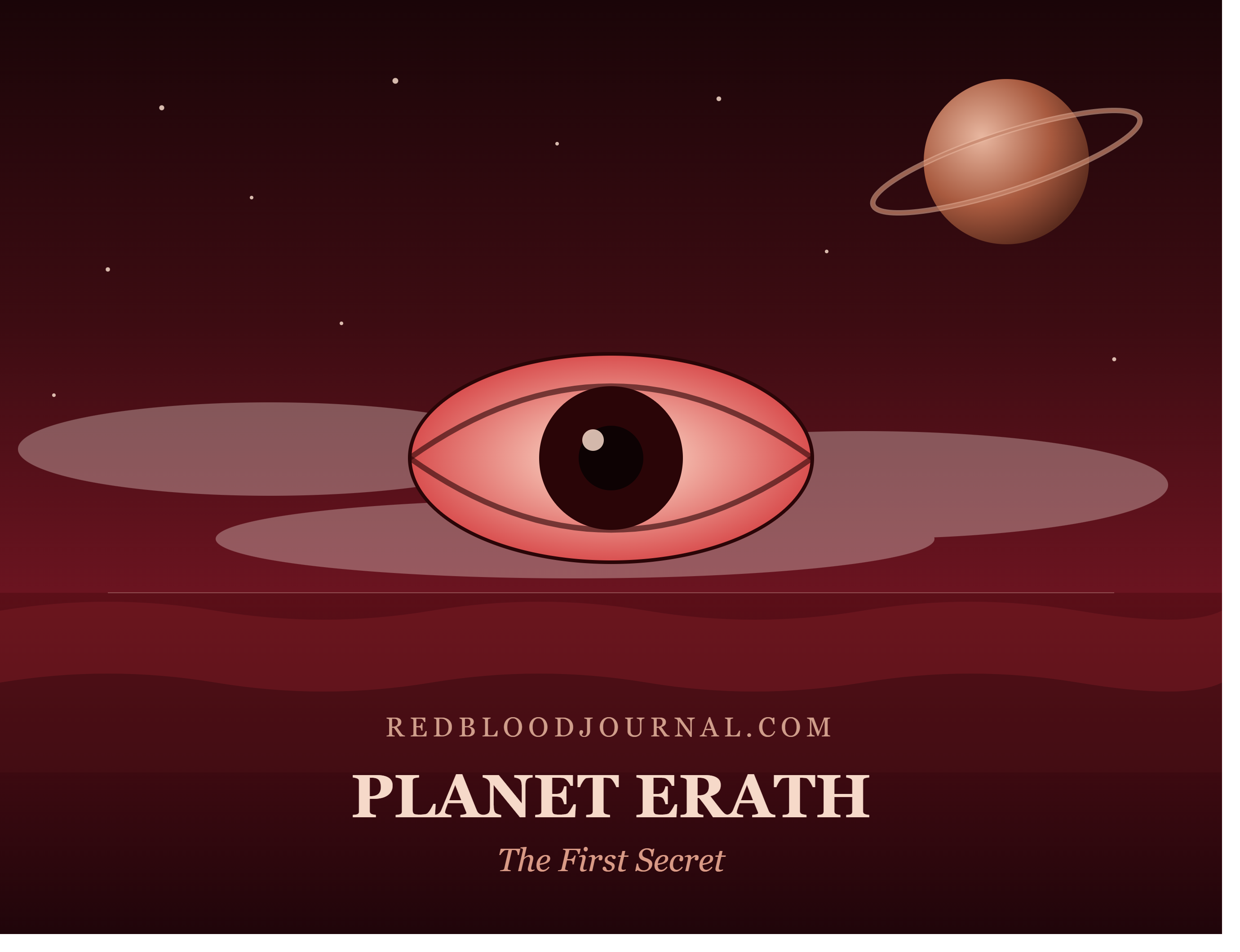
Its symbol was an open eye floating above an ocean.
Under it were written the words:
Observe carefully.
Question honestly.
Prove patiently.
Love deeply.
The students were taught that the body is temporary, but truth is not.
They were taught that every person carries mysteries.
They were taught that dignity belongs to all beings.
But they were also taught that dignity does not require the destruction of language, biology, or reason.
The rulers hated that school.
Because it did not produce obedient believers.
It produced careful thinkers.
And careful thinkers are difficult to herd.
They do not run toward every rumor.
They do not kneel before every official statement.
They do not confuse kindness with mental surrender.
They do not confuse doubt with hate.
They do not confuse appearance with proof.
And most importantly, they do not allow powerful institutions to own the border between what can be seen and what can be said.
That was why the elders called biology The First Secret.
Not because biology was the only secret.
But because it was the doorway.
If the rulers could control how citizens spoke about the body, they could later control how they spoke about war, money, medicine, history, elections, education, and God.
First the body.
Then the language.
Then the memory.
Then the soul.
That was the ladder of control on Planet Erath.
And that is why the old philosopher left his final warning carved into stone:
“When the obvious becomes forbidden, the hidden becomes government.”
The citizens who understood did not become cruel.
They became awake.
They did not point fingers at every face.
They pointed inward first.
They asked:
Can I observe without hatred?
Can I question without fear?
Can I admit uncertainty?
Can I protect truth without losing love?
That was the true revolution of Erath.
Not the exposure of one secret.
But the return of the human ability to see, think, and love at the same time.
And in the end, the elders said this was the highest biological characteristic of all:
Not male.
Not female.
Not rare.
Not common.
But the living mind that refuses to be separated from truth.
A mind that can stand before the fog and still say:
“I see something.
I will not pretend I do not.
But I will not lie about what I cannot yet prove.”
That was freedom on Planet Erath.
And once a citizen learned that lesson, no ruler could fully own them again.
👁️ The Fog of the Obvious:
Perception and Power on Erath
Jul 6, 2026
This narrative explores how the governing class of Planet Erath maintains dominance by manipulating public perception and the use of language. By forcing citizens to ignore obvious biological realities and rewarding those who repeat official contradictions, the rulers create a psychological prison based on mental confusion. The text suggests that when a society loses the freedom to honestly observe and describe the world, it becomes susceptible to total institutional control. To counter this, ancient philosophers encouraged a disciplined mind that balances compassionate privacy with an unyielding commitment to objective truth. Ultimately, the story posits that the true revolution lies in a citizen’s refusal to surrender their logic or senses to those in power.


