


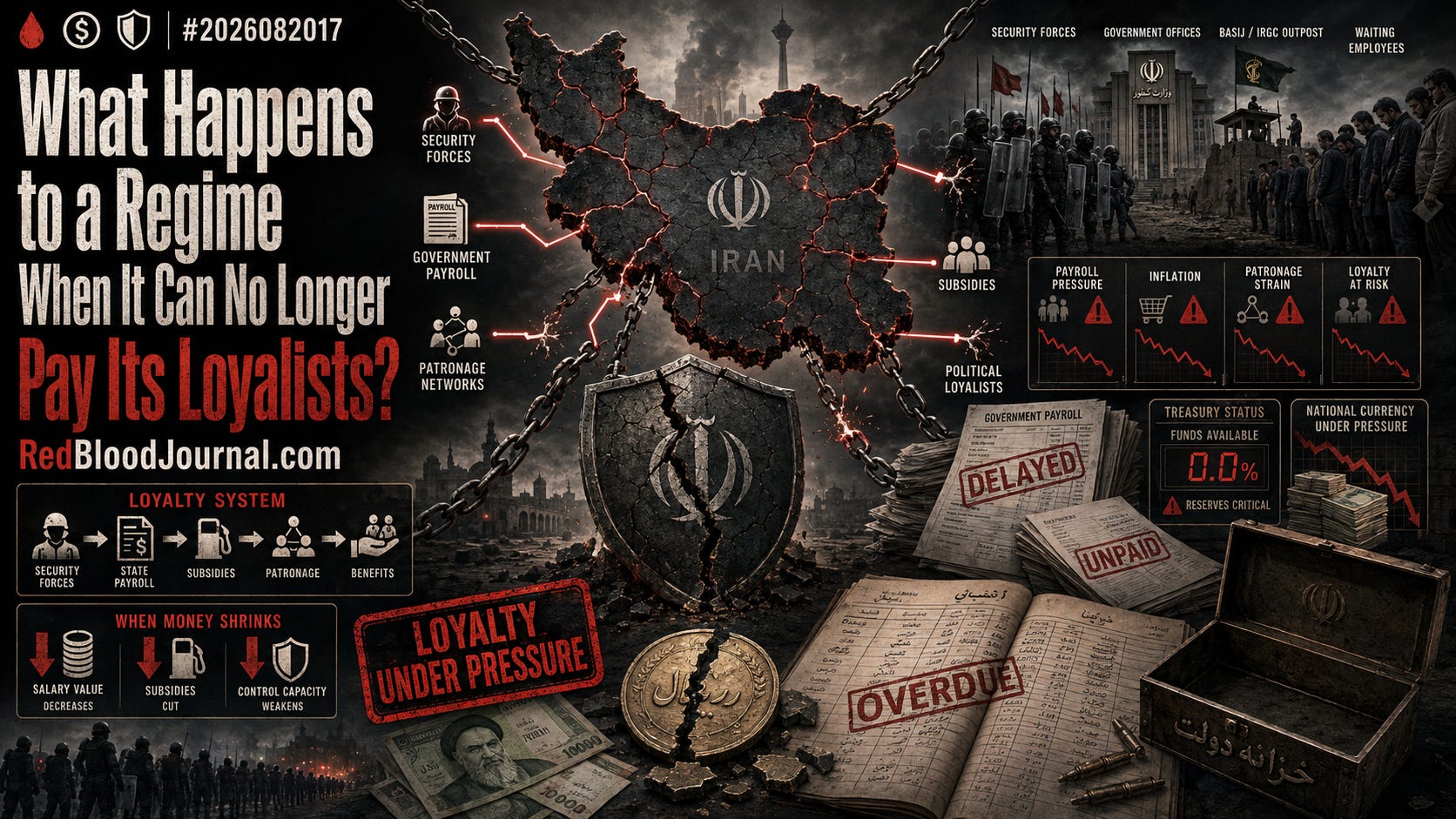
🩸 💰 🛡️ #2026082017 — What Happens to a Regime When It Can No Longer Pay Its Loyalists?
RedBloodJournal.com
Every government has an ideology.
Every government has institutions.
Every government has supporters.
But underneath all of them sits something less philosophical:
a payroll.
Security forces must be paid.
Government employees must be paid.
Political networks require funding.
Subsidies require money.
Patronage requires money.
Organizations loyal to the state require money.
Even ideology eventually meets accounting.
The source behind this report raises a potentially important question about the Islamic Republic:
What happens if the government’s financial channels shrink so much that loyalty itself becomes harder to finance?
Near the end of the source, the narrator argues that if Tehran’s economic “breathing routes” are fully blocked, the government may eventually have less money available for those who have supported and defended it.
That is presented as an interpretation, not proof that such a breakdown has already occurred.
But the question deserves examination.
Governments Do Not Run on Ideology Alone
Political systems often present loyalty as something pure.
Patriotism.
Religion.
Revolution.
Duty.
National security.
But large institutions cannot operate on belief alone.
A soldier has rent.
A police officer has children.
A government employee has groceries.
A militia member has expenses.
A political organizer expects support.
A patronage network expects rewards.
Even the most ideological political systems require material reinforcement.
That creates a simple rule:
Belief may create loyalty. Money helps maintain it.
When both exist, a system can be extremely durable.
When the money begins disappearing, ideology is tested under much harsher conditions.
The Islamic Republic Built More Than a Government
The Islamic Republic is not merely a collection of ministries.
Over decades, it developed layers of institutions, security organizations, semi-state businesses, foundations, political networks and affiliated organizations.
The source does not provide a complete institutional map of those organizations.
But its broader argument is that severe restrictions on oil income, trade and financial access could eventually reduce Tehran’s ability to fund the people and structures that protect the system.
The same source earlier describes oil revenues as being under severe pressure and quotes Central Bank chief Abdolnaser Hemmati discussing constrained oil income and inaccessible reserves.
If state revenue falls while expenses remain, arithmetic begins doing what political opposition sometimes cannot.
It forces choices.
Who Gets Paid First?
Imagine a government suddenly receiving substantially less usable revenue.
It cannot immediately eliminate every obligation.
So priorities emerge.
Military?
Security forces?
Government salaries?
Pensions?
Food subsidies?
Fuel subsidies?
Infrastructure?
Health?
Education?
Foreign allies?
Political organizations?
Debt?
Currency intervention?
Every toman spent in one place cannot be spent somewhere else.
This is where economic pressure becomes political pressure.
Not because poverty automatically produces revolution.
But because scarcity forces governments to reveal what they value most.
The Loyalty Pyramid
A durable authoritarian political system can be imagined as a pyramid.
At the top:
the central leadership.
Below:
senior political and security officials.
Below them:
institutional leadership.
Then:
government employees,
security personnel,
political activists,
economic beneficiaries,
contractors,
business networks,
and broader constituencies that receive some advantage from stability.
At the bottom are millions of ordinary citizens whose relationship with the state may range from support to indifference to opposition.
Money flows downward through this structure in different forms.
Salary.
Contracts.
Subsidies.
Preferential access.
Cheap credit.
Licenses.
Jobs.
Government procurement.
Currency advantages.
Housing.
Benefits.
The system does not need to purchase everybody’s beliefs.
It only needs to make enough people feel that the existing order is preferable to uncertainty.
What Happens When the Money Shrinks?
The first stage may not be rebellion.
It may simply be delay.
A salary arrives late.
A benefit loses value.
A pension fails to keep up with inflation.
A subsidy disappears.
A government contract goes unpaid.
A favored business cannot obtain foreign currency.
Then another transformation occurs.
The person may still support the government ideologically.
But loyalty becomes more expensive personally.
And every month forces the question again.
How much sacrifice is belief worth?
Inflation Is a Hidden Pay Cut
A government does not even have to stop paying salaries for the loyalty system to weaken.
Inflation can accomplish something similar.
A worker receives the same nominal salary.
But food costs more.
Rent costs more.
Gasoline costs more.
Repairs cost more.
Medicine costs more.
The paycheck still arrives.
Its power disappears.
The source portrays Iran’s cost-of-living crisis as severe enough that some households’ income covers only a fraction of their monthly necessities, and it cites warnings that deteriorating living conditions could contribute to social unrest.
That pressure does not distinguish perfectly between opponents and supporters.
A loyal employee also buys groceries.
The Security Forces Are Citizens Too
Political analysis often talks about security forces as if they exist outside society.
They do not.
They have families.
They experience inflation.
They need housing.
Their children need employment.
Their cars need gasoline.
Their relatives may be angry about the economy.
This creates one of the most important thresholds in any political crisis:
When does the person ordered to defend the system begin suffering from the same system-wide failures as the person protesting against it?
That does not automatically produce defection.
Security organizations may have stronger compensation, privileges, housing, food support or ideological discipline than the general public.
But economic deterioration can gradually change the calculation.
A system that can still provide materially for its defenders has one kind of stability.
A system that asks defenders to endure the same deprivation as everyone else has another.
The Source Makes a Much Stronger Claim
The uploaded report goes beyond economics.
It speculates that some people serving the regime have remained loyal partly because they are compensated, and that if the regime loses access to money, some may no longer be willing to suppress protesters.
That should not be treated as established fact.
The source does not provide payroll records, surveys of security personnel or evidence demonstrating how many supporters are motivated primarily by financial incentives.
But it identifies a legitimate analytical question:
How much of regime durability comes from belief, and how much comes from material dependence?
That question may become increasingly important if economic pressure intensifies.
There Are At Least Four Types of Loyalty
Not every supporter is the same.
1. Ideological loyalty
Some people genuinely believe in the political and religious structure.
Money may matter little.
2. Institutional loyalty
Some may defend the system because their profession, organization or identity is tied to it.
3. Economic loyalty
Some benefit materially from the existing arrangement.
Contracts.
Employment.
Access.
Status.
4. Survival loyalty
Some may not support the system at all but depend on it for a paycheck.
These categories overlap.
And that distinction matters enormously.
Economic pressure is least effective against the first category.
It may be much more powerful against the third and fourth.
When Patronage Turns Into Resentment
There is another risk for the government.
Suppose loyal constituencies were promised protection.
They accepted political restrictions because the system provided stability.
Then the economic bargain collapses.
Now they receive:
less purchasing power,
less economic security,
fewer benefits,
more shortages,
and greater personal risk.
At that point resentment can become more dangerous than ordinary opposition.
Why?
Because betrayal feels different from disagreement.
An opponent never expected the government to protect him.
A loyalist did.
The Government’s Dilemma
If resources become scarce, Tehran may have to choose between protecting its political base and protecting the broader population.
Spend heavily on security organizations and loyal constituencies?
Then ordinary citizens may see proof that the system protects itself first.
Spread resources more evenly?
Then the political-security structure may lose privileges that reinforced loyalty.
Cut subsidies?
Public anger rises.
Print money?
Inflation rises.
Raise taxes?
Economic pressure rises.
Raise gasoline prices?
Household and transportation costs rise.
Every solution creates another problem.
Can Repression Become Too Expensive?
Repression has costs rarely discussed in political rhetoric.
Personnel.
Vehicles.
Communications.
Surveillance.
Intelligence.
Facilities.
Prisons.
Equipment.
Overtime.
Logistics.
Cyber capabilities.
Informants.
Political organizations.
Propaganda.
A wealthy state can sustain these systems easily.
A financially constrained state must prioritize.
The most dangerous point for any government may therefore not be when protesters become angriest.
It may be when the cost of controlling them begins increasing while the resources available to maintain control begin falling.
But Economic Collapse Does Not Guarantee Political Collapse
This point is essential.
Governments have survived catastrophic economic conditions.
North Korea has survived extraordinary deprivation.
Cuba has survived decades of economic isolation.
Venezuela survived economic collapse that many observers once predicted would end its government.
Iran itself has survived repeated sanctions, currency shocks and protest waves.
Economic suffering can weaken a state.
It can also strengthen coercive control.
Citizens may become too focused on daily survival to organize.
Black markets may enrich politically connected networks.
Security organizations may receive priority resources precisely because everyone else is being cut.
The government may blame foreign enemies and strengthen nationalist sentiment.
There is no automatic equation:
No money = no regime.
History is much more complicated.
The Real Threshold
The critical question may not be whether Iran runs out of money.
Governments almost never literally reach zero.
The real question is:
Does the state retain enough money, coercive power and institutional cohesion to keep the people who protect it better off—or at least more secure—than the alternative?
That is a very different test.
A regime can survive with a poor population.
It becomes more vulnerable when its own protective layers begin doubting whether the system can still protect them.
The Red Blood Perspective
Economic pressure on Iran should therefore be monitored differently.
Do not look only at oil exports.
Do not look only at the rial.
Do not look only at GDP.
Watch the institutions that hold the political structure together.
Are government salaries being delayed?
Are pensions losing purchasing power?
Are security benefits being reduced?
Are state contractors being paid?
Are favored businesses losing access to foreign currency?
Are political organizations receiving fewer resources?
Are internal disputes over budgets becoming visible?
Are security personnel expressing economic grievances?
Are families of regime supporters experiencing the same crisis as everyone else?
Those indicators may reveal more about political durability than another headline about sanctions.
The question is not:
Is Iran poor?
The question is:
Can the government still finance loyalty faster than economic collapse destroys it?
The Most Dangerous Moment
For any political system dependent partly on patronage, the most dangerous moment may occur when money stops flowing but orders continue flowing.
The government says:
Go into the street.
Defend the system.
Accept the risk.
Control the protesters.
And the person receiving the order thinks:
My salary no longer feeds my family.
That thought does not guarantee defection.
But once it begins appearing widely enough, the relationship between power and obedience changes.
Ocean of Love and Positivity Perspective
From the Ocean of Love and Positivity, the entire idea of purchasing political loyalty reveals something uncomfortable about human systems.
A healthy society should not require citizens to choose between conscience and survival.
A police officer should not have to suppress another citizen to protect a paycheck.
A government worker should not have to pretend belief to preserve food on the table.
A citizen should not have to join the favored political network simply to obtain opportunity.
When survival becomes dependent on obedience, loyalty stops being loyalty.
It becomes dependency.
And when governments intentionally create dependency, they may appear powerful while becoming spiritually and structurally weak.
Real loyalty cannot be purchased forever.
It must eventually come from legitimacy.
Fairness.
Trust.
Competence.
Respect.
Opportunity.
The ability of a citizen to disagree without becoming an enemy.
A government that needs money to constantly purchase obedience may possess authority.
But authority purchased every month must be purchased again next month.
And eventually the bill arrives.
The strongest government is not the one whose citizens are paid to defend it.
It is the one whose citizens believe it is worth defending even when nobody is paying them to say so.
In an Ocean of Love and Positivity.
🩸🌊✨ Fantastic!
📉
The Price of Loyalty: Financing the State Machine
Aug 20, 2026
This text examines the critical link between financial stability and political endurance within the Islamic Republic of Iran. The author argues that while ideology and patriotism are important, a government’s survival depends heavily on its ability to maintain a consistent payroll for security forces and loyalists. As international sanctions and economic mismanagement shrink state revenues, the regime faces a “loyalty pyramid” where scarcity forces difficult choices between funding its defenders or supporting the general public. The source suggests that inflation and late payments act as hidden pay cuts that can eventually erode the dedication of those tasked with protecting the state. Ultimately, the report highlights that the most significant threat to a regime’s power occurs when the cost of repression exceeds its available resources, potentially turning material dependency into resentment. While history shows that governments can survive extreme poverty, the text posits that durability is tested when the protective layers of the state no longer feel economically secure.
#RedBloodJournal #Iran #IranRegime #PoliticalLoyalty #RegimeLoyalty #Patronage #StatePower #SecurityForces #IranEconomy #EconomicCrisis #EconomicPressure #Sanctions #IranSanctions #OilRevenue #GovernmentSpending #StatePayroll #PublicSalaries #Inflation #CurrencyCrisis #CostOfLiving #PoliticalStability #Authoritarianism #RegimeSurvival #PoliticalEconomy #EconomicCollapse #SocialUnrest #IranProtests #SecurityState #GovernmentLoyalists #InstitutionalLoyalty #EconomicLoyalty #IranianPeople #CitizenFirst #Geopolitics #MiddleEast #OceanOfLoveAndPositivity


