


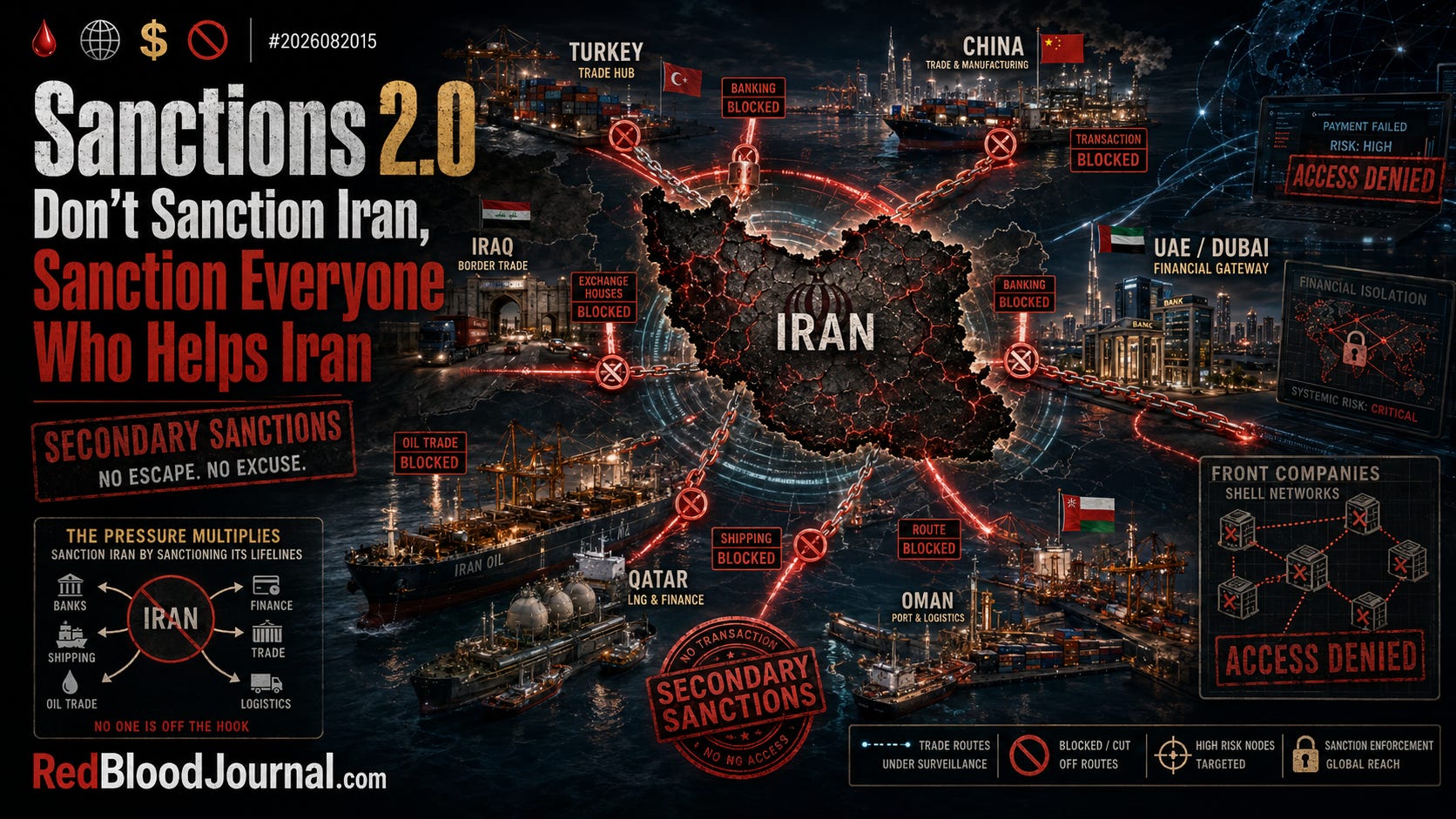
🩸 🌍 💵 🚫 #2026082015 — Sanctions 2.0 — Don’t Sanction Iran, Sanction Everyone Who Helps Iran
RedBloodJournal.com
For decades, the Islamic Republic has lived under sanctions.
And for decades, it has also learned how to live around them.
A sanctioned bank can be replaced.
A blocked company can become another company.
A ship can change registration.
Money can move through an exchange house.
Oil can be sold through intermediaries.
Goods can enter through neighboring countries.
The system survives because sanctions aimed at Iran do not automatically isolate everyone willing to do business with Iran.
But the source behind this report describes what may be a much more aggressive strategy.
Instead of asking:
How do we sanction Iran more?
The new question appears to be:
How do we make everyone else afraid to help Iran?
That is a completely different kind of economic war.
The Message Was Not Only for Tehran
According to the source, Donald Trump announced what he described as an unprecedented economic campaign against the Islamic Republic, specifically identifying oil smuggling, swap lines, cash transfers, exchange houses, ship registration and front companies as targets.
But the most consequential part may not be what was said to Tehran.
It may be what was said to everyone around Tehran.
The source interprets the announcement as a warning directed toward China, Iraq and the broader financial and commercial networks that have helped keep Iranian trade functioning.
The message becomes:
Sell Iranian oil?
There may be a price.
Move Iranian money?
There may be a price.
Register Iranian-linked ships?
There may be a price.
Create a shell company?
There may be a price.
Provide the financial oxygen?
There may be a price.
The target is no longer only the sanctioned country.
The target becomes the ecosystem surrounding the sanctioned country.
Sanctions 1.0
Traditional sanctions work directly.
Freeze assets.
Restrict banking.
Block exports.
Blacklist companies.
Prevent access to technology.
Target individuals.
Iran became extremely experienced at operating inside that environment.
Every restriction created demand for another intermediary.
And where there is profit, intermediaries usually appear.
A company in one country buys something.
Another company resells it.
A payment crosses several accounts.
A tanker changes paperwork.
An exchange house moves currency.
The process becomes slower, more expensive and less transparent.
But it continues.
This is one reason sanctions can punish an economy without necessarily destroying the system controlling it.
The government learns adaptation.
The citizen pays the additional cost.
Sanctions 2.0
Secondary sanctions change the psychology.
Now Washington does not merely say:
You cannot do business with Iran.
It says:
You may have to choose between doing business with Iran and doing business with us.
That choice is far more powerful.
A Chinese bank might be willing to process an Iranian transaction.
But is the transaction valuable enough to risk access to dollar clearing?
An international shipping company might carry Iranian cargo.
But is that shipment valuable enough to risk insurance, financing and access to Western ports?
A Gulf exchange house may make money moving Iranian funds.
But is that profit worth being blacklisted?
The sanction works before anyone is punished.
Fear does the enforcement.
The Weapon Is Access
The United States possesses something more powerful than many people realize.
It does not control every bank.
It does not control every ship.
It does not control every government.
But it sits near the center of a financial architecture that enormous parts of the world still want access to.
Dollar transactions.
American banks.
Capital markets.
Technology.
Insurance.
Trade relationships.
Corporate investment.
That creates leverage.
Washington does not have to make another country obey directly.
It can make the cost of disobedience larger than the profit.
That is how economic power becomes coercive power.
Why China Is the Real Test
The source itself identifies China as one of the most important remaining channels and asks whether Washington can genuinely pressure Chinese banks and associated networks.
This may be where the entire strategy succeeds or fails.
Small countries can be pressured.
Small banks can be frightened.
Shipping companies can change routes.
Exchange houses can disappear.
But China is different.
China possesses enormous economic weight.
It purchases energy.
It operates major banks.
It maintains its own strategic interests.
It may decide that Iranian oil is valuable enough to justify confrontation with Washington.
If Chinese institutions continue processing Iranian trade at scale, then Iran retains a major opening.
If large Chinese institutions begin withdrawing because the American cost becomes too high, Tehran’s room to maneuver becomes dramatically smaller.
Therefore China may be the most important scoreboard.
Iraq Is Another Critical Door
The source also points toward Iraq and exchange networks that could facilitate Iranian finance.
This matters because economic pressure is rarely defeated by one enormous secret transaction.
It is defeated by thousands of small pathways.
Border trade.
Cash.
Exchange houses.
Commercial intermediaries.
Religious networks.
Trucking routes.
Informal settlement systems.
Regional banking.
Closing a central bank is one thing.
Closing an entire ecosystem of small transactions is something else.
That requires intelligence, enforcement and constant replacement of sanctions as new workarounds emerge.
Iran has decades of experience doing exactly that.
Sanctions Become a Game of Whack-a-Mole
Close Company A.
Company B appears.
Sanction Ship A.
Ship B changes its name.
Freeze Account A.
Payments move elsewhere.
Blacklist Broker A.
Broker B enters the market.
The system adapts because profit rewards adaptation.
This is the weakness of conventional sanctions.
But secondary sanctions attempt to attack the incentive itself.
Instead of endlessly hunting the next intermediary, Washington tries to make intermediaries conclude:
There is not enough money in Iran to justify the danger.
If that calculation takes hold, circumvention becomes much harder.
The UAE May Be an Early Signal
The source claims the UAE moved to halt commercial and financial dealings connected with Iran before Trump’s announcement, portraying the move as potentially part of the broader pressure campaign.
If the claim is accurate and implemented broadly, the significance goes beyond Dubai.
Other governments would be watching.
Not only:
What did Washington say?
But:
What happened to the first country that complied?
Were businesses protected?
Were financial relationships rewarded?
Did trade simply move elsewhere?
Did Iran retaliate?
Secondary sanctions become most powerful when one defection creates another.
One country closes a route.
Another bank becomes nervous.
Another shipping company reviews exposure.
Another government quietly warns domestic businesses.
Soon the behavior changes without another public announcement.
The Economic Domino
Imagine Iran’s sanctions-survival system as a network.
China.
UAE.
Iraq.
Turkey.
Qatar.
Oman.
Front companies.
Exchange houses.
Shipping registries.
Private traders.
Informal money transfers.
The regime does not require every node.
It requires enough nodes.
Therefore the real objective of Sanctions 2.0 would not necessarily be to eliminate everything.
It would be to reduce the number of functioning nodes below the level required to maintain normal economic circulation.
At that point, problems begin multiplying.
Imports become harder.
Money becomes harder to move.
Currency becomes scarcer.
Shipping costs increase.
Insurance becomes expensive.
Suppliers demand cash in advance.
Intermediaries charge larger premiums.
Transactions take longer.
Eventually a financial network begins behaving like a clogged artery.
But There Is a Problem
Economic warfare is never clinically precise.
A government may be the intended target.
But commerce connects everything.
The source itself recognizes that intensified restrictions on trade, imports and currency flows would inevitably affect ordinary Iranians.
That means the same mechanism designed to weaken state finances may also raise the price of:
food,
medicine,
vehicle parts,
industrial equipment,
housing materials,
transportation,
and everyday consumer goods.
The government possesses ministries, security organizations and mechanisms for rationing scarce resources.
The average citizen has a salary.
This imbalance matters.
Does Economic Pain Weaken Governments?
Sometimes.
But not automatically.
Economic pain can create public anger.
It can weaken patronage networks.
It can reduce the government’s ability to finance loyalists.
It can increase defections.
It can expose incompetence.
But it can also produce:
black markets,
smuggling,
corruption,
elite enrichment,
greater dependence on government distribution,
political repression,
and nationalism against the foreign power imposing the sanctions.
There is no simple formula.
Starve the economy does not automatically mean overthrow the government.
History contains too many counterexamples.
The Question of Loyalty
One of the most interesting implications in the source appears near the end.
It speculates that if Tehran’s financial channels are sufficiently restricted, the government may eventually have less money available to sustain supporters and those who serve its political-security structure.
This deserves serious examination.
Every political system has a cost structure.
Government employees must be paid.
Military personnel must be paid.
Security forces must be paid.
Subsidies must be funded.
Political organizations require resources.
Patronage requires money.
A government under severe financial pressure begins making choices.
Which institution gets paid first?
Which subsidy disappears?
Which constituency becomes expendable?
At what point does ideological loyalty stop compensating for an empty wallet?
This may ultimately matter more than oil-export statistics.
The Red Blood Perspective
The most significant shift described in the source is philosophical.
For forty years, the Islamic Republic became increasingly skilled at asking:
How do we bypass the American sanction?
Sanctions 2.0 attempts to reverse the problem:
How do we make bypassing the sanction itself dangerous?
That moves the battlefield from Tehran to Dubai, Beijing, Baghdad, Istanbul, Doha, Muscat and every financial office willing to handle Iranian money.
It is no longer simply America versus Iran.
It becomes a global decision offered to thousands of institutions:
Which relationship matters more?
Iran’s?
Or America’s?
If most choose America, the Islamic Republic’s economic world becomes smaller.
If enough refuse, the strategy fails.
That is why announcements mean little by themselves.
Watch the banks.
Watch the ships.
Watch the insurance companies.
Watch the exchange houses.
Watch China.
Watch Iraq.
Watch whether front companies disappear faster than replacements appear.
Those are the places where Sanctions 2.0 either becomes reality—or another headline.
Ocean of Love and Positivity Perspective
From the Ocean of Love and Positivity, there is something deeply strange about modern economic warfare.
Human beings created money to facilitate exchange.
Banks to move it.
Ships to carry goods.
Ports to connect civilizations.
Currencies to measure value.
Trade to allow one person to produce what another person needs.
Then governments discovered that the same network could become a weapon.
A bank becomes a checkpoint.
A currency becomes leverage.
A port becomes pressure.
A shipment becomes contraband.
And millions of people who never sat at a negotiating table find themselves inside the battlefield.
The moral test should therefore remain simple:
Who is being pressured, and who is actually suffering?
If those responsible for destructive government policies bear the consequences, there is an argument for accountability.
If the political elite remains protected while ordinary families lose purchasing power, medicine and economic security, the operation deserves much harder questions.
Perhaps the future of intelligent foreign policy should not be measured only by how effectively one government can squeeze another.
Perhaps it should also be measured by how accurately accountability can be separated from collective punishment.
Because every sanction eventually becomes somebody’s grocery bill.
Somebody’s medicine.
Somebody’s job.
Somebody’s future.
And the people paying that bill are often the least powerful participants in the entire conflict.
In an Ocean of Love and Positivity.
🩸🌊✨ Fantastic!
⛓️
Sanctions 2.0: Weaponizing the Global Financial Ecosystem
Aug 20, 2026
The provided text analyzes a strategic shift in international economic policy referred to as Sanctions 2.0, which moves from targeting Iran directly to intimidating its global trade partners. This aggressive doctrine utilizes the United States’ central role in the global financial system to force a choice between doing business with Tehran or maintaining access to the American dollar. By targeting the ecosystem of intermediaries—including banks, shipping registries, and exchange houses in countries like China, Iraq, and the UAE—the strategy seeks to make bypass attempts too risky to be profitable. While traditional sanctions are often circumvented through shell companies and smuggling, this new approach aims to suffocate the Iranian economy by creating a psychological climate of fear among third-party facilitators. However, the report notes a significant moral concern, as these maneuvers often result in collective punishment that impacts ordinary citizens’ access to food and medicine. Ultimately, the effectiveness of this campaign depends on whether major powers like China prioritize their strategic interests over the threat of being blacklisted by Washington.
#SecondarySanctions #EconomicWar #EconomicPressure #MaximumPressure #FinancialIsolation #EconomicIsolation #IranEconomy #USIran #Trump #USForeignPolicy #China #Iraq #UAE #Dubai #Turkey #Qatar #Oman #MiddleEast #Geopolitics #OilTrade #Shipping #Banking #FinancialNetworks #SanctionsEvasion #FrontCompanies #ShadowEconomy #TradeRoutes #CurrencyCrisis #RegimePressure #IranianPeople #CitizenFirst #OceanOfLoveAndPositivity


