


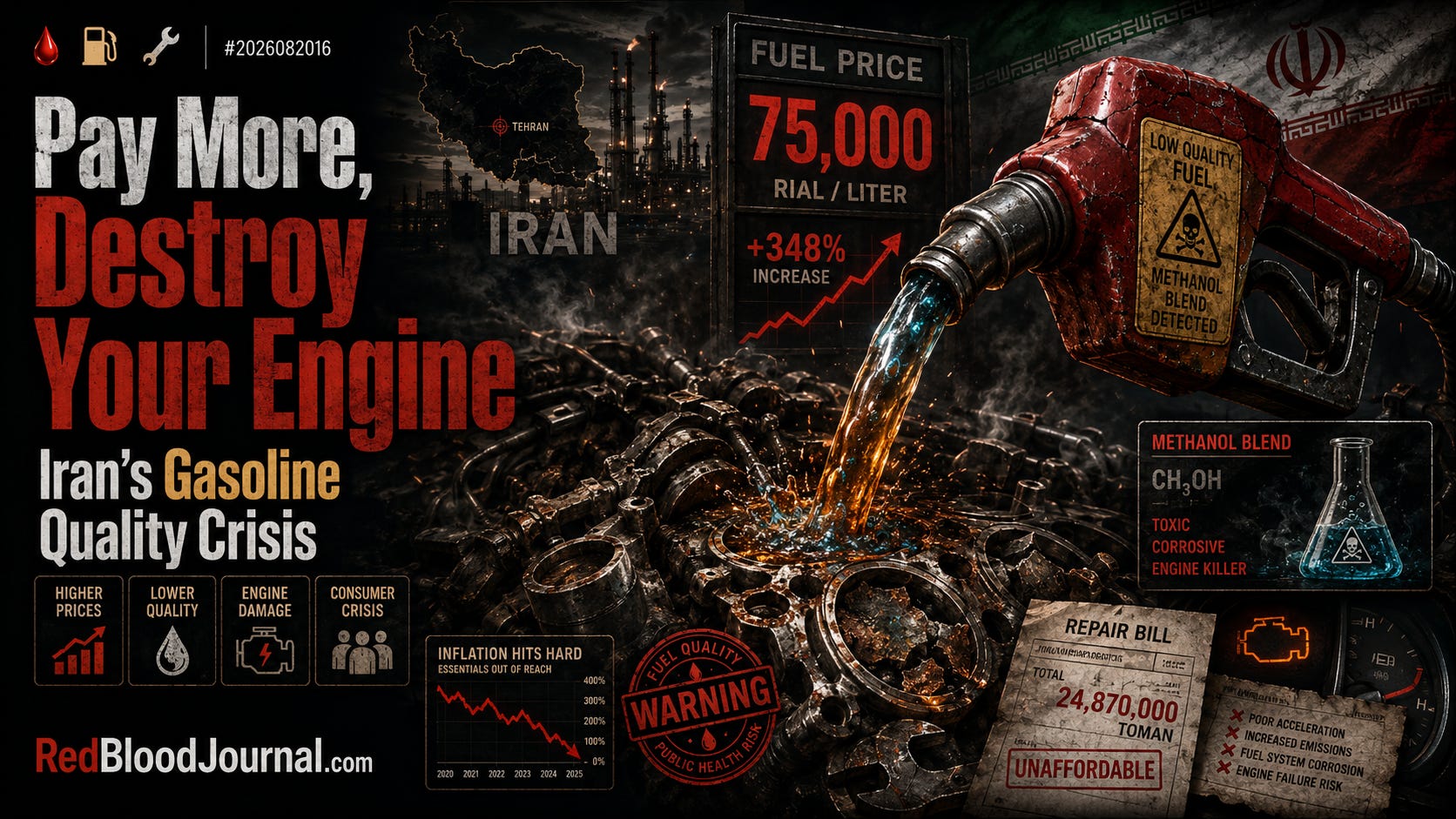
🩸 ⛽️ 🔧 #2026082016 — Pay More, Destroy Your Engine — Iran’s Gasoline Quality Crisis
RedBloodJournal.com
Imagine being told that gasoline is about to become dramatically more expensive.
Then imagine being told something worse:
the gasoline itself may be getting worse.
That is the crisis described in the source behind this report.
The file says Iranian officials and commentators are discussing a new higher gasoline price tier while, at the same time, concerns are being raised about deteriorating fuel quality, methanol blending, refinery constraints and possible damage to ordinary vehicles.
For the Iranian citizen, the equation could become brutal:
Pay more for the fuel.
Then pay again to repair the car.
The New Gasoline Price
According to the source, reports circulating inside Iran say a new fourth gasoline price tier has been approved.
The file cites figures in the approximate range of 70,000 to 80,000 toman, while also referring back to an earlier reported figure of 87,200 toman.
The exact implementation details are described as not yet fully announced.
That matters.
A proposal is not the same as a nationwide price at the pump.
But the direction is unmistakable in the source:
the government is looking for significantly more revenue from gasoline.
And officials themselves acknowledge that higher gasoline prices do not remain confined to gasoline.
Transportation affects everything.
Food.
Goods.
Construction.
Delivery.
Agriculture.
Manufacturing.
Services.
If fuel rises sharply, the increase travels through the economy.
The source notes that Mohammad Reza Aref acknowledged that gasoline-price increases can directly and indirectly affect the prices of other goods.
So gasoline is not one price.
It is a multiplier.
But Then Comes the Second Problem
The file raises a much more disturbing allegation.
It cites economist Sadegh Al-Hosseini as saying gasoline production had fallen from around 120 million liters per day to 100 million liters, before being pushed back toward 120 million liters through changes to fuel quality.
The source presents his warning in dramatic terms: that the decline in gasoline quality could damage vehicle engines over the coming months.
That claim deserves careful treatment.
The file provides the allegation.
It does not provide independent laboratory testing of national gasoline samples or mechanical studies proving that millions of Iranian cars will actually fail on the predicted timetable.
But even the existence of the warning reveals the depth of concern.
Iran may not simply have a gasoline-price problem.
It may have a gasoline-production problem.
Why Would Quality Be Reduced?
The source gives the answer indirectly.
Iran faces a mismatch between supply and consumption.
It says gasoline consumption may reach approximately 135 million liters per day, while domestic production is struggling to keep pace.
Normally, the gap could be filled with imports.
But imports require foreign currency.
And foreign currency requires revenue.
The same source describes severe pressure on oil income, financial access and trade routes.
So the government may be caught between three bad choices:
reduce consumption,
import more fuel,
or stretch domestic production.
Reducing consumption creates political risk.
Importing requires money.
Stretching production creates quality concerns.
There is no painless option.
Methanol Enters the Story
The source then points to another controversial development.
It says the managing director of Persian Gulf Star Refinery announced that methanol was being combined with gasoline to increase production.
That immediately generated alarm.
The file records warnings that methanol could damage fuel-system components and engine parts because of its corrosive characteristics.
This is where the story becomes especially important.
Fuel blending itself is not automatically evidence of wrongdoing.
Modern fuels around the world contain numerous additives and oxygenates.
The real questions are:
What percentage of methanol is being used?
What additives accompany it?
Which vehicles are compatible?
What fuel standards are being followed?
What testing has been performed?
Are concentrations controlled?
None of those technical details are established in the source.
That uncertainty is critical.
The story should not become:
Methanol exists, therefore every engine will be destroyed.
The real investigative question is:
What exactly is being put into Iranian gasoline, at what concentration, under what standard, and with what testing?
The Citizen Becomes the Test Laboratory
This is where the problem becomes uncomfortable.
If the government is under severe economic and production pressure, the incentive becomes obvious:
keep the pumps supplied.
A shortage is visible immediately.
Drivers line up.
Stations run dry.
Videos spread.
Political anger grows.
Quality degradation is different.
It may take weeks or months to notice.
A fuel pump fails.
A hose deteriorates.
An injector develops problems.
An engine begins running poorly.
The individual citizen may never be able to prove whether the cause was gasoline, maintenance, age, manufacturing quality or something else.
That makes poor fuel quality politically easier to hide than no fuel at all.
The station can say:
The tank is full.
The driver discovers the rest later.
The Hidden Price of Gasoline
Suppose fuel costs rise.
The obvious cost is visible on the pump.
But if the fuel also contributes to mechanical deterioration, then the actual price becomes:
gasoline price
fuel-filter replacement
injector work
fuel-pump repair
hoses
engine diagnostics
lost transportation
lost work time.
For a wealthy household, that is frustrating.
For a working Iranian family already struggling with rent and food, it can be devastating.
The source later includes testimony from an Iranian describing how ordinary living expenses and vehicle repairs are already overwhelming household income.
A car in that environment is not always a luxury.
It may be employment.
Delivery work.
Transportation to work.
Family mobility.
A repair bill can become an economic emergency.
A Perfect Economic Trap
The citizen now faces a remarkable chain.
The government needs revenue.
Gasoline becomes more expensive.
The government needs more fuel supply.
Quality may be altered.
The vehicle requires more repairs.
Parts themselves become more expensive because of sanctions and currency weakness.
The mechanic charges more.
Transportation prices rise.
Businesses raise prices.
The citizen pays at every stage.
And unlike political elites, ordinary people cannot simply move the cost onto someone else.
They are the final destination of the bill.
Iran’s Energy Paradox
Iran possesses some of the largest hydrocarbon resources on Earth.
Yet the source describes a country facing gasoline imbalance, gas shortages, refinery constraints, electricity problems and industrial shutdown risks.
That is the deeper story.
Natural resources do not automatically create energy security.
A country also needs:
investment,
technology,
refining capacity,
maintenance,
infrastructure,
efficient consumption,
stable trade,
access to capital,
and competent long-term management.
Oil underground does not power a car.
An entire industrial system must exist between the reservoir and the fuel nozzle.
When that system deteriorates, a resource-rich country can experience scarcity.
The Political Danger of Gasoline
Iranian governments understand the danger of gasoline prices.
Fuel affects nearly everyone.
And price increases are immediate.
The source notes political disagreement over raising gasoline prices and also discusses warnings about possible social unrest later in the year.
That does not mean a gasoline increase will automatically trigger an uprising.
But gasoline occupies a uniquely sensitive place in Iranian political memory.
It combines economics with daily visibility.
People can tolerate abstract monetary policy without understanding it.
A fuel price appears on a sign.
Everybody sees it.
Everybody pays it.
And every time the number changes, the government’s economic condition becomes visible in public.
The Red Blood Perspective
The gasoline story should be investigated as two separate issues that may be colliding.
First: Price
How much will gasoline actually cost?
Who will pay the fourth-tier price?
How much fuel remains subsidized?
When does implementation begin?
Second: Quality
What is actually in the gasoline?
What octane levels are being delivered?
How much methanol is being blended?
Which standards govern the mixture?
What do independent laboratory tests show?
Has vehicle damage increased?
Until those questions are answered, dramatic claims should remain claims.
But the concerns themselves cannot simply be dismissed.
Because if Iranian citizens are simultaneously being asked to pay much more for fuel while receiving lower-quality fuel, then this becomes one of the clearest examples of economic collapse transferring its cost directly onto ordinary people.
The government solves its shortage.
The citizen inherits the damage.
Pay More, Get Less
There is perhaps no better symbol of economic deterioration.
In a healthy economy:
productivity improves,
quality improves,
competition increases,
and consumers generally expect better products over time.
During deterioration, the relationship can reverse.
Price rises.
Quality falls.
Service falls.
Availability falls.
And the public is told to be grateful that the product exists at all.
That is not inflation alone.
It is economic degradation.
The citizen’s money buys less quantity, less quality and less security at the same time.
Ocean of Love and Positivity Perspective
From the Ocean of Love and Positivity, there is something fundamentally wrong when ordinary people become the shock absorber for every failure above them.
Officials make decisions.
Governments confront foreign powers.
Institutions mismanage resources.
Infrastructure deteriorates.
Revenue disappears.
And finally the consequences arrive at one place:
the citizen.
At the gasoline pump.
A father trying to get to work.
A mother driving a child somewhere.
A taxi driver earning a living.
A delivery driver trying to finish another order.
They did not design refinery policy.
They did not negotiate sanctions.
They did not determine foreign policy.
Yet they may pay for all three.
Good government should work in the opposite direction.
Leadership should absorb complexity so citizens do not have to.
Infrastructure should protect people from instability.
Standards should ensure that what enters a fuel tank will not damage what a family spent years buying.
Transparency should answer the simplest question imaginable:
What exactly are you selling us?
If gasoline quality is safe, prove it.
Publish the composition.
Publish the standards.
Publish laboratory results.
Allow independent testing.
If the allegations are wrong, transparency protects the government.
If the allegations are right, transparency protects the people.
Either way, secrecy protects nobody except whoever benefits from uncertainty.
The Iranian citizen should never have to wonder:
Am I filling my tank—or slowly destroying my car?
In an Ocean of Love and Positivity.
🩸🌊✨ Fantastic!
⛽
Iran’s Gasoline Crisis: Rising Prices and Degrading Quality
Aug 20, 2026
The provided text describes a growing gasoline crisis in Iran, where citizens face the dual burden of rising fuel prices and deteriorating fuel quality. Reports indicate that the Iranian government is introducing a new, significantly more expensive pricing tier to address revenue shortages and a mismatch between supply and demand. Simultaneously, there are serious allegations that methanol blending and refinery constraints are lowering fuel standards, which could lead to widespread engine damage and costly vehicle repairs. This situation creates a “perfect economic trap” where ordinary people must pay more for a product that may actively harm their property. The source highlights a broader energy paradox, noting that despite Iran’s massive natural resources, economic mismanagement and sanctions have led to scarcity and infrastructure decay. Ultimately, the text argues that the Iranian public has become a shock absorber for state failures, inheriting the physical and financial costs of a degrading energy sector.
#RedBloodJournal #Iran #IranEconomy #Gasoline #FuelCrisis #GasolinePrices #FuelPrices #FuelQuality #Methanol #IranGasoline #EnergyCrisis #EnergySecurity #Refinery #FuelShortage #CarDamage #EngineDamage #VehicleRepairs #CostOfLiving #Inflation #EconomicCrisis #EconomicPressure #Sanctions #IranSanctions #CurrencyCrisis #MiddleClass #IranianPeople #ConsumerProtection #Transparency #EnergyPolicy #EconomicDegradation #CitizenFirst #OceanOfLoveAndPositivity


