


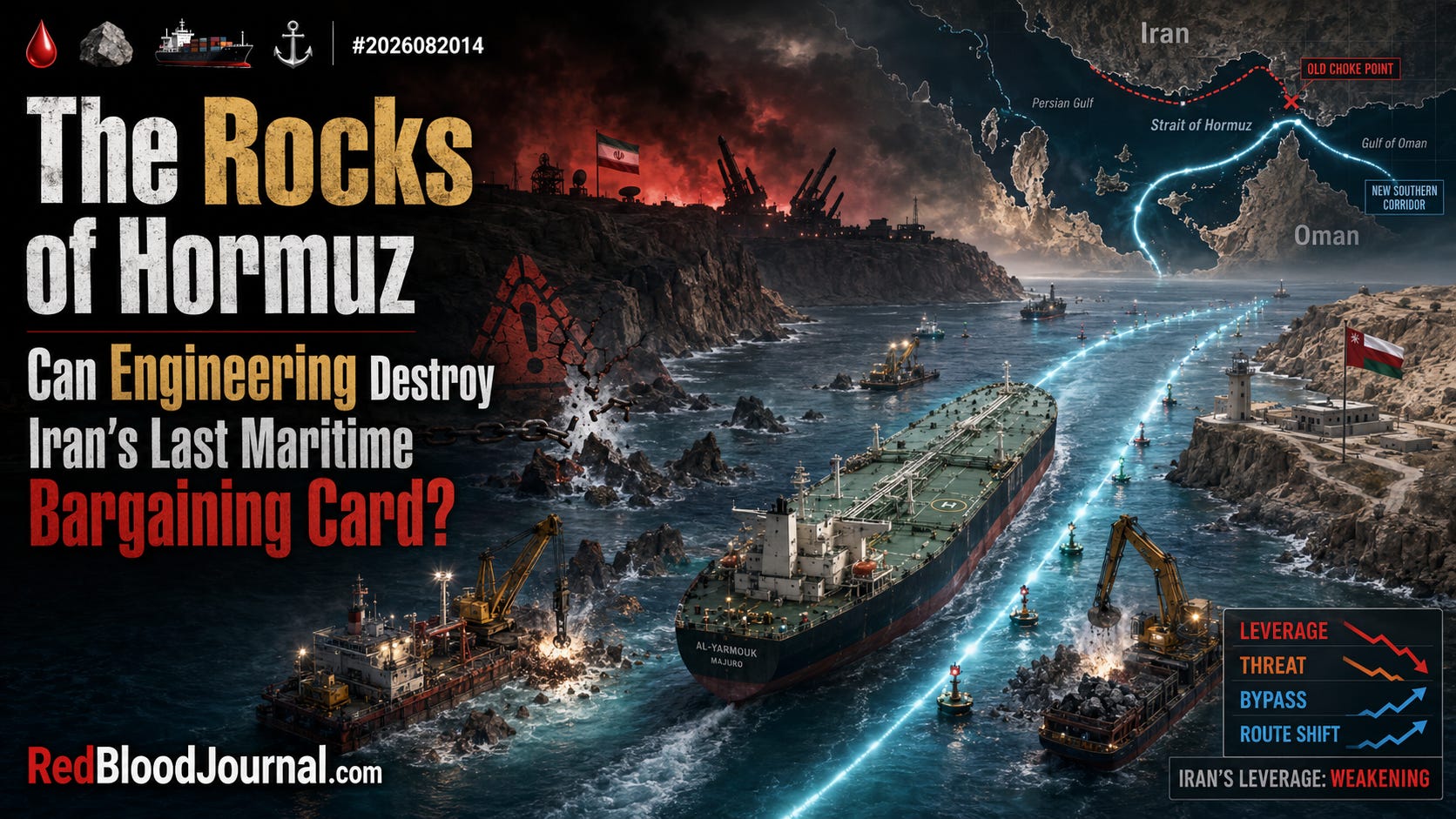
🩸 🪨 🚢 ⚓️ #2026082014 — The Rocks of Hormuz — Can Engineering Destroy Iran’s Last Maritime Bargaining Card?
RedBloodJournal.com
For decades, the Strait of Hormuz has been more than geography.
For the Islamic Republic, it has been leverage.
The logic has always been simple:
If Iran cannot export its oil, then perhaps nobody else should be able to safely export theirs through the Persian Gulf.
That threat gave Tehran something sanctions could not easily remove:
a choke point.
But the source behind this report raises a startling possibility.
What if the answer to Iran’s threat is not another aircraft carrier, another missile battery, another sanction package or another round of negotiations?
What if the answer is simply:
change the geography.
The Card Iran Thought Could Never Be Taken Away
Iran has repeatedly treated the Strait of Hormuz as one of its strongest strategic cards.
The source summarizes the longstanding Iranian position as essentially:
If Iranian oil cannot leave the Gulf, other countries’ oil will not be allowed to leave either.
But according to the report, reality has begun moving in the opposite direction.
It claims Iranian oil exports have been severely constrained while significant volumes of oil from Arab Gulf states continue moving through the region.
That alone changes the balance.
But then comes the more extraordinary allegation.
The Rocks
The source claims American engineering teams equipped with specialized vessels have been working along the Omani side of the Strait of Hormuz to remove or shave down obstructing rocks and make the southern shipping corridor wider and easier for large vessels to navigate.
The report attributes confirmation of this claim to Iranian journalist Ali Gholhaki.
If accurate, the significance would be enormous.
Because the problem Washington would be solving would not simply be navigation.
It would be dependency.
If large tankers can move safely through a route farther from Iranian-controlled waters, then Tehran’s ability to threaten the entire oil flow of the Persian Gulf may diminish.
A mountain of strategy could be defeated by a few meters of rock.
When Engineering Becomes Geopolitics
Most people imagine geopolitical power through weapons.
Aircraft.
Missiles.
Warships.
Submarines.
Troops.
But engineering can sometimes alter strategic power more permanently than weapons.
A bridge can redirect commerce.
A canal can create an empire.
A pipeline can eliminate dependence on a sea lane.
A deeper shipping channel can move an entire trade route.
And a widened maritime corridor can potentially change who controls the risk surrounding a chokepoint.
This is what makes the claim in the source so important.
If Iran’s leverage depends partly upon ships being forced into waters where Tehran can threaten them, then changing those shipping lanes could quietly weaken that leverage without firing a shot.
The Strait Is Still the Strait
There is an important limitation.
The uploaded source makes this engineering claim, but it does not provide technical charts, hydrographic surveys, project documents, vessel records or official American confirmation showing exactly what has been altered and how much additional navigational freedom has actually been created.
So the strongest conclusion cannot yet be:
Hormuz has been bypassed.
The proper question is:
Is someone trying to make Hormuz less strategically valuable?
That distinction matters.
The Strait remains narrow.
Geography does not disappear because rocks are removed.
Iran still possesses coastal territory, missiles, naval forces, drones and other means of threatening shipping.
But geopolitical leverage does not need to disappear completely to become weaker.
It only needs alternatives to become credible.
Iran’s Threat Depends on Everyone Being Trapped Together
Consider Iran’s traditional strategic logic.
Iran suffers.
Gulf exporters suffer.
Global energy markets suffer.
Oil prices rise.
The world becomes frightened.
Pressure builds on Washington.
Eventually somebody comes back to Tehran asking for a deal.
That logic depends on economic pain being shared.
But what happens if Iran becomes increasingly isolated while its neighbors retain functioning export routes?
Then the strategic equation reverses.
Iran loses oil revenue.
Saudi Arabia exports.
The UAE exports.
Qatar exports.
Iraq exports.
Global markets experience disruption—but not paralysis.
At that point the Strait stops behaving like a hostage situation in which everyone is locked in the same room.
One participant may suddenly discover that the exits work for everybody except him.
Was This the Purpose of the Quiet Period?
The source makes an even more provocative interpretation.
It suggests that during the ceasefire and negotiating period—while many observers were focused on diplomacy and military preparations—the United States may have been quietly improving the Omani-side route.
That is an inference from the source, not an established fact.
But strategically, it raises an interesting possibility.
Perhaps time itself was the weapon.
Every week without a major confrontation would allow engineering work, logistical adjustment, naval planning and new commercial routes to mature.
Then, once the alternative route became sufficiently usable, Washington could intensify economic pressure with less fear that Tehran could answer by shutting down Gulf exports.
If so, what looked like hesitation may have been preparation.
Again, the source does not establish this as fact.
But the possibility deserves examination.
The Larger Pattern: Make Hormuz Irrelevant
This report does not exist in isolation.
Iran’s leverage around Hormuz can theoretically be reduced in several ways:
pipeline expansion,
alternative export terminals,
new ports,
offshore loading,
additional storage capacity,
naval escort,
air and missile defense,
alternate shipping corridors,
and physical modification of navigational routes.
Each individual measure may seem insufficient.
Together, they can produce something more important:
redundancy.
And redundancy is the enemy of leverage.
A chokepoint is powerful because there is no substitute.
Create substitutes, and the chokepoint gradually becomes just another route.
The Most Dangerous Weapon Against Iran May Be Boredom
There is something almost anticlimactic about this possibility.
For decades the Strait of Hormuz has generated dramatic headlines:
WAR.
MISSILES.
OIL SHOCK.
BLOCKADE.
NAVAL CONFRONTATION.
But perhaps the most damaging response to Iran’s threat would be painfully unglamorous.
Survey the seabed.
Remove obstacles.
Widen the route.
Build pipelines.
Expand terminals.
Create insurance mechanisms.
Redirect traffic.
Repeat.
Until one day the threat to close Hormuz produces a response no government wants to hear:
Go ahead.
That would represent the true destruction of the bargaining card.
Not because Iran lost the ability to cause trouble.
Because the world lost its fear of the trouble.
The Red Blood Perspective
The most interesting part of this story is not the rocks themselves.
It is the philosophy behind them.
The Islamic Republic has spent decades investing in asymmetric leverage.
It does not need to defeat the United States militarily.
It needs to make confrontation expensive enough that Washington prefers negotiation.
Hormuz fits that strategy perfectly.
But every asymmetric weapon has a countermeasure.
If the weapon is dependence on a chokepoint, the countermeasure is reducing dependence.
If the uploaded source is correct that engineering work is being conducted on the Omani-side corridor, then Washington may be attacking one of Iran’s most important strategic assets without attacking Iran itself.
That is what makes this story worth watching.
The question is no longer simply:
Can Iran close Hormuz?
The more important question may become:
If Iran closes it, how much will the world still care?
What Would Confirm the Theory?
There are several things worth watching.
Do tankers increasingly transit farther south?
Are maritime charts updated?
Do insurers begin treating the Omani corridor differently?
Do Gulf producers announce additional export capacity that avoids Iranian-controlled waters?
Do American or Omani authorities acknowledge navigational improvements?
Does Iranian rhetoric about closing Hormuz become less frequent?
And most importantly:
Does Washington become more aggressive economically after becoming more confident that Gulf oil can continue moving?
Those developments would help determine whether this is simply an interesting claim—or part of a much larger restructuring of the Persian Gulf.
Ocean of Love and Positivity Perspective
From the Ocean of Love and Positivity, there is another way to view the story.
Human history repeatedly demonstrates the same pattern.
One side discovers leverage.
Another side searches for a way around it.
The first side builds a wall.
The second builds a tunnel.
The first controls a road.
The second builds another road.
The first threatens a shipping lane.
The second begins moving rocks.
Billions of human beings then live with the consequences of a competition they did not design.
Perhaps the highest form of intelligence is not finding a better method of strangling one another.
Perhaps it is building enough alternative paths that no nation can hold millions of ordinary people hostage to geography.
A Strait should carry ships.
A pipeline should carry energy.
A port should carry commerce.
They should not have to carry the accumulated hatred of governments.
If engineering can reduce the ability of one government to threaten millions of civilians and economies, that can be positive.
But if the same engineering merely makes it easier to tighten an economic siege that devastates ordinary Iranian citizens, then the moral question remains unresolved.
Technology is neither compassionate nor cruel.
The intention behind it—and the consequences flowing from it—determine what humanity has actually built.
Maybe one day the greatest achievement will not be making the Strait of Hormuz impossible to close.
Maybe it will be creating a world in which nobody wants to close it.
In an Ocean of Love and Positivity.
🩸🌊✨ Fantastic!
🪨
Eroding Iran’s Leverage: Engineering the Strait of Hormuz
Aug 20, 2026
The provided text examines a strategic shift in the Persian Gulf where American engineering may be systematically undermining Iran’s long-held geopolitical leverage over the Strait of Hormuz. By allegedly dredging and widening shipping lanes near Oman, the United States aims to create a southern maritime corridor that allows global oil tankers to bypass waters controlled by Tehran. This physical modification of maritime geography represents a transition from military confrontation to infrastructure-based strategy, potentially rendering Iran’s threats to block energy exports ineffective. While the report acknowledges a lack of official hydrographic confirmation, it suggests that diversifying export routes and removing navigational obstacles serves as a powerful countermeasure to asymmetric warfare. Ultimately, the source argues that reducing global dependency on a single chokepoint could permanently alter the balance of power without the need for traditional combat.
#RedBloodJournal #Iran #StraitOfHormuz #Hormuz #PersianGulf #Oman #Shipping #OilShipping #OilTrade #EnergySecurity #MaritimeSecurity #Geopolitics #IranStrategy #IranLeverage #EconomicWarfare #Sanctions #MaximumPressure #USIran #MiddleEast #OilMarkets #ShippingRoutes #MaritimeTrade #StrategicChokepoint #NavalStrategy #EnergyRoutes #GulfStates #IranCrisis #Engineering #Infrastructure #TradeRoutes #OceanOfLoveAndPositivity


