


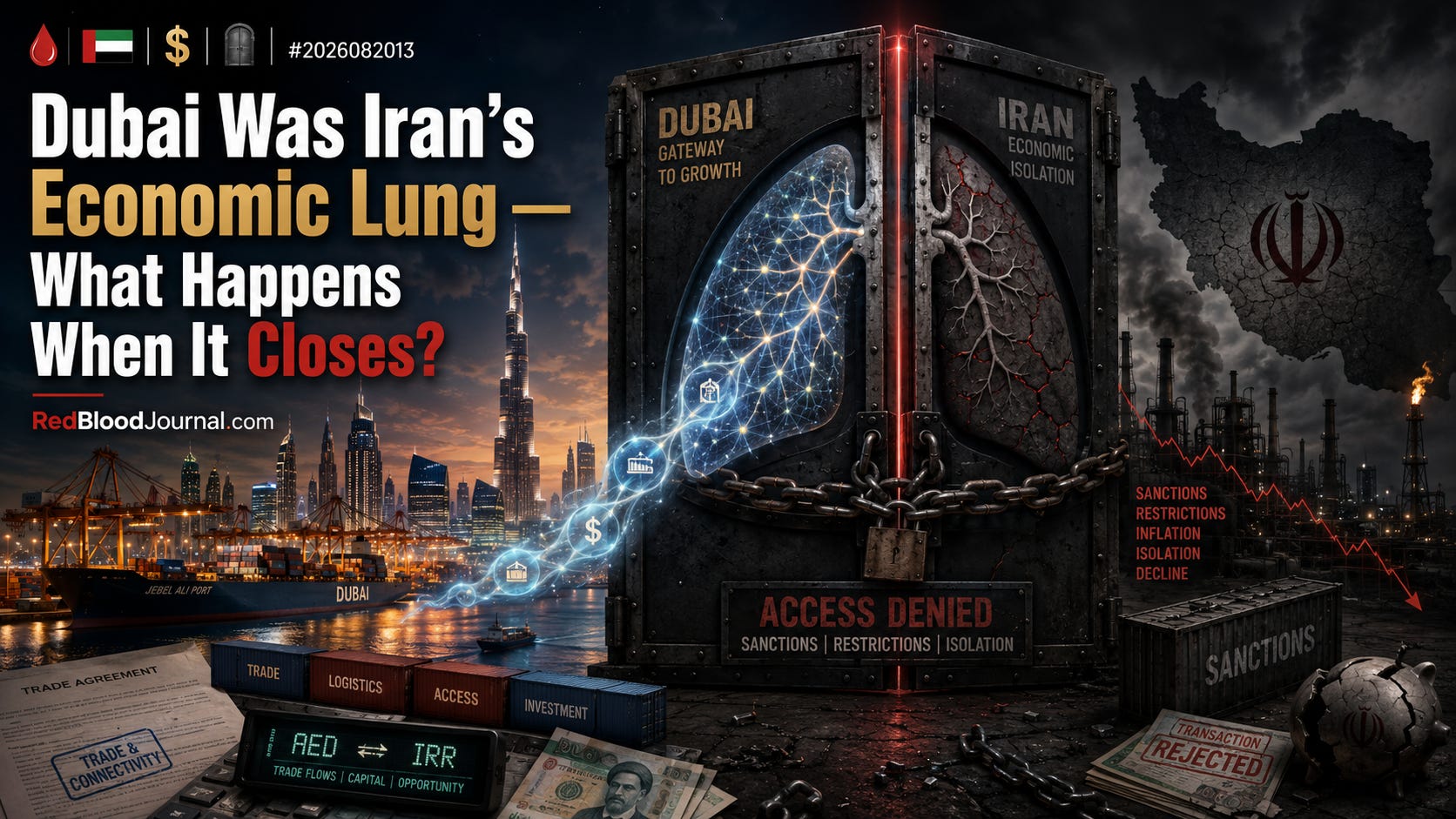
🩸 🇦🇪 💰 🚪 #2026082013 — Dubai Was Iran’s Economic Lung — What Happens When It Closes?
RedBloodJournal.com
For decades, Iran survived sanctions partly because sanctions were never the same thing as isolation.
A government can be sanctioned on paper while money, merchandise, gold, machinery, electronics, spare parts and foreign currency continue moving through neighboring commercial hubs.
For Iran, one of the most important of those hubs has been Dubai.
The source behind this report makes a dramatic claim: the United Arab Emirates has begun shutting down commercial and financial activity connected to the Islamic Republic, potentially removing one of Tehran’s most important economic escape routes.
If that claim develops into a broad and enforceable cutoff, the story is much larger than another sanction.
It would mean someone is closing the emergency exit.
Dubai Was More Than a Trading Partner
Iran and the UAE appear beside one another on trade statistics.
But statistics can hide the real relationship.
According to the source, Dubai functioned as:
a gateway for Iranian imports,
a center for re-exporting goods into Iran,
a place where Iranian funds could be converted into dirhams and other usable currencies,
a payment channel for foreign suppliers,
a purchasing center for gold, electronics and consumer goods,
a base for thousands of Iranian traders and companies,
and, crucially, a location for intermediary and front companies used to work around sanctions.
That makes Dubai less like an ordinary foreign market and more like part of Iran’s unofficial financial infrastructure.
Iran did not need every international door to remain open.
It needed enough doors.
Dubai was one of the biggest.
Sanctions Work Differently When the Neighboring Door Closes
Traditional sanctions frequently create a strange economic ecosystem.
The sanctioned country remains officially isolated while middlemen become increasingly valuable.
A shipment cannot go directly from Point A to Iran?
Send it to Point B first.
A foreign company cannot comfortably accept Iranian payment?
Create another company.
Dollars become difficult?
Use dirhams.
A ship attracts attention?
Change registration.
A banking channel closes?
Find an exchange house.
Every additional layer raises cost, but the system continues breathing.
The uploaded source argues that the newest American pressure strategy may be aimed precisely at this secondary infrastructure—not merely at Iran itself, but at anyone providing Iran with the mechanisms necessary to continue trading.
That distinction matters enormously.
The question changes from:
Can Iran survive American sanctions?
to:
Can Iran survive if the countries and companies that helped it survive American sanctions decide that helping Iran has become too dangerous?
The Most Powerful Sanction May Be Fear
Washington does not necessarily have to physically prevent every shipment.
It may only have to make everyone involved afraid of touching it.
Banks fear losing access to the American financial system.
Shipping companies fear sanctions.
Insurers fear penalties.
Foreign companies fear being blacklisted.
Exchange houses fear losing correspondent relationships.
Governments fear consequences for their own economies.
Once that calculation changes, enforcement begins occurring voluntarily.
A merchant does not need an American official standing at the warehouse door.
The merchant simply decides:
Iranian business is no longer worth the risk.
That is when sanctions begin transforming into isolation.
The First Signs Would Appear in Ordinary Commerce
The source includes accounts from Iranian traders claiming merchandise moving through Dubai had become stuck and that some shipments were being diverted or returned.
These accounts alone do not establish the scale or permanence of a UAE-wide cutoff.
But they illustrate what such a closure would look like from the ground.
Not presidents.
Not generals.
Not diplomats.
A trader waiting for electrical equipment.
An importer whose container does not move.
A manufacturer unable to obtain a component.
A shopkeeper discovering that replacement inventory will cost dramatically more.
A customer eventually paying the difference.
Economic warfare rarely arrives at the citizen’s door labeled economic warfare.
It arrives labeled:
Out of stock.
Delivery delayed.
Price increased.
Currency unavailable.
The Dirham Problem
One particularly important issue is currency.
The source describes Dubai as a major location for converting Iranian money and revenues into dirhams and other internationally useful currencies.
That matters because international trade requires more than having wealth somewhere on paper.
A country needs usable money.
Iran can possess oil.
It can possess rial liquidity.
It can possess foreign assets frozen abroad.
But an importer trying to purchase machinery from Asia needs a payment mechanism the seller accepts.
Cut those mechanisms and the problem becomes less:
Does Iran possess money?
and more:
Can Iran actually move it?
Those are entirely different questions.
The Domino Effect
The UAE by itself would hurt.
The much larger danger for Tehran would be imitation.
The source identifies other potential channels including Iraq, Turkey, Oman, Qatar and, most importantly, China.
Imagine the system as a room with several oxygen tubes.
Closing one hurts.
Closing two creates panic.
Closing nearly all of them changes the nature of the crisis completely.
That may explain why the reported American strategy focuses not merely on Iranian entities but on third parties that facilitate oil sales, payments, ship registration and front-company activity.
Iran has spent decades learning how to circumvent sanctions.
The counterstrategy would therefore be obvious:
Do not chase Iran through every loophole.
Make the loopholes afraid to remain open.
But There Is an Important Unanswered Question
Announcements are easy.
Economic quarantine is extraordinarily difficult.
The source itself acknowledges this.
Can Washington really pressure Chinese banks?
Can it stop Iraqi exchange networks?
Can it identify front companies fast enough?
Can it prevent new companies from replacing sanctioned ones?
Can Turkey, Qatar, Oman or other intermediaries become alternate gateways?
Can cryptocurrency, barter, gold or informal financial networks substitute for conventional channels?
Can China simply decide that its relationship with Washington matters less than Washington assumes?
Those questions determine whether this becomes a historic economic blockade or another layer in a forty-year sanctions maze.
The source explicitly recognizes this uncertainty, asking whether the United States can translate rhetoric into actual pressure against Chinese banks, Iraqi exchange houses, shipping firms and front companies.
That uncertainty should not be erased.
And Then There Are the Iranian People
This is the part sanctions debates repeatedly try to separate from geopolitics.
But economies do not permit that separation.
If imports become harder:
prices rise.
If foreign currency becomes scarcer:
the rial weakens.
If industrial components disappear:
factories struggle.
If transportation costs increase:
food becomes more expensive.
If businesses cannot replace inventory:
employment suffers.
The source itself acknowledges that ordinary Iranians would not escape the consequences of the pressure.
This creates the central moral contradiction of economic warfare.
The intended target may be the government.
The transmission mechanism runs through the population.
The Red Blood Perspective
Dubai may reveal whether the newest pressure campaign against the Islamic Republic is fundamentally different from previous sanctions.
For years, Tehran’s survival strategy was adaptation.
One route closes.
Another appears.
One bank stops.
Another intermediary emerges.
One company gets sanctioned.
Three shell companies replace it.
That is why focusing exclusively on sanctions lists can be misleading.
The real measure of pressure is not how many Iranian names appear on a Treasury document.
The real measure is:
How many usable doors remain open?
If Dubai genuinely stops functioning as Iran’s commercial and financial lung—and if other regional channels follow—the Islamic Republic would face something qualitatively different from ordinary sanctions.
It would face shrinking economic geography.
But this report’s central claim must still be tested against what happens next.
Does trade actually stop?
Do UAE banks reject Iranian-linked transactions?
Do ships turn around?
Do other regional governments follow?
Does China comply?
Or does commerce simply reroute itself again?
Those observable outcomes will tell us whether a lung has truly closed—or merely whether Iran has been forced to breathe through another tube.
Ocean of Love and Positivity Perspective
From the Ocean of Love and Positivity, governments are not economies.
People are not regimes.
A shopkeeper in Tehran did not design Iran’s foreign policy.
A mother buying food did not create sanctions.
A factory worker did not negotiate nuclear policy.
A child needing medicine did not choose geopolitical confrontation.
When governments fight economically, civilians become the terrain across which the battle travels.
That does not mean governments should never face consequences.
It means those consequences should always be examined by asking the question power finds easiest to forget:
Who actually absorbs the pain?
If economic pressure produces political change while minimizing suffering, its defenders will call it successful.
If it destroys ordinary lives while political elites remain protected, history may judge the operation very differently.
So watch Dubai.
But do not watch only the ships, banks, exchange houses and sanction lists.
Watch the grocery stores.
Watch the factories.
Watch the currency.
Watch the medicine shelves.
Watch the citizens.
Because that is where the real measurement of economic warfare eventually appears.
In an Ocean of Love and Positivity.
🩸🌊✨ Fantastic!
🚪
Closing the Lung: Iran’s Economic Isolation in Dubai
Aug 20, 2026
The provided text explores how Dubai has historically served as a vital financial and logistical “lung” for Iran, allowing it to bypass international sanctions through a complex network of intermediaries and trade routes. Recent reports suggest that the United Arab Emirates may be closing these economic escape routes, shifting the American strategy from targeting Iran directly to intimidating the third-party entities that facilitate its commerce. This potential isolation threatens to disrupt the flow of essential goods and foreign currency, making the cost of doing business prohibitively high for the Islamic Republic. While the effectiveness of this pressure depends on the cooperation of other nations like China and Turkey, the transition from sanctions to true economic quarantine would have a profound impact. Ultimately, the narrative highlights that while the geopolitical goal is to pressure the government, the civilian population often bears the brunt of the resulting inflation and shortages. Therefore, the situation in Dubai serves as a critical indicator of whether Iran can continue to adapt or if its economic geography is permanently shrinking.
#RedBloodJournal #Dubai #UAE #Iran #IranEconomy #EconomicWar #EconomicSanctions #MaximumPressure #SecondarySanctions #IranSanctions #DubaiTrade #UAEIran #IranTrade #FinancialIsolation #EconomicIsolation #IranianEconomy #Dirham #CurrencyCrisis #TradeRoutes #SanctionsEvasion #FrontCompanies #ShadowEconomy #Shipping #OilTrade #MiddleEast #Geopolitics #Trump #USForeignPolicy #EconomicPressure #IranCrisis #RegimePressure #IranianPeople #CitizenFirst #OceanOfLoveAndPositivity


