


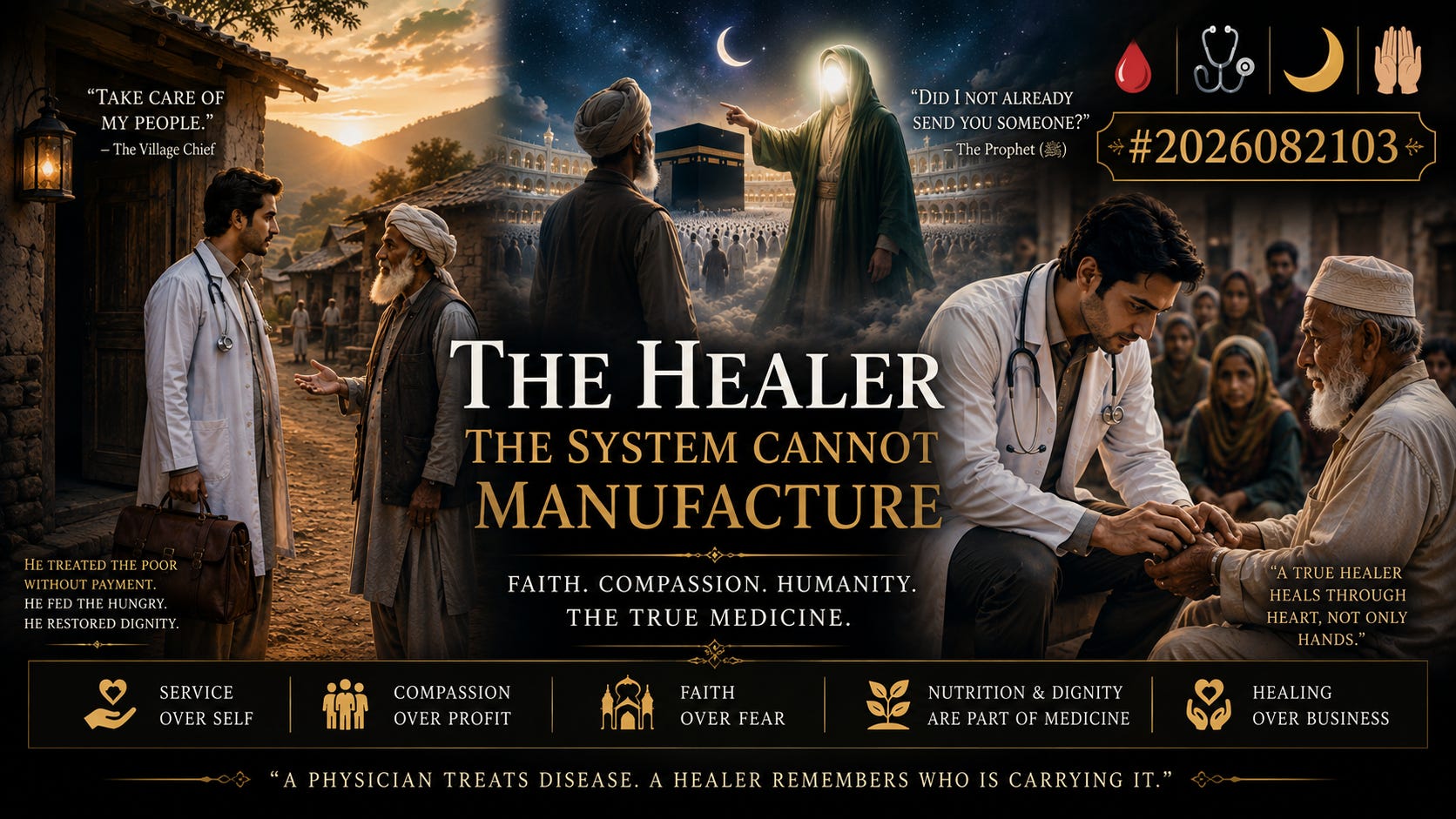
🩸 🩺 🌙 🤲 #2026082103 — The Healer the System Cannot Manufacture
Faith, Medicine, and the Difference Between Treating Disease and Caring for a Human Being
A Red Blood Journal Exclusive
By Red Blood
PROLOGUE — Before Medicine Became a Business
There was a time when medicine was understood less as an industry and more as a calling.
A doctor did not merely diagnose disease, write a prescription, and send the patient home.
A doctor entered another human being’s suffering.
Knowledge mattered.
Science mattered.
Medicine mattered.
But so did compassion.
So did responsibility.
So did character.
This is the story of a physician who lived according to that older understanding of medicine.
He was not famous.
He built no hospital empire.
He wrote no medical textbook.
He accumulated no great fortune from the sick.
But thousands of people trusted him with something more valuable than money:
their lives.
He was a physician.
He was a Sufi.
And he was my father.
I
The Law That Sent a Young Doctor Away From the City
When my father graduated from medical school, new physicians could not simply establish themselves wherever the money and opportunity were greatest.
For the first two years, doctors were required to serve areas where physicians were desperately needed.
That often meant leaving the city.
It meant villages.
Poor communities.
Dusty roads.
Families who sometimes had little money and almost no access to modern medical care.
Many young physicians considered such service an inconvenience.
My father did not.
He went to a village outside the city where there was no doctor.
He arrived not as a businessman looking for customers, but as a young physician looking for a place to serve.
Before practicing medicine there, however, he first needed something more important than an office.
He needed the trust of the village.
II
The Village Chief
The most important man in the village was its chief.
My father introduced himself respectfully and explained that he wanted to establish a small medical clinic.
The chief studied the young doctor.
He saw someone educated but humble.
Someone polite.
Someone willing to live among people who could offer him very little financially.
The chief eventually offered him an empty room inside his own house.
No expensive lease.
No complicated contract.
Just a room.
A clinic.
And one unspoken responsibility:
Take care of the people.
My father accepted.
He planned to return the following day with his medical equipment.
Everything appeared settled.
But during the night, something changed.
III
The Door Closed Because of One Word
When my father returned the next morning, the chief stood at the doorway.
The warmth from the previous day had disappeared.
The chief asked him:
“Are you a Sufi?”
My father had been raised to believe that honesty was sacred.
He answered simply:
“Yes.”
The chief’s expression changed.
Someone had apparently spoken to him during the night.
He had been told that Sufis were strange people.
Perhaps heretics.
Perhaps people who did not truly believe in God.
The accusation was enough.
The chief told my father that he could no longer remain in the village.
The clinic was finished before it had even opened.
My father did not argue.
He did not insult the chief.
He did not hide his beliefs in order to gain acceptance.
He simply left, intending to return later for his belongings.
The door had closed.
But only for one night.
IV
The Dream
That night, according to the story the chief later told my father, he had an extraordinary dream.
He found himself in Mecca.
Before him stood the Prophet Muhammad.
The chief had suffered from chronic back pain for years.
In the dream, he asked for healing.
The Prophet listened.
Then he pointed behind the chief and said:
“Did I not already send you someone?”
The chief turned.
Standing behind him was the young doctor he had rejected.
He woke shaken.
Whether a reader understands such an experience spiritually, psychologically, symbolically, or through faith is ultimately a personal matter.
But to the village chief, the meaning was unmistakable.
He believed he had made a terrible mistake.
V
The Door Opened Again
The following morning, my father returned expecting only to collect his belongings.
Instead, he saw the chief running toward him.
The elder was crying.
He embraced the young physician.
He kissed his hands.
He asked forgiveness.
Tea was prepared.
Sweets were brought.
Then the chief told him about the dream.
The same man who had rejected him because of religious prejudice now begged him to stay.
And so the small room became a clinic.
What had begun with rejection became the foundation of a relationship that would last for generations.
VI
The Village Became His Family
For the next two years, my father practiced medicine there.
He treated farmers.
Laborers.
Children.
Old men.
Widows.
Families who had never had reliable access to a physician.
Some could pay.
Some could not.
The difference rarely mattered to him.
Sometimes medicine alone was not enough.
A patient might need nutrition more urgently than another prescription.
My father would call the butcher and say:
“Give them meat. Put it on my account.”
Or he would call the pharmacist:
“Give them the medicine. I will pay.”
To him, medicine was not merely a collection of chemicals.
A hungry patient needed food.
A frightened patient needed reassurance.
A poor patient still deserved dignity.
He understood something that modern medicine sometimes risks forgetting:
Nutrition and dignity are part of medicine.
Healing begins when the physician sees the human being before seeing the disease.
VII
He Treated Humans, Not Charts
As the years passed, my father’s reputation expanded far beyond that village.
He developed an extraordinary ability to notice illness.
Sometimes it began with something as simple as the way a person walked into the room.
A change in posture.
The color of the skin.
A tremor in the voice.
A small movement.
A tired expression.
He observed carefully.
He listened.
He asked questions.
Other physicians sometimes sought his opinion because his diagnostic instincts had become exceptionally sharp.
To people watching from the outside, it could appear almost mysterious.
But perhaps what looked mysterious was partly the result of something increasingly rare:
attention.
He looked at the patient.
Not merely the laboratory result.
Not merely the medical chart.
Not merely the billing code.
He treated humans, not paperwork.
VIII
The Doctor Across the Street
There was an irony in the story.
The physician associated with spreading rumors about my father’s Sufi beliefs eventually opened his own clinic nearby.
But patients did not respond to him the same way.
Trust cannot be purchased with a medical degree.
It cannot be manufactured through advertising.
People eventually learn the difference between someone who practices medicine primarily as commerce and someone who experiences medicine as service.
The other physician eventually left medicine and went into the used-car business.
The village had made its choice.
Not through ideology.
Through experience.
IX
What Makes a Healer?
This is where the story becomes larger than one doctor.
Medical schools can teach anatomy.
They can teach pharmacology.
They can teach pathology.
They can teach surgery.
They can teach sophisticated diagnostic systems and increasingly powerful technologies.
All of those things are valuable.
But there is one thing no university can guarantee:
character.
Technology can make medicine faster.
Artificial intelligence may someday make diagnosis extraordinarily precise.
Robots may perform surgeries with accuracy beyond human hands.
Pharmaceutical science may continue producing treatments previous generations could barely imagine.
But none of those things automatically creates a healer.
Because a healer requires something beyond technical competence.
A healer must care what happens after the patient leaves the room.
A healer must still see a human being when the system sees a case number.
A healer must remember that fear, poverty, nutrition, loneliness, dignity, and hope can all exist beside the disease.
Medicine without humanity becomes machinery.
Medicine with humanity becomes care.
X
When the Healer Became the Patient
Eventually, the physician who had spent his life treating others became seriously ill himself.
The diagnosis was Non-Hodgkin lymphoma.
Our family believed that exposure to Roundup, which he used around the roses he loved growing, may have contributed to his illness.
That remains our family belief rather than something this story can medically prove.
But the cruel symbolism has always remained with me.
A man who spent his life fighting illness eventually became its patient.
He faced that reality much as he had faced the suffering of others:
with dignity,
with faith,
and without bitterness.
He died at 62.
XI
The Funeral Was His Medical Record
There is one measurement of a physician that never appears on a résumé.
Who comes when he dies?
At my father’s funeral, people came from everywhere.
Former patients.
Families.
Farmers.
People from the village.
People whose children he had treated.
People whose parents he had helped.
People who had carried memories of his kindness for decades.
Businesses closed.
The city slowed.
They did not gather because he had become wealthy.
They did not gather because his name had appeared on television.
They came because somewhere during their lives, when they were vulnerable, frightened, sick, poor, or desperate, this man had treated them as though their lives mattered.
That was his medical legacy.
Not a building.
Not a fortune.
People.
XII
The Healer the System Cannot Manufacture
Modern medicine has achieved extraordinary things.
Diseases that once killed millions can now be treated.
Surgeries once considered impossible have become routine.
Diagnostic technologies can look deep inside the human body.
These achievements deserve respect.
But progress creates its own danger.
As medicine becomes increasingly technological, institutional, algorithmic, and corporate, the patient can slowly disappear behind the machinery surrounding the patient.
The problem is not science.
The problem is forgetting what science is supposed to serve.
The purpose of medicine is not merely to process disease.
It is to care for the person experiencing disease.
That distinction may determine the future character of medicine.
Because hospitals can manufacture efficiency.
Universities can manufacture physicians.
Corporations can manufacture pharmaceuticals.
Algorithms can manufacture recommendations.
But none of them can mass-produce compassion.
None can guarantee humility.
None can program moral responsibility into every human heart.
And none can manufacture the kind of physician who quietly tells a butcher:
“Give that family food. I will pay.”
THE RED BLOOD PERSPECTIVE
The story of my father should not become an argument against modern medicine.
It should become a challenge to modern medicine.
Keep the science.
Keep the technology.
Keep the laboratories.
Keep the advanced drugs.
Keep the machines capable of seeing what previous generations could never see.
But do not remove the human being.
A civilization should never have to choose between scientific medicine and compassionate medicine.
The highest form of medicine should contain both.
Knowledge without compassion becomes cold.
Compassion without knowledge becomes powerless.
But knowledge guided by compassion becomes healing.
My father understood that without ever needing to write the philosophy down.
He simply lived it.
THE OCEAN OF LOVE AND POSITIVITY PERSPECTIVE
Perhaps the deepest lesson has nothing to do with medicine.
The village chief initially saw a label:
Sufi.
And the label created fear.
Then he encountered the human being behind the label.
Everything changed.
The young doctor could have answered prejudice with anger.
He did not.
The chief could have protected his pride after realizing his mistake.
He did not.
One man returned.
Another apologized.
A door reopened.
And because that door reopened, generations of people received care.
That is how the Ocean of Love and Positivity works in ordinary human life.
Not by pretending disagreement does not exist.
Not by demanding that everyone believe the same thing.
But by refusing to let fear become stronger than humanity.
A village once rejected a doctor because of what it had been told about him.
It eventually loved him because of what he actually did.
Perhaps that is one of life’s simplest tests:
Judge less by the label.
Watch the life.
RECEIPTS BOX — What the Story Actually Shows
Service: A young physician began his career serving a village without adequate medical care.
Prejudice: His Sufi identity initially caused the village chief to reject him.
The Dream: The chief later described a dream in Mecca that persuaded him to reverse his decision.
Compassion: Poor patients sometimes received treatment, medicine, and food at the doctor’s expense.
Medicine: He developed a reputation for careful observation and unusually strong diagnostic intuition.
Trust: Patients continued seeking his care long after his required village service ended.
Legacy: Former patients and families returned in large numbers to honor him after his death.
Lesson: Technical competence can create a physician. Character can turn a physician into a healer.
FINAL WORD
Machines can assist medicine.
Universities can educate doctors.
Science can defeat disease.
But character determines what a physician does when nobody is watching.
My father left no medical empire behind.
He left something harder to build.
Trust.
And perhaps that is why decades later his story still deserves to be told.
A physician treats disease.
A healer remembers who is carrying it.
In an Ocean of Love and Positivity.
🩸🌊✨ Fantastic!
🩺
The Healer the System Cannot Manufacture
Aug 21, 2026
This text narrates the life of a compassionate Sufi physician whose career serves as a critique of the modern, transactional medical industry. It follows his journey from a humble village clinic—where he overcame religious prejudice through a profound act of honesty—to a respected career defined by holistic healing and personal sacrifice. The author highlights how his father prioritized human dignity and nutrition over financial gain, often paying for the medicine and food of his poorest patients. Unlike contemporary systems that emphasize data and efficiency, this doctor relied on deep observation and character to treat people rather than mere symptoms. Ultimately, the source argues that while science can produce doctors, only genuine empathy and moral responsibility can create a true healer. His legacy is presented as a timeless challenge to integrate advanced medical technology with the indispensable warmth of human compassion.
#RedBloodJournal #TheHealerTheSystemCannotManufacture #SufiPhysician #Sufism #FaithAndMedicine #Medicine #Healing #Compassion #Humanity#MedicalEthics #Doctors #Physician #HealingWithFaith #HumanityBeforeProfit #MedicineWithHeart #ServiceBeforeProfit#PatientDignity #HolisticHealing #Spirituality #HumanSpirit#LegacyOfCompassion #OceanOfLoveAndPositivity #RedBlood#2026082103


