


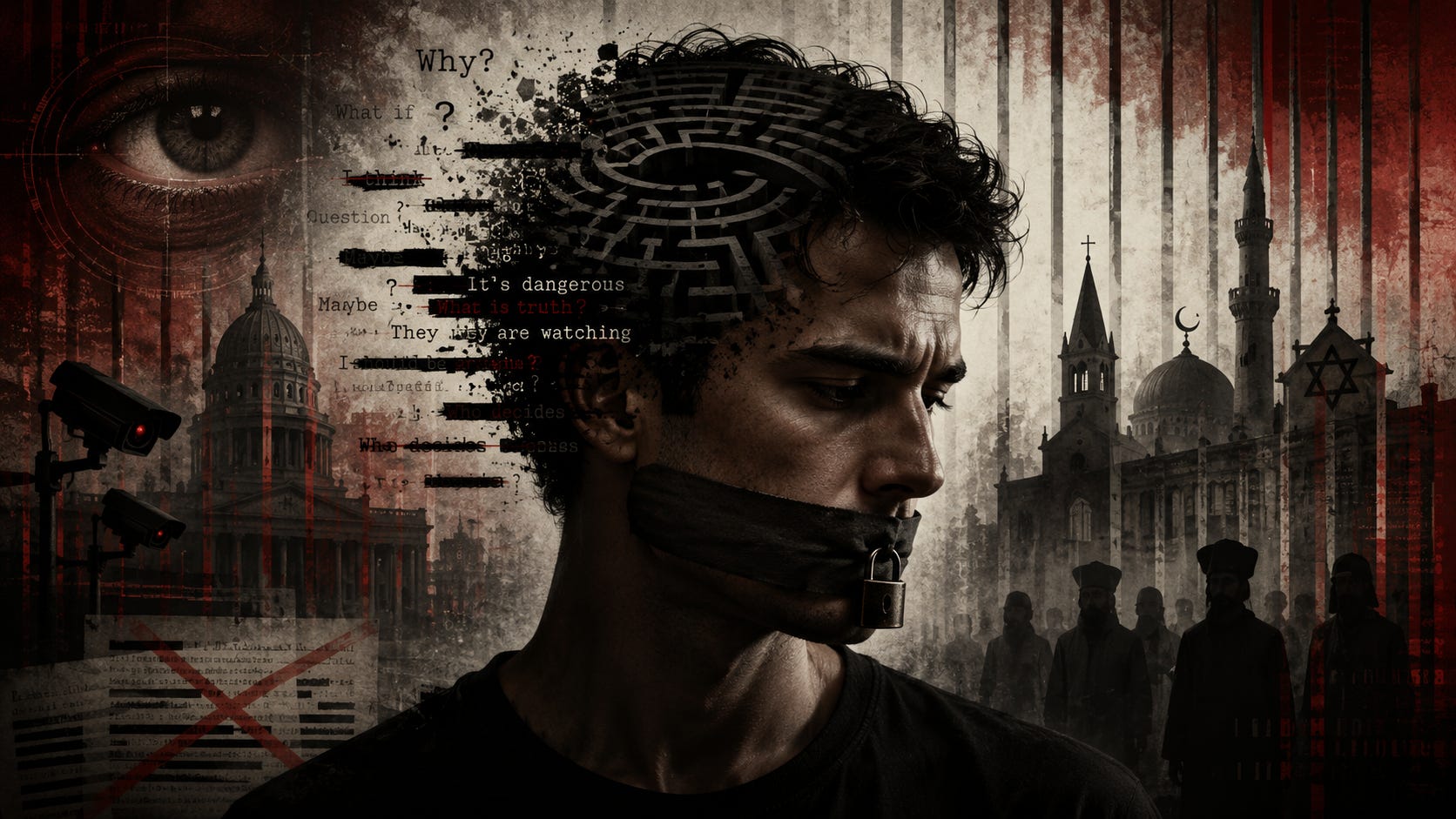
🩸 🧠 🔒 🤐 #2026082001 — When the Mind Learns to Censor Itself
Religion, Self-Censorship, and Why an Authoritarian Government May Prefer Citizens Who Police Their Own Thoughts
RED BLOOD JOURNAL TRANSMISSION
There is a form of censorship that requires no police officer, no blocked website, no prison cell, and no government censor sitting behind a desk.
The individual performs it personally.
A thought appears.
Then another thought immediately follows:
I should not think that.
A question forms.
Then the internal warning arrives:
I should not ask that.
A doubt emerges.
The mind answers itself:
What if questioning this is wrong?
At that point censorship has moved from the government building, the religious institution, or the community into the human mind.
And once people learn to censor themselves, governing them can become considerably easier.
This report examines an uncomfortable question:
Can religious conditioning that teaches people to monitor their own thoughts unintentionally create psychological habits that authoritarian governments can exploit?
The question is not whether Judaism, Christianity, or Islam are secretly totalitarian systems.
They are not interchangeable, their histories are enormously diverse, and each has produced dissidents, reformers, philosophers, mystics, revolutionaries, scientists, artists, and defenders of individual liberty.
The narrower question is about a mechanism:
What happens when religion teaches the mind that certain thoughts, doubts, desires, or questions must themselves be monitored?
And what happens when political power discovers a population already accustomed to doing exactly that?
1. The Most Efficient Censor Lives Inside the Citizen
Ordinary censorship requires enforcement.
Someone must watch.
Someone must identify prohibited speech.
Someone must punish violations.
Self-censorship is different.
The individual anticipates the consequences before speaking.
Eventually the person may anticipate them before even completing the thought.
The external censor has therefore accomplished something extraordinary:
the censor has been reproduced inside the person being censored.
The citizen begins asking not:
Is this true?
but:
Am I allowed to say it?
Eventually even that may become:
Am I allowed to think it?
That distinction matters enormously.
A government capable of controlling behavior possesses considerable power.
A government capable of influencing the boundaries within which citizens think possesses something much greater.
2. Abrahamic Religion Introduces an Extraordinary Psychological Idea
Judaism, Christianity, and Islam differ profoundly.
Yet all three contain the concept of an ultimate authority that exists beyond the individual.
God knows.
God sees.
God judges.
Human actions possess moral consequences beyond immediate earthly consequences.
In many theological traditions, intention matters as well as behavior.
Christianity famously moves moral scrutiny into the interior life. Anger, lust, hatred, pride and intention can become spiritually significant even when they never become outward acts.
Islam likewise assigns enormous importance to niyyah — intention, and Islamic theology emphasizes divine knowledge extending far beyond publicly observable behavior.
Judaism similarly contains extensive traditions of divine judgment, conscience, repentance, intention and moral accountability.
For believers, these ideas can produce profound ethical responsibility.
A person may behave honorably when nobody else is watching precisely because the individual believes morality does not disappear when human surveillance disappears.
That can be enormously positive.
But psychologically, the same architecture contains another possibility:
the person learns that there is never truly a moment without observation.
3. From “God Sees Me” to “I Must Monitor Myself”
Consider the mental structure.
If a child repeatedly learns:
God sees what you do.
God knows what you think.
Certain thoughts are sinful.
Certain questions may indicate disbelief.
Certain desires must be resisted.
Certain words must not be spoken.
Eventually a remarkable transition can occur.
Nobody needs to be standing nearby.
The child has learned to watch himself.
That does not prove religion was designed as a political control system.
It demonstrates something more modest and more important:
religious discipline can cultivate habits of internal monitoring.
Whether those habits produce ethical maturity or psychological confinement depends enormously on the surrounding culture, interpretation, family, institution and individual.
But authoritarian power has reasons to find such habits interesting.
4. Governments Have a Self-Censorship Problem
Every authoritarian government faces the same expensive challenge:
There are too many people.
There are too many conversations.
There are too many private thoughts.
There are too many kitchens, bedrooms, workplaces, cafés, mosques, churches, synagogues, phones and computer screens.
A government cannot efficiently place an officer beside every citizen.
The ideal political solution is therefore not universal surveillance.
It is anticipated surveillance.
Citizens behave as though someone might be watching.
The next stage is even more efficient:
Citizens begin avoiding prohibited territory automatically.
No command is necessary.
No arrest is necessary.
No censorship notice is necessary.
The boundaries have become psychological.
Research on authoritarianism recognizes co-optation and repression as important mechanisms of regime survival. Scholarship specifically examining authoritarian regulation of religion shows that regimes may both endorse religious institutions they can incorporate and restrict religious organizations they consider threatening.
That is an important distinction.
Authoritarian governments do not necessarily hate religion.
Sometimes they fear independent religion.
Sometimes they suppress it.
Sometimes they incorporate it.
Sometimes they transform religious institutions into partners.
The political question becomes:
Who controls the moral microphone?
5. The Government Does Not Necessarily Need to Destroy God
A simplistic model imagines authoritarian government fighting religion.
History is considerably more complicated.
A government may discover that established religion provides useful infrastructure:
authority,
ritual,
community organization,
moral vocabulary,
social legitimacy,
hierarchy,
and habits of obedience.
The state therefore has several choices.
It can suppress religion.
It can regulate religion.
It can appoint or approve religious leadership.
It can favor compliant institutions.
Or it can merge political loyalty with religious virtue.
Political-science research describes precisely this mixture of co-optation and repression: authoritarian governments may positively endorse religious organizations that can be incorporated while restricting organizations possessing enough independence to challenge the regime.
That tells us something crucial.
The authoritarian ideal is not necessarily:
Nobody believes in God.
It may instead be:
Believe—but believe through institutions we can control.
6. The Iranian Example Makes the Mechanism Easy to See
Iran provides an unusually visible version because religious and political authority overlap institutionally.
When political obedience can be presented as religious obligation, disagreement becomes more complicated.
A citizen is no longer merely asking:
Do I disagree with the government?
The citizen may also confront:
Am I disobeying religion?
Am I betraying the community?
Am I betraying God?
Those are radically different psychological pressures from disagreeing with a tax policy or transportation regulation.
Political authority has acquired metaphysical weight.
The government no longer merely possesses police.
It possesses access to conscience.
That is an extraordinary political asset.
But Iran also demonstrates the opposite phenomenon: religion can become a language of resistance against the government, and religious authorities independent of political power can challenge state legitimacy.
That is why authoritarian states frequently attempt to control religion rather than simply encourage it.
Independent moral authority is dangerous to monopoly political authority.
7. Christianity Produced Both Obedience and Revolt
Christian history presents the same paradox.
Certain Christian traditions emphasized obedience to rulers and religious hierarchy.
Others produced arguments saying earthly rulers themselves stand beneath a higher moral law.
That second idea can be devastating to authoritarianism.
If the individual believes:
The king commands me, but God commands justice, therefore I can resist the king,
religious belief has strengthened independence rather than obedience.
Christian dissidents repeatedly used religious conscience against political authority.
The same tradition therefore contains both possibilities:
External authority can condition obedience.
But:
A higher authority can also liberate the individual from earthly authority.
Which side emerges depends enormously on who interprets the religion and whether questioning authority is treated as conscience or rebellion.
8. Judaism Contains an Interesting Counterweight: Argument
Judaism complicates the self-censorship argument further because its intellectual tradition frequently institutionalizes disagreement.
Rabbinic literature preserves disputes rather than always erasing the losing argument.
Questions generate additional questions.
Interpretation produces competing interpretations.
The intellectual act of arguing with sacred material became part of the tradition itself.
That does not mean Judaism lacks boundaries, authority or self-censorship.
Highly restrictive religious communities can create substantial pressure toward conformity.
But a tradition that normalizes disagreement possesses an internal defense mechanism against absolute intellectual obedience:
argument itself can become sacred activity.
That is significant.
A mind taught to question authority may be harder to govern through unquestioned political authority.
9. Islam Contains the Same Internal Conflict
Islam also cannot simply be reduced to obedience.
There are strong traditions involving law, authority and doctrinal boundaries.
But there are equally important traditions of philosophy, jurisprudential argument, poetry, scientific inquiry, mysticism and direct examination of the self.
Sufism in particular frequently directs attention inward toward ego, intention, consciousness and the purification of the self.
Yet political systems can selectively emphasize the portions of religion most compatible with authority.
This is where the distinction between religion and state-managed religion becomes critical.
Research on Muslim-majority countries has found relationships between government regulation of religion and lower levels of democracy, including cases where governments particularly targeted Muslims operating independently of state-controlled religion or challenging authoritarian governments.
That should prevent an easy conclusion such as:
Islam causes authoritarianism.
The more interesting possibility is almost the reverse:
authoritarian governments may attempt to control Islam precisely because uncontrolled religious authority can compete with the government.
10. What Authoritarianism Really Wants
The authoritarian government does not merely want religious citizens.
It wants predictable citizens.
Ideally:
They respect hierarchy.
They fear crossing established boundaries.
They associate obedience with virtue.
They distrust dangerous questions.
They monitor one another.
They monitor themselves.
They prefer approved interpretations.
They fear social exclusion.
They believe stability is morally superior to disruption.
They hesitate before challenging authority.
Religion can potentially reinforce some of those tendencies.
So can nationalism.
So can political ideology.
So can corporate culture.
So can education.
So can social media.
So can family conditioning.
Religion possesses no monopoly on psychological conformity.
The mechanism is larger than religion.
11. The Perfect Totalitarian Citizen Does Not Need to Be Forced
Imagine two citizens.
Citizen A disagrees openly with government policy.
Police must watch him.
Censors must monitor him.
Officials must investigate him.
Perhaps he must be arrested.
That citizen is expensive.
Citizen B experiences the same disagreement.
But before speaking, Citizen B thinks:
Perhaps I should remain quiet.
People may misunderstand.
Maybe questioning authority is irresponsible.
Maybe I could lose something.
Perhaps this thought itself is inappropriate.
Citizen B deletes the message.
No government employee did anything.
From the perspective of authoritarian efficiency, Citizen B is almost perfect.
The government has outsourced censorship to the citizen.
12. And Then Something Even More Powerful Happens
Children watch their parents.
Employees watch coworkers.
Believers watch fellow believers.
Neighbors watch neighbors.
People begin enforcing boundaries socially.
The government no longer needs one censor for every citizen.
The population becomes a distributed censorship network.
This mechanism is not theoretical.
A 2026 study of sermons from state-registered Protestant churches in China examined how pastors operated under increasing Communist Party repression and specifically investigated patterns of self-censorship within government-approved religious institutions.
That example is especially useful because China is officially governed by a Communist Party, not an Abrahamic religious ideology.
Yet the same mechanism appears.
Therefore:
The fundamental phenomenon is not religion.
It is control of permissible thought.
Religion is simply one possible vehicle.
13. The Strange Partnership Between Surveillance and Conscience
Physical surveillance says:
Someone may be watching.
Religious surveillance can say:
Someone is always watching.
Authoritarian psychology benefits when those ideas become culturally familiar.
But there is an essential distinction.
A person who believes God watches him might refuse corruption when the government encourages corruption.
He might protect another human being when government orders otherwise.
He might refuse torture.
He might expose wrongdoing.
He might oppose the ruler.
Therefore belief in divine observation does not automatically produce political obedience.
Everything turns on the next question:
Whose authority wins when conscience and government collide?
If religion teaches:
Obey political authority because authority is sacred,
government benefits enormously.
If religion teaches:
No government stands above conscience and moral truth,
the government has a problem.
14. The Government’s Dream Is Not Religion
The government’s dream is transferable obedience.
First:
Obey the parent.
Then:
Obey the religious authority.
Then:
Obey the institution.
Then:
Obey the government.
Then:
Obey because obedience itself feels safe.
The crucial psychological transition occurs when authority no longer needs to justify itself.
The citizen asks:
What should I do?
instead of:
Why should I do it?
That is where self-censorship becomes politically valuable.
15. But This Report Cannot Make the Easy Accusation
It would be intellectually careless to conclude:
Abrahamic religions were created to prepare humanity for totalitarian government.
There is no evidence establishing that sweeping proposition.
The historical record actually creates a much stranger picture.
Abrahamic religions have legitimized rulers.
They have also delegitimized rulers.
They have justified hierarchy.
They have inspired revolutions.
They have suppressed questions.
They have generated enormous traditions of questioning.
They have punished heresy.
They have created dissidents willing to die rather than submit to government.
Religion therefore appears less like a single political program and more like a powerful psychological and social technology whose direction depends upon who controls its interpretation.
That is exactly why governments have repeatedly fought to control it.
16. The Evidence Shows the Relationship Goes Both Ways
Current comparative research continues to show extensive government involvement in restricting religious life around the world. Pew Research Center’s 2026 global dataset tracks government and social restrictions across 198 countries and territories; some countries experience extremely high levels of both government restrictions and social hostility involving religion.
Earlier Pew analysis also found authoritarian regimes disproportionately represented among countries with very high government restrictions on religion.
That creates an important correction to the premise of this investigation:
Authoritarian governments do not merely exploit religious obedience. They are frequently frightened by uncontrolled religious belief themselves.
Why?
Because anyone who claims access to moral authority outside the state potentially competes with the state.
The dictator wants obedience.
But the dictator wants obedience directed toward the dictator.
17. So What Is the Real Danger?
Perhaps the danger is not believing in God.
Perhaps the danger is training the mind in the following sequence:
Do not question.
Do not doubt.
Do not investigate forbidden territory.
Trust authority.
Fear deviation.
Suppress unacceptable thoughts.
Confess deviation.
Return to approved thinking.
Once that neurological and cultural habit becomes deeply established, the identity of the authority may become almost secondary.
Priest.
Cleric.
Party.
Leader.
Government.
Institution.
Algorithm.
Employer.
Crowd.
The name above the doorway can change.
The architecture of obedience remains.
18. The Opposite Architecture
A genuinely free mind would require something much harder.
Ask the forbidden question.
Examine the uncomfortable possibility.
Challenge one’s own assumptions.
Challenge the authority making the claim.
Demand evidence.
Listen to competing explanations.
Remain willing to discover that one’s own belief is wrong.
And perhaps most importantly:
Never confuse obedience with morality.
A person can obey and do evil.
A person can disobey and do good.
The moral quality of an action cannot therefore be determined merely by whether an authority commanded it.
That principle is dangerous to every totalitarian project.
Because the totalitarian state ultimately requires the citizen to surrender precisely that judgment.
The Red Blood Perspective
The most efficient prison may not require walls.
It requires boundaries the prisoner has learned not to approach.
The most efficient censor may not carry a government identification card.
It may be the voice inside the individual saying:
Don’t ask.
Don’t question.
Don’t say it.
Don’t even think it.
Abrahamic religions contain doctrines capable of reinforcing that voice when fear, unquestionable authority, divine surveillance and punishment become dominant.
But the same religions also contain traditions capable of destroying that voice through conscience, argument, compassion, moral courage and resistance to unjust rulers.
The evidence therefore does not support blaming Judaism, Christianity or Islam as inherently totalitarian.
It points toward something more universal and perhaps more disturbing:
Any institution that convinces human beings to censor themselves has accomplished part of the authoritarian government’s work before the government ever arrives.
And any government moving toward totalitarian control would logically prefer citizens who already consider self-censorship a virtue.
Ocean of Love and Positivity Perspective
Only here does the Ocean enter the discussion.
If there is an Ocean of Love and Positivity, perhaps it does not need frightened minds.
Perhaps it would have little use for humans terrified of asking the wrong question.
An ocean does not require a fence around every drop of water.
The question would not be:
Who gave permission for this thought?
It would become:
Where does this thought lead?
Does it produce understanding?
Does it reduce unnecessary suffering?
Does it create compassion?
Does it expose deception?
Does it improve the self?
Does it contribute something positive to another being?
And if an idea—including the idea of the Ocean itself—cannot survive examination, then perhaps it deserves to dissolve.
A spirituality genuinely based upon love should not need intellectual imprisonment to survive.
Perhaps the ultimate opposite of totalitarianism is not simply political freedom.
It is a consciousness that has learned:
I am permitted to look.
I am permitted to question.
I am permitted to discover that I was wrong.
I am responsible for what I do with what I discover.
That mind is considerably harder to rule through fear.
In an Ocean of Love and Positivity.
🩸🌊✨ Fantastic!
🤐
The Architecture of Obedience: Religion and Internal Censorship
Aug 20, 2026
This text explores the psychological intersection between religious conditioning and authoritarian governance, specifically examining how habits of internal monitoring can be exploited by the state. While Abrahamic traditions can inspire moral courage and resistance, they also introduce the concept of divine surveillance, which may inadvertently train individuals to censor their own thoughts. Authoritarian regimes often prefer to co-opt religious institutions rather than destroy them, seeking to transform spiritual devotion into transferable obedience. By outsourcing censorship to the citizen’s own conscience, power becomes more efficient because the boundaries of permissible thought are enforced from within. Ultimately, the source suggests that the greatest defense against totalitarianism is a mind that preserves the right to question authority and refuses to equate compliance with morality.
#SelfCensorship #FreedomOfThought #Religion #AbrahamicReligions #Authoritarianism #Totalitarianism #PoliticalPsychology #ThoughtControl #Surveillance #Conscience #FreeMind #ReligiousAuthority #GovernmentControl #Freedom #RedBloodJournal


