


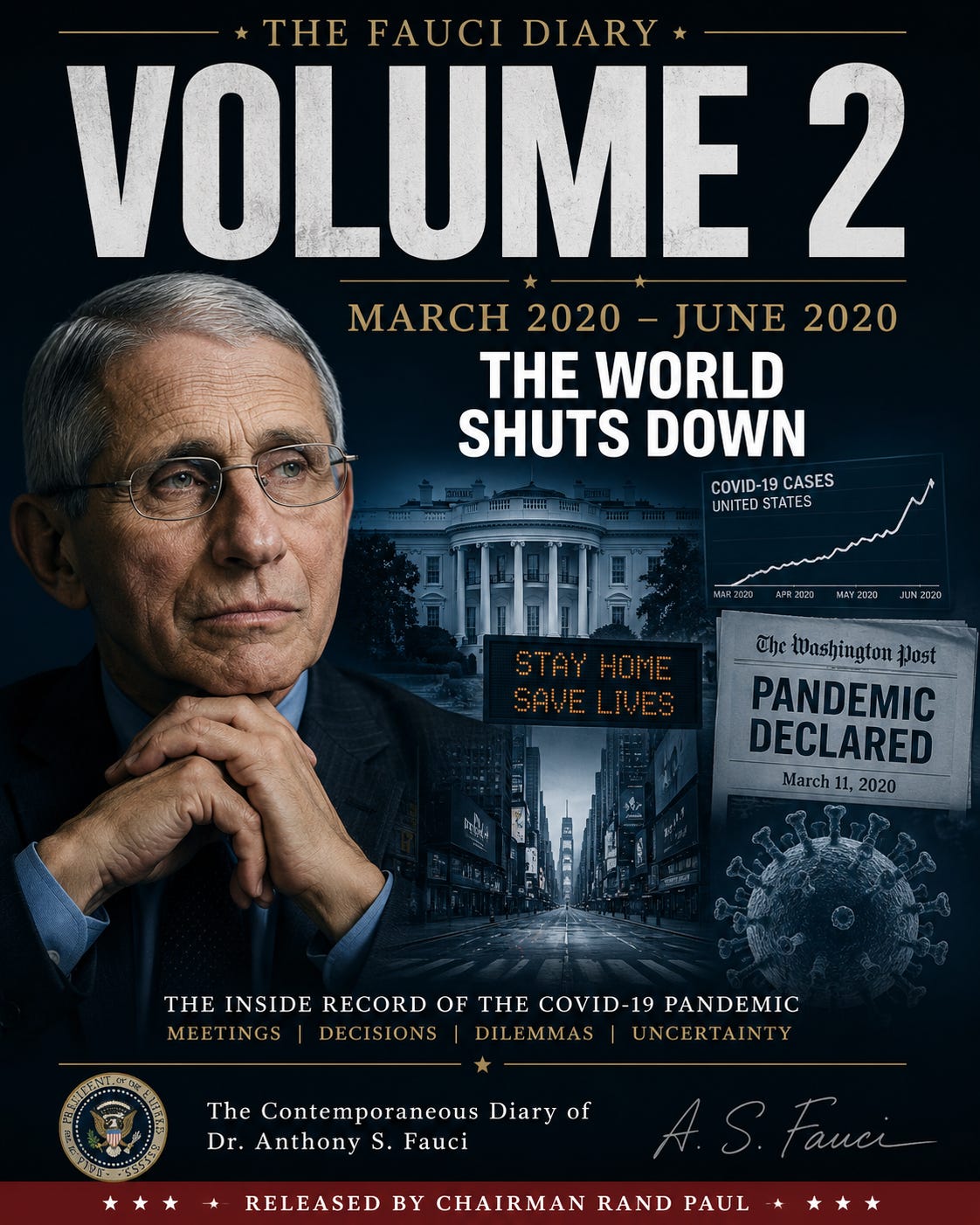

The Fauci Diary
Volume 2 — March 2020 to June 2020
The World Shuts Down
🩸 RedBloodJournal.com 🩸
March 2020
From Containment to Global Crisis
March marks the transition from attempts to contain COVID-19 to managing a worldwide pandemic.
The diary reflects an almost continuous schedule of White House meetings, National Security Council briefings, media appearances, scientific consultations, and coordination with state officials.
March 11
Pandemic Declared
The World Health Organization declares COVID-19 a pandemic.
The diary shifts from monitoring an outbreak to coordinating an emergency response across the federal government, with growing attention to hospitals, testing capacity, and mitigation measures.
March 13
National Emergency
The United States declares a national emergency.
Daily White House meetings intensify as agencies coordinate logistics, public messaging, and emergency planning.
March 15
“BIG DAY!”
One of the diary’s most discussed entries is dated March 15, 2020.
Fauci writes that he spoke with New York City Mayor Bill de Blasio, describing how he encouraged the closing of New York City schools and discussed broader mitigation measures, including bars and restaurants. This entry has drawn attention because of later public debate over Fauci’s role in recommending closures.
March
The White House Task Force
The diary documents frequent meetings involving:
President Donald Trump
Vice President Mike Pence
Coronavirus Task Force members
senior health officials
scientific advisers
Fauci becomes one of the principal public faces of the federal response through daily briefings and interviews.
Testing Challenges
Throughout March, the diary reflects concern over:
testing availability,
laboratory capacity,
rapidly increasing case counts,
pressure from state governments,
hospital preparedness.
Federal coordination dominates the daily entries.
Operation Warp Speed Begins to Take Shape
As March progresses, vaccine development accelerates.
The diary records ongoing coordination with researchers and government agencies as vaccine programs advance from early concepts toward large-scale development.
April 2020
America’s Daily Routine Changes
By April, much of the country is operating under varying degrees of restrictions.
The diary records:
daily White House briefings,
meetings with governors,
scientific consultations,
media interviews,
discussions regarding masks,
reopening plans,
and hospital capacity.
Growing National Attention
Fauci notes that media attention surrounding him expands rapidly.
He records frequent television appearances and extensive press coverage as public interest in the pandemic intensifies.
Relations with President Trump
The diary records both cooperative and difficult interactions with President Trump.
Entries describe discussions over:
reopening the economy,
testing,
public messaging,
mask guidance,
and differing approaches to communicating risk.
May 2020
National Recognition
Fauci reflects on becoming one of the country’s most recognizable public figures.
He writes that his national and international fame has become extraordinary and notes the large volume of media attention surrounding him, while also expressing discomfort with the celebrity culture developing around his public role.
Media Coverage
The diary contains numerous references to:
newspaper articles,
television interviews,
magazine profiles,
celebrity contacts,
public recognition,
merchandise using his name or likeness.
Fauci writes that the attention has become excessive and at times embarrassing.
Public Health Guidance Evolves
As new data emerge, the diary reflects continued discussions about:
masks,
reopening,
distancing,
changing scientific evidence,
and CDC recommendations.
The entries illustrate how guidance evolved alongside the available information.
June 2020
Reopening the Country
Many states begin phased reopening.
The diary increasingly focuses on balancing:
economic recovery,
rising case numbers,
scientific advice,
public expectations,
and political pressures.
Continuing Scientific Debate
The diary reflects ongoing discussions about:
virus transmission,
mitigation strategies,
vaccine progress,
public communication,
and the continuing uncertainty surrounding COVID-19.
Major Themes of Volume 2
National emergency
Pandemic declaration
White House Coronavirus Task Force
School closures
Business restrictions
Public health guidance
Hospital preparedness
Testing expansion
Vaccine development
Operation Warp Speed
Media attention
Public communication
Relations with President Trump
Governors and state coordination
Reopening strategies
Scientific uncertainty
Balancing health and economic concerns
Conclusion
Volume 2 captures the period in which COVID-19 transformed from an emerging public health crisis into a defining national emergency. The diary portrays an intense schedule of government meetings, scientific discussions, public briefings, and policy coordination as officials confronted rapidly changing conditions. It also records Fauci’s reflections on his unexpectedly prominent public role and the pressures of communicating evolving scientific information during an unprecedented global event.
Next Volume
Volume 3 — July 2020 to December 2020
Vaccines, Politics, and an Election Year
📔
📔 The Fauci Diary: The World Shuts Down
Jul 30, 2026
The provided text summarizes a specific volume of Anthony Fauci’s personal journals covering the initial escalation of the COVID-19 pandemic in early 2020. These entries detail the transition from local containment efforts to a national emergency, highlighting his involvement in school closures and the federal Coronavirus Task Force. The documents trace the acceleration of vaccine development alongside the logistical challenges of expanding testing and hospital capacity. Furthermore, the writing captures the political tensions regarding economic reopening and Fauci’s own discomfort with his sudden transformation into a prominent public figure. Ultimately, the source provides a chronological look at how scientific guidance evolved during a period of intense global uncertainty.


