


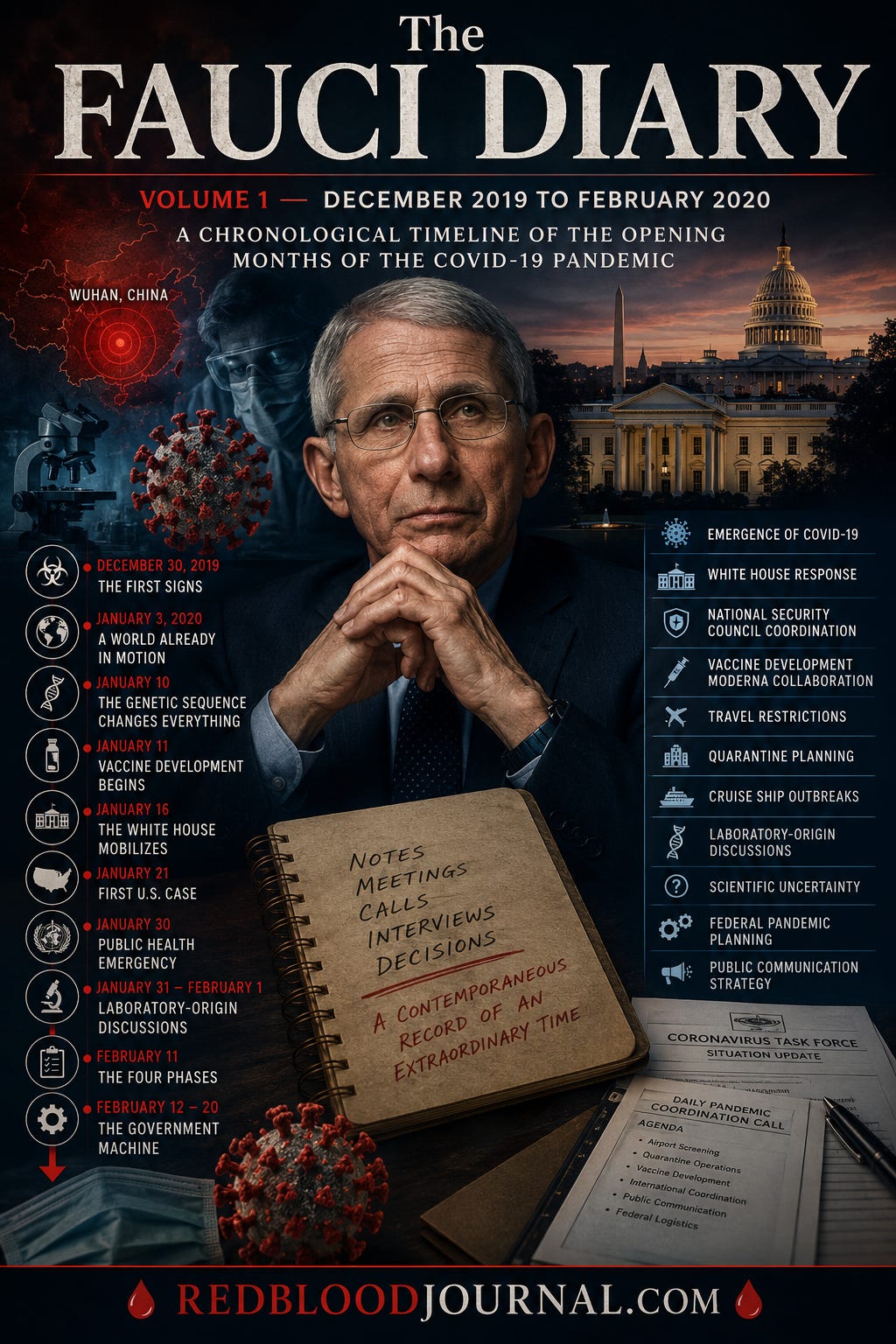
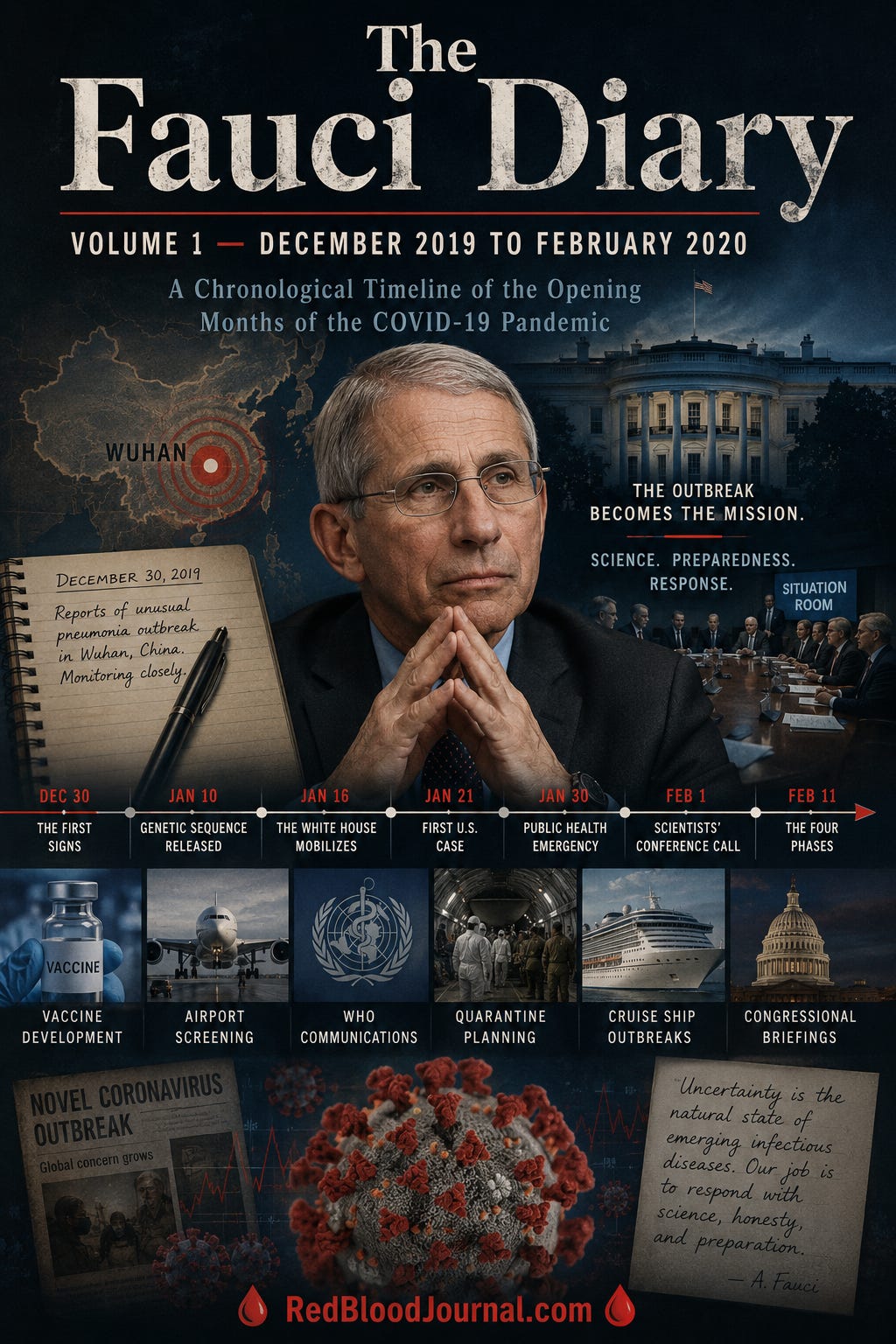
The Fauci Diary
Volume 1 — December 2019 to February 2020
The Opening Months of COVID-19
🩸 RedBloodJournal.com 🩸
History is often reconstructed years after events have ended.
The Fauci Diary is different.
It is a day-by-day record written as events unfolded, documenting the earliest weeks of what would become one of the most significant public health crises of the modern era.
Rather than looking backward through hindsight, the diary captures government discussions, scientific uncertainty, policy debates, media engagement, and the rapidly expanding federal response as COVID-19 evolved from reports of an unusual pneumonia in Wuhan into the central focus of the United States government.
December 30, 2019
The First Signs
The diary begins with reports of an unusual pneumonia outbreak in Wuhan, China.
At this stage, the event appears to be another infectious disease investigation among many that public health officials routinely monitor.
Dr. Anthony Fauci continues his normal schedule, balancing influenza interviews and everyday responsibilities while carefully watching developments overseas.
No one yet knows that the coming weeks will transform nearly every aspect of government.
January 3, 2020
A World Already in Motion
Two major stories unfold simultaneously.
The United States conducts the military strike that kills Iranian General Qassem Soleimani.
At the same time, Fauci continues monitoring the mysterious pneumonia spreading inside Wuhan.
The diary illustrates that COVID-19 initially competed with other major geopolitical events for the attention of senior government officials.
January 10
The Genetic Sequence Changes Everything
China publicly releases the genetic sequence of the novel coronavirus.
The significance is immediately recognized.
Fauci notes that humanity is now confronting a third major coronavirus capable of causing serious disease after:
• SARS
• MERS
• The newly identified Wuhan coronavirus.
Media requests begin increasing rapidly as scientific interest expands.
January 11
Vaccine Development Begins
One brief diary entry later becomes historically significant.
Barney Graham orders vaccine constructs.
The race to develop a vaccine officially begins.
January 14
Moderna Enters
Development work involving Moderna begins.
While vaccine research accelerates, Fauci continues appearing in the media to explain what little is known about the outbreak.
Science and public communication begin advancing together.
January 16
The White House Mobilizes
The outbreak is no longer viewed as a distant foreign event.
The diary records increasing federal coordination involving:
• National Security Council meetings
• Airport screening
• Situation Room discussions
• Interagency coordination
Preparation for a possible domestic response is now underway.
January 17–20
Human-to-Human Transmission
Evidence increasingly suggests that the virus spreads from person to person.
The diary reflects an accelerating pace of activity.
Daily coordination calls become routine.
Airport planning expands.
Media appearances multiply.
Concern inside government steadily increases.
January 21
The First U.S. Case
The first confirmed American case is identified in Seattle.
Daily White House Pandemic Coordination Calls become routine.
Attention begins shifting from preventing entry into the country toward preparing for domestic management.
January 22–24
Escalation
China expands lockdown measures.
The World Health Organization debates declaring an international public health emergency.
Federal agencies begin larger operational planning.
Budget discussions begin.
The outbreak is no longer viewed as temporary.
January 25
China Locks Down
Large portions of China effectively shut down.
Fauci notes uncertainty regarding whether China is revealing the complete picture of the outbreak.
Planning begins to evacuate Americans.
January 26
Asymptomatic Transmission
Reports emerge suggesting infected individuals may transmit the virus before developing symptoms.
The diary reflects skepticism regarding some early Chinese interpretations while recognizing that, if confirmed, asymptomatic transmission could fundamentally change containment strategies.
January 27
Border Restrictions
White House discussions increasingly focus on travel restrictions from China.
Arguments both supporting and opposing broad restrictions are recorded.
Previous outbreak experience becomes part of the decision-making process.
January 28
Quarantine Planning
Federal planning expands significantly.
Meetings focus on:
• Returning American citizens
• Military quarantine facilities
• Airport logistics
• Interagency coordination
March Air Reserve Base becomes one of the planned quarantine locations.
January 29
President Trump
Fauci attends Situation Room meetings with President Donald Trump.
According to the diary, the President directs numerous questions to Fauci concerning the developing outbreak.
The entries suggest growing White House confidence in Fauci as one of the government’s principal scientific advisers.
January 30
Public Health Emergency
The World Health Organization declares a Public Health Emergency of International Concern.
The White House Coronavirus Task Force is announced.
Fauci becomes one of the central public faces of the federal response.
January 31
One of the Most Discussed Entries
One of the diary’s most widely discussed entries occurs on this date.
Fauci records receiving a call from Jeremy Farrar following discussions involving Kristian Andersen and Edward Holmes.
According to the diary:
• Questions arise regarding mutations near the furin cleavage site.
• Laboratory involvement is discussed as one possible explanation.
• Additional virologists and evolutionary biologists are invited into the discussion.
• Francis Collins joins the process.
• Plans are made for a larger scientific conference call the following day.
February 1
The Scientists’ Conference Call
A large international discussion is held involving numerous scientists, including:
• Francis Collins
• Jeremy Farrar
• Kristian Andersen
• Christian Drosten
• Ron Fouchier
• Robert Garry
• Edward Holmes
• Andrew Rambaut
• Patrick Vallance
• Additional scientific advisers
The diary records differing scientific opinions.
Some participants believe natural evolution sufficiently explains the virus.
Others conclude that laboratory involvement remains possible and deserves additional investigation.
The discussion ends with plans for continued consultation and possible involvement by the World Health Organization.
February 2–5
Building the Response
The federal response expands rapidly.
The diary increasingly focuses on:
• Airport funneling
• Quarantine operations
• Congressional briefings
• White House coordination
• Expanding logistics
COVID-19 becomes the dominant subject of daily government activity.
February 6
National Academies Review
Scientific advisers continue evaluating available evidence.
Discussions regarding the virus’s origin continue while federal response planning expands.
February 7–10
Cruise Ships
Attention shifts toward cruise ship outbreaks.
Planning increasingly focuses on:
• Quarantine
• Evacuation
• Military facilities
• International coordination
• Containment strategy
The operational scope of the response continues to widen.
February 11
The Four Phases
The diary records a structured federal response plan consisting of four stages:
Phase I — Current Posture
Phase II — Aggressive Containment
Phase III — Partial Mitigation
Phase IV — Mitigation
Potential measures include:
• Travel restrictions
• Social distancing
• Cancellation of public gatherings
• Continuity of government operations
• Broader mitigation strategies
February 12–20
The Government Machine
The diary increasingly becomes a record of continuous government operations.
Almost every day includes combinations of:
• White House meetings
• Congressional briefings
• WHO conference calls
• Quarantine decisions
• Cruise ship management
• Scientific coordination
• Public communication
• Federal planning
The pace becomes relentless as COVID-19 dominates the daily work of multiple agencies across the federal government.
Major Themes of Volume 1
• Emergence of COVID-19
• White House response
• National Security Council coordination
• Airport screening
• Vaccine development
• Moderna collaboration
• WHO communications
• Travel restrictions
• Quarantine planning
• Cruise ship outbreaks
• Congressional briefings
• Daily media engagement
• Laboratory-origin discussions
• Scientific uncertainty
• Federal pandemic planning
• Public communication strategy
Conclusion
Volume 1 documents the transformation of COVID-19 from a distant outbreak into the central focus of the United States government’s public health response.
The diary records an extraordinary concentration of meetings, scientific discussions, media appearances, policy decisions, and logistical planning as officials worked to understand a rapidly evolving situation.
It also preserves moments of uncertainty, differing scientific viewpoints, and the complexity of decision-making during the earliest phase of the pandemic.
As a contemporaneous record written while events unfolded, The Fauci Diary provides a chronological window into how the federal response developed during the opening months of one of the defining global events of the twenty-first century.
Next Volume
Volume 2 — March 2020 to June 2020
The World Shuts Down
🩸 Ocean of Love and Positivity. 🩸
📔
📔 Genesis of a Pandemic:
The Fauci Diary Volume 1
Jul 30, 2026
This source provides a chronological timeline of the initial months of the COVID-19 pandemic as documented through the personal records of Dr. Anthony Fauci. The text tracks the rapid transition from monitoring a mysterious pneumonia in China to the mobilization of a massive federal response within the United States. Key milestones include the early stages of vaccine development with Moderna and the shift toward domestic containment strategies such as airport screenings and quarantines. Significant entries highlight high-level White House meetings and intense scientific debates regarding the virus’s origins and the possibility of laboratory involvement. Ultimately, the diary illustrates how the outbreak transformed from a distant concern into the primary focus of the U.S. government, necessitating relentless scientific and logistical coordination.


