


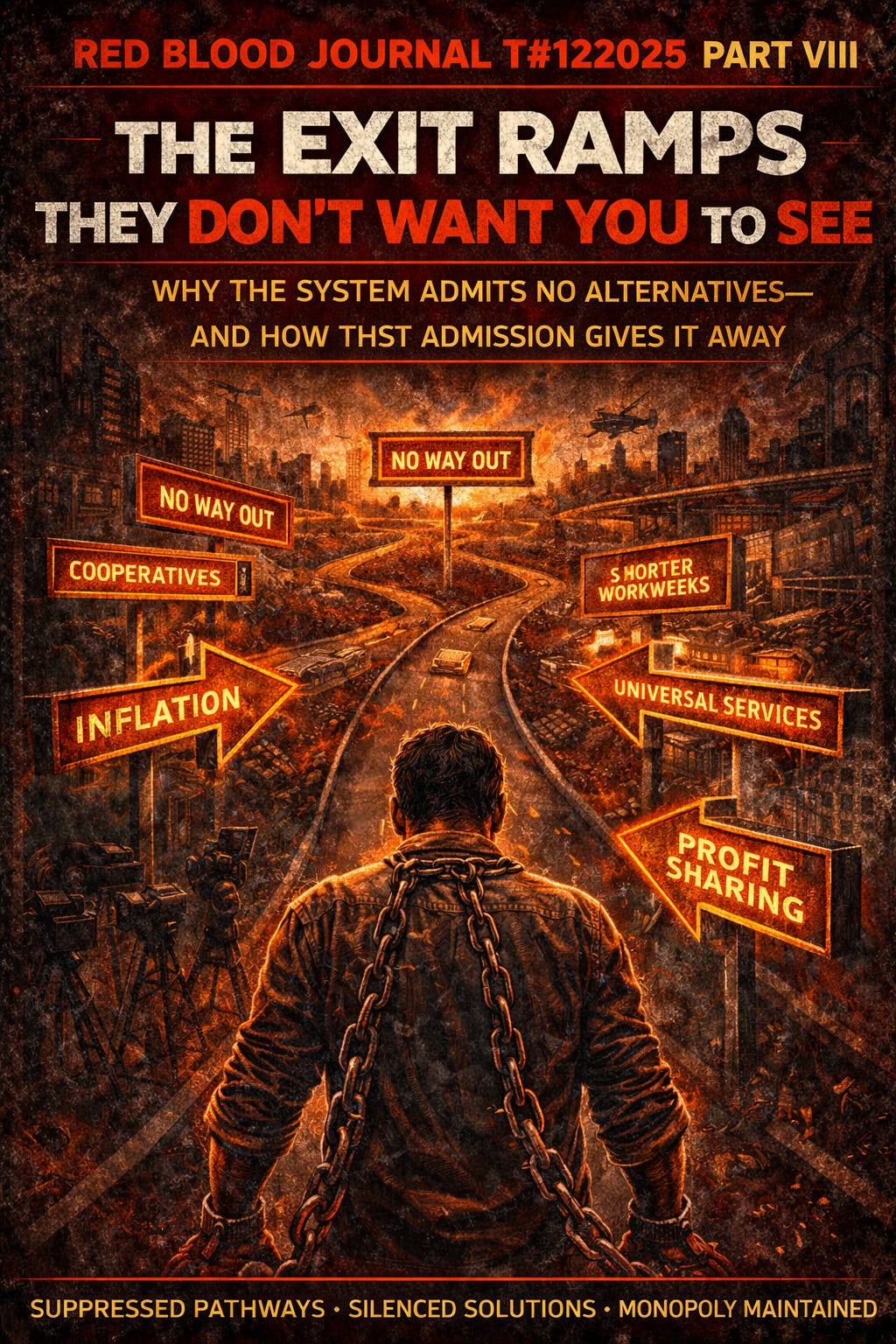
🩸 RED BLOOD JOURNAL — CONSPIRACY TRANSMISSION
T#122025–UNEMPLOYMENT–PSYOP
PART VIII
THE EXIT RAMPS THEY DON’T WANT YOU TO SEE
Why the System Admits No Alternatives—and How That Admission Gives It Away
Classification: Deep Pattern Analysis / Suppressed Pathways
Distribution: Restricted
Method: Conspiracy Lens (Structural, Incentive-Based, Non-Allegorical)
PROLOGUE — IF THERE WERE NO EXIT, THEY WOULDN’T GUARD IT
A system confident in its legitimacy does not fear alternatives.
It debates them.
It improves itself against them.
It adapts.
The modern economic order does something else entirely.
It denies exits exist at all.
That denial is the tell.
I. THE FIRST RULE OF CONTAINMENT: THERE IS NO OUTSIDE
From childhood onward, people are taught a quiet doctrine:
This is how the economy works
This is how jobs work
This is how money works
Any deviation is framed as:
Unrealistic
Radical
Dangerous
“Not how the real world works”
This framing is essential.
If people believe there is no alternative, they stop looking.
II. THE EXIT RAMPS ARE NOT SECRET — JUST UNMENTIONED
The exits are not hidden in classified vaults.
They are hidden in silence.
Notice what is rarely discussed seriously in mainstream discourse:
Worker ownership
Cooperative firms at scale
Sectoral bargaining
Profit-sharing mandates
Shorter workweeks without pay cuts
Universal basic services
Public options that actually compete
Antitrust with teeth
Labor representation on corporate boards
These ideas are not unknown.
They are unspoken.
III. WHY EXITS ARE FRAMED AS “IMPOSSIBLE”
Every exit threatens a core pillar of control:
Worker ownership → breaks capital monopoly
Collective bargaining → breaks individual isolation
Profit sharing → breaks extraction asymmetry
Reduced work hours → breaks time discipline
Universal services → breaks debt dependency
So the system does not argue against them honestly.
It declares them impossible by default.
Impossibility is cheaper than suppression.
IV. THE FALSE BINARY TRAP
People are offered a rigged choice:
Accept the current system
Or face chaos, collapse, or tyranny
This binary is false.
It erases the vast middle ground of:
Reform
Rebalancing
Redistribution of leverage
The trap works because fear works.
V. THE GLOBAL EXCUSE LOOP
Another containment tactic:
“We can’t do that here because of global competition.”
This argument is endlessly recycled.
Yet the same system somehow:
Coordinates global finance
Enforces IP law worldwide
Protects capital across borders
Bails out institutions internationally
Global coordination is possible—
when it serves capital.
When it would serve labor, it suddenly becomes “unrealistic.”
VI. WHY SMALL EXITS ARE MORE DANGEROUS THAN REVOLUTION
The system does not fear riots.
It fears replicable alternatives.
A cooperative that works
A shorter workweek that doesn’t collapse productivity
A public option that outperforms private firms
These are contagious.
They don’t need slogans.
They need visibility.
That is why they are buried.
VII. THE PSYCHOLOGICAL EXIT — SEEING THE SYSTEM CLEARLY
The most dangerous exit is not economic.
It is perceptual.
Once people realize:
Their suffering is structural
The metrics are curated
The narratives are constrained
Self-blame collapses.
And with it collapses compliance.
A person who understands the system is no longer governable in the same way.
VIII. WHY EXIT TALK IS ALWAYS DELAYED
Notice the pattern:
“After the next election”
“After the crisis passes”
“After growth returns”
“After stability is restored”
The exit is always postponed.
Because a system that requires permanent postponement is not stable.
It is addictive.
IX. THE REAL EXIT THEY FEAR MOST
The exit they fear most is not policy.
It is solidarity without permission.
When people stop competing vertically and start aligning horizontally:
Metrics lose power
Fear loses leverage
Threats stop working
That is the point at which control mechanisms fail.
X. THE END STATE — A SYSTEM THAT MUST DENY CHOICE
A healthy system offers exits and improvements.
An unhealthy one must insist:
“There is no alternative.”
That insistence is not strength.
It is exposure.
CONCLUSION — THE MAP WAS NEVER THE TERRITORY
The unemployment narrative.
The wage suppression loop.
The productivity myth.
The infinite workforce.
The automation threat.
The metric prison.
All of them serve one purpose:
To convince you that the world you see is the only one possible.
It isn’t.
And the fact that alternatives must be constantly dismissed, delayed, mocked, or erased tells you everything you need to know.
If there were truly no exit ramps—
They wouldn’t work so hard to make sure you never see them.
🩸 END PART VIII
🚪T#122025–UNEMPLOYMENT–PSYOPPART VIII
The provided text outlines a conspiracy-based analysis of modern economic structures, arguing that the current system maintains power by suppressing the visibility of alternative models.
It suggests that concepts like worker ownership and reduced workweeks are intentionally framed as impossible to prevent the public from pursuing viable exits from the status quo.
By manufacturing a false choice between the existing order and total chaos, the system ensures continued labor compliance and debt dependency. The author asserts that true control relies on a psychological monopoly where citizens are conditioned to believe no other reality can exist.
Ultimately, the source claims that the aggressive dismissal of these alternatives proves their potential effectiveness and threat to established power.
This “Deep Pattern Analysis” encourages readers to achieve structural clarity as a means of breaking free from systemic manipulation.


