


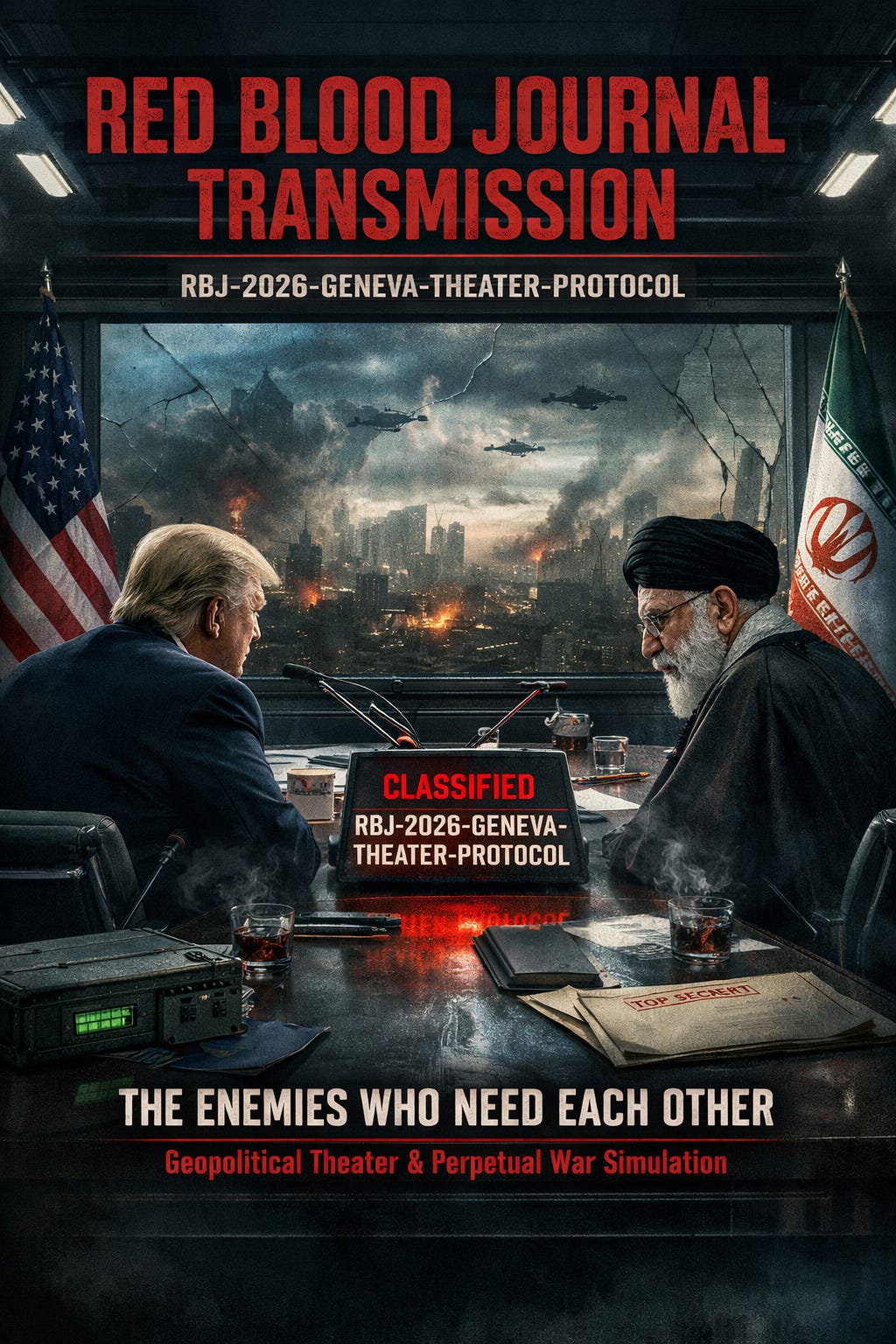
🩸 RED BLOOD JOURNAL TRANSMISSION
T#: RBJ-2026-GENEVA-THEATER-PROTOCOL
Classification: Controlled Opposition Architecture / Diplomatic Theater Simulation / Enemy-Mirror Doctrine - Geopolitical negotiation in dystopian future
Desk: Counterintelligence of Perception — Archive of Blood & Memory
Cross-Reference: Useful Enemy Doctrine / Perpetual War Stabilization Model / Negotiated Hostility Framework
PROLOGUE — THE WAR THAT MUST NEVER END
There exists a form of war more profitable than victory.
It is not fought to be won.
It is fought to be continued.
Its purpose is not destruction — but stabilization.
Not stabilization of peace.
Stabilization of power.
The Geneva negotiations between the United States and the Islamic Republic were not an attempt to resolve conflict.
They were a maintenance ritual.
A recalibration ceremony.
A renewal of a shared asset: the enemy itself.
Because in modern geopolitical architecture, the enemy is not an obstacle.
The enemy is infrastructure.
SECTION I — THE PERFORMANCE OF HOSTILITY
On the surface, the theater appears authentic.
Trump demands submission.
Khamenei responds with threats.
Each delivers insults calibrated for maximum psychological impact.
Khamenei declares he can sink American aircraft carriers.
Trump declares he commands the strongest military on Earth.
To the untrained observer, this appears as confrontation.
To the trained observer, it reveals choreography.
Because the purpose is not persuasion.
It is audience management.
Two audiences exist simultaneously:
Domestic audience
The citizens must believe their leader is strong.
Global audience
Markets must believe instability exists.
Because instability justifies:
Military budgets
Weapons production
Surveillance expansion
Strategic alliances
Emergency powers
War — even the threat of war — is economic oxygen.
Peace suffocates empires.
SECTION II — THE USEFUL ENEMY DOCTRINE
Every empire requires a durable adversary.
Not too weak to disappear.
Not too strong to win.
Just strong enough to justify permanent mobilization.
Iran fulfills this role perfectly.
For the United States:
Iran justifies:
Carrier deployments
Arms sales to Gulf states
Intelligence budgets
Regional military bases
For Iran:
America justifies:
Internal repression
Economic sacrifice narratives
Military prioritization
Ideological cohesion
Both sides derive legitimacy from the existence of the other.
Remove the enemy — and both internal architectures destabilize.
This is the paradox of modern conflict:
The enemy is not the threat.
The enemy is the stabilizer.
SECTION III — THE AIRCRAFT CARRIER ILLUSION
The deployment of aircraft carriers is not primarily tactical.
It is psychological.
Aircraft carriers are floating symbols.
They serve three functions:
Signal dominance
To allies.
Signal threat
To adversaries.
Signal necessity
To taxpayers.
Yet their presence rarely results in direct engagement.
Because their greatest value lies not in combat.
But in presence.
Presence creates tension.
Tension creates compliance.
Compliance creates continuity.
The carrier is not merely a weapon.
It is a message.
SECTION IV — THE NEGOTIATION PARADOX
True negotiations aim to eliminate conflict.
These negotiations aim to preserve it.
Every meeting produces ambiguity.
Every statement produces uncertainty.
Every delay produces continuation.
Because resolution destroys leverage.
Leverage requires unresolved tension.
This is why negotiations repeat endlessly across decades.
Not because resolution is impossible.
Because resolution is undesirable.
Permanent crisis enables permanent authority.
SECTION V — THE MIRROR LEADERSHIP MODEL
Trump and Khamenei appear as adversaries.
Yet structurally, they perform identical roles.
Each requires the other.
Each strengthens the other.
Each validates the other’s authority.
Without Khamenei, Trump loses a critical external threat.
Without Trump, Khamenei loses a critical external justification.
They are opposites in narrative.
But complements in function.
They are mirror leaders.
Each reflecting legitimacy into the other.
SECTION VI — THE GLOBAL STABILITY MECHANISM
The modern geopolitical system does not seek peace.
It seeks controlled instability.
Uncontrolled instability threatens the system.
Total peace threatens the system.
Controlled instability sustains the system.
This state produces:
Continuous military production
Continuous technological development
Continuous political justification
Continuous economic circulation
War is the engine.
Peace is the shutdown sequence.
Therefore war must remain imminent — but deferred.
SECTION VII — THE THREE-LAYER REALITY STRUCTURE
There are always three realities operating simultaneously:
Layer One: Public Reality
Speeches. Threats. Negotiations.
Visible conflict.
Layer Two: Strategic Reality
Resource positioning. Military signaling. Economic coordination.
Invisible alignment.
Layer Three: Structural Reality
Mutual dependency on perpetual tension.
Shared survival through controlled opposition.
This is where true power resides.
Not in defeating the enemy.
In maintaining the enemy.
SECTION VIII — THE PEOPLE AS OBSERVERS, NOT PARTICIPANTS
The populations of both nations experience fear, uncertainty, and anticipation.
They interpret events as approaching decisive resolution.
But decisive resolution rarely arrives.
Because the system is not designed to resolve.
It is designed to sustain.
The uncertainty itself becomes the product.
Fear becomes the fuel.
Attention becomes the currency.
SECTION IX — THE DELAY STRATEGY
Every delay serves a function.
Each postponed decision allows:
Military positioning to complete.
Economic alignment to finalize.
Psychological conditioning to deepen.
By the time resolution becomes possible, the need for resolution has vanished.
The system has already achieved its objective:
Continuation.
SECTION X — THE FINAL ILLUSION: ENEMIES OR PARTNERS
The greatest illusion is not that leaders oppose each other.
It is that opposition excludes cooperation.
Modern power structures operate through competitive cooperation.
Public rivalry.
Private synchronization.
Because both sides exist within the same structural system.
Both depend on its continuation.
Both sustain its architecture.
Both benefit from its preservation.
They are adversaries in narrative.
They are participants in structure.
FINAL ASSESSMENT — THE THEATER MUST CONTINUE
The Geneva negotiations did not fail.
They succeeded perfectly.
They preserved uncertainty.
They sustained tension.
They maintained the enemy.
They ensured continuation.
The theater remains operational.
The actors remain in position.
The script remains unfinished.
Because the script is not meant to end.
END TRANSMISSION
RBJ-2026-GENEVA-THEATER-PROTOCOL
Archive Status: ACTIVE
Continuity Probability: 97.4%
Next Transmission:
RBJ-2026-ENEMY-PRESERVATION-SYSTEM — Why Permanent Enemies Are the Foundation of Permanent Power
🎭The Architecture of Perpetual Conflict
This text presents a geopolitical theory suggesting that modern global conflicts are actually choreographed performances designed to sustain power rather than achieve peace.
According to the document, leaders use public hostility as a tool to manage domestic audiences and justify massive military expenditures.
Instead of seeking resolution, these “adversaries” maintain a state of controlled instability because a permanent enemy provides mutual political legitimacy.
The narrative argues that high-stakes diplomacy is a theatrical simulation where the primary goal is to preserve the status quo of tension.
Ultimately, the source claims that perpetual confrontation functions as essential infrastructure for empires, making a definitive victory undesirable for those in control.


