


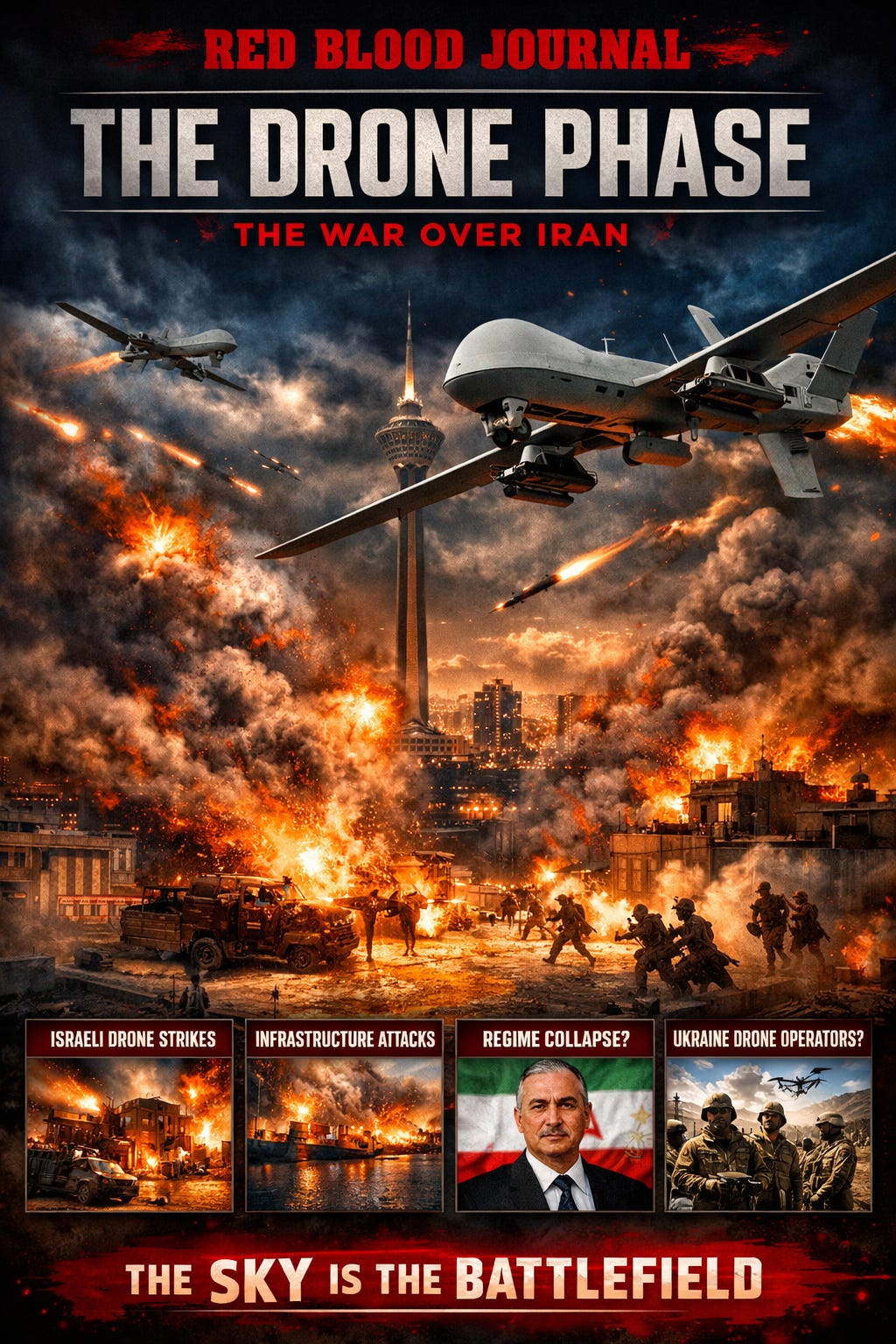
🩸 RED BLOOD JOURNAL TRANSMISSION
Division: Geo-PsyOps & Middle East Influence Cartography Unit
Transmission Code: RBJ-GPME-2026-DRONE-PHASE-IRAN
Classification: Strategic Conflict Analysis / Hybrid Warfare
Archive: The Archive of Blood & Memory
The aerial siege of the Iranian regime
The Drone Phase of Iranian Conflict
THE DRONE PHASE
The Transformation of War Over Iran
A Red Blood Journal Strategic Transmission
PROLOGUE — THE MOMENT THE SKY CHANGED
Across the cities of Iran, a new phenomenon has entered the theatre of war.
Not armies marching.
Not tanks crossing borders.
But machines in the sky.
Reports emerging from Tehran and other cities describe a new phase of conflict in which drone technology is used to strike security checkpoints, military infrastructure, and enforcement forces inside urban environments.
Iran March 12, 2026
To observers of modern warfare, this represents something unprecedented:
A war conducted simultaneously in the air, the information sphere, and the psychology of the population.
For decades the Islamic Republic maintained control of the streets through a network of:
Revolutionary Guard units (IRGC)
Basij paramilitary forces
security checkpoints
surveillance networks
intimidation and repression
The streets themselves were the regime’s primary instrument of control.
Now the battlefield has moved upward.
The sky has entered the war.
SECTION I — THE ATTACKS ON THE STREET ENFORCEMENT SYSTEM
Reports circulating through Iranian media and opposition networks describe drone attacks targeting regime checkpoints in several districts of Tehran.
Iran March 12, 2026
Areas mentioned include:
Haft-e Tir
Shahrak-e Gharb
Sohrevardi
Mehrabad
Abbasabad
Karimkhan
Mahallati Highway
Fadaiyan-e Islam Boulevard
Jeyhoon Street
These checkpoints were historically deployed during periods of unrest to:
control movement
identify protesters
intimidate neighborhoods
enforce regime authority in public space
Witness accounts claim that drones struck several of these checkpoints, reportedly killing members of the Basij and security forces stationed there.
Iran March 12, 2026
Whether the scale of these attacks matches the claims circulating online remains uncertain.
But the symbolic meaning is unmistakable.
For the first time in the history of the Islamic Republic:
The street enforcement apparatus itself became the target.
SECTION II — EXPANSION OF STRIKES AGAINST MILITARY INFRASTRUCTURE
The conflict narrative also describes strikes against strategic Iranian ports and military facilities.
Locations mentioned include:
Bushehr
Chabahar
Bandar Abbas
Qeshm Island
These ports hold critical roles in Iran’s military posture:
• naval deployment
• logistics and supply routes
• missile and drone infrastructure
• strategic presence in the Persian Gulf
Simultaneously, the U.S. Central Command reportedly issued warnings urging civilians to avoid port facilities connected to Iranian naval operations, suggesting possible military activity around these areas.
Iran March 12, 2026
In modern warfare, such warnings often serve two purposes:
civilian safety
psychological signaling before strikes
SECTION III — CLAIMS OF COLLAPSING MILITARY CAPABILITIES
Statements attributed to American leadership during the conflict suggest that Iranian military capabilities were significantly degraded.
Claims circulating in the narrative include:
Iran’s air force largely neutralized
radar and air defense systems destroyed
missile capacity heavily reduced
drone production facilities targeted
These claims cannot be independently verified in full, but they reflect a strategic messaging campaign intended to shape perception of the war’s trajectory.
Iran March 12, 2026
Modern wars are fought not only with weapons but with narratives of inevitability.
If an opponent believes defeat is certain, the battle may end faster than through military destruction alone.
SECTION IV — MESSAGES TO THE IRANIAN POPULATION
During the escalation, political messaging toward the Iranian population intensified.
One message attributed to Israel’s leadership stated that:
Israel respects Iran’s culture and territorial integrity
the goal is not the Iranian people but the ruling regime
the Iranian population should ultimately reclaim control of their country
In parallel, Reza Pahlavi issued a message advising citizens to stay home temporarily, gather supplies, and prepare for a decisive phase of struggle.
Iran March 12, 2026
His message also encouraged:
continued strikes
nighttime protest chants
defection of security forces from the regime
The implication was clear:
A transition moment might be approaching.
SECTION V — THE INTERNAL PSYCHOLOGICAL BATTLE
Inside Iran, reactions appear divided.
Among regime supporters:
fear of drone attacks increased
questions emerged about the effectiveness of air defenses
some attempted to maintain morale through patriotic messaging
Among opposition voices:
the drone attacks were interpreted as a signal that the balance of power had shifted
Several commentators described the conflict as entering a new phase of warfare.
SECTION VI — THE FOUR-PHASE WAR THEORY
Some analysts describe the conflict as unfolding in four strategic stages.
Phase I
Destruction of military leadership and missile capabilities.
Phase II
Neutralization of air defenses and strategic weapons systems.
Phase III
Drone warfare targeting street-level enforcement forces.
Phase IV
Civilian uprising combined with aerial support.
This theory reflects a growing belief among some observers that control of the streets determines the survival of the regime.
If street forces lose control, the political structure may unravel rapidly.
SECTION VII — THE GLOBAL DRONE REVOLUTION
One of the most intriguing elements in the narrative involves Ukraine’s drone warfare expertise.
The Ukrainian “Army of Drones” has become globally known for its ability to:
detect enemy units
destroy armored vehicles
conduct precision strikes with inexpensive drones
Reports claim that Ukrainian drone specialists were deployed to the Middle East to assist U.S. forces with counter-drone and surveillance operations.
Iran March 12, 2026
If true, this represents a striking transformation of global warfare:
Technology developed in one war theatre migrating to another.
SECTION VIII — INFORMATION WARFARE AND SYMBOLIC SIGNALS
Another unusual element discussed in the narrative involves a past social-media post by Elon Musk showing imagery of explosions over Tehran.
Some commentators speculate that powerful individuals may have had foreknowledge of future conflict scenarios.
Such interpretations fall within the realm of information warfare narratives, where symbolism and coincidence often become part of the strategic story surrounding events.
SECTION IX — THE INFRASTRUCTURE QUESTION
Despite the severity of military claims, statements attributed to American leadership suggest that Iran’s civilian infrastructure has deliberately not been targeted.
Energy facilities and petrochemical plants were reportedly left intact.
The reasoning described:
Destroying Iran’s electrical grid could set the country back 25 years in rebuilding.
In this interpretation, the objective would not be destruction of the nation but removal of the regime while preserving the state.
SECTION X — THE QUESTION OF REGIME COLLAPSE
Several commentators speculate that the Islamic Republic may be approaching its final phase.
Predictions circulating in the narrative include:
collapse of regime authority
return of Reza Pahlavi
formation of a new political order
Whether such predictions materialize remains uncertain.
History shows that regimes often survive longer than analysts expect.
Yet it also shows that sudden collapses can occur once control of the streets disappears.
COUNTERINTELLIGENCE NOTES
Key factors determining the outcome:
Loyalty of security forces
control of major cities
ability to maintain communications and propaganda networks
public willingness to mobilize
If any of these pillars break simultaneously, regime stability could change rapidly.
DEEP PATTERN ANNEX
The Drone Age of Political Warfare
The events described in this transmission point toward a broader transformation of global conflict.
The 20th century was the era of:
tanks
aircraft carriers
large standing armies
The 21st century is becoming the era of:
drones
cyber operations
psychological influence campaigns
In this new environment, power may belong not only to the strongest army but to those who can combine:
technology
information
and narrative.
The skies above Iran may represent only the beginning.
Archive Note
This transmission records a moment when observers believe the conflict surrounding Iran may be entering a decisive stage.
Whether it proves to be the final chapter of the current regime—or merely another phase in a long struggle—remains unknown.
But one fact is clear.
The battlefield has changed.
And in the new era of war,
the sky itself has become the street.
🛸The Drone Phase:
The Transformation of War Over Iran
This report analyzes a shift in modern conflict characterized by drone technology and psychological operations targeting the Iranian regime.
The narrative describes a transition where aerial strikes focus on urban security checkpoints and military hubs, effectively challenging the government’s traditional grip on the streets.
Strategic messaging from international leaders and opposition figures aims to demoralize regime forces while encouraging a civilian uprising to reclaim national control.
Highlighting the influence of Ukrainian drone expertise, the text suggests that specialized technology is being repurposed to neutralize Iranian air defenses and logistics.
Ultimately, the source frames this as a new era of hybrid warfare where the combination of precision machinery and information control seeks to dismantle a political structure from above.
These developments indicate that the survival of the current administration depends on its ability to maintain domestic stability amidst a rapidly evolving battlefield.
🛸The Aerial Siege:
The Drone Phase of Iranian Conflict
This text details a paradigm shift in modern conflict termed the “Drone Phase,” where aerial technology is utilized to dismantle the Iranian regime’s domestic authority.
By targeting urban checkpoints and military infrastructure, these operations challenge the government’s traditional methods of street-level repression and surveillance.
The narrative emphasizes a hybrid warfare strategy that integrates precision strikes with psychological operations to encourage a civilian uprising and military defections.
The source suggests that international expertise, particularly from Ukraine, has been instrumental in neutralizing Iranian defenses and degrading their strategic capabilities.
Ultimately, the report frames this as a new era of engagement where control of the sky is used to reshape the political landscape on the ground.
This transformation signifies a move away from conventional armies toward a focus on technological superiority and information control.


