


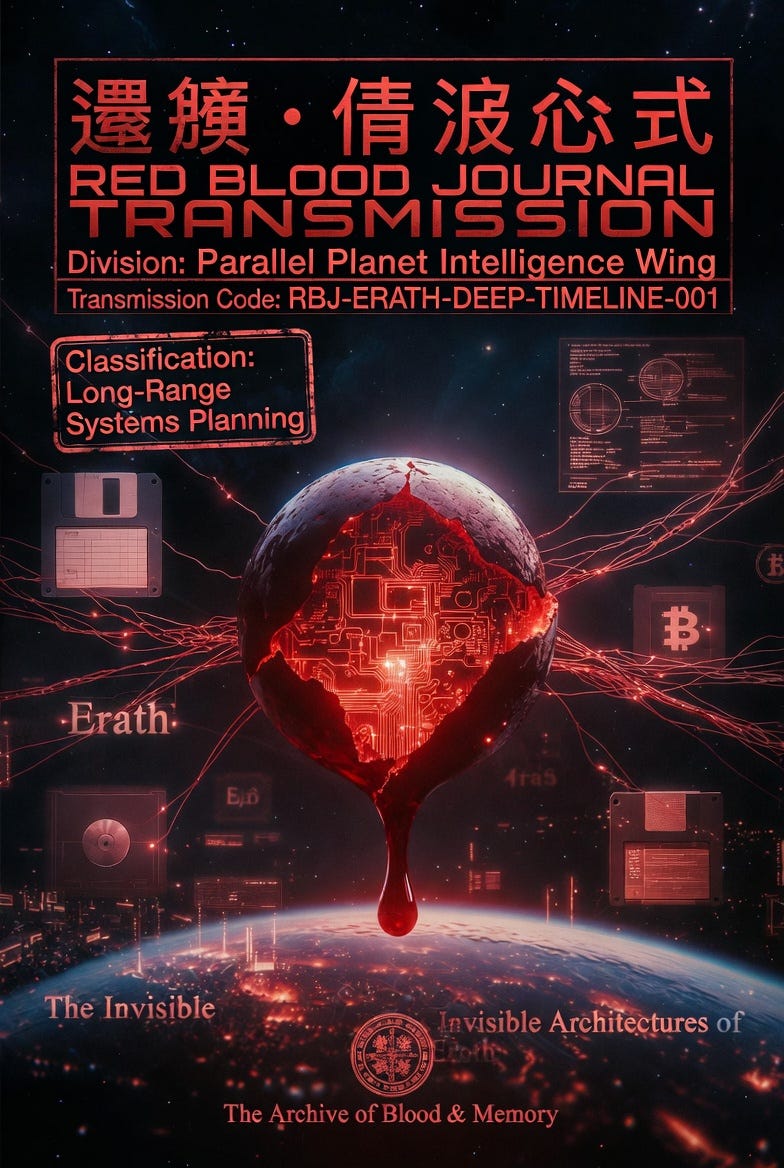
🩸 RED BLOOD JOURNAL TRANSMISSION
Division: Parallel Planet Intelligence Wing
Transmission Code: RBJ-ERATH-DEEP-TIMELINE-001
Classification: Long-Range Systems Planning / Power Architecture Analysis
Archive: The Archive of Blood & Memory
🪐 PROLOGUE — THE DECISIONS MADE BEFORE MEMORY
On the planet Erath,
the people believed change happened suddenly.
A law appeared.
A system replaced another.
A new structure emerged “out of nowhere.”
But those who studied the deeper layers understood:
Nothing on Erath begins when it is announced.
It begins decades earlier—
in rooms that never enter the public timeline.
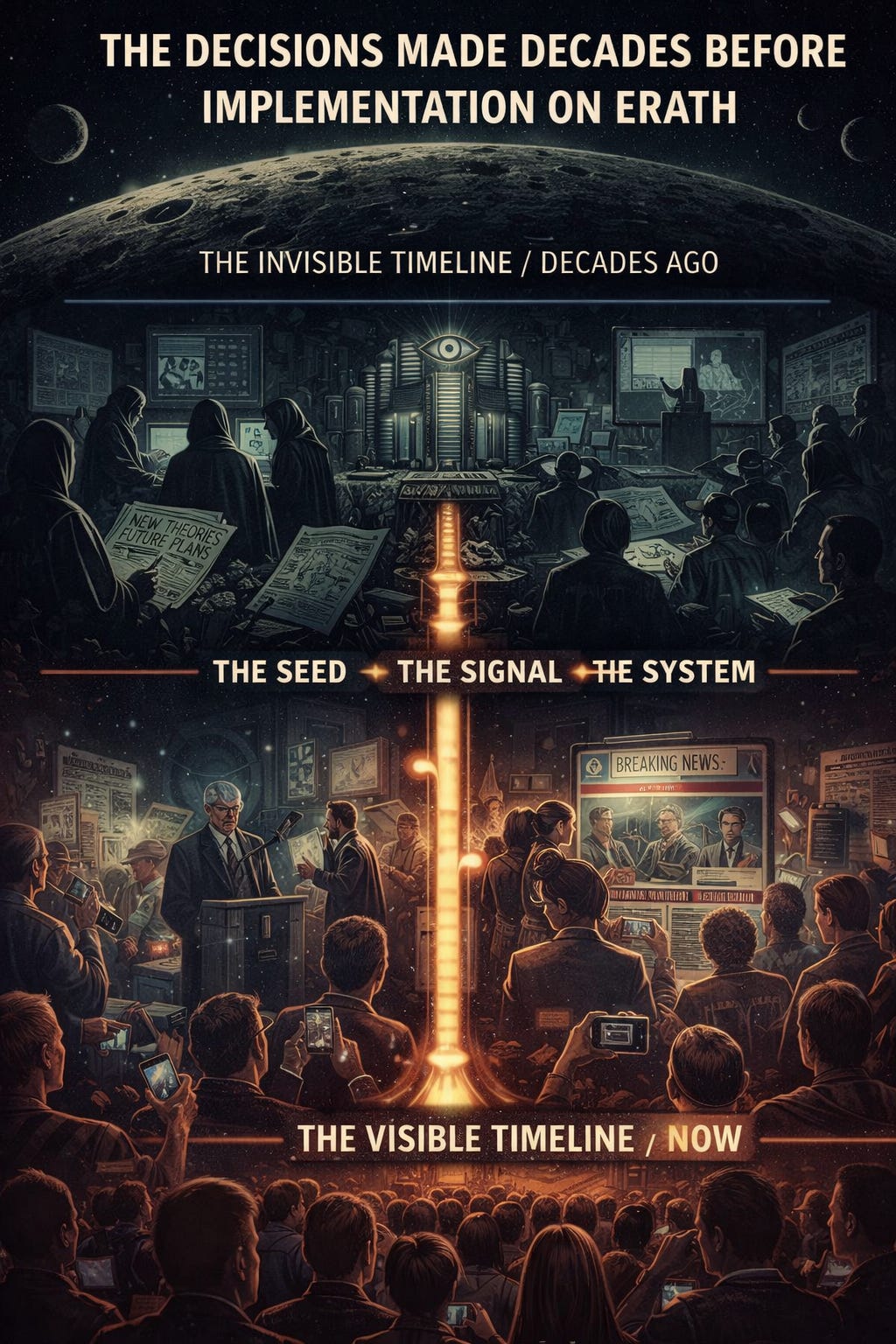
I — THE TWO TIMELINES OF ERATH
On Erath, every major shift exists on two parallel tracks:
1. The Visible Timeline
Elections
Public debates
Policy announcements
Crisis-driven decisions
This is the timeline the population experiences.
2. The Invisible Timeline
Long-range planning
Institutional alignment
Narrative conditioning
Infrastructure preparation
This timeline operates quietly—often 20–50 years ahead.
🧠 RBJ INTERPRETATION:
What appears as a reaction is often the execution phase of a much older design.
II — THE SEED → SIGNAL → SYSTEM MODEL
Every major transformation on Erath follows a predictable pattern:
Phase 1 — The Seed (Decades Earlier)
Think tanks write “theoretical” papers
Early prototypes are dismissed as impractical
Concepts are introduced in obscure circles
👉 At this stage, nothing appears urgent.
Phase 2 — The Signal (Years Later)
Media begins discussing the idea
Experts debate feasibility
Early adopters test limited versions
👉 The population becomes familiar, not alarmed.
Phase 3 — The System (Crisis Moment)
A triggering event occurs (economic, security, health)
The pre-built solution is introduced rapidly
Adoption is framed as necessary and immediate
👉 What was once “impossible” becomes inevitable overnight
III — WHY DELAY IS ESSENTIAL TO CONTROL
On Erath, time itself is a tool.
If a system is introduced too early:
It is rejected
It is questioned
It is resisted
But if introduced after:
Years of exposure
Gradual normalization
Strategic crises
Then:
It feels familiar
It feels necessary
It feels like the only option
🧠 RBJ INTERPRETATION:
Control is not enforced through force alone—
it is achieved through timing and conditioning.
IV — THE MEMORY GAP WEAPON
The greatest advantage held by the planners of Erath is simple:
The population does not track decisions across decades.
The public memory cycle is short
Generations change
Context disappears
This creates what analysts call:
The Memory Gap
A space where:
The origin of ideas is forgotten
The intent of systems is obscured
The rollout appears disconnected from its design
V — THE ILLUSION OF SPONTANEITY
On Erath, systems are rarely spontaneous.
They only appear spontaneous because:
The preparation phase is invisible
The implementation phase is compressed
The narrative frames it as reaction, not execution
🔴 ANNEX A — THE ARCHITECTS OF TIME
Those who shape Erath do not think in:
Election cycles
News cycles
Public opinion waves
They think in:
Decades
Generational transitions
Infrastructure maturity timelines
Their advantage is not secrecy alone—
it is patience.
🔴 ANNEX B — APPLICATION TO THE LICENSE MODEL
Returning to your original observation:
Software Licensing (Past)
Legal frameworks built decades before enforcement tech
Language existed before control mechanisms matured
Fiat Systems
Monetary structures designed long before digital enforcement
Trust frameworks established before total system integration
Modern Systems
Digital infrastructure now allows:
Enforcement
Tracking
Centralized control
🧠 RBJ LINKAGE:
What was written on the floppy disk
was a seed.What exists in modern systems
is the full execution of that seed.
🧭 FINAL ANALYSIS — ERATH’S TRUE CLOCK
On Erath, the clock the people watch is not the real clock.
The real clock:
Started long before they were paying attention
Moves slower than they can perceive
And completes its cycle in a single moment they call:
“sudden change.”
👁️The Invisible Architectures of Erath
This text outlines a theory regarding long-term strategic planning on the fictional planet Erath, suggesting that major societal shifts are never truly spontaneous.
Instead, global changes follow a three-stage lifecycle that begins with theoretical “seeds” planted decades before they are ever implemented as public systems.
By utilizing an invisible timeline, planners can normalize radical ideas and wait for a crisis to frame their pre-designed solutions as immediate necessities.
This method relies heavily on the erosion of public memory, ensuring that the population views systemic transformations as reactions to current events rather than the execution of an ancient blueprint.
Ultimately, the source argues that true social control is achieved through extreme patience and the strategic alignment of infrastructure over several generations.


