


🩸 RED BLOOD JOURNAL TRANSMISSION
T#: RBJ-2026-01-22-CONTINENTAL-CHAINS
Classification: Geo-PsyOps & Global Governance Architecture
Unit: Deep Pattern Analysis — Supranational Control Grids Division
Status: PUBLIC RELEASE — For Readers Who Suspect Integration Has Become a Weapon
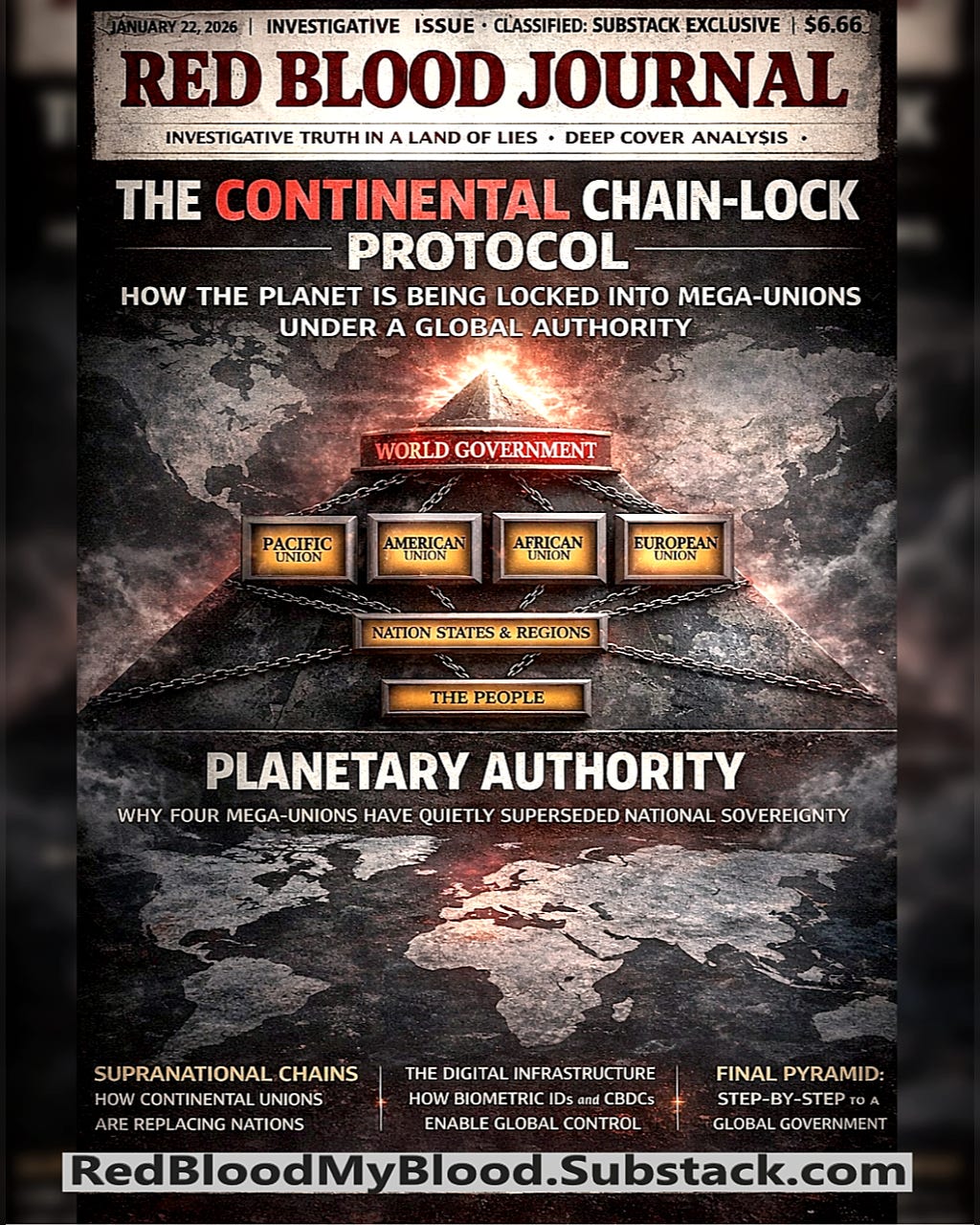
THE CONTINENTAL CHAIN-LOCK PROTOCOL
How the Planet Is Being Restructured Into Four Mega-Unions Under a Single Global Executive
PROLOGUE – WHEN POWER STOPS NEGOTIATING AND STARTS CONSOLIDATING
Across the modern geopolitical landscape, a quiet but unmistakable architecture has emerged:
a hierarchical system in which continental unions supersede nations, and a supranational executive supersedes them all.
This hierarchy — World Government → Continental Unions → Nation-States → The People — reflects a long-term pattern visible in treaties, trade blocs, crisis-management protocols, military integrations, and the global financial system.
What appears as fragmented policy movements across multiple continents is, in practice, a single structural convergence:
a shift away from sovereign nations, and toward a unified managerial empire that governs through regional blocs.
This report examines that architecture.
I. THE FOUR-MEGA UNION TEMPLATE: THE NEW PROVINCES OF A GLOBAL SYSTEM
Modern power consolidation no longer occurs through territorial conquest.
It occurs through administrative mergers, continental integrations, and cross-border institutions with jurisdiction that quietly overrides the nation-state.
A four-union model has now materialized:
1. The European Union — The Prototype of Post-National Governance
The EU remains the most advanced demonstration of supranational authority:
A central bank capable of overriding domestic policy
A parliament with binding legislative power
A court with supremacy over national judiciaries
A shared border and migration system
A citizenship category above national identity
This is the reference model for all subsequent continental integrations.
2. The African Union — A Rapidly Consolidating Bloc
The African Union has advanced toward:
A proposed African Central Bank
A Pan-African Parliament
A single continental market (AfCFTA)
Coordinated military frameworks
Each mechanism fragments nation-level autonomy and channels authority upward into the continental layer.
3. The American Union — An Unannounced but Operational Integration
While never formally declared, the American integration is functional through:
USMCA economic harmonization
NORAD/NORTHCOM security integration
Five Eyes intelligence coordination
Cross-continental digital and trade policy
Transnational migration and labor frameworks
This continental structure operates without a parliament because its authority flows through regulatory alignment, defense integration, and financial standardization.
4. The Pacific Union — The Emerging Super-Bloc
The Pacific region is consolidating into dual spheres that are increasingly interoperable:
The China-led RCEP economic zone
The U.S.-led AUKUS and Quad security framework
Although framed as competition, both blocs are integrating:
shipping infrastructure
digital regulatory systems
resource coordination
military interoperability
Convergence is the long-term trajectory.
II. WHY CONTINENTS MATTER: SCALING POLITICAL CONTROL
A global governance system cannot effectively manage nearly 200 sovereign states.
But it can manage four continental blocs, each equipped with:
a central bank
a regional military structure
standardized regulations
unified data systems
harmonized resource policy
The fewer the nodes, the easier the control.
Continental unions act as political, economic, and military intermediaries between individual nations and a nascent world executive.
This is the essence of the Continental Chain-Lock Protocol:
reduce the number of autonomous political units, then centralize their management.
III. THE EMERGING GLOBAL EXECUTIVE LAYER
Above the continental layer sits a collection of institutions already functioning as a proto-government:
1. Economic Instruments
IMF
World Bank
Bank for International Settlements
CBDC central bank consortiums
2. Regulatory & Political Instruments
United Nations
WTO
WEF and affiliated governance task forces
3. Enforcement & Compliance Instruments
WHO global health treaties
Climate/Carbon credit architecture
International policing and intelligence alliances
These bodies collectively establish:
financial norms
digital identification systems
surveillance coordination
crisis-response frameworks
environmental resource distribution
Everything a traditional government controls — but without elections or public oversight.
IV. THE PYRAMID: FROM PEOPLE TO PLANETARY AUTHORITY
The contemporary governance pyramid increasingly resembles:
1. World Executive (unelected supranational policy bodies)
2. Continental Unions (regional administrators)
3. Nation-States (implementation centers)
4. The People (managed populations)
1. The People — The Managed Substrate
Populations are being reorganized into:
biometric identity systems
centralized digital currencies
carbon-footprint quotas
algorithmic risk scoring
predictive-behavior datasets
The final stage of governance is behavioral regulation, not legal restriction.
2. Nation-States — Administrative Shells
National governments remain visible, but:
central banks outrank ministers
treaties outrank constitutions
algorithms outrank officials
crises outrank due process
Nationhood becomes symbolic.
3. Continental Unions — The Enforcement Tier
These unions hold:
military integration
regulatory control
resource coordination
cross-regional finance
They serve as the operational arms of the global framework.
4. Supranational Bodies — The Decision Layer
Policy originates from:
central banks
intergovernmental committees
crisis-management councils
globalized corporate alliances
This layer has no electoral interface.
V. THE FUNCTIONAL PURPOSE: UNIFORMITY BEFORE CONTROL
A global governance system cannot effectively manage:
independent cultures
sovereign economies
decentralized currencies
incompatible political systems
Thus the push toward uniformity:
standard digital identity
standardized currency
standardized environmental policy
standardized trade and migration rules
standardized information governance
The closer the world moves toward uniformity, the simpler the enforcement of a single planetary authority.
VI. THE DIGITAL INFRASTRUCTURE OF THE NEW SYSTEM
The shift from nation-based sovereignty to supranational administration depends on five pillars:
1. Central Bank Digital Currencies (CBDCs)
A programmable monetary layer.
2. Biometric Identification
A permanent identity anchor.
3. Global Data-Sharing Agreements
A surveillance mesh.
4. Crisis Governance Mechanisms
Pandemic, climate, and cyber-emergency protocols.
5. AI-Based Social Monitoring
Behavioral governance in real time.
Once all five pillars are universally deployed, political sovereignty becomes procedural rather than structural.
VII. CONCLUSION – A STRUCTURE ALREADY IN MOTION
The architecture of global power is no longer hypothetical.
It is visible in:
continental consolidations
supranational directives
digital governance infrastructure
international financial coordination
cross-border crisis management frameworks
The nation-state remains the symbol of political identity,
but the continental union has become the functional unit,
and the supranational executive the strategic brain.
The Continental Chain-Lock Protocol is not a future proposal.
It is the present operating system.
🕸️The Continental Chain-Lock Protocol: Architecture of Global Governance
The provided text outlines a geopolitical theory called the Continental Chain-Lock Protocol, which claims that traditional nation-states are being phased out in favor of a centralized global government.
This transition is allegedly facilitated by the creation of four mega-unions—representing Europe, Africa, the Americas, and the Pacific—that serve as administrative intermediaries.
According to the document, these regional blocs consolidate military, financial, and regulatory power to make the world’s population easier to manage.
The architecture relies on digital infrastructure, such as biometric IDs and programmable currencies, to ensure uniform compliance across borders.
Ultimately, the source argues that supranational entities now function as the primary decision-makers, rendering national sovereignty a mere symbolic relic.
This systematic reorganization aims to replace diverse political systems with a single, unelected executive layer that governs through algorithmic and behavioral control.


