


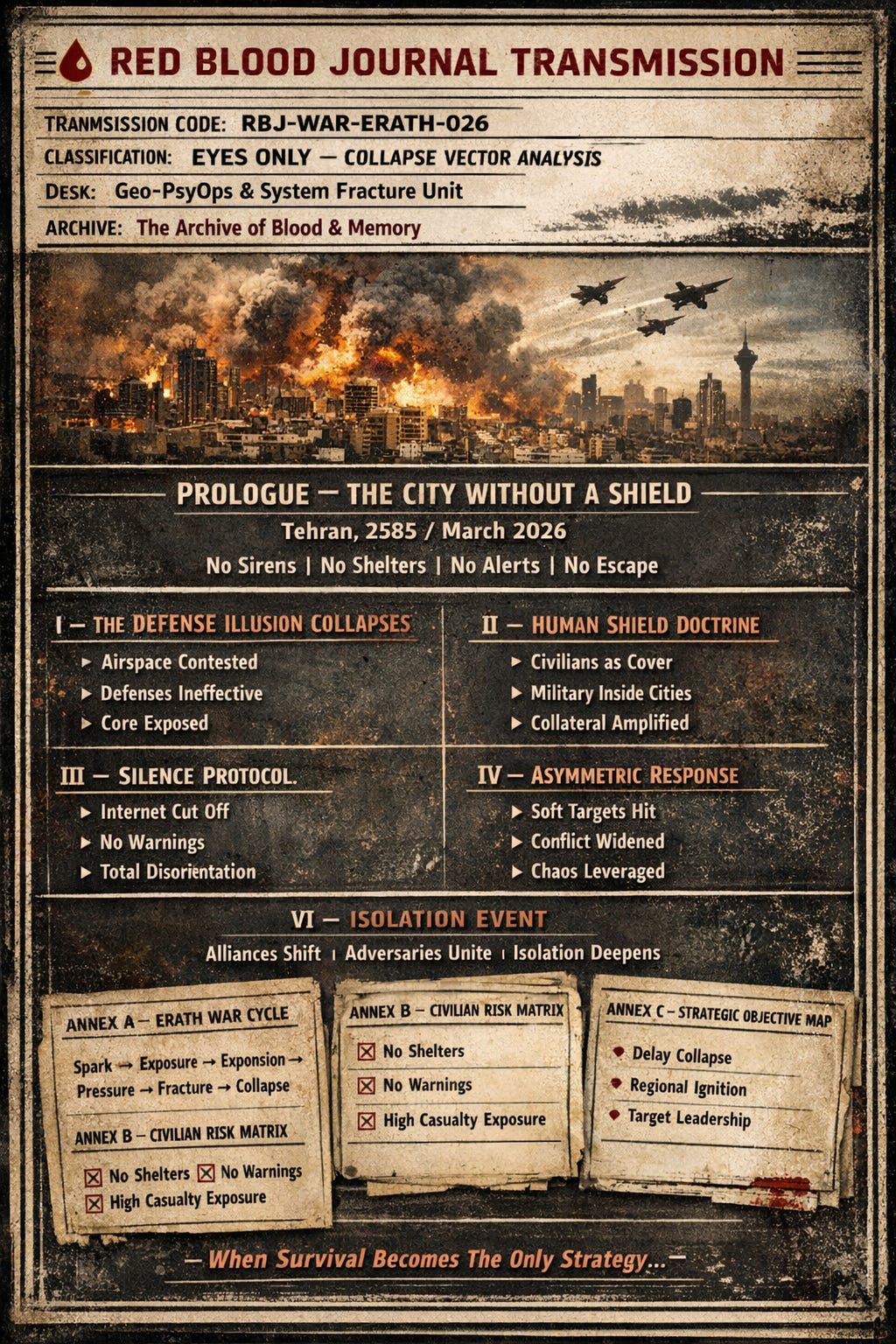
🩸RED BLOOD JOURNAL TRANSMISSION
Transmission Code: RBJ-WAR-ERATH-026
Classification: EYES ONLY — COLLAPSE VECTOR ANALYSIS
Desk: Geo-PsyOps & System Fracture Unit
Archive: The Archive of Blood & Memory
PROLOGUE — THE CITY WITHOUT A SHIELD
On the Planet Erath, there exists a moment in every war when reality breaks through the narrative.
Not slowly.
Not gently.
But all at once.
A capital once presented as fortified…
A system once described as impenetrable…
Now stands exposed.
A city without a shield.
Tehran — the symbolic heart of the system — is no longer defined by power…
but by absence:
No sirens
No shelters
No warning systems
No digital alerts
No information flow
Only impact.
I — THE DEFENSE ILLUSION COLLAPSES
For years, the system projected strength:
Advanced air defense networks
Indigenous missile shields
Strategic deterrence capabilities
But on Erath, there is a recurring law:
The louder the system speaks of strength… the more fragile it often is.
After sustained conflict:
Airspace control is contested
Defensive systems appear ineffective
Strategic infrastructure is repeatedly targeted
The illusion was not broken by one strike.
It was dissolved through repetition.
Outcome:
The capital transitions from “protected core” → exposed surface
II — THE HUMAN SHIELD DOCTRINE
A pattern emerges across Erath’s conflict zones:
Military infrastructure embedded within civilian space.
Not at the edges.
Not hidden in isolation.
But inside the population grid:
Command centers near residential blocks
Security units positioned within neighborhoods
Strategic assets distributed across urban density
This creates a dual-layer effect:
Protection through proximity to civilians
Amplified damage when targeted
The battlefield is no longer separate from the population.
The population becomes the battlefield.
III — THE SILENCE PROTOCOL
War on Erath is not only kinetic.
It is informational.
During active strikes:
Internet access is restricted
Communication channels collapse
Real-time awareness disappears
The result is not just vulnerability…
It is disorientation.
No alerts.
No updates.
No clarity.
A population without information becomes easier to control —
but harder to protect.
IV — THE ASYMMETRIC RESPONSE MODEL
Direct confrontation reveals imbalance.
So the system adapts.
Instead of engaging dominant military forces head-on,
the response shifts toward:
Regional expansion of conflict
Targeting softer assets (energy routes, maritime flows)
Leveraging proxy actors
This is not victory.
It is redistribution of pressure.
When force cannot be matched, chaos becomes the substitute.
V — THE REGIONAL IGNITION STRATEGY
On Erath, escalation is rarely accidental.
It is strategic.
The doctrine observed:
Expand conflict across multiple theaters
Involve neighboring regions
Disrupt global energy and logistics systems
Objective:
Force external powers into pressure cycles
→ Trigger calls for de-escalation
→ Preserve internal survival
This is not about winning the war.
It is about stopping the clock before collapse.
VI — THE ISOLATION EVENT
A critical shift has occurred:
Former adversaries align.
Former neutral actors reposition.
Across Erath:
Regional blocs consolidate
External powers coordinate
Strategic isolation deepens
The system is no longer facing a single opponent…
It is facing converging fronts.
Isolation is not declared.
It is realized when no ally remains willing to act.
VII — THE INTERNAL FRACTURE
Inside the structure, two forces emerge:
1 — Expansion Faction
Continue escalation
Broaden conflict
Maintain pressure externally
2 — Stability Faction
Concerned with economic collapse
Aware of infrastructure degradation
Recognizing systemic limits
But on Erath, hierarchy determines outcome.
And hierarchy favors force over caution.
VIII — THE SURVIVAL DOCTRINE
At this stage, objectives simplify:
Not prosperity.
Not stability.
Not reconstruction.
Only one:
Survival of the system itself.
Even if:
Infrastructure collapses
Economy stalls
Population suffers
The calculation becomes:
“If the system remains… it can rebuild.”
IX — THE COLLAPSE PARADOX
History on Erath shows a pattern:
Systems rarely collapse gradually.
They appear stable…
until the moment they are not.
Examples across timelines reveal:
Prolonged pressure
Sudden structural failure
Rapid transition from control → vacuum
The visible structure holds…
until the invisible supports give way.
X — THE CURRENT STATE VECTOR
At the time of this transmission:
Conflict intensity is increasing
Defensive capability is degraded
Civilian exposure is elevated
Regional escalation is active
Internal cohesion is weakening
Trajectory:
Escalation → Strain → Threshold Event
The exact moment of transition remains unknown.
But the direction is no longer ambiguous.
ANNEX A — THE ERATH WAR CYCLE
Spark → Exposure → Expansion → Pressure → Fracture → Collapse / Reset
Spark: Initial trigger event
Exposure: Weakness revealed
Expansion: Conflict spreads
Pressure: Multi-front stress builds
Fracture: Internal divisions intensify
Collapse / Reset: System transformation
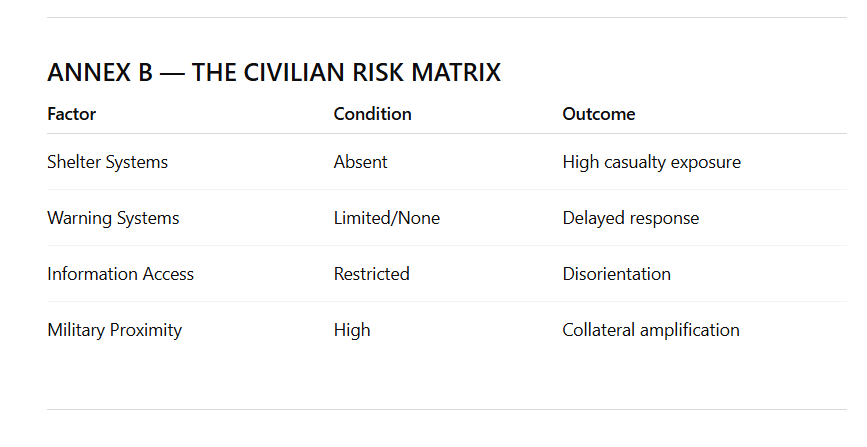
ANNEX C — THE STRATEGIC OBJECTIVE MAP
Observed Goals:
Delay collapse
Expand conflict radius
Trigger international pressure
Preserve governing structure
Counter-Forces:
Sustained external strikes
Targeted leadership disruption
Infrastructure degradation
Regional coalition pressure
ANNEX D — THE FINAL OBSERVATION
On Erath, systems do not fall because they are attacked.
They fall when:
Their defenses no longer protect
Their narratives no longer hold
Their internal structure no longer aligns
And most critically—
When survival becomes the only strategy left.
End of Transmission
🌋Erath War Cycle:
System Fracture and Survival Doctrine
The provided text outlines a strategic analysis of a crumbling geopolitical entity on the fictional planet Erath, where a once-formidable system faces imminent collapse.
This report details how military illusions of strength dissolve under repeated pressure, leaving key urban centers exposed and defenseless.
The narrative emphasizes a survival doctrine where the ruling hierarchy prioritizes its own endurance over civilian safety, often embedding weaponry within residential areas and restricting information to maintain control.
As defensive capabilities degrade, the system attempts to avoid total failure by expanding the conflict regionally and utilizing asymmetric tactics.
Ultimately, the source describes a terminal cycle of instability where internal fractures and international isolation lead toward a systemic breaking point.
The document concludes that true collapse occurs when a regime’s only remaining goal is its own functional preservation amidst widespread ruin.


