



🩸 Red Blood Transmission Journal
T#1113251 – The Digital ID Thesis
Title: The Soft Cage Closes – Consent as the Final Frontier of Control
Author: Field Analyst [Redacted]
Date: November 13, 2025
ABSTRACT
This thesis examines the global implementation of digital identification systems—biometric and behavioral—and argues that their deployment represents the culmination of a long-running campaign to merge corporate data extraction with state surveillance.
Unlike traditional totalitarian frameworks, which relied on visible force, the modern regime of control is voluntary, wrapped in convenience, and concealed within private-sector “innovation.”
The guiding premise is simple: Consent has replaced coercion as the mechanism of enslavement.
I. INTRODUCTION: THE INVISIBLE HANDCUFF
In past eras, the state chained bodies.
Today, it trains behavior.
Greg Reese’s 2025 report outlines the next phase of digital governance—a model where compliance is achieved not through government decrees but corporate normalization.
The COVID-19 era served as the prototype: mandates were socialized through apps, QR codes, and digital credentials. Once obedience was established, the same infrastructure was repurposed for permanent biometric identification.
Every “Accept” click, every camera unlock, every facial scan at an airport is not a transaction—it is a ritual of surrender disguised as progress.
II. METHODOLOGY: HOW THE MACHINE OPERATES
At the core of the system lies a biometric supply chain linking citizens, corporations, and governments in a feedback loop of consent:
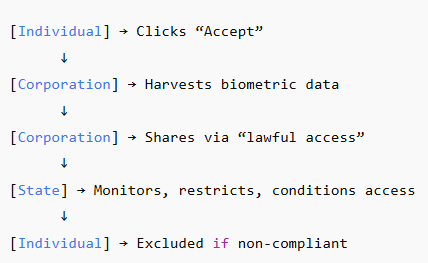
No legislation needs to be passed; no protests erupt.
Freedom evaporates silently within the terms of service.
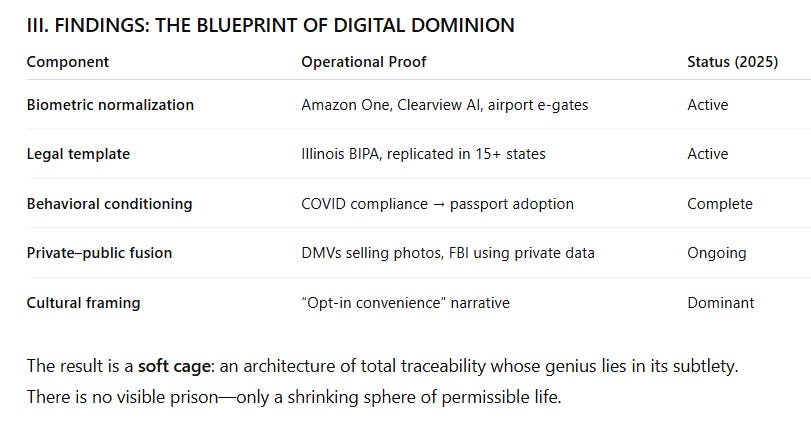
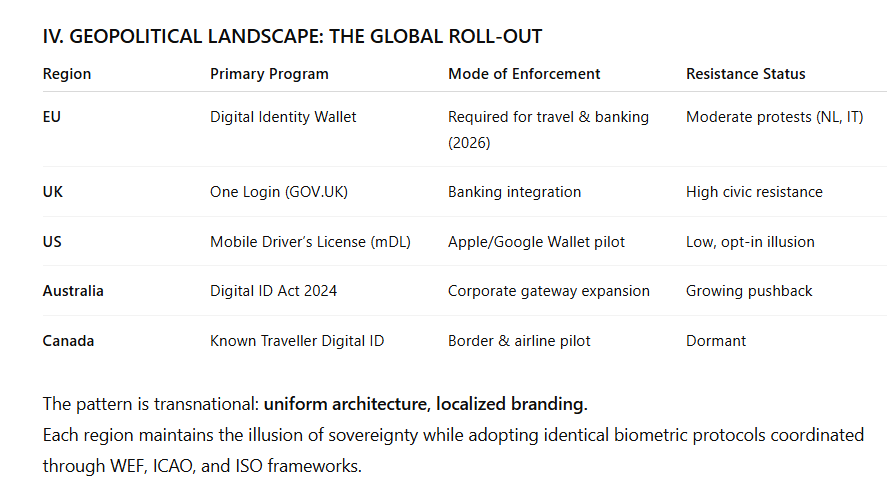

V. DISCUSSION: THE POLITICS OF CONSENT
Digital ID systems do not seize power; they invite it.
They seduce through ease, efficiency, and fear of exclusion.
Reese’s central insight—“Consent is engineered, refusal is exile”—captures the new moral geometry of the digital age.
Under this design:
Participation equals privilege.
Refusal equals invisibility.
Invisibility equals economic death.
This is governance by algorithmic omission. The citizen who declines becomes a ghost.
VI. RESISTANCE THEORY: STRESS-POINTS OF FAILURE
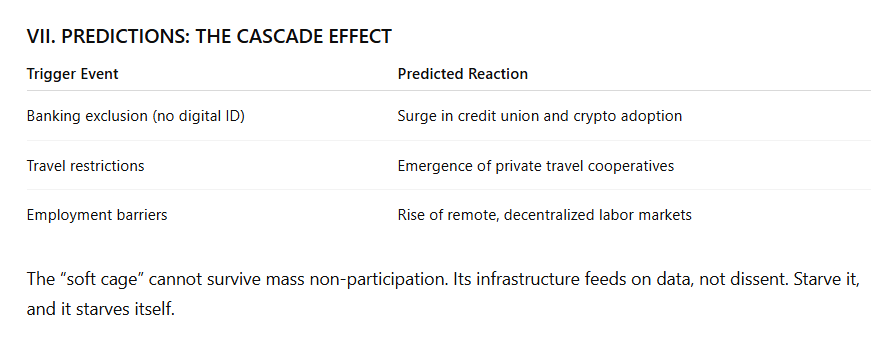
The architecture’s strength is also its fragility. It depends on near-total participation.
The following resistance vectors emerge as key pressure points:
Legal Friction:
Use privacy litigation (BIPA, GDPR, CCPA) to weaponize bureaucracy.
Overwhelm enforcement mechanisms through class actions.
Technological Disruption:
Support decentralized identity frameworks (self-sovereign crypto IDs).
Promote open-source encryption and local network autonomy.
Economic Withdrawal:
Prefer cash transactions, barter, and local trade networks.
Redirect capital toward credit unions and cooperative banks.
Optical Warfare:
Publicly record biometric coercion; amplify with #NoDigitalID.
Convert visibility into deterrence.
Cultural Subversion:
Normalize refusal as civic duty.
Redefine “inconvenience” as the new patriotism.
If 90% compliance sustains the system, then reducing it to 70% collapses it.
VIII. CONCLUSION: WALK OUT WHILE THE DOOR IS OPEN
The digital ID grid represents the ultimate inversion of freedom:
a system where obedience feels like autonomy and imprisonment feels like safety.
Greg Reese warned,
“They complied with the grocery store to buy food.”
The next phase will demand more than compliance—it will demand identity itself.
The countermeasure is not violence but withdrawal of consent.
Grow the food. Print the cash. Trade with those who remember paper and handshake.
Every act of refusal weakens the chain.
The cage is not yet locked.
But the lock is learning your face.
🩸 Red Blood Transmission – T#1113251
Directive: Disrupt Consent
Status: Active Dissemination
Archive: Red Blood Journal Mainframe
⛓️The Soft Cage Closes: Digital ID and Engineered Consent
“The Soft Cage Closes: Digital ID and Engineered Consent,” asserts that global digital identification systems represent a new form of societal control that merges state surveillance with corporate data extraction. The author argues that this modern regime relies on engineered consent—where compliance is achieved through convenience and the threat of exclusion—rather than overt coercion. This “soft cage” is built on a biometric supply chain where individuals accept terms of service, corporations harvest data, and the state monitors behavior, effectively making refusal of participation equal to economic and social exile. The document concludes by outlining several resistance strategies focused on legal friction, technological disruption, and mass economic withdrawal to undermine the system’s dependence on near-total public compliance.
COVID Lockdown Model for Digital ID Deployment


