


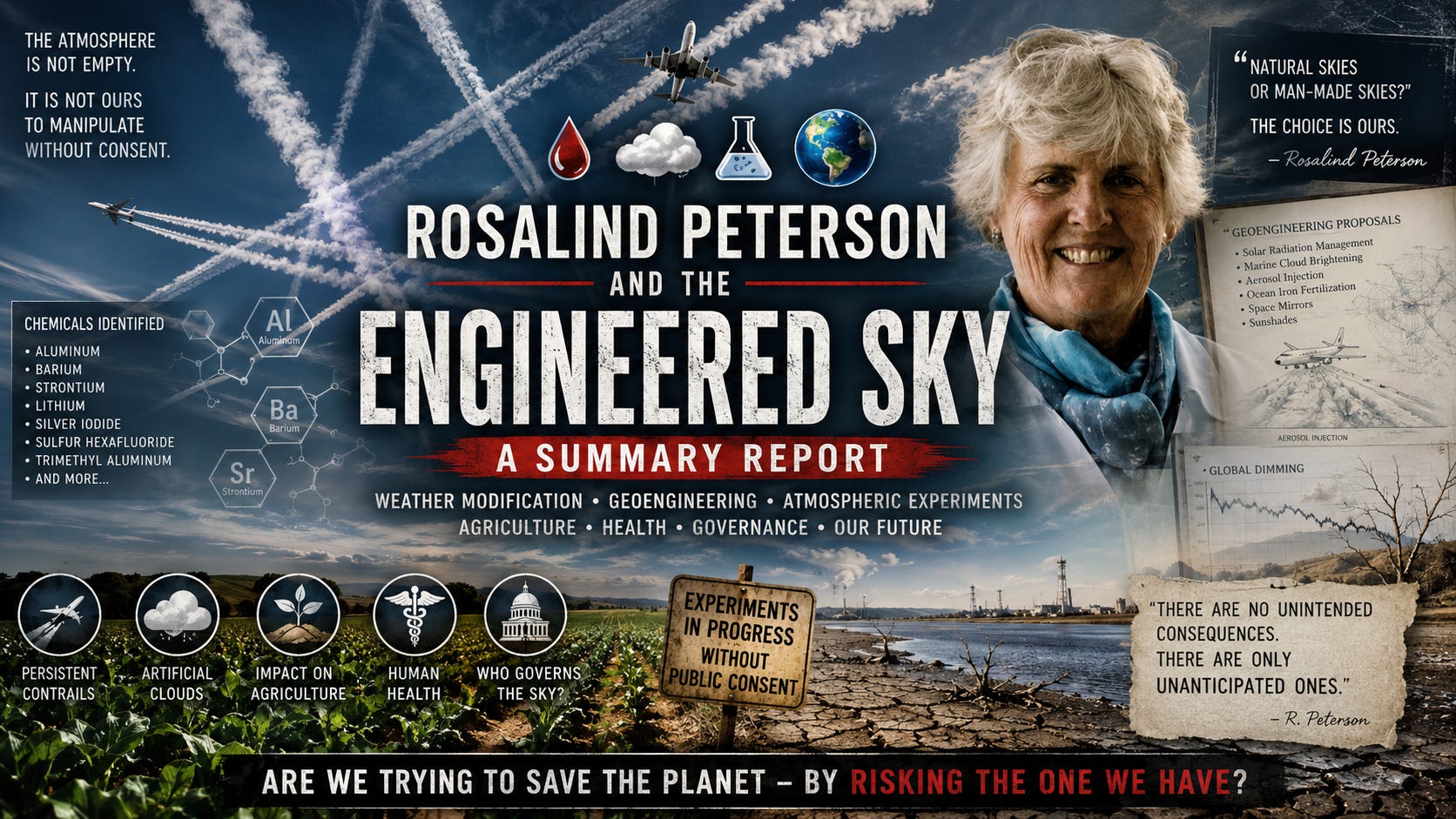
🩸 ☁️ 🧪 🌎 Rosalind Peterson and the Engineered Sky — A Summary Report
Geoengineering, Weather Modification, Agriculture, and the Question of Who Controls the Atmosphere
🩸 RedBloodJournal.com 🩸
Rosalind Peterson’s presentations were not built around one narrow accusation.
They were built around a much larger question:
What happens when governments, militaries, corporations, scientists, and private contractors acquire the ability to deliberately alter the atmosphere — while the public has almost no meaningful role in deciding how that power is used?
Peterson approached that question through agriculture.
That matters.
She described herself as having worked for the USDA Farm Service Agency, the Mendocino County Agricultural Department, and as a certified agricultural crop-loss adjuster. Her professional work involved determining why crops failed and assessing the resulting losses.
Her concern was therefore not simply what was happening thousands of feet above the ground.
Her concern was what eventually happened to the ground.
1. Weather Modification Was Not Science Fiction
One of the strongest points emerging from Peterson’s presentation is also the simplest:
weather modification exists.
She discussed cloud seeding, rainfall enhancement, snow enhancement, cloud dissipation, hurricane experimentation, and other forms of deliberate weather intervention, saying that the United States had been experimenting with weather modification since the 1940s.
She also described numerous operational programs across American states and internationally, including programs in California and activity involving private entities such as Pacific Gas & Electric.
That distinction is critical.
The debate should not begin with:
“Can humans modify weather?”
They can.
The more difficult questions are:
How much can they modify it?
At what scale?
Using what materials?
With whose permission?
And with what consequences?
2. Geoengineering Goes Far Beyond Cloud Seeding
Peterson separated ordinary weather modification from the much larger concept of geoengineering or climate remediation.
She described solar radiation management proposals in which particles or chemicals might be introduced into the atmosphere to reflect some incoming sunlight away from Earth. She specifically discussed materials such as sulfur compounds and aluminum oxide.
Other proposals mentioned throughout the presentation included:
artificial cloud brightening,
aerosols,
ocean iron fertilization,
solar reflectors,
space mirrors,
solar sails,
sunshades,
carbon sequestration,
atmospheric particle injection,
and other methods intended to manipulate planetary energy balance.
Peterson’s objection was straightforward:
The atmosphere is not an isolated laboratory.
Anything deliberately placed into it becomes part of a system containing air, soil, oceans, forests, agriculture, wildlife, drinking water, and human beings.
3. The Atmosphere as a Laboratory
Perhaps the most provocative part of Peterson’s presentation concerned documented upper-atmospheric experimentation.
She discussed NASA, the U.S. Air Force, the Navy, rockets, spacecraft, ionospheric research, artificial auroras, and releases involving substances including barium, strontium, lithium, calcium, sulfur hexafluoride, trimethyl aluminum, and aluminum compounds.
Peterson argued that the public discussion frequently treated geoengineering as something humanity might someday do, while atmospheric experimentation of various kinds had already occurred for decades.
That does not automatically prove that every unusual aircraft trail or environmental measurement is part of a covert geoengineering program.
But it does destroy the much simpler claim that governments have never deliberately released materials into the atmosphere for experimentation.
Those are two completely different propositions.
And confusing them prevents serious investigation.
4. Where Do the Materials Go?
Peterson repeatedly returned to a basic physical question.
If substances are released into the atmosphere:
do they stay there forever?
Her answer was no.
She argued that atmospheric materials eventually descend and therefore must be considered in relation to air, soil, surface water, drinking water, forests, and agriculture.
This became one of her major investigative themes surrounding aluminum, barium, silver compounds, and other substances.
But this is also where careful investigation becomes essential.
The fact that a material has been used in an atmospheric experiment does not by itself establish that a particular concentration found in drinking water, soil, or rain came from that experiment.
Source attribution requires evidence.
The proper question is therefore not:
“Was aluminum detected?”
It is:
“What aluminum was detected, in what concentration, at what location, at what time, and what evidence identifies its source?”
That is the difference between observation and proof.
5. Contrails, Artificial Clouds, and the Chemtrail Question
Peterson also spent considerable time discussing persistent aircraft trails.
She distinguished ordinary short-lived contrails from trails that persist, spread, and eventually resemble cirrus cloud cover. Later in the presentation she explicitly discussed the word “chemtrails” and described her own observations of aircraft and unusual persistent trails.
This subject is frequently destroyed by an all-or-nothing argument.
One side says:
Every persistent trail is a secret chemical spraying operation.
The other says:
Aircraft cannot meaningfully alter cloud cover or climate at all.
Neither proposition is necessary to investigate the real question.
Aircraft can create persistent contrails and artificial cirrus cloudiness under appropriate atmospheric conditions.
Separately, governments have conducted atmospheric chemical-release experiments.
Separately again, cloud-seeding and weather-modification programs exist.
The investigative challenge is determining where these categories overlap — and where they do not.
6. The Agricultural Warning
Peterson’s strongest expertise was agriculture, and this is where her argument became particularly important.
Plants require sunlight.
Agriculture requires relatively predictable seasonal patterns.
Fruit trees need specific temperature cycles.
Pollinators depend on timing.
Soil chemistry matters.
Rainfall matters.
Photosynthesis matters.
Peterson therefore questioned the wisdom of intentionally reducing incoming sunlight as a climate intervention.
Her argument was simple:
You cannot manipulate sunlight without also manipulating biology.
She linked excessive artificial cloud cover and solar reduction to potential decreases in photosynthesis, reduced crop yields, tree stress, and declining solar-energy output.
Whether every causal link she proposed is ultimately supported requires individual verification.
But the underlying question is legitimate:
What are the agricultural consequences of deliberately altering the amount or distribution of sunlight reaching Earth?
7. The Pollution Paradox
Peterson’s presentation repeatedly returned to what may be her most powerful criticism of geoengineering:
Why would humanity respond to atmospheric pollution by deliberately adding additional material to the atmosphere?
Geoengineering advocates may answer that carefully selected interventions could offset a much larger climate risk.
Peterson’s response was essentially:
And what if the treatment creates another disease?
Sulfur affects atmospheric chemistry.
Particles eventually interact with ecosystems.
Artificial clouds influence both incoming sunlight and outgoing heat.
Ocean fertilization changes biological systems.
Cloud seeding introduces materials into weather systems.
No intervention occurs in a vacuum.
Her warning was not merely that geoengineering might fail.
It was that it might work in one narrow measurement while damaging something else that was never properly counted.
8. The Ocean Is Part of the Experiment Too
Peterson also criticized ocean iron fertilization, in which nutrients such as iron are introduced to stimulate phytoplankton growth in hopes of increasing carbon uptake.
Her concern was that manipulating one biological process could produce cascading consequences throughout marine ecosystems.
She also questioned systems in which environmental interventions could generate carbon credits allowing pollution elsewhere.
The issue becomes larger than science.
It becomes economics.
Who funds the intervention?
Who receives the credits?
Who assumes the environmental risk?
Who measures whether the intervention actually worked?
And who pays if it causes damage?
9. The Governance Problem May Be Bigger Than the Science
Peterson discussed congressional hearings, UK parliamentary interest, and international discussions surrounding geoengineering governance.
That leads to a problem humanity has still not completely resolved:
Who has authority over the atmosphere?
If one country injects reflective particles into the atmosphere and rainfall decreases somewhere else, who is responsible?
If one intervention benefits one region but damages agriculture somewhere else, who decides whether the tradeoff is acceptable?
If atmospheric intervention crosses national borders, is national permission enough?
Could a corporation participate?
Could a billionaire finance it?
Could a military conduct experiments for national-security purposes?
Could one government effectively modify atmospheric conditions experienced by another?
The technology may eventually prove easier than the politics.
10. Consent
This was perhaps Peterson’s deepest concern.
Not simply geoengineering.
Not merely chemicals.
Not even weather modification.
Consent.
She characterized the atmosphere as being used as an experimental physics laboratory without meaningful public knowledge or permission.
The atmosphere belongs to everyone and no one simultaneously.
There is no fence around it.
There is no national border at 30,000 feet that prevents atmospheric effects from traveling.
That makes geoengineering fundamentally different from building a dam, power plant, laboratory, or highway.
The experiment cannot necessarily be contained inside the property of the experimenter.
The Red Blood Perspective
Rosalind Peterson’s work should not be reduced to a single word such as “chemtrails.”
Doing so actually hides the larger story.
Her presentations touched on several subjects that are independently real and documentable:
weather modification,
cloud seeding,
military atmospheric experiments,
rocket-borne chemical releases,
persistent contrails,
artificial cirrus clouds,
solar radiation management proposals,
ocean fertilization,
geoengineering governance,
and decades of government atmospheric research.
The investigative mistake would be to take those facts and automatically conclude that every additional claim Peterson made must therefore also be true.
The opposite mistake would be equally serious:
to discover that one claim is unsupported and therefore dismiss everything she documented.
The proper investigation sits between those two extremes.
Claim. Document. Evidence. Causation.
Four separate steps.
If a government document confirms an atmospheric experiment, report it.
If Peterson interprets that experiment as responsible for environmental contamination, examine the evidence connecting the two.
If the evidence stops before causation is established, say so.
If additional evidence establishes the connection, say that too.
That is how the subject should have been investigated from the beginning.
🌊 Ocean of Love and Positivity Perspective
Peterson began her presentation with something unexpectedly hopeful.
She told the audience that terrible information should not leave people paralyzed.
Learn.
Investigate.
Ask questions.
Educate others.
Participate.
Demand oversight.
That may ultimately be the most useful part of her legacy.
The sky should not belong exclusively to governments.
It should not belong exclusively to corporations.
It should not belong exclusively to scientists, militaries, activists, billionaires, or environmental organizations.
It belongs to the living world beneath it.
And if humanity ever decides to deliberately engineer that sky on a planetary scale, perhaps the first question should not be:
Can we do it?
Perhaps it should be:
Who gave us permission?
In an Ocean of Love and Positivity.
🩸🌊✨ Fantastic!
☁️
Geoengineering and the Engineered Sky: The Rosalind Peterson Report
Aug 22, 2026
This report explores the life and advocacy of Rosalind Peterson, who raised critical questions regarding geoengineering, weather modification, and their effects on agriculture. The source highlights that humans have intentionally manipulated the atmosphere for decades through cloud seeding and military experimentation, moving the debate beyond whether such technology exists to how it is managed. Peterson specifically warned that artificial cloud cover and chemical releases could disrupt photosynthesis, damage soil health, and threaten global food security. She argued that the atmosphere is a shared resource being used as a laboratory without the public’s informed consent or oversight. Ultimately, the text calls for a rigorous, evidence-based investigation into how climate intervention impacts the delicate biological systems of the planet. Through this overview, the author emphasizes the urgent need for transparency and international governance regarding the power to alter the sky.
#RedBloodJournal #RosalindPeterson #EngineeredSky #Geoengineering #WeatherModification #AtmosphericExperiments #ClimateEngineering #SolarRadiationManagement #CloudSeeding #PersistentContrails #ArtificialClouds #ManMadeSkies #AtmosphericResearch #WeatherEngineering #ClimateIntervention #NASA #USAirForce #USNavy #Ionosphere #AtmosphericChemicals #AluminumOxide #Barium #Strontium #TrimethylAluminum #EnvironmentalHealth #AirPollution #WaterPollution #SoilContamination #Agriculture #FoodSecurity #CropProduction #Photosynthesis #GlobalDimming #ForestHealth #OceanGeoengineering #IronFertilization #GeoengineeringGovernance #PublicConsent #EnvironmentalOversight #WhoOwnsTheSky #NaturalOrManMade #QuestionEverything #FollowTheDocuments #OceanOfLoveAndPositivity #RedBlood 🩸🌊✨


