


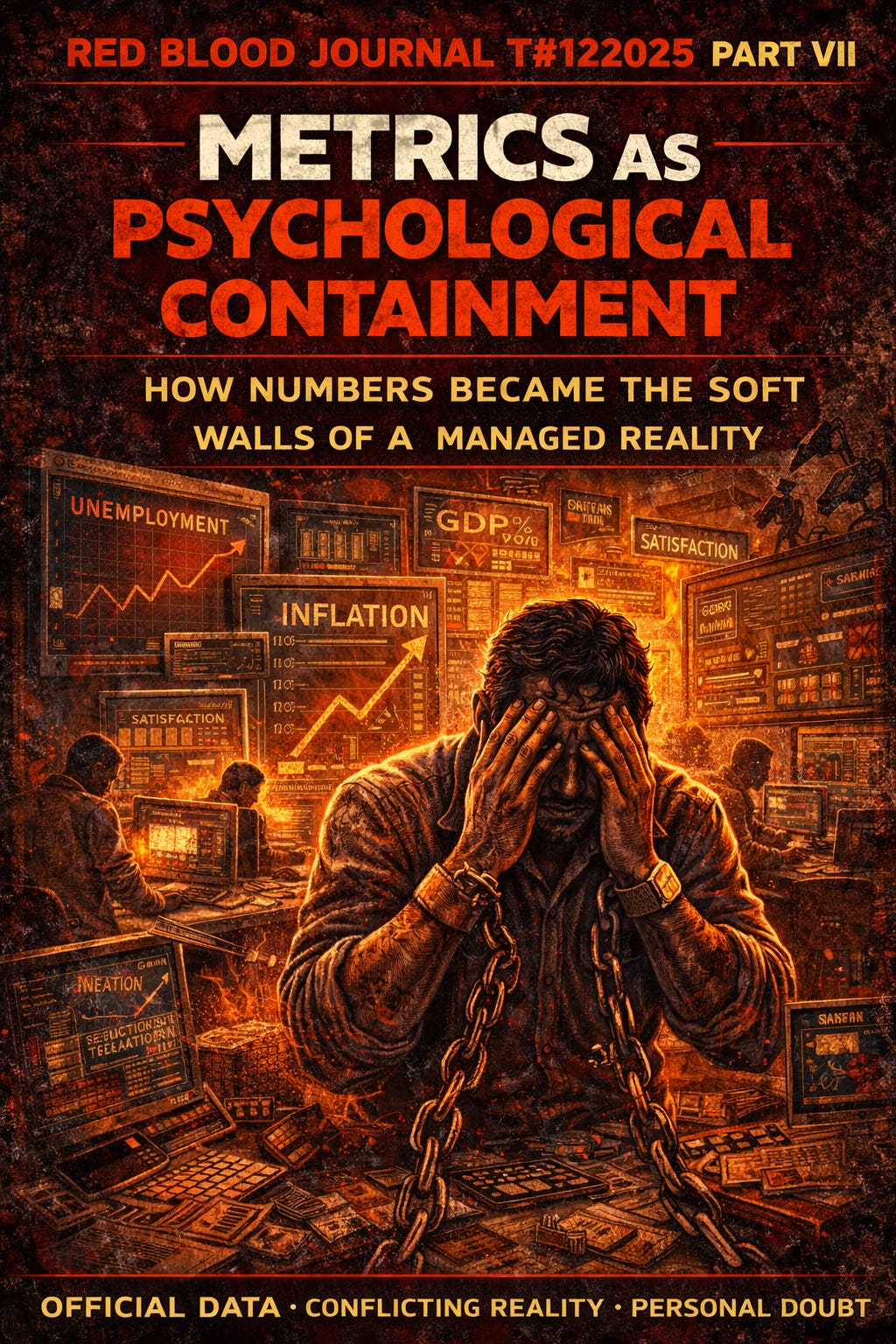
🩸 RED BLOOD JOURNAL — CONSPIRACY TRANSMISSION
T#122025–UNEMPLOYMENT–PSYOP
PART VII
METRICS AS PSYCHOLOGICAL CONTAINMENT
How Numbers Became the Soft Walls of a Managed Reality
Classification: Deep Pattern Analysis / Cognitive Control Architecture
Distribution: Restricted
Method: Conspiracy Lens (Structural, Incentive-Based, Non-Allegorical)
PROLOGUE — THE CAGE YOU CAN’T SEE
The most effective prison has no bars.
It has dashboards.
In the modern system, people are not controlled primarily by force, law, or even ideology. They are contained by metrics—numbers that feel objective, neutral, scientific, and therefore unquestionable.
Metrics do not tell you what to think.
They tell you when to stop thinking.
I. WHY METRICS ARE MORE POWERFUL THAN PROPAGANDA
Propaganda argues.
Metrics assert.
A claim can be debated.
A number ends the conversation.
When an anchor says:
“Unemployment is 4.2%”
The psychological effect is immediate:
Closure
Finality
Authority
No story.
No faces.
No questions.
The metric replaces reality with resolution.
II. THE REDUCTION TRICK — COMPLEXITY COLLAPSED INTO DIGITS
Human experience is messy:
Multiple jobs
Debt
Anxiety
Instability
Fear of the future
Metrics compress all of this into:
A rate
A percentage
A quarterly figure
This reduction is not for understanding.
It is for containment.
What cannot be expressed numerically is treated as irrelevant.
III. METRICS AS MOOD REGULATORS
Metrics are not designed only to inform policymakers.
They regulate public emotion.
Low unemployment → calm
Rising GDP → optimism
Stock market up → confidence
CPI easing → patience
Whether or not these reflect lived reality is secondary.
The primary function is emotional pacing.
Too much despair leads to unrest.
Too much hope leads to demands.
Metrics are tuned to keep the population manageable.
IV. THE OFFICIAL REALITY / LIVED REALITY SPLIT
When people feel poor but are told the economy is strong, a split forms.
This split creates three outcomes:
Self-Blame
“If things are good, I must be failing.”Silencing
“Complaining makes me sound ignorant.”Alienation
“No one else seems to see what I see.”
This is not accidental.
A population that doubts its own perception is easier to govern than one that trusts it.
V. THE METRIC HIERARCHY — WHAT COUNTS AND WHAT DOESN’T
Notice what is measured obsessively:
Employment
Inflation
Growth
Productivity
Markets
Now notice what is not:
Stress
Exhaustion
Job insecurity
Time poverty
Dignity
What is not measured is not governed.
And what is not governed can be ignored.
VI. MOVING THE GOALPOSTS WITHOUT MOVING THE STORY
Metrics allow the system to change definitions without changing narratives.
If conditions worsen:
Definitions narrow
Baselines shift
Categories disappear
The headline stays the same.
This is not lying.
It is semantic drift weaponized.
The map changes.
The traveler is blamed for being lost.
VII. METRICS AS SOCIAL ENFORCEMENT
Metrics don’t just discipline governments.
They discipline people.
When numbers say things are fine:
Dissent sounds irrational
Protest feels embarrassing
Organizing seems unnecessary
Metrics create peer pressure:
“What are you upset about? Look at the data.”
The data becomes a social bludgeon.
VIII. THE MEDIA’S ROLE — TRANSLATORS OF CONFINEMENT
Media does not need to invent narratives.
It only needs to:
Repeat official metrics
Frame them positively
Avoid qualitative contradiction
A story backed by numbers is considered complete—even if it explains nothing.
This is not coordination.
It is convergence.
IX. WHY METRICS NEVER ASK THE WRONG QUESTION
Metrics answer the questions power wants asked.
They never ask:
Can people afford to live?
Are jobs worth having?
Is work dignified?
Is life improving in meaningful ways?
Those questions are dangerous.
So the system replaces them with safer ones.
X. THE END STATE — A NUMERIC REALITY PRISON
In the final stage, people learn to:
Distrust their own experience
Trust dashboards instead
Accept contradiction as normal
They feel trapped, but can’t explain why.
Because the walls are made of numbers.
CONCLUSION — THE MOST PERFECT CONTAINMENT
Metrics are not evil.
But in a system designed to preserve hierarchy, they become psychological containment fields—soft walls that prevent collective realization.
You are not told:
“Your suffering doesn’t matter.”
You are shown a chart that implies it.
And once numbers replace meaning, power no longer needs to argue.
It only needs to publish.
🩸 END PART VII
📊🩸METRICS AS PSYCHOLOGICAL CONTAINMENT
This text examines how statistical data acts as a subtle form of psychological control by replacing complex human experiences with oversimplified numbers.
The author argues that official metrics, such as unemployment rates and GDP, function as “soft walls” that suppress dissent and regulate public emotion.
By prioritizing numerical authority over lived reality, the system encourages individuals to doubt their own perceptions and accept a managed version of the truth.
Crucially, the source suggests that what is left unmeasured, such as dignity or stress, is intentionally ignored to maintain existing power structures.
Ultimately, these dashboards serve as a modern prison, where data is weaponized to end debate and ensure a compliant, manageable population.


