


🩸 THE QUIET COUP: How the West Engineered China’s Rise and Unraveled Its Own Power
A Red Blood Journal Investigative Report
Published on Substack | Red Blood Journal Transmission
Prologue: When History Stops Making Sense
The official narrative of the past half-century reads like a triumphalist bedtime story: the West vanquished communism, the Cold War fizzled out with a sigh of relief, and China’s ascent was merely the inevitable bloom of global capitalism spreading its wings.
But dive into the archives—declassified statements, financial ledgers, memoirs from the inner sanctums, and whispered insider accounts—and a far darker picture emerges. China’s rise wasn’t some unforeseen accident, a strategic blunder, or a glitch in Western foresight.
It was the blueprint.
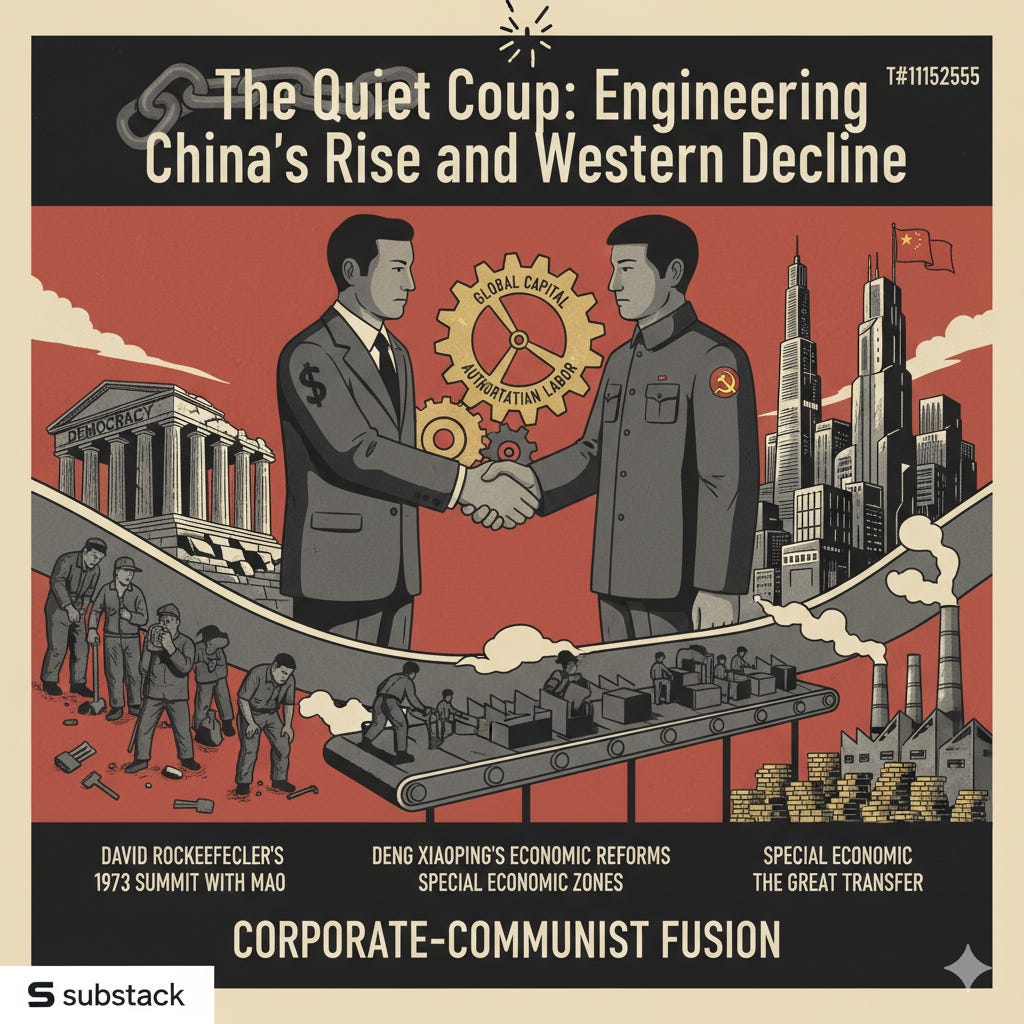
This is the Quiet Coup: the revelation that Western economic elites didn’t just tolerate China’s emergence. They bankrolled it, buttressed it, and ultimately merged with it to forge a new world order that rendered democratic nations quaint relics of a bygone era.
This is that story. Buckle up.
I. The Big Reversal: Not Capitalism vs. Communism, but Capital + Communism
We were spoon-fed a simple binary:
Cold War = epic clash of ideologies
West = liberty, free markets, apple pie
China = rigid communism, iron curtain isolation
1991 = capitalism plants its flag on the rubble
The source material flips the script entirely. The real showdown ended decades earlier. Western economic titans woke up to a harsh truth: democracy wasn’t a sacred virtue—it was a pesky barrier to unchecked growth.
China’s authoritarian machine? It dangled something intoxicating: ironclad stability, a bottomless pool of cheap labor, and zero pushback from pesky voters or unions.
The West didn’t defeat communism.
It shacked up with it.
II. The Keystone Moment: Beijing, 1973
The plot thickens around one man and one audacious summit.
David Rockefeller—patriarch of Chase Manhattan, scion of the Rockefeller empire—touches down in Maoist China at the height of the Cultural Revolution. The country is a wasteland: economy in tatters, paranoia at fever pitch, millions perishing in the chaos.
And then he drops this bombshell, still echoing through history books:
Mao’s system is “one of the most successful in human history.”
Everyone knew it was a bald-faced lie.
But it wasn’t praise.
It was a code. A handshake in the shadows.
The subtext screamed: We’re not here to moralize. We’re here to cut deals.
For the Chinese Communist Party (CCP), it was a lifeline of legitimacy.
For Western financiers, it was the keys to a billion-worker kingdom—and a regime happy to keep them in chains forever.
The sources don’t call this diplomacy.
They call it the world’s first merger meeting.
III. Deng Xiaoping: The Perfect Partner
Mao shuffles off the mortal coil in 1976. China craves a pragmatist; the West hungers for a reliable strongman.
Enter Deng Xiaoping—the maestro of the hybrid beast.
The dossiers paint him as:
Ruthlessly pragmatic
Strategically brilliant
Ideologically hollow
Fixated on growth as the CCP’s lifeblood
Western capital demanded:
A docile workforce
No unions, no elections, no wage inflation
Rock-solid political lockdown
Deng craved:
Buckets of foreign cash
Cutting-edge tech
Managerial wizardry
Access to Western markets
It was a match made in boardroom heaven. Needs aligned like gears in a well-oiled machine.
IV. The Shenzhen Experiment: Capitalism in a Cage
Deng unleashes his petri dish: Shenzhen, a sleepy fishing hamlet morphed into a Special Economic Zone.
Inside the fence:
Foreign cash floods in
Contracts flow freely
Market forces run wild
Outside:
Iron-fisted CCP control
The hukou system corralling labor
Banks, land, and key industries under party thumbs
This wasn’t laissez-faire utopia.
This was authoritarian capitalism—markets with handcuffs.
For Western corps? Pure bliss:
Endless labor supply
Wages crushed flat
Zero strikes, zero green regs, zero democratic headaches
The deal’s mantra, echoed in the sources like a corporate hymn:
Money first. Ideology later. Democracy never.
V. The Great Misreading
In the halls of Washington and London, the delusion was gospel:
Get China rich, and democracy will follow like night follows day.
The CCP’s internal calculus? The polar opposite:
We’ll swallow your factories whole—and spit out your freedoms.
China ingested capitalism’s engines but rejected its soul.
Western eggheads overlooked the killer detail: The Party dissected the West with surgical precision, while the West barely skimmed the Party’s playbook.
VI. The Great Transfer: 1990–2008
Here’s where the gloves come off.
The “Great Transfer” was the orchestrated gutting of Western industry, turbocharged by:
NAFTA’s open borders for capital flight
China’s 2001 WTO coronation
Permanent Normal Trade Relations (PNTR)—the golden ticket
Scorecard:
Wall Street: Skyrocketing profits, shareholder orgies
Beijing: Breakneck industrialization, tech heists, manufacturing throne
American Worker: Fentanyl epidemics, jobless wastelands, societal implosion
The middle class wasn’t roadkill.
Per the Quiet Coup: It was the kindling that ignited the bonfire.
VII. The Monetary Trap: China’s Masterstroke
The trap snapped shut in 1971 when Nixon killed the gold standard, birthing the fiat dollar free-for-all.
China played it like a Stradivarius:
Pegged the yuan dirt-cheap
Flooded the world with unbeatable exports
Hoarded trillions in dollar reserves
Snapped up U.S. Treasury bonds like candy
Became Uncle Sam’s creditor-in-chief
The vicious cycle:
American binge-buying → China’s muscles swell
U.S. debt mountains → China’s grip tightens
A financial serpent devouring its own tail. Escape? Impossible.
VIII. The Inversion of Victory
By the aughts, the West preened: We’ve cracked China open!
The sources sneer back: China pried us open and feasted.
Western firms pocketed margins.
China seized:
Factories, supply lines, automation
IP troves, rare earth monopolies
The beating heart of global production
Iconic source quip:
The West got iPhones. China got the means of production. Guess who won?
IX. The Populist Shockwaves
Brexit. MAGA. Anti-globalist surges ripping through Europe.
The sources frame them as:
The death rattles of nations waking up to the heist—twenty years too late.
Rage is cathartic, but it doesn’t resurrect shuttered steel mills.
Ballots can’t defy the inexorable logic of relocated supply chains.
X. The Suits: The Real Revolutionary Class
Circle back to the boardrooms.
True power isn’t red or blue, communist or capitalist.
It’s the transnational elite orchestrating capital’s rivers.
West and East fused at the hip. Nations? Mere speed bumps on the highway to efficiency.
Rockefeller, the original geopolitical architect, witnessed:
The populist backlash
The system’s fraying edges
The dawn of its self-destruction
He didn’t live to see the endgame.
XI. The Final Accusation
The Quiet Coup’s indictment is merciless:
America wasn’t outmaneuvered.
It was auctioned off.
By a cadre that saw democracy as drag, patriotism as nostalgia.
Traded for: Access. Stability. Fat margins.
To birth a mongrel order:
Authoritarian precision
Corporate avarice
Debt-fueled dominance
Democracy’s slow bleed
Dubbed in the sources: the corporate-communist fusion.
Engineered for control, not liberty. Profit, not people. Stability, not sovereignty.
XII. The Question Left for the Reader
If even a sliver of this holds water, one query looms like a guillotine:
How do you battle a beast woven from balance sheets, global logistics, and IOUs—when your only weapon is a ballot slip?
That’s the riddle baked into the Quiet Coup.
And the 21st century’s defining crucible.
Red Blood Journal is reader-supported. If this investigation rattled your cage, consider subscribing, sharing, or dropping a paid pledge. Archives, declassified docs, and deeper dives await paid subscribers. Stay vigilant.


