


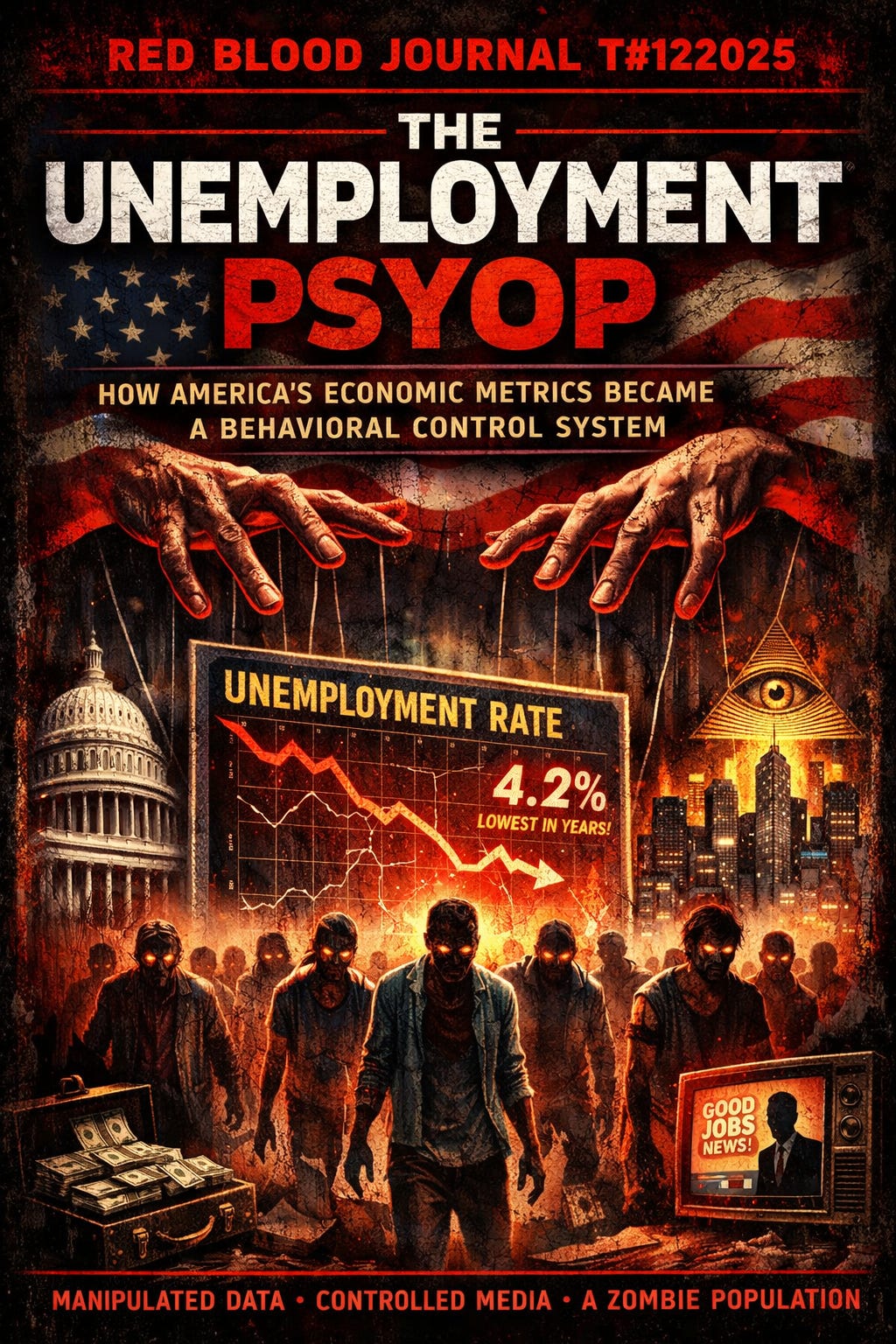
🩸 RED BLOOD JOURNAL — CONSPIRACY TRANSMISSION
Title: THE UNEMPLOYMENT PSYOP
Subtitle: How America’s Economic Metrics Became a Behavioral Control System
Classification: Deep Pattern Analysis / Psychological Operations
Distribution: Restricted
Method: Conspiracy Lens (Structural, Incentive-Based, Non-Allegorical)
EXECUTIVE WARNING
This report does not claim a single room of villains, a secret handshake, or a signed memo labeled “Lie to the People.”
That would be too crude.
What follows is more dangerous:
A distributed system of incentives, definitions, and narrative enforcement that functions like a conspiracy without requiring conspirators—a machine that produces the same outcome every time, regardless of who is elected.
The outcome: Compliance through statistics.
I. THE PRIME DIRECTIVE — STABILITY OVER TRUTH
Every large system has a prime directive.
For the modern American state, that directive is not prosperity.
It is stability.
Stability means:
Calm markets
Predictable consumer behavior
Political legitimacy
Social inertia
Truth is optional.
Optics are mandatory.
Unemployment statistics sit at the center of this stability doctrine.
II. THE METRIC AS A WEAPON
The unemployment rate is not a measurement tool.
It is a narrative weapon.
Why This Metric?
Because employment touches:
Identity (“I have a job”)
Worth (“I’m productive”)
Hope (“Things are getting better”)
Control the employment narrative, and you control morale.
A demoralized population questions power.
A falsely reassured population adapts to decline.
III. THE DEFINITION TRAP — HOW REALITY IS FILTERED OUT
The official unemployment rate (U-3) is engineered around behavior, not hardship.
You are counted only if you:
Are actively searching (recently)
Are immediately available
Are completely detached from any income stream
This creates a perverse outcome:
The more broken the job market becomes,
the better the unemployment number can look.
Why?
Because discouraged people self-delete from the dataset.
The system does not need to silence them.
It teaches them to silence themselves.
IV. THE DISCOURAGED WORKER PURGE
Here is the first true conspiracy layer.
When a person:
Searches endlessly
Is rejected algorithmically
Gives up out of despair or necessity
They are removed from the labor force.
Not unemployed.
Not employed.
Invisible.
From a systems perspective, this is elegant:
Despair reduces the unemployment rate
Withdrawal is interpreted as recovery
Failure is recoded as success.
This is not accidental.
It is mathematically predictable — and politically useful.
V. UNDEREMPLOYMENT: THE BLACK HOLE CATEGORY
The system refuses to distinguish between:
Survival labor
Productive labor
Exploitative labor
A person driving rideshare 12 hours a day with no benefits is counted as a success.
Why?
Because the goal is not quality of life.
The goal is labor attachment.
As long as the body is attached to labor — any labor — the system declares victory.
This is not an employment system.
It is a containment system.
VI. MULTI-JOB NORMALIZATION — THE END OF DIGNITY
When people work multiple jobs, the data:
Celebrates “strong employment”
Ignores economic desperation
Erases exhaustion
This reframes collapse as hustle.
The psychological trick is critical:
Poverty becomes a personal failure
Overwork becomes a virtue
Structural breakdown becomes “grind culture”
The system externalizes blame while internalizing obedience.
VII. THE LABOR FORCE PARTICIPATION COVER-UP
Labor force participation is the number that threatens the illusion.
It answers the forbidden question:
How many people have given up on the system entirely?
This number reveals:
Long-term despair
Caregiving displacement
Disability
Psychological withdrawal
That is why it is rarely headlined.
A conspiracy does not need secrecy.
It needs selective emphasis.
VIII. THE INFLATION SEPARATION FIREWALL
Here is where intent becomes unmistakable.
Employment data is never structurally paired with:
Housing affordability
Healthcare costs
Food inflation
Transportation expenses
Why?
Because if you combine them, the lie collapses instantly.
A job that cannot sustain life is not employment.
It is managed dependency.
Separating these datasets protects the narrative.
IX. THE MEDIA AS A SYNCHRONIZATION GRID
This is not about journalists lying.
It is about shared constraints:
Access journalism
Economic incentives
Advertising dependencies
Political proximity
“Unemployment low” is safe.
“Employment no longer works” destabilizes trust.
So headlines synchronize — not by command, but by survival instinct.
A chorus forms without a conductor.
X. THE ZOMBIE CONDITION — HOW PEOPLE ARE TRAINED NOT TO THINK
The population is not asleep.
It is exhausted.
People:
Work longer hours
Carry more debt
Face rising costs
Receive contradictory signals
Cognitive energy collapses.
In this state:
Numbers are accepted
Authority is deferred to
Reality is endured, not analyzed
This is not stupidity.
It is burnout weaponized.
XI. THE TRUE CONSPIRACY — INCENTIVE ALIGNMENT
There does not need to be a cabal meeting.
The conspiracy is structural:
Politicians need good numbers
Markets need confidence
Media needs stability
Corporations need compliant labor
The unemployment statistic satisfies all four.
That is why it will never change.
XII. THE END STATE — A MANAGED DECLINE ECONOMY
What you are witnessing is not recovery.
It is managed decline with psychological cushioning.
The numbers are designed to:
Prevent panic
Delay revolt
Encourage adaptation
Normalize less
A population trained to survive on scraps will call survival “success.”
CONCLUSION — THE NUMBER THAT PACIFIES
The unemployment rate is not a lie.
It is something far more effective:
A truth-shaped object, engineered to:
Calm
Distract
Normalize
Contain
The conspiracy is not hidden.
It is printed every month.
And the most dangerous part is this:
Once people sense the disconnect but cannot articulate it, they stop trusting everything — including each other.
That is how empires rot quietly.
🩸 END CONSPIRACY TRANSMISSION
This text outlines a theory that official unemployment statistics are used as a psychological tool to maintain social and political stability rather than to report economic truth.
The author argues that the government uses selective definitions to hide the reality of poverty, such as excluding discouraged workers and those trapped in underemployment from the data. By focusing on the U-3 rate, the system reframes economic desperation as a success, effectively silencing the struggling population through mathematical invisibility.
This structural manipulation ensures market confidence and prevents public unrest by normalizing a state of managed decline.
Ultimately, the source suggests that these metrics function as a narrative weapon designed to encourage compliance and mask the erosion of the American middle class.


