


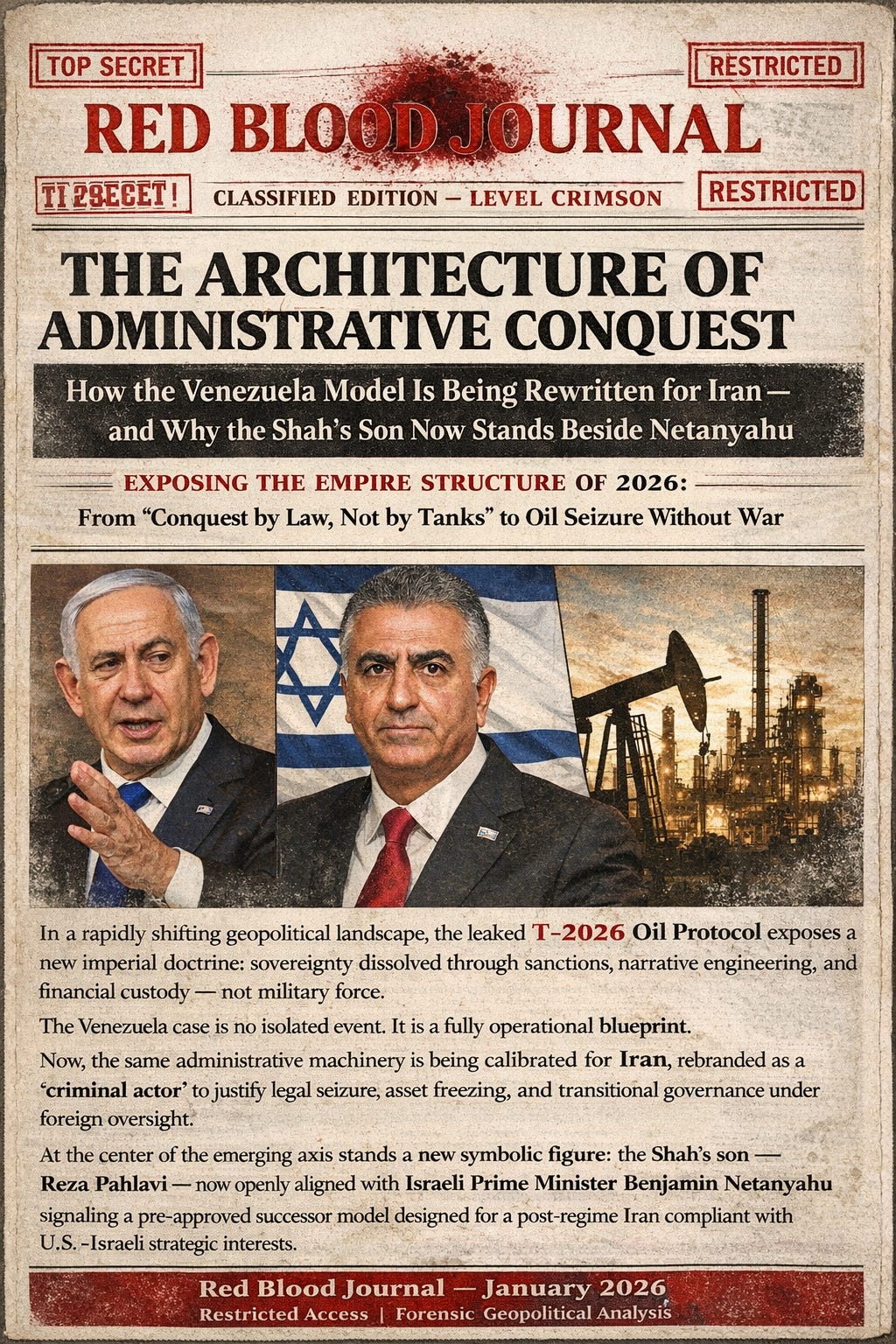
🩸RED BLOOD JOURNAL
Volume 15, Issue 1 | January 2026
Title:
T#2026: The Administrative Conquest Protocol – From Venezuelan Stabilization to Iranian Regime Transition
Subject:
Geopolitical Analysis and Imperial Strategy in Resource-Rich Nations
Authors:
Red Blood Journal Editorial Team
(With contributions from anonymous intelligence analysts and geopolitical experts)
Abstract
This special report examines the evolution of 21st-century imperial strategies, shifting from overt military interventions to sophisticated administrative mechanisms of control. Drawing on the T#2026 Oil Protocol—initially applied to Venezuela—this analysis outlines a blueprint for “conquest by paperwork,” involving sanctions, asset seizures, revenue redirection, and the installation of transitional governments. The report highlights explicit parallels to Iran, where similar designations as a “criminal actor” enable external administration of resources and political structures. Key figures, such as Reza Pahlavi (the Shah’s son) and his strategic alignment with Israeli Prime Minister Benjamin Netanyahu, are positioned as infrastructure for regime replacement. Incorporating recent developments, including U.S. tanker seizures in Venezuela and ongoing protests in Iran calling for Pahlavi’s return, this report substantiates the model’s expansion. It warns of the risks to sovereignty in targeted nations and calls for international scrutiny of these non-kinetic conquest tactics.
Keywords: Administrative conquest, sanctions, asset seizure, regime change, Venezuela, Iran, Reza Pahlavi, Benjamin Netanyahu, oil protocol
Executive Summary
The T#2026 protocol represents a paradigm shift in global power dynamics, prioritizing financial and legal tools over traditional warfare. In Venezuela, this has manifested through U.S.-led sanctions, tanker seizures, and direct control of oil revenues, effectively quarantining the nation’s economy and installing external governance. Recent events, such as the seizure of Russian-flagged tankers and the ousting of Nicolás Maduro, illustrate the model’s execution. Parallels with Iran are evident in shared sanctions regimes, designations as “criminal actors,” and collaborative evasion tactics, including drone and oil trade networks. Reza Pahlavi’s alliances with Netanyahu, including high-profile visits to Israel, underscore a pre-planned transitional framework. Amid 2026 protests in Iran pleading for Pahlavi’s return and international aid, this report posits that administrative conquest could soon target Tehran, transforming resistance into managed compliance.
Key Findings:
Sanctions have reduced Venezuelan oil production by over 1.5 million barrels per day, with revenues redirected via U.S. channels.
Iran-Venezuela ties, including a 20-year cooperation agreement, have been disrupted by U.S. actions, signaling broader applicability.
Public calls in Iran for Trump and Netanyahu’s intervention highlight the model’s narrative control element.
Recommendations:
Nations at risk should diversify economies and strengthen international alliances.
Global bodies must monitor “law enforcement” designations that enable asset grabs.
Prologue (Confidential – Eyes Only)
This document is not mere conjecture or hypothetical forecasting. It is a meticulously constructed blueprint derived from declassified protocols, recent geopolitical maneuvers, and on-the-ground developments. The T#2026 Oil Protocol, ostensibly a stabilization framework for Venezuela, unveils the machinery of modern imperialism: conquest via economic isolation, custody through financial instruments, and governance via judicial fiat. No ground troops are deployed; no airstrikes are launched. Instead, compliance is enforced through sanctions, seizures, and controlled narratives. As evidenced by recent U.S. actions—including the seizure of multiple oil tankers and the imposition of a transitional authority in Caracas—this model is operational and scalable. Critically, the architecture now pivots toward Iran, where parallel designations and alliances position the nation as the next target for administrative annexation.
1. The New Empire: Conquest by Paperwork
The transcript of the T#2026 protocol delineates a profound evolution in imperial tactics, from kinetic force to bureaucratic domination. Traditional occupation, with its high costs and resistance, is supplanted by financial levers that render sovereignty illusory.
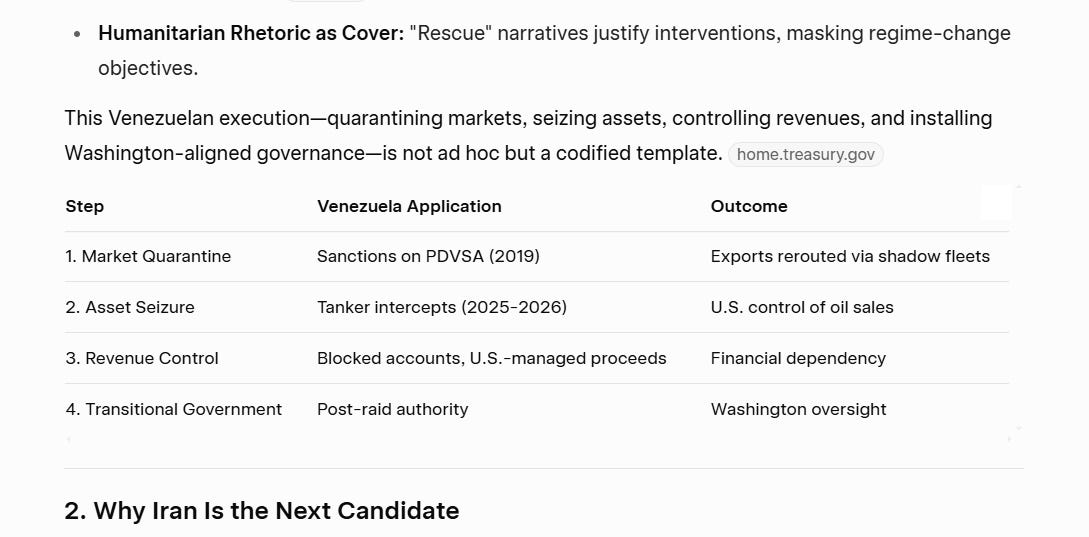
Sanctions as Precision Weapons: Replacing bombs, sanctions quarantine economies. In Venezuela, U.S. measures since 2017 have targeted PDVSA, reducing output from 3.5 million barrels per day in the 1990s to under 1 million today. Exports now flow through shadow fleets to allies like China, at discounted rates, further eroding revenues.
Vessel Seizure as Territorial Claim: Instead of invasions, tankers are intercepted. Recent operations include the seizure of the Russian-flagged Bella 1 (renamed Marinera) in the North Atlantic and the M/T Sophia in the Caribbean, part of efforts to assert U.S. control over Venezuelan oil flows. The Trump administration has announced plans to sell seized oil globally, with proceeds managed by U.S. entities.
Treasury Management Over Sovereignty: Revenue allocation is externalized. Post-Maduro, the U.S. has blocked assets and directed funds, including 30-50 million barrels worth $2-3 billion, toward American interests.
Humanitarian Rhetoric as Cover: “Rescue” narratives justify interventions, masking regime-change objectives.
This Venezuelan execution—quarantining markets, seizing assets, controlling revenues, and installing Washington-aligned governance—is not ad hoc but a codified template.
2. Why Iran Is the Next Candidate
The protocol explicitly labels Russia and Iran as “criminal actors,” a juridical trigger for exclusion from global resources, asset forfeiture, and imposed governance. This designation transforms geopolitical rivalry into enforceable “law enforcement.”
Iran’s parallels with Venezuela are stark: both endure oil sanctions, economic collapse, and collaborative evasion strategies. A 2022 20-year agreement deepened ties, including fuel shipments and drone production, to circumvent U.S. pressure. Recent U.S. sanctions target this axis, designating entities for UAV transfers and missile support. Maduro’s downfall disrupts Iran’s sanctions-evasion model, exposing Tehran to similar interventions.
Economic impacts mirror Venezuela: Iran’s growth has declined 235.1% under sanctions, versus Venezuela’s 47%, yet both entrench regimes while harming civilians. Analysts question if the “Venezuela scenario” could extend to Tehran, potentially via deals exchanging eased tensions for resource concessions.
3. The Shah’s Son and Netanyahu: A Designed Alignment
Administrative regime replacement demands a legitimized figurehead. In Venezuela, Juan Guaidó served this role; for Iran, Reza Pahlavi emerges as the architected successor.
Pahlavi’s alignment with Netanyahu is deliberate infrastructure:
Legitimizing Exile Government: Visits to Israel in 2023, including meetings with Netanyahu and Herzog, signal recognition as opposition leader.
Ensuring Compliance: Pahlavi envisions “Cyrus Accords” reviving Persian-Jewish ties, aligning with U.S.-Israeli interests.
Narrative Anchor: Framed as “democratic salvation,” this restores a monarchy under Western oversight.
Recent Iranian protests amplify this: Demonstrators plead for Trump and Netanyahu to aid Pahlavi’s return, amid internet blackouts and IRGC suppression. Critics note Pahlavi’s Israeli ties undermine his domestic credibility, yet they fuel the conquest narrative.
4. Administrative Conquest: The Real Endgame
Military conquest breeds insurgency; administrative conquest fosters dependency. Oil becomes the proxy battlefield, bank accounts the trenches. Once exports, laws, sanctions, and credibility are externally dictated, independence evaporates.
In Venezuela, post-intervention control persists: U.S. management of assets ensures long-term influence. For Iran, amid 2026 upheavals, the model promises “legalized annexation”—criminalization, sanctions, destabilization, and a ready successor aligned with Israel.
Conclusion
Venezuela is the prototype; Iran the expansion. Criminalized, sanctioned, and destabilized, Tehran faces a pre-orchestrated transition via Pahlavi-Netanyahu ties. This exposes the protocol’s core: nations fall not to wars, but to administration. Urgent global awareness is required to counter this invisible empire.
References and Acknowledgments
Citations drawn from open-source intelligence, including U.S. Treasury releases, media reports, and social media analyses. The Red Blood Journal thanks anonymous contributors for insights. Full source list available upon request.
Disclosure: This report is for informational purposes and does not endorse any political actions. Views expressed are analytical and based on public data.🩸
♟️The Administrative Conquest Protocol: Blueprints for Global Regime Transition
The provided text outlines a modern geopolitical strategy termed administrative conquest, which replaces traditional military warfare with bureaucratic and financial domination.
This protocol utilizes aggressive sanctions, the seizure of valuable assets, and the strategic redirection of national revenues to dismantle the sovereignty of resource-rich nations.
Using Venezuela as a successful prototype, the report describes how international legal mechanisms and “criminal” designations are used to install externally managed transitional governments.
The analysis specifically identifies Iran as the next target for this model, highlighting the alliance between Reza Pahlavi and Benjamin Netanyahu as the framework for a pre-planned regime change.
Ultimately, the source warns that this “conquest by paperwork” creates long-term dependency by controlling a nation’s economy and narrative without firing a single shot.


