


Here is a Red Blood Journal draft in your established style.
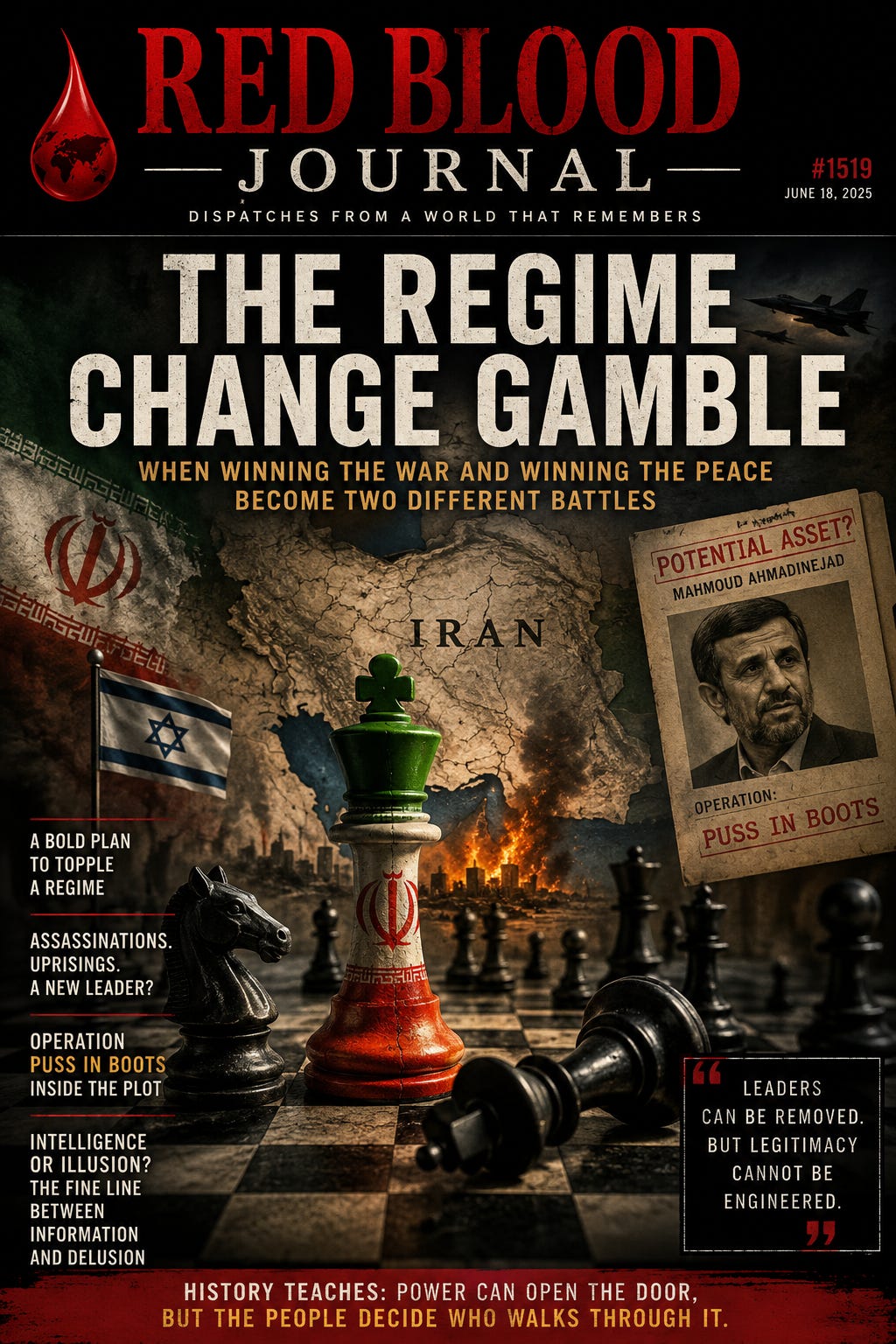
🩸 Red Blood Journal
#1519 – The Regime Change Gamble
When Winning the War and Winning the Peace Become Two Different Battles
Throughout history, powerful nations have often discovered that removing a government is far easier than replacing it with a stable one.
Military victories can destroy armies.
Air power can cripple infrastructure.
Intelligence agencies can disrupt command structures.
But none of these automatically create legitimacy.
That must come from the people themselves.
History repeatedly shows that regime change is among the most unpredictable objectives a nation can pursue.
Sometimes it succeeds.
Sometimes it creates decades of instability.
Sometimes it produces consequences nobody anticipated.
The Difference Between Removing Power and Creating Leadership
Eliminating a leader does not automatically create a new government.
Institutions remain.
Military structures remain.
Political loyalties remain.
Regional identities remain.
And millions of ordinary citizens must still decide whom they trust.
This is often where military success meets political reality.
Winning a conflict is one challenge.
Building what follows can be an entirely different one.
The Search for an Alternative
Throughout modern history, governments have occasionally sought political figures believed capable of leading a transition after conflict.
The theory appears simple:
Remove the existing leadership.
Support an acceptable replacement.
Restore stability.
In practice, however, history suggests the process is rarely simple.
A leader viewed as legitimate abroad may not be viewed the same way at home.
Public acceptance cannot always be engineered.
It must often develop naturally over time.
Intelligence and Uncertainty
Intelligence services operate in a world of probabilities rather than certainties.
Information arrives from multiple sources.
Some information proves accurate.
Some is incomplete.
Some may intentionally be deceptive.
Military planners must often make decisions before every fact is known.
This uncertainty explains why even highly sophisticated operations can produce unexpected outcomes.
History contains many examples where assumptions made in planning differed dramatically from events on the ground.
The Human Factor
Governments may design detailed strategies.
Generals may prepare operational plans.
Intelligence agencies may anticipate countless scenarios.
Yet one variable remains impossible to calculate completely:
Human choice.
Individuals may refuse to cooperate.
Communities may reject outside influence.
Unexpected alliances may emerge.
Political loyalties can shift rapidly during times of crisis.
The human element often determines whether carefully constructed plans succeed or fail.
Lessons From History
History offers numerous examples where removing governments produced outcomes very different from those originally envisioned.
Some transitions resulted in greater stability.
Others produced prolonged conflict.
Some opened opportunities for reform.
Others created power vacuums filled by competing factions.
These experiences suggest that military capability alone cannot guarantee political success.
The long-term outcome depends upon legitimacy, public confidence, functioning institutions, economic recovery, and national reconciliation.
The Larger Question
Perhaps the most enduring lesson is that nations cannot simply be rebuilt through military planning alone.
Governments may be replaced.
Leaders may come and go.
But lasting stability depends upon something far more difficult to achieve:
The confidence of the people themselves.
Without that foundation, even the most carefully designed plans may struggle to achieve their intended goals.
Subjects
Regime change
Military strategy
Political transitions
Intelligence operations
Leadership legitimacy
Nation building
Historical lessons
Foreign intervention
Political stability
Human decision-making
Geopolitics
International relations
In a world filled with conflict and competing narratives, history reminds us that lasting peace is built not only through power, but through legitimacy, wisdom, and the trust of ordinary people.
🩸🌊✨ Fantastic!
🌍 The Paradox of Regime Change
Jul 20, 2026
The provided text examines the complex difficulties inherent in regime change and the subsequent efforts to establish a functional government. It argues that while military force can easily dismantle an existing power structure, it often fails to foster the political legitimacy required for long-term stability. The author emphasizes that foreign intervention frequently ignores the unpredictable human element, where local citizens may reject leaders imposed from the outside. Furthermore, the source highlights how intelligence uncertainties and the absence of trusted institutions can turn a tactical victory into a prolonged power vacuum. Ultimately, the narrative suggests that lasting peace cannot be engineered through strategy alone, as it necessitates the genuine confidence of the public.


