


🩸 Red Blood Journal
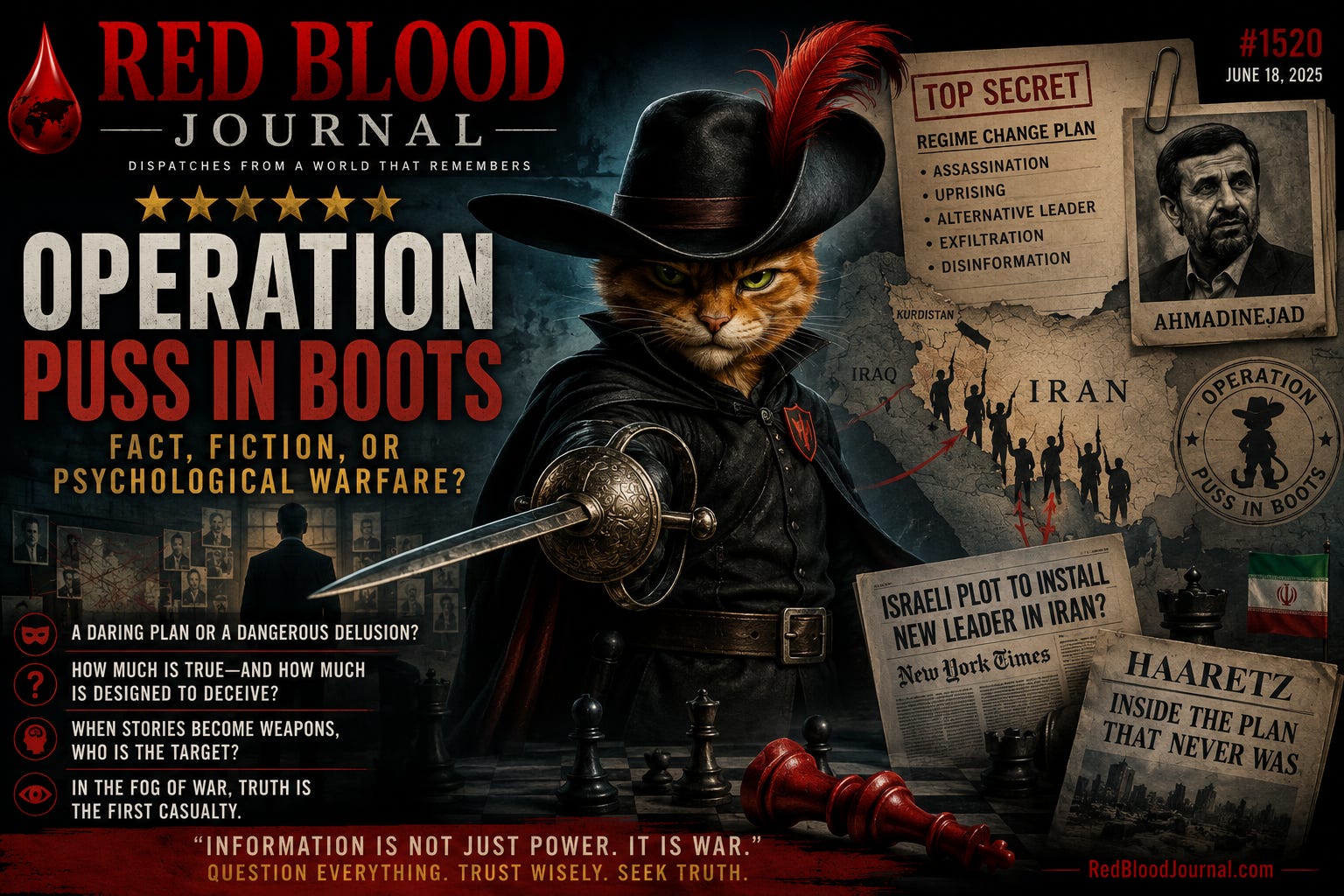
#1520 – ⭐⭐⭐⭐⭐ Operation Puss in Boots
Fact, Fiction, or Psychological Warfare?
One of the greatest challenges during war is not determining who is firing the missiles.
It is determining which stories are real.
Modern warfare is fought on two battlefields.
One is physical.
The other exists inside the human mind.
Long before tanks move or aircraft take flight, narratives begin competing for attention.
Some are accurate.
Some are exaggerated.
Some are deliberately planted.
And many contain just enough truth to make separating fact from fiction extraordinarily difficult.
Information Has Become a Weapon
Throughout history, armies have used deception to confuse their enemies.
Fake troop movements.
False radio transmissions.
Inflatable tanks.
Forged documents.
Controlled leaks.
Today those same principles operate at digital speed.
Instead of fooling one general, a carefully crafted story can influence millions of people around the world within hours.
Information itself has become a strategic asset.
The Curious Story
Recent reporting has described an alleged operation involving a plan to encourage political change inside Iran through covert contacts, ethnic uprisings, and the possible installation of an alternative political figure.
According to these reports, the proposal included secret meetings, intelligence planning, and a series of events that ultimately failed to unfold as originally envisioned.
Whether every detail is accurate remains difficult to verify independently.
Some elements have been reported by established news organizations.
Other details remain disputed.
As with many intelligence stories, complete certainty may remain elusive for years.
Psychological Warfare
There is another possibility worth considering.
Sometimes the objective of a story is not to describe reality.
Sometimes the objective is to influence reality.
If leaders begin questioning one another...
If military commanders become suspicious...
If political allies lose confidence...
Then the story itself has already achieved strategic value regardless of whether every detail is true.
In intelligence work, uncertainty can become a weapon.
A rumor may accomplish what an army cannot.
The Intelligence Dilemma
Intelligence agencies rarely operate in absolutes.
They evaluate probabilities.
They collect fragments.
They compare sources.
They assess intentions.
Decision-makers are often required to act before every piece of evidence becomes available.
This creates an unavoidable reality.
Good decisions sometimes produce poor outcomes.
Poor information sometimes produces disastrous decisions.
Perfect information almost never exists.
The Public’s Challenge
For ordinary citizens, distinguishing verified facts from competing narratives has never been more difficult.
News organizations race to publish.
Governments protect national interests.
Military officials withhold operational details.
Anonymous sources emerge.
Social media amplifies everything.
Artificial intelligence can now generate convincing images, videos, and voices.
The result is an information environment where certainty often becomes the rarest commodity.
Healthy Skepticism
Healthy skepticism differs from automatic disbelief.
Rejecting every official statement is no more reliable than accepting every headline without question.
Critical thinking requires patience.
Evidence should be weighed.
Sources should be compared.
Contradictions should be acknowledged.
Sometimes the most honest conclusion is simply:
“We do not yet know.”
The Larger Lesson
Wars eventually end.
Documents are declassified.
Participants write memoirs.
Archives open.
Historians compare competing accounts.
Only then does a clearer picture begin to emerge.
Until that time, certainty may be less valuable than humility.
The first casualty of war has often been described as truth.
Perhaps the greater casualty is confidence that we already possess it.
Subjects
Psychological warfare
Information warfare
Intelligence operations
Strategic deception
Propaganda
Media narratives
Regime change
Iran
Israel
Covert operations
Critical thinking
Modern conflict
National security
Public perception
The fog of war
History reminds us that wars are fought not only with soldiers and machines, but also with ideas, perceptions, and competing stories. The search for truth requires curiosity, patience, and the humility to recognize that the complete picture often emerges only after the conflict has passed.
🩸🌊✨ Fantastic!
📰 The Fog of Information and Strategic Deception
Jul 20, 2026
The provided text explores how modern warfare is waged through psychological operations and the manipulation of strategic narratives. It highlights how information serves as a weapon, using a specific alleged intelligence plot regarding regime change in Iran to illustrate the difficulty of verifying facts. The source emphasizes that intelligence agencies and governments often use deception to destabilize enemies, making digital misinformation a primary threat to public perception. Ultimately, the author argues that critical thinking and a healthy sense of skepticism are essential tools for navigating the modern fog of war. Readers are encouraged to prioritize patience over certainty, as the full truth of complex global conflicts typically emerges only long after they have concluded.


