


🩸 Red Blood Journal
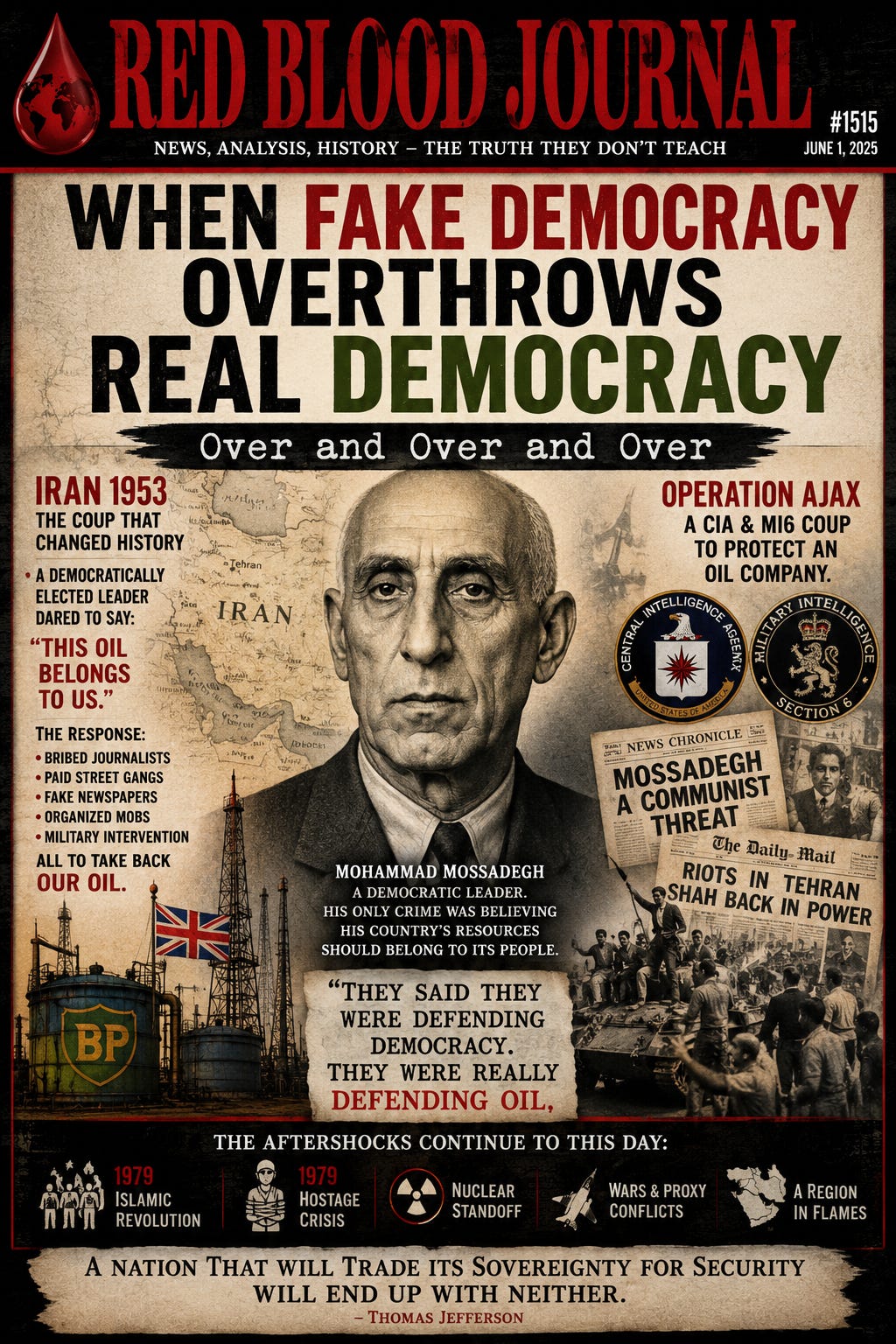
#1515 – When Fake Democracy Overthrows Real Democracy
How Democracies Can Be Undermined in the Name of Defending Democracy
The transcript centers on the 1953 overthrow of Iranian Prime Minister Mohammad Mossadegh and argues that a democratically elected government was removed through a covert operation supported by foreign intelligence services, propaganda, economic pressure, and military intervention.
Throughout history, powerful nations have often claimed to defend democracy.
Yet history also contains examples where governments chosen through constitutional or parliamentary processes were replaced through outside intervention.
This creates an uncomfortable question:
Can democracy be defended by destroying democracy?
When a population votes...
When a parliament approves...
When a constitutional government exercises its legal authority...
...but foreign powers decide the outcome is unacceptable,
what remains is no longer simply democracy.
It becomes democracy conditioned upon approval from those with greater power.
The 1953 Iranian coup has become one of history’s most discussed examples of this dilemma.
Supporters of the intervention argued it was necessary to prevent communist expansion during the Cold War.
Critics argue the primary motivation was protecting strategic oil interests and preserving geopolitical influence.
Both interpretations continue to be debated by historians.
What is less disputed today is that the elected government was overthrown through a coordinated covert campaign involving propaganda, political influence, financial support for opposition networks, and military cooperation.
Democracy or Permission?
The deeper philosophical question extends far beyond Iran.
If elections are respected only when they produce acceptable results...
If governments may govern only until they challenge larger interests...
If sovereignty exists only while it aligns with foreign objectives...
Then democracy gradually changes its meaning.
Instead of government by the people,
it becomes government by permission.
A Repeating Pattern?
Many analysts have pointed to later interventions in other countries as examples of a recurring strategy, though each case has its own unique historical context and remains debated.
The larger question is not whether every intervention is identical.
The question is whether powerful nations sometimes justify extraordinary actions using ideals that differ from the underlying strategic interests.
When national security,
resources,
geopolitics,
or economic influence become intertwined,
the language of democracy can become difficult to separate from the pursuit of power.
History’s Long Memory
The transcript argues that the consequences of 1953 extended well beyond the immediate change of government, influencing later mistrust between Iran and the West and becoming part of the historical context for the 1979 revolution and subsequent decades of confrontation.
Whether one agrees with every conclusion or not, one lesson appears repeatedly throughout history:
Actions taken in secret often produce consequences that last far longer than those who planned them ever imagined.
Governments may change.
Leaders may disappear.
Empires may rise and fall.
But historical memory often survives for generations.
Sometimes far longer than the operation itself.
🩸 Red Blood Journal
History reminds us that the principles nations proclaim and the actions they take are not always the same. Understanding that tension is part of understanding history itself.
🩸🌊✨ Fantastic!
🛢️ Operation Ajax:
The Death of Iranian Democracy
Jul 19, 2026
The provided text explores the 1953 Iranian coup, known as Operation Ajax, where the United States and Britain orchestrated the removal of the democratically elected Prime Minister Mohammad Mossadegh. This intervention was primarily driven by the nationalization of the Iranian oil industry, which threatened the strategic and financial interests of the Anglo-Iranian Oil Company. To achieve their goals, foreign intelligence agencies utilized covert propaganda, bribery, and orchestrated civil unrest to replace a constitutional government with the absolute rule of the Shah. The sources argue that while the operation was a short-term success for Western energy interests, it sowed deep mistrust and anti-Western sentiment that ultimately fueled the 1979 Islamic Revolution. Consequently, the text serves as a philosophical critique of how powerful nations sometimes undermine democratic ideals to secure geopolitical and economic dominance. These historical events continue to influence modern global conflicts and diplomatic tensions between Iran and the West.


